⭐️ Jim In Tucson

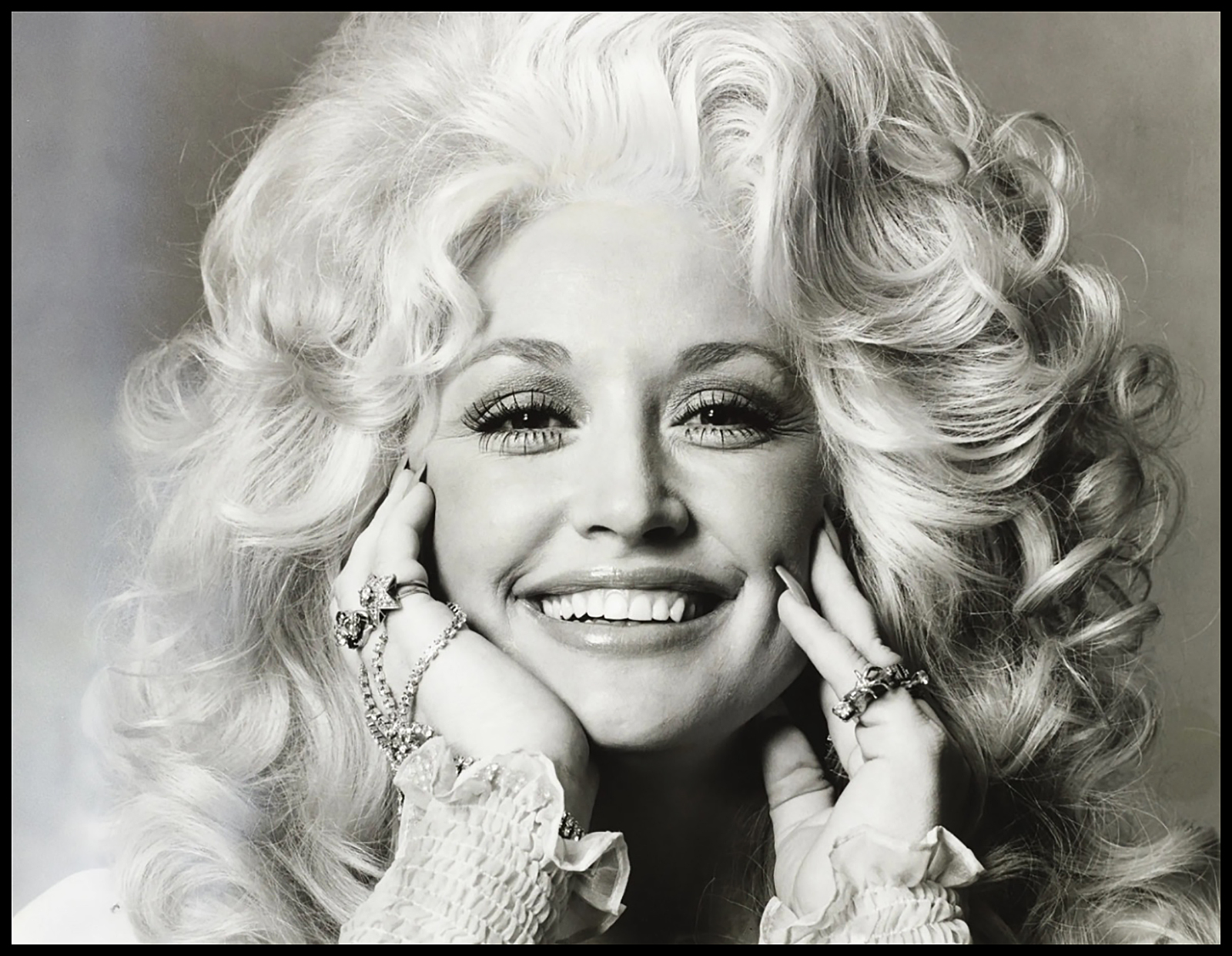

Dolly Rebecca Parton : born January 19, 1946
✪ Dolly Rebecca Parton is an American singer, songwriter, actress, philanthropist, and businesswoman. After achieving success as a songwriter for other artists, Parton’s debut album, Hello, I’m Dolly, was released in 1967; commencing a career spanning 60 years and 50 studio albums. Regarded as the “Queen of Country,” Parton is one of the most-honored female country performers in history and has received various industry and professioanl accolades, including eleven Grammy Awards and three Emmy Awards, as well as nominations for two Academy Awards including a humanitarian honorary Oscar win in 2025, six Golden Globe Awards, and a Tony Award.
Parton has sold more than 100 million records worldwide, making her one of the best-selling music artists ever. Her music includes Recording Industry Association of America (RIAA)-certified gold, platinum and multi-platinum awards. She has had 25 singles reach No. 1 on the Billboard country music charts; a record number for a female artist (tied with Reba McEntire). She has produced 44 career Top 10 country albums, a record for any artist and she has 110 career-charted singles over the past 40 years.
Her 49th solo studio album, Rockstar (2023), became her highest charting Billboard 200 album, peaking at number three. Parton has composed over 3,000 songs, including “I Will Always Love You” (a two-time U.S. country chart-topper and an international hit for Whitney Houston), “Jolene, Coat of Many Colors” and “9 to 5.” As an actress, she has starred in the films 9 to 5 (1980) and The Best Little Whorehouse in Texas (1982), for each of which she earned Best Actress Golden Globe nominations, as well as Rhinestone (1984), Steel Magnolias (1989), Straight Talk (1992), and Joyful Noise (2012).
Outside of her work in the music and film industries, Parton co-owns The Dollywood Company, which manages a number of entertainment venues including the Dollywood theme park, the Splash Country water park and a number of dinner theater venues such as The Dolly Parton Stampede and Pirates Voyage. She has also founded a number of charitable and philanthropic organizations; chief among them being the Dollywood Foundation, which manages a number of projects which provide education and poverty relief to East Tennessee, where she spent her childhood.
Dolly Rebecca Parton was born on January 19, 1946, in a one-room cabin on the banks of the Little Pigeon River in Pittman Center, Tennessee. She is the fourth of twelve children born to Avie Lee Caroline (née Owens; 1923–2003) and Robert Lee Parton Sr. (1921–2000).
Parton has long credited her father for her business savvy and her mother’s family for her musical abilities. Parton’s father, known as “Lee,” worked in the mountains of East Tennessee; first as a sharecropper and later tending his own small tobacco farm and acreage. He also worked construction jobs to supplement the farm’s small income. Despite her father’s illiteracy, Parton has often commented that he was one of the smartest people she has ever known with regard to business.
Parton’s mother was a housewife who cared for their large family. Her eleven pregnancies (the tenth being twins) in twenty years made her a mother of twelve by age thirty-five. Parton attributes her musical abilities to the influence of her mother. Although often in poor health, she still managed to keep house and entertain her children with Smoky Mountain folklore and ancient ballads. Of Welch ancestry, Avie Lee knew many old ballads immigrants from the British Isles brought to southern Appalachia in the 18th and 19th Century. Avie Lee’s father (Dolly’s maternal grandfather), Jake Owens, was a Pentecostal preacher. Parton and her siblings all attended church regularly.
Parton describes her family as being “dirt poor.” Parton’s father paid missionary Dr. Robert F. Thomas with a sack of cornmeal to deliver her. Later, Parton wrote a song about Dr. Thomas. She also outlined her family’s poverty in her early songs “Coat of Many Colors” and “In the Good Old Days (When Times Were Bad).”
For six or seven years, Parton and her family lived in their one-bedroom cabin on their small subsistence farm on Locust Ridge. This was a predominantly Pentecostal area located north of the Greenbrier Valley of the Great Smoky Mountains.
There, music played an important role in her early life. She was brought up in the Church of God (Cleveland, Tennessee) in the congregation her grandfather, Jake Robert Owens, pastored. Her earliest public performances were in the church, beginning at age six. At seven, she started playing a homemade guitar. When she was eight, her uncle bought Dolly her first real guitar.
Parton began performing publicly as a child, singing on local radio and television programs in the East Tennessee area. By 10 years old, she was appearing on The Cas Walker Show on both WIVK Radio and WBIR-TV in Knoxville, Tennessee. At 13, she recorded the single “Puppy Love” on a small Louisiana label, Goldband Records. When she first appeared at the Grand Ole Opry, she met Johnny Cash. He encouraged her to follow her own instincts regarding her career. After graduating from Sevier County High School in 1964, Parton moved to Nashville the next day.
Dolly Parton arrived in Nashville on a Saturday morning. After starting her laundry inside the Wishy Washy Laundromat, Parton got a cold drink and walked outside. Carl Thomas Dean (July 20, 1942 – March 3, 2025), a Nashville native, pulled up along the sidewalk where Parton was standing. Dean mentioned to Parton she might get sunburned because of the style of shirt she was wearing. That began a conversation. Two years later, they were married in Ringgold, Georgia on May 30, 1966. Although Parton does not often use Dean’s surname professionally, she has stated that her passport reads “Dolly Parton Dean” and she sometimes uses Dean when signing contracts,
Dean, who ran an asphalt road and driveway-paving business in Nashville for decades, always shunned publicity and rarely accompanied his wife to public events. According to Parton, he only saw her perform once.
Parton’s initial success came as a songwriter, having signed with Combine Publishing shortly after her arrival in Nashville Along with her frequent songwriting partner, uncle Bill Owens, she wrote several charting singles during this time, including two Top 10 hits for Bill Phillips: “Put It Off Until Tomorrow” and “The Company You Keep” (1966). She also wrote Skeeter Davis’s number 11 hit “Fuel to the Flame” (1967).
During this period, her songs were recorded by many other artists, including Kitty Wells and Hank Williams Jr. At 19, Parton signed with Monument Records in 1965, where she was initially pitched as a bubblegum pop singer. She released a string of singles, but the only one that charted, “Happy, Happy Birthday Baby,” did not even crack the Billboard Hot 100. Although she expressed a desire to record country material, Monument resisted, thinking her unusually high soprano voice was not suited to the genre.
However, her first country single, “Dumb Blonde,” composed by Curly Putman, reached number 24 on the country chart in 1967, followed by “Something Fishy,” which went to number 17. The two songs later appeared on her first full-length debut album, Hello, I’m Dolly.
▶️ 8 Minutes 4 Seconds
In 1967, musician and country music entertainer Porter Wagoner invited Parton to join The Porter Wagoner Show, offering her a regular spot on his weekly syndicated television program and in his road show. As documented in her 1994 autobiography, much of Wagoner’s audience was initially unhappy Parton had replaced previous performer Norma Jean. Sometimes the audience would chant loudly for Norma Jean when Dolly appeared on stage.
Wagoner convinced his label, RCA Victor, to sign her. RCA decided to protect their investment by releasing her first single as a duet with Wagoner. That song, a remake of Tom Paxton’s “The Last Thing on My Mind,” was released in late 1967 and reached the Country Top 10 in January 1968; launching a six-year streak of virtually uninterrupted Top 10 singles for the duo.
Parton’s first solo single for RCA Victor, “Just Because I’m a Woman,” was released in the summer of 1968 and became a moderate chart hit, reaching number 17. For the next two years, none of Parton’s solo efforts; even “In the Good Old Days (When Times Were Bad” were as successful as her earlier duets with Wagoner. Although the duo was named Vocal Group of the Year in 1968 by the Country Music Association, Parton’s solo efforts remained mostly ignored.
Wagoner persuaded Parton to record Jimmie Rodgers’ “Mule Skinner Blues,” a marketing gimmick which worked. The record shot to number three, followed closely by her first number-one single, “Joshua” in February 1971. For the next two years, Parton had numerous solo hits in addition to her duets, including her signature song, “Coat of Many Colors” which went all the way to number 4 in 1971.
In 1974, her song, “I Will Always Love You,” written about her professional break from Wagoner, went to number one on the country chart. Around the same time, Elvis Presley indicated he wanted to record the song. Parton was interested until Presley’s manager, Colonel Tom Parker, informed her it was standard procedure for the songwriter to sign over half of the publishing rights to any song recorded by Presley. Parton refused & that decision has been credited with helping to make her many millions of dollars in royalties from the song over the years.
Between 1974 and 1980, Parton’s career continued with a series of country hits, with eight of her singles reaching number one. Her influence on pop culture is reflected by the many performers covering her songs, including mainstream and crossover artists such as Olivia Newton-John, Emmylou Harris and Linda Ronstadt. Her albums during this period were developed specifically for pop-crossover success.
Parton began to embark on a high-profile crossover campaign, attempting to aim her music in a more mainstream direction and increase her visibility outside of the confines of country music. Parton also began taking more of an active role in production to specifically target her music into a more mainstream, pop direction. The result, 1977’s Here You Come Again, became her first million-seller, topping the country album chart and reaching number 20 on the pop chart.
Her commercial success grew in 1980 with the theme song to the 1980 feature film 9 to 5, in which she starred with Jane Fonda and Lily Tomlin. 9 to 5 not only reached number one on the country chart, but also on the pop and the adult-contemporary charts in February 1981, giving her a triple number-one hit. Parton became one of the few female country singers to have a number-one single on the country and pop charts simultaneously. However, despite this success, RCA Records did not renew her contract after it expired in 1986 and in 1987 she signed with Columbia Records.
Parton’s recorded music during the mid-to-late-1990s remained steady and somewhat eclectic. Her 1995 re-recording of “I Will Always Love You,” performed as a duet with Vince Gill from her album Something Special, won the Country Music Association’s Vocal Event of the Year Award. The following year, Treasures, an album of covers of 1960s/70s hits was released and featured a diverse collection of material, including her songs covered by Mac Davis, Pete Seeger, Kris Kristofferson, Cat Stevens and Neil Young.
On October 27, 2009, Parton released a four-CD box set, Dolly, which featured 99 songs, spanning most of her career. In July 2019, Parton made an unannounced appearance at the Newport Folk Festival in Rhode Island and performed several songs accompanied by the Highwomen and Linda Perry. In 2019, Parton collaborated with the Christian alternative rock duet For King and Country and released a version of their hit “God Only Knows.” She followed this by recording a duet with Christian music artist Zach Williams with the song “There Was Jesus.”
In early 2022, Parton was nominated for induction into the Rock and Roll Hall of Fame, but initially declined the nomination believing the Rock and Roll Hall of Fame was “for the people in rock music.” However, after learning this was not always the case, Parton said she would accept her induction if she were chosen for the honor. In May, her induction was announced and on November 5, 2022, she was inducted into the Rock and Roll Hall of Fame. In October 2022, Parton stated in an interview that she would no longer tour, but would continue to occasionally play live shows.
On January 17, 2023, Parton announced she would release her first rock album, titled Rockstar. The album was released on November 17, 2023, and features collaborations with Paul McCartney, Ringo Starr, Sting, Elton John, Sheryl Crow and Miley Cyrus, amongst others.
During her career, Parton turned down several offers to pose nude for Playboy magazine, but she did appear on the cover of the October 1978 issue wearing a Playboy bunny outfit, complete with ears and a tail. The issue featured Lawrence Grobel’s extensive and candid interview with Parton, representing one of her earliest high-profile interviews with the mainstream press.
Parton is known for having undergone considerable plastic surgery. On a 2003 episode of The Oprah Winfrey Show, Winfrey asked what kind of cosmetic surgery Parton had undergone. Parton replied that cosmetic surgery was imperative in keeping with her famous image. Parton has repeatedly joked about her physical image and surgeries, saying, “It takes a lot of money to look this cheap.”
Parton, often credits much of her inspiration to her family and community. In her 2020 book, Songteller: My Life in Lyrics, Parton wrote of her mother, “So it was just natural for my mom to always be singing. My mother had that old-timey voice and she used to sing all these songs that were brought over from the Old World. They were English, Irish, Welsh, folk songs where people tell stories.” Parton calls her mother’s voice “haunting. Lord you would feel it.”
However, her biggest influence was her Aunt Dorothy Jo: “People often ask me who my influences were, they think I’m going to say some big names and there were a few ‘stars’ I was impressed with. But my hero was my aunt Dorothy Jo, Mama’s baby sister. She was not only an evangelist, she played banjo, she played guitar and she wrote some great songs.”
Though unable to read sheet music, Parton plays many instruments, including: the dulcimer, autoharp, banjo, guitar, electric guitar, fiddle, piano, recorder and the saxophone. In 1998, Nashville Business ranked her the wealthiest country music star. As of 2025, her estimated net worth is $800 million.
Parton has invested much of her earnings into business ventures in her native East Tennessee, notably Pigeon Forge. She is a co-owner of The Dollywood Company, which operates the theme park Dollywood (formerly Silver Dollar City), a dinner theater, Dolly Parton’s Stampede, the waterpark Dollywood’s Splash Country and the Dream More Resort and Spa, all located in Pigeon Forge. With 3.1 million visitors in 2024, Dollywood is among the 20 most popular theme park in the United States.
Since the mid-1980s, Parton has supported many charitable efforts, particularly in the area of literacy, primarily through her Dollywood Foundation. Her literacy program, Dolly Parton’s Imagination Library, which is a part of the Dollywood Foundation, was founded in honor of her father, who never learned to read or write. It mails one book per month to each enrolled child from the time of their birth until they enter kindergarten. Over 1600 local communities provide the Imagination Library to almost 850,000 children each month across the U.S., Canada, the UK, Australia and the Republic of Ireland. In February 2018, she donated her 100 millionth free book, a copy of Parton’s children’s picture book Coat of Many Colors, to the Library of Congress in Washington, D.C. and was honored by the Library on account of the “charity sending out its 100 millionth book.”
In 1999, Parton received country music’s highest honor, an induction into the Country Music Hall of Fame. She also received an honorary doctorate degree from Carson-Newman College (Jefferson City, Tennessee) in 1990. This was followed by her induction into the National Academy of Popular Music & Songwriters Hall of Fame in 2001. In 2002, she ranked number 4 in CMT’s 40 Greatest Women of Country Music.
During the first term of the Trump presidency, Parton turned down the Presidential Medal of Freedom twice due to her husband’s illness and the ongoing pandemic. Parton later turned down the Presidential Medal of Freedom a third time during the Biden Presidency to avoid the appearance of politics.
Parton has earned 11 Grammy Awards (including her 2011 Lifetime Achievement Grammy) and a total of 55 Grammy Award nominations, the third-most nominations of any female artist in the history of the prestigious awards. ✪















▶️ ◼️◼️◼️◼️◼️◼️◼️◼️◼️◼️ ✪✪✪ DONATE ✪✪✪ ◼️◼️◼️◼️◼️◼️◼️◼️◼️
▶️ DONATE VIA PAYPAL (DEBIT & CREDIT CARD)
ALL PayPal Transactions Are Encrypted For Card Holder Privacy & Security
▶️ DONATE VIA ZELLE (DIRECT BANK CASH TRANSFER)
ZELLE is the perfect online alternative to PayPal. It’s an incredibly simple, secure, easy, fast and FREE way to send or receive money to recipients directly from your online banking account without a middleman. Best of all, there are NO fees.
ZELLE is a service provided by your bank and is already built in to your online banking account. You only need to activate it first before using. If you’ve already activated ZELLE in your online bank or credit union account, you can donate to The New Americanist by using our ZELLE address:
vip@thenewamericanist.com
To activate your ZELLE, follow these easy instructions (a simple two minute process):

▶️ DONATE VIA SNAIL MAIL