⭐️ warpmine


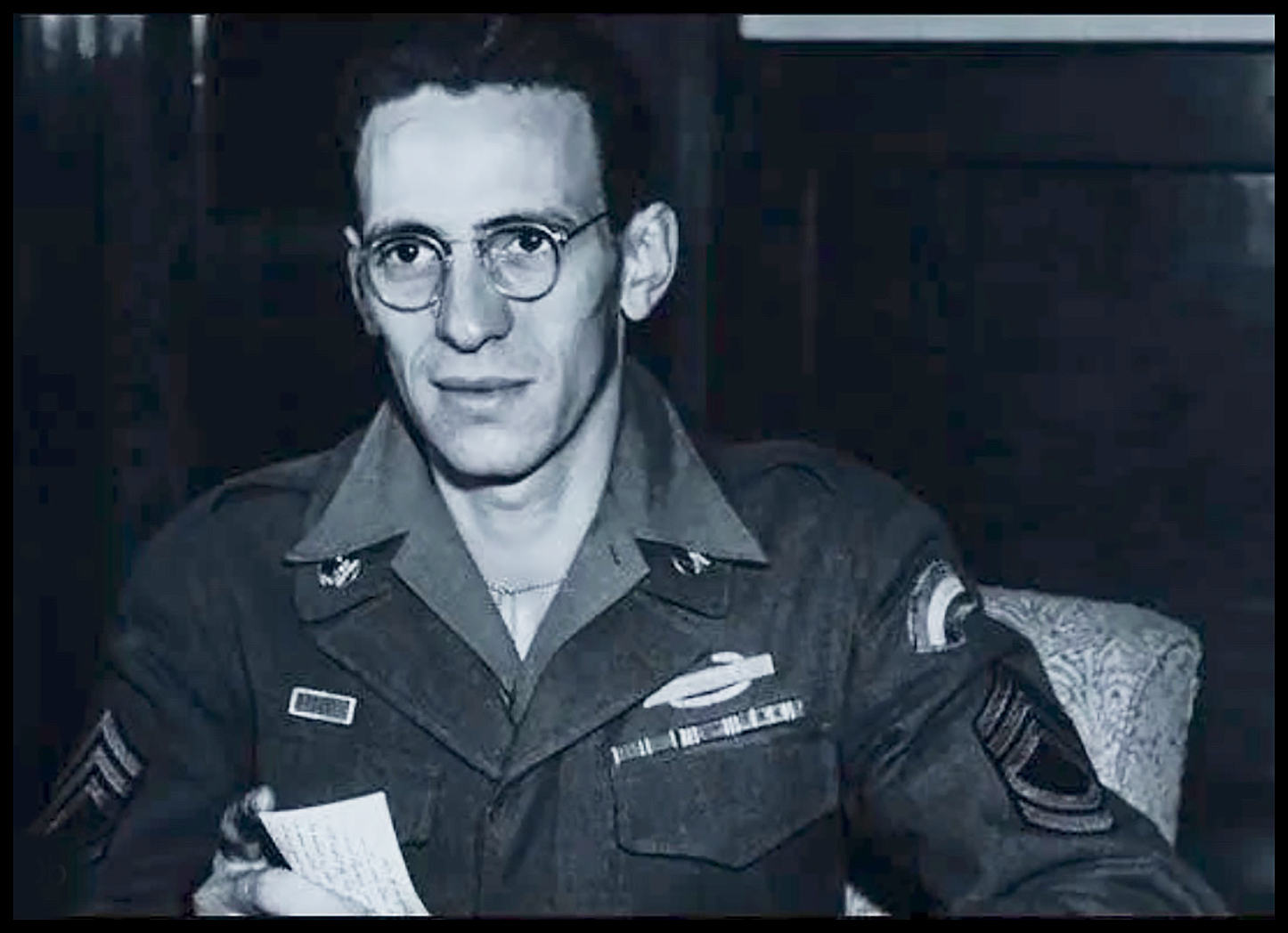

Vito Rocco Bertoldo: December 1, 1916 – July 23, 1966
✪ Vito Rocco Bertoldo was a United States Army soldier and veteran of World War II. He was awarded the Medal of Honor for his heroic actions near Hatten, France in January 1945.
Bertoldo was born and raised in Decatur, Illinois, and worked as a coal miner and truck driver before enlisting for service. He was exempt from the World War II draft because of poor eyesight, but after numerous rejections he was finally allowed into the U.S. Army in 1942, where he was initially approved for limited duty stateside as a military policeman and cook.
He finally obtained approval to undergo basic training as an infantryman, and was deployed to France with the 42nd Infantry Division. During Germany’s Operation Nordwind offensive of December 1944-January 1945, Bertoldo was one of several soldiers assigned to guard the Command Post (CP) of the 1st Battalion, 242nd Infantry Regiment. After the battalion staff was ordered to relocate to an alternate location in expectation of an impending German attack, Bertoldo volunteered to remain behind to cover their withdrawal and defend the Command Post.
During January 9 and 10, 1945, he single-handedly fought off multiple German assaults on the Command Post, and then continued the fight by taking part in defending the battalion’s alternate Command Post. After the war, he personally received the Medal of Honor from President Harry Truman for his distinguished heroism during this action.
Vito Rocco Bertoldo was born in Decatur, Illinois on December 1, 1916, the son of Rocco B. Bertoldo and Mary (Antonacci) Bertoldo. He received his education in the parochial and public schools of Decatur. At sixteen, he began working as a coal miner, and was later employed as a truck driver for Oakes Products, a company which manufactured automobile parts before converting to munitions production during World War II.
On August 2, 1941, Bertoldo married Dorothy Sutter of Decatur. They later divorced, and in 1958 he married Mae Clary of Kentfield, California, who survived him.
Bertoldo & his first wife had one son: David Valor Bertoldo (born 1946), who served in the United States Marine Corps from1965to 1983 during the Vietnam War and received the Bronze Star Medal. He also served with the California Highway Patrol from 1983 to 2006. Bertoldo is also the grandfather of David Christopher Bertoldo (born 1968), who served in the United States Army during the Gulf War.
Bertoldo was ineligible for the World War II draft because of poor eyesight. He was designated as legally blind. He decided to enlist despite his draft exemption, and after numerous rejections from almost every branch of service, he finally found a recruiter who accepted him. He joined the Army in 1942 and was approved for limited duty in the United States as a mess cook and military policeman. However, Bertoldo eventually talked his way into basic training as an infantryman and was assigned to Company A, 1st Battalion, 242nd Infantry Regiment, 42nd Infantry Division.
Bertoldo’s regiment took part in combat in France and by January 1945 he had attained the rank of private first class. According to a 1995 letter by Bertoldo’s company commander, William Corson, Company A’s only discipline problem was Bertoldo, who did not get along with the company mess sergeant. As a result, when his battalion headquarters requested three soldiers per company to stand guard duty at the 1st Battalion Command Post during the German Operation Nordwind offensive between December 1944 and January 1945, Corson included Bertoldo as one of the three in his company’s contingent.
On January 9, 1945, Bertoldo was on duty at the entrance to the battalion CP near Hatten, France, when German troops began their offensive by shelling the town. The battalion staff withdrew, and Bertoldo volunteered to stay and provide rearguard defense as they moved to an alternate location. On his own initiative, and while under intense enemy fire, he mounted a machine gun at the Command Post entrance, which enabled him to cover the main approach. He held this position, firing against German tanks as they advanced shelling the building, then turned his fire upon the advancing infantrymen which followed.
By the early morning of January 10, Bertoldo moved to the alternate command post; which he also defended against a continuing assault by German troops, firing a machine gun and directly exposing himself to enemy fire in order to throw hand grenades. When German troops began firing a self-propelled 88-millimeter gun directly into the room from which Bertoldo was shooting, the concussion from the third round knocked him across the room and left him dazed. After ensuring his assistant gunner had not been killed, he returned to his machine gun and continued fighting. He continued to provide cover as the battalion staff withdrew from the alternate command post; and he did not withdraw himself until everyone else had already moved to safety.
Bertoldo’s official Medal of Honor citation reads:
“He fought with extreme gallantry while guarding 2 command posts against the assault of powerful infantry and armored forces which had overrun the battalion’s main line of resistance. On the close approach of enemy soldiers, he left the protection of the building he defended and set up his gun in the street, there to remain for almost 12 hours driving back attacks while in full view of his adversaries and completely exposed to 88-mm., machinegun and small-arms fire. He moved back inside the command post, strapped his machinegun to a table and covered the main approach to the building by firing through a window, remaining steadfast even in the face of 88-mm. fire from tanks only 75 yards away. One shell blasted him across the room, but he returned to his weapon. When 2 enemy armored personnel carriers led by a tank moved toward his position, he calmly waited for the troops to dismount and then, with the tank firing directly at him, leaned out of the window and mowed down the entire group of more than 20 Germans. Some time later, removal of the command post to another building was ordered. M/Sgt. Bertoldo voluntarily remained behind, covering the withdrawal of his comrades and maintaining his stand all night. In the morning he carried his machinegun to an adjacent building used as the command post of another battalion and began a day-long defense of that position. He broke up a heavy attack, launched by a self-propelled 88-mm. gun covered by a tank and about 15 infantrymen. Soon afterward another 88-mm. weapon moved up to within a few feet of his position, and, placing the muzzle of its gun almost inside the building, fired into the room, knocking him down and seriously wounding others. An American bazooka team set the German weapon afire, and M/Sgt. Bertoldo went back to his machinegun dazed as he was and killed several of the hostile troops as they attempted to withdraw. It was decided to evacuate the command post under the cover of darkness, but before the plan could be put into operation the enemy began an intensive assault supported by fire from their tanks and heavy guns. Disregarding the devastating barrage, he remained at his post and hurled white phosphorus grenades into the advancing enemy troops until they broke and retreated. A tank less than 50 yards away fired at his stronghold, destroyed the machinegun and blew him across the room again but he once more returned to the bitter fight and, with a rifle, single-handedly covered the withdrawal of his fellow soldiers when the post was finally abandoned. With inspiring bravery and intrepidity M/Sgt. Bertoldo withstood the attack of vastly superior forces for more than 48 hours without rest or relief, time after time escaping death only by the slightest margin while killing at least 40 hostile soldiers and wounding many more during his grim battle against the enemy hordes.“
In addition to receiving the Medal of Honor, Bertoldo was also awarded the Combat Infantryman Badge, Bronze Star Medal with oak leaf cluster, Purple Heart, and the French Croix de Guerre.
▶️ 2 Minutes 59 Seconds
Bertoldo continued to serve in the Army until the end of the war, and attained the rank of master sergeant before his honorable discharge in February 1946. He later worked as a contact representative for the Veterans Administration in San Francisco, helping veterans to receive treatment and rehabilitation benefits and advocating on their behalf during application processes. After leaving the VA in 1958, Bertoldo owned & operated his own landscaping company.

In 1966, Bertoldo was diagnosed with lung cancer. He died at the VA hospital in Martinez, California on July 23, 1966. Bertoldo is interred at the Golden Gate National Cemetery in San Bruno, California. ✪














▶️ ◼️◼️◼️◼️◼️◼️◼️◼️◼️◼️ ✪✪✪ DONATE ✪✪✪ ◼️◼️◼️◼️◼️◼️◼️◼️◼️
▶️ DONATE VIA PAYPAL (DEBIT & CREDIT CARD)
ALL PayPal Transactions Are Encrypted For Card Holder Privacy & Security
▶️ DONATE VIA ZELLE (DIRECT BANK CASH TRANSFER)
ZELLE is the perfect online alternative to PayPal. It’s an incredibly simple, secure, easy, fast and FREE way to send or receive money to recipients directly from your online banking account without a middleman. Best of all, there are NO fees.
ZELLE is a service provided by your bank and is already built in to your online banking account. You only need to activate it first before using. If you’ve already activated ZELLE in your online bank or credit union account, you can donate to The New Americanist by using our ZELLE address:
vip@thenewamericanist.com
To activate your ZELLE, follow these easy instructions (a simple two minute process):

▶️ DONATE VIA SNAIL MAIL