




▶️ VICTOR DAVIS HANSON: IRAN, MIDTERMS & OCTOBER SURPRISES
⭐️ HelloKitty’sGotAHairTrigger

VICTOR DAVIS HANSON: IRAN, MIDTERMS & OCTOBER SURPRISES

jjj
he Iran war could reshape the midterms as Democrats, Iran’s regime, dissidents, and Kurdish rebels weigh the political and military stakes of the next 50 days. Many narratives swirl around the U.S. war with Iran as the November 3 midterm elections loom.
The Left is giddy with confidence Democrats may retake control of Congress. It is therefore planning a circus of impeachments, lawfare, and investigations to neuter the last two years of the Trump Administration.
High gas prices and the current unpopularity of the Iran conflict, coupled with the historical reality that the president’s party has lost seats in Congress in 39 of the last 41 midterm elections, have convinced Democrats that they could win enough seats to cut off funds for the war.
Yet the elections are still seven weeks away, and the sheer number of known unknowns ensures an uncertain outcome. Every side is now gaming the midterms.
The Democrats believe the unpopular war can at last halt Trump’s momentum and are already declaring it all but lost. The Iranian theocracy agrees.
It will do its best to ratchet up tensions with a series of October surprises in hopes that Trump loses control of Congress and the United States reverts to familiar Democrat policies of ending sanctions and downplaying Iran’s race toward nuclear weapons.
Its leaders also remember Barack Obama’s “hands-off” policy when a million Iranians took to the streets during the Green Revolution of 2009. Then-President Obama remained silent as thousands of protesters were jailed and killed.
As for Trump, he remains enigmatic and says only that the war will likely end shortly after the midterms. Trump could simply mean that Iran is on the ropes and the regime cannot survive much more than two months.
Or Trump may be hinting that after the midterms, regardless of who controls Congress, he will be free of electoral pressures and able to resume military operations to accelerate the theocracy’s ongoing economic ruin.
But it is often forgotten that two other groups may also be gaming the midterms with October surprises of their own; and in quite different ways.
If Iranian dissidents—35,000 of whom were killed by their own government in January—believe a Democrat takeover of Congress would benefit the murderous regime they hate, then they may face very different deadlines and renewed incentives to resist.
The embattled opposition, suffering existential food and energy shortages, might conclude if the regime is tottering in October, this may be its last chance to overthrow it before Democrats restrain Trump and spare the hated mullahs.
The same mindset might be embraced by some 10–15 million restive Iranian Kurds, who periodically resist the theocracy in Tehran.
If they, too, believe ascendant post-midterm Democrats might defund the current American strikes against the theocracy, or that Trump will eventually be pressured into ending American involvement, then they may see overthrowing the hated regime as a now-or-never proposition.
The point is not what might actually happen if the Democrat opposition controls Congress or otherwise pressures Trump this fall to end the conflict. The key, instead, is the perception that it would.
There are still more known unknowns. This remains a strange conflict in which almost no news emerges from Iran. The United States has used no ground troops. There are no embedded correspondents. Western media are largely barred from Iran unless they regurgitate theocratic propaganda.
Thus, no one knows the true extent of the damage to Iran’s nuclear, industrial, and military complexes. Nor do Westerners know precisely how much the new sanctions, secondary boycotts, strangulating blockades, and frozen foreign assets have further weakened an already crippled regime; and driven a starving, fuel-starved, and furious populace to desperate measures.
It is understandable why the bloody popular uprisings of early 2026 failed against an oil-rich Iran whose half-century-old, half-trillion-dollar military-industrial complex was still largely intact.
Not now. The theocracy is now vastly diminished after months of Israeli and American bombing and crushing new sanctions. Moreover, the desperate regime has continued to murder dissidents in the months since the failed uprising of January 2026.
In sum, the Iranian conflict is one of the strangest wars of the modern age. The Iranian regime has suffered terrible material and financial damage. Its nuclear program is likely in ruins, and its original command-and-control leadership has been destroyed. The people detest it. The Kurdish minority loathes it. Conditions on the ground are dire, with terrible shortages of food, medicine, and fuel.
The resistance may sense that the Trump administration would double down on kinetic force to finish off the wounded regime if a mass popular uprising emerged and needed support from the air.
Taken together, these possible October surprises before the November midterms could make the next 50 days the most volatile in modern memory. ✪

▶️ VICTOR DAVIS HANSON: THE FANTASY HOUSE OF MARK CARNEY
⭐️ HelloKitty’sGotAHairTrigger

VICTOR DAVIS HANSON: THE FANTASY HOUSE OF MARK CARNEY

eee
anadian Prime Minister Mark Carney now believes he is more than just the Western foil to Donald Trump and his MAGA movement. He is the global one. Accordingly, he seems determined to demonstrate to the world how to stand up to Donald Trump, to force Trump to lose the midterms, and to hurt the U.S. economy to such a degree that Trump will never again bully other nations.
So, at the eleventh hour, Carney stormed out of an apparently completed tariff deal with the United States which would have privileged Canada over almost all of America’s other trading partners. Canada, we recall, has enjoyed a $50 billion goods trade surplus with the United States for years in a supposedly free and equitable North American trade zone.
Carney claimed American proposals stripped away Canadian sovereignty and quashed Canadian culture, particularly French-Canadian culture. Yet he has not released the documents detailing the bilateral offers he rejected. Nor has he allowed his representatives to explain to the media why Canada blew up the negotiations at the last minute. Carney’s ever-changing excuses, explanations, and invectives about what happened are incoherent and contradictory.
That said, analysts on both sides of the border now concede American digital-media companies do not customarily pay special taxes; as Carney demands, to promote local, regional, and ethnic culture while operating in Canada, any more than Canadian companies would be taxed for those purposes in the United States.
Canada and the United States both agree China dumps cheap steel and aluminum into Canada, allowing Canadian manufacturers to use that cost advantage to export assembled vehicles to the vast U.S. market at prices below those of American vehicles. In that way, Canada’s new partnership with China circumvents America’s tariffs on Beijing. China will also send nearly 50,000 electric cars and trucks into Canada under a meager tariff, ensuring the Canadian EV market is increasingly dominated by Chinese vehicles.
But Carney’s ploy goes beyond helping the communist Chinese dictatorship gain trade leverage over his own NATO neighbor. He has eagerly concluded a comprehensive Chinese-Canadian pact involving travel, visas, food safety, energy, and public security. Carney has grandly described these new agreements with Beijing as part of a new paradigm in which “middle powers” like Canada play China against the United States (Canada’s annual nominal GDP is roughly the size of that of New York State).
How ironic that Carney attacks his neighbor, the United States, for trade unfairness while warming to the communist dictatorship in China. Communist China, after all, is history’s greatest violator of trade protocols; guilty of manipulating its currency, dumping products to secure market share, violating copyright and patent laws, and imprisoning a million Uyghurs.
Has Carney learned anything from Panama’s misadventures after naively inviting in a Chinese omnipresence at the American-built Panama Canal? Does Carney recall the American Monroe Doctrine originally was aimed at foreign intrusion into the North American west?
Canada’s new partner is a totalitarian police state that infected the world with its manufactured gain-of-function COVID-19 virus, which killed more than 1.5 million North Americans. China stonewalled inquiries and never offered details about the pandemic’s origins in its Wuhan lab. It has promised to conquer Taiwan and so terrified its democratic neighbors; Australia, Japan, the Philippines, Taiwan, and South Korea, that they joined a defensive alliance with the United States.
So what drives Carney’s hubristic fantasies? Has Canada’s natural wealth in oil, gas, timber, and minerals made it a military and economic dynamo, as it once was? Hardly.
Canada’s population is 11.8 percent of America’s. Its economy is barely one-thirteenth the size of America’s. Canadian GDP per capita is only 60 percent of America’s.
Canada quietly relies on the U.S. military to deter foreign powers from North America, whether by fending off challenges to Canada’s extensive Arctic claims—including its dubious claim of absolute sovereignty over the Northwest Passage—or by keeping Canadian skies free of foreign combat aircraft and missiles.
Canada’s navy—once one of the world’s preeminent surface fleets—has been reduced to fewer than 30 ships. Its 89 American-made jets are more than 40 years old.
Paradoxically, Carney’s dreams derive not from confidence and strength but from insecurity and defensiveness. Carney and former Prime Minister Justin Trudeau nearly ruined the Canadian economy despite the country’s treasure trove of natural resources. Canada has only half the GDP of California—a state currently decaying under neo-socialist governance—despite having roughly the same population.
Nearly 45 percent of Canadians are either foreign-born or the children of foreign-born parents. These often-impoverished immigrants impose gargantuan social-welfare costs which Canada’s European-style socialist economy simply cannot support. While Carney lectures on “Canadian values,” Canada’s fertility rate of 1.25 is among the lowest in the Western world, while euthanasia accounts for 5 percent of all deaths, the highest rate in the West.
Nevertheless, Carney now claims, in passive-aggressive fashion, that the United States bullies Canada—even as Canada runs trade surpluses with America, relies on the American economy for 72 percent of its exports, and depends on the American military for its safety. That asymmetry indirectly subsidizes Canada’s disastrous energy, immigration, defense, regulatory, and tax policies.
The Canadian energy industry depends on U.S. purchases of much of its tar sands oil, specialized U.S. refineries, and American pipelines. For over a decade, globalist Canada refused to meet its NATO commitment to invest 2 percent of GDP in defense, relying instead on American magnanimity to protect North America from foreign aggression.
No matter. Carney has melodramatically characterized his tiff with the United States as a “fight” and even a “war.” Yet, oddly for such an anti-American Canadian hyper-nationalist, Carney is a globalist banker who, until he became prime minister, held citizenship in three nations.
Yet the Canadian prime minister who urges Canada’s vulnerable working classes to decouple from America is himself—like thousands of Canadian grandees—deeply entwined with the United States. Some 91 percent of Carney’s investments are in U.S.-based companies, and two of his four children, like their father, attended college in the United States. Both now reside in America, along with nearly one million other Canadians. Apparently, Carney is so eager for a veritable economic, cultural, and political war with the United States that 91 percent of his holdings remain invested in the homeland of his enemy.
But why, from a position of such hypocrisy and vulnerability, has Carney blown up the trade agreement, ginned up anti-American Canadian nationalism—and done so now?
Only in this way, Carney believes, can he stop autonomy referenda in Alberta and Quebec. And only in this way can he openly interfere in the U.S. midterm elections by targeting new tariffs at red and purple border states while working directly with left-wing Democrat politicians to help Democrats regain control of Congress and restore the prior status quo.
His anti-American screeds have certainly worked at home. Canadians now boo at the mere sound of “The Star-Spangled Banner.” They brag of a new “elbows up” policy to stop U.S. “aggression.” Their social media is flooded with braggadocio about new ways to hurt Americans. Some three-quarters of the country has bought into Carney’s fantasies. Hating America is the new Canadian pastime.
But, sadly, this will not end well for Canada, for at least five reasons. First, America certainly is not the cause of Canada’s maladies, other than by subsidizing its suicidal domestic choices for years. Canada’s self-destructive socialist and globalist policies are its government’s doing alone.
The United States did not force Canada to adopt European-style socialist policies of mass unvetted immigration, subsidized green energy, near-disarmament, and unsustainable social-welfare spending. America did not urge Canadians to stop having children or enlist their government to help them kill themselves.
In truth, America prefers a militarily and economically strong Canadian partner, not a weak one lashing out from insecurity.
Second, the American public has so far been mostly indifferent to the spat. But now that the North American media has begun revealing the extent of Canada’s anti-American venom, along with Carney’s brinkmanship and disingenuous rhetoric, anger is rising at his cheap politicking and the animus he has fanned.
In sum, Carney has no idea that he is reframing the dispute not as a conflict with Trump but as an affront to the American people themselves—who have long memories.
Third, for all his globalist background and internationalist performance-art stunts, Carney is alone on the world stage. Europe may applaud his defiance, but it has no desire to join his anti-American campaign. When the United States finally insisted on symmetrical trade, only communist China and Canada—the latter enjoying the most generous entrée into the American economy of any country in the world—slapped counter-tariffs on the United States. Apparently, other nations did not agree that Carney’s perennial $50 billion surplus was his birthright.
Fourth, Canada is far more vulnerable than the United States if Carney’s “war” continues. Canada relies on the United States for 72 percent of its exports, while America relies on Canada for only 15 percent of its own exports. Last month, even before the full effect of the new tariffs was felt, Canada lost 42,000 jobs while the United States gained 160,000. The damage will only grow, ever more asymmetrically, as tariffs mount on Canadian businesses.
Nearly a million Canadians reside in the United States, but only 350,000 Americans live in Canada. And it is easier for a Canadian to obtain an expedited U.S. work visa than for an American to do the same in Canada. Indeed, Canadians do not appreciate that they are nearly the only visitors in the world granted six months of residence in the United States without a visa.
Fifth, since Carney walked out at the last minute, it will be incumbent upon him to resume talks—especially as the damage he has done to Canadian workers and small businesses worsens. But should Carney seek to renew negotiations immediately after the Canadian provincial elections and the U.S. midterms, he will be exposed as a disingenuous politico who ginned up the fight to manipulate both Canadian and American balloting to benefit himself and his party.
If that happens, he may learn that the American friendship train has left the station. He will also discover China treats obsequious outreach from Western “middle powers” as weakness to exploit, not magnanimity to reciprocate.
Carney’s political disingenuousness will eventually earn the animus of Canadians and Americans alike—who may ironically unite in their distaste for Mark Carney and his fantasy house. ✪
▶️ JB SHURK: BLOWHARD OBAMA IS BACK TO STOKE AI FEARS
⭐️ HelloKitty’sGotAHairTrigger

JB SHURK: BLOWHARD OBAMA IS BACK TO STOKE AI FEARS

jjj
f you needed another reminder why this year’s midterm elections are so important, Barack Hussein Obama II is back to make the case: Democrats intend to seize control over artificial intelligence and shape it to their advantage. The former president, who has refused to exit the political stage a decade after leaving office, wants his communist-curious comrades to scare voters about potential threats from AI in the final weeks of election season (Remember when we used to vote in person and tally all those votes in a single day?).
Obama is a blowhard, but he knows how to tap into voter fears for maximum political leverage. When he entered the White House, race relations between black and white Americans were at a historic high. Obama enjoyed extremely high approval ratings because Republicans who voted against him hoped his presidency would heal any remaining racial wounds. Instead of embracing that goodwill and uniting Americans in common purpose, Obama and his attorney general wingman, Eric Holder, jumped at every opportunity to pour salt in those wounds.
Even though crime statistics proved otherwise, Obama and Holder insisted (with the help of a compliant news media) that law enforcement officers were abusing and murdering black Americans. By the time his divide-and-conquer presidency came to an end, race relations between black and white Americans had deteriorated; Democrats were screaming, “Black lives matter!” and, “Defund the police!” in the streets; and domestic terrorists had assassinated numerous police officers across the country. Obama used the imaginary problems of “systemic racism” and police brutality to stoke fears, resentments, and racial divisions.
Obama has a long track record of inciting public fears and using those fears as political weapons. His decision to start banging the apocalyptic drum over AI is no different. Just as he inexcusably convinced half the nation police officers were murdering black Americans, he is now working to convince voters unregulated AI means certain doom. Obama’s not against the technological reality of artificial intelligence; he just wants to make sure Democrats are in complete control of it. This is what disciples of Big Government do: They write laws, rules, and regulations that give preferred companies monopoly power within a given industry, and in return, the corporate beneficiaries of these unfair privileges do Big Government’s bidding.
This is the leftist, globalist, crony-capitalist model of governance throughout the West. First, governments conjure a problem that can be used to scare the public. Then their partners in the corporate news media hammer that problem until the public demands government action. Finally, governments propose new laws that infringe upon the public’s freedoms while allocating new powers to the fearmongering governments. Scaring people until they beg for more government is how authoritarianism and totalitarianism take hold.
For decades, the best example of this government-run con game has been the “global warming” bugaboo. Over the last fifty years, Western governments have told us to be afraid of a cooling planet, then a warming planet, then a changing climate, and now extreme weather. Their constantly revised temperature predictions, shoddy science, and fake statistics have not stopped them from frantically ringing the alarm about a coming apocalypse that they use to terrify children. “The science is settled!” Obama and his globalist friends all exclaim.
Lucky for us, the leftist-globalists have a “solution:” Carbon taxes, expensive “green energies,” and expansive government regulations just might save the day! If we allow governments to control every part of the economy, some people could survive. It’s amazing when you think about it. Planet Earth is 4.5 billion years old, but we humans were on our way to killing it until we discovered that paying more in taxes fixes “global warming.” Of course, more taxes and regulations do produce a lower standard of living for the average person, which means that some percentage of the population must be sacrificed for the “greater good.” The Ancient Aztecs who sacrificed humans to appease their weather gods must have been the “progressives” of their day.
Just as people were starting to see through the “climate change” con, Western governments gave us the “Reign of COVID Terror.” Anthony Fauci and his government health bureaucrats funded a dangerous research project in communist China that ended up infecting most of the planet. Rather than admit that government scientists had once again killed a lot of people, Western governments saw an opportunity to push totalitarianism upon their populations. We got lockdowns, small business bankruptcies, school closures, mask mandates, experimental mRNA concoctions falsely labeled “vaccines,” quarantine camps, and “vaccine” passports. Online public debate was censored. Church congregations were arrested for praying together. In the United States, the whole Bill of Rights was thrown out the window. But pharmaceutical companies made tons of money! And Big Box stores such as Amazon and Walmart saw record profits after governments forced all their smaller competitors to close up shop! It’s almost as if Big Government and Big Business conspired to screw over billions of people!
We didn’t have to shut down the planet to survive COVID. We could have taken Anthony Fauci’s Chinese bioweapon project in stride. There was no reason for Westerners to curl up into balls and embrace mass panic. But governments told us that tyrannical edicts were the only acceptable “solutions” to a public health emergency they created. They told us unless we consented to totalitarianism, we were all going to die! It was the “global warming” model of governance turbocharged to regulate us into total submission in record time. Just as is the case with every other globalist information war against the public, the blueprint remained the same: (1) Scare the public with a new problem. (2) Encourage the public to demand a government solution. (3) Provide a “solution” that transfers power from the public to the government.
The era of AI has arrived, and here we go again! AI tech bros are publicly hyperventilating about how their creations will probably murder us all. Wall Street and City of London speculators are promising society will soon collapse. Big Government priests such as Obama are warning that the situation is dire unless bureaucrats seize more power. The corporate news media are blaring the same sirens that they use for “global warming” and COVID. All the smartest, wealthiest, most powerful people and institutions are screaming in unison: Regulate us before we hurt you!
Should we do it? Should we once again demand governments come up with “solutions” that coincidentally take freedom and power away from us and hand those priceless heirlooms over to them? Or will we pause to consider how much of today’s AI fearmongering resembles the “global warming” and COVID fearmongering of the recent past? Will we ponder whether governments have our best interests at heart or theirs? After all, Barack Obama doesn’t come out of retirement unless there’s a golden opportunity to scare people into handing his friends more power.
If the Democrat Party takes control over AI, all the “politically correct” lies that run amok today will become cybernetic “truths.” AI will tell us some women have penises and some men can give birth. It will regulate market transactions in order to “save us” from “global warming.” It will rewrite history in order to hide the fact that communism killed well over a hundred million people last century. It will falsely identify President Trump’s MAGA movement and other political parties that defend national sovereignty as being ideologically equivalent to Hitler’s Nazis. Leftist, Marxist, globalist points of view will become the default settings for the greatest information repository ever created. If Obama and his fellow travelers secure a government monopoly over AI, they will use it to advance their totalitarian playbook.
When Barack Obama tells you to be afraid, he wants to take something from you. If you don’t let him scare you, he can’t succeed. ✪
▶️ DON’T GIVE THE GOVERNMENT ANOTHER BUCK

DON’T GIVE THE GOVERNMENT ANOTHER BUCK

bbb
any Americans treat a larger public budget as an obvious social good: if a problem persists, the remedy is another transfer from private production to government.
A functioning society needs government to do a short list of things well; primarily courts, policing, firefighting, and basic infrastructure. The mistake is the further premise dollars automatically serve society better once they leave private hands.
Taxes are compulsory. They are force. That is not a slogan; it is why public spending needs a higher burden of proof than private spending. Citizens should not be required to satisfy a politician’s appetite to spend. Before they surrender another slice of private wealth, they should ask three questions. Do I actually want a larger government? Can I trust this government to fix the potholes rather than buy more surveillance cameras? Can I trust it to maintain parks rather than accommodating homeless encampments?
Milton Friedman’s four ways to spend money explain the incentive problem typical of government spending. When you spend your own money on yourself, you watch both price and quality. When you spend your own money on someone else, you still watch the price, but you can only guess whether the purchase will satisfy the recipient.
When you spend someone else’s money on yourself, you care about quality but have little reason to economize. When you spend someone else’s money on someone else, you have little incentive to control either price or quality. The fourth category is how most public funds are spent.
Money is often wasted because government lacks the feedback which disciplines a household or a firm. When schools disappoint, just raise taxes. When roads deteriorate, pass a bond. If housing is unaffordable, simply create another subsidy. Agencies grow, contractors organize, and failure is recast as underfunding.
“More revenue” is not an analysis. It is a habit. A society which never asks whether existing funds are badly prioritized will keep buying the habit.
The questions are concrete. Are we treating every visible failure as proof that taxes are too low? Are we ignoring the value of leaving as much wealth as possible in the sector that actually builds houses, cars, food, software, and medical equipment? What if the government already has a great deal of money and spends it foolishly?
California makes the abstraction local. Proposals to tax accumulated wealth sit beside the usual menu of sales-tax increases, parcel taxes, bonds, assessments, and fees. Each measure arrives alone, tied to firefighters, schools, libraries, parks, roads, or clearing encampments. That is political marketing. It is not a budget.
The state has already shown what happens when large revenues meet weak accountability. In 2008 California voters approved high-speed rail on estimates of $33 billion to $45 billion and service by 2020. Construction started late. As of 2026 the state has spent billions on land takings and Central Valley structures, and the opening date keeps moving. The first operating stretch, Merced to Bakersfield, is aimed at 2033. Official plans now put a “right-sized” San Francisco–Los Angeles system at around $126 billion and the original design above $230 billion. That is not the system voters were sold.
Fraud is not merely a talking point either. In 2026, California’s attorney general charged 21 people in a Medi-Cal hospice scheme which billed about $267 million for services which were never provided: stolen identities, straw owners, and empty companies. The point is not that enforcement exists. It is that eligibility and billing were loose enough for empty companies to bill nine figures before the raid. Separate investigations have targeted waste and self-dealing in homelessness programs, including the Los Angeles Homeless Services Authority. Audits have warned for years the state spends heavily on homelessness without consistent outcome tracking. Those are not arguments against helping sick people or housing the destitute. They are arguments against writing a larger check to systems that cannot show what the last check bought.
The same logic applies to a billionaire tax. Most voters can tell themselves the bill is someone else’s. But large fortunes are not bags of idle cash. They are claims on companies, factories, equipment, securities, real estate, and new ventures. Capital finances expansion, research, and payroll. Moving it into the public budget has effects beyond inconveniencing the rich. Wealthy taxpayers have the option to leave. Several already have, such as Alphabet co-founders Larry Page and Sergey Brin (Florida and Nevada); Peter Thiel (Florida); Travis Kalanick (Texas); and David Sacks (Texas) — with others, including Mark Zuckerberg, Jan Koum, Andy Fang, and Don Hankey, reported to have moved or taken steps to cut California residency before the January 1, 2026, deadline. Some of their companies stayed, but their tax domicile did not.
Politicians are driven by different incentives than investors. Reelection rewards visible programs. Programs create constituencies. Agencies protect budgets. Contractors chase contracts. Public-employee organizations lobby. Industries seek subsidies and rules that favor incumbents. The result is often a coalition of government and its vendors, not a tight focus on the basic services voters think they are buying.
The next dollar still requires an accounting. What was promised? What was spent? What was accomplished? What failed? Which agencies grew after they failed? Which outlays serve organized claimants more than the public?
Private firms obtain money, in the usual case, by persuasion. Government obtains it by law. That difference is why citizens should examine tax increases in a harsh light unless it is shown that the funds already collected are prioritized and working. The test is not whether a ballot measure names a popular cause. The test is whether the government that already holds the purse can be trusted with a larger one. ✪
▶️ THE ARSENAL OF DEMOCRACY IS RUNNING DRY

THE ARSENAL OF DEMOCRACY IS RUNNING DRY
eee
he hard truth, delivered without any soothing euphemisms, is this: The United States of America is running low on weapons. Not because we fought a cataclysmic, generation-defining world war. Not because we mobilized the full might of the republic against a peer adversary. No. We have burned through far too many of our munitions stockpiles in a limited, months-long air campaign against the Islamic Republic of Iran—a country which is a terrorist menace, but which also boasts a GDP smaller than Texas. Let that sink in.
A damning new Pentagon inspector general report should end all complacency. Between February 28 and June 30, the U.S. spent an estimated $33.4 billion on the Iran war, including $22.3 billion on munitions alone. The inspector general warned that this has resulted in crippling strategic inventory shortfalls. The Congressional Budget Office has also warned that replenishing those depleted inventories could take years.
Bloomberg has helpfully provided some of the grisly estimates:
Bloomberg Economics estimates the U.S. has fired off a third of its global supply of Tomahawks—long-range strike missiles used heavily in the early days of the conflict, before Iranian air defenses had been degraded. Even more alarmingly, the US may have used up more than half of its Patriot missiles and about 40% of its Terminal High Altitude Area Defense interceptors, which are designed to knock out high-flying ballistic missiles. Smaller stockpiles of some newer strike missiles are reportedly near depletion.
Lest we forget: This was Iran. Not China. Not a simultaneous two-front war against peer or near-peer adversaries. Iran. And yet the war has consumed quantities of sophisticated missiles and interceptors that we cannot easily replace any time soon.
To be clear: I’m not criticizing the war—or at least not criticizing President Trump’s initial decision to wage it. (Reasonable minds will differ as to the manner in which the war was subsequently conducted). I’m merely recognizing reality. That is not just a procurement problem. It is a massive national security problem.
For years, Beltway swamp-dwellers have talked about “great power competition” as though merely uttering the magical incantation were itself a strategy. It’s not.
China, that most worrisome fellow “great power” which poses the 21st Century civilizational risk to the American people and the American way of life, has built out enormous manufacturing capacity, including in its defense-industrial sector. Xi Jinping’s People’s Liberation Army is not merely acquiring weapons; it is preparing for a conflict in which industrial endurance, supply chains, production rates, logistics, and magazine depth could matter as much as the technological superiority of any particular platform. The United States must start thinking the same way.
Military assessments of American preparedness for a prolonged war with China have identified shortages in long-range munitions, air defenses, interceptors, and unmanned systems. Some critical weapons have production timelines measured in multiple years. That is simply unacceptable.
America needs a revolution in how we think about, and act upon, defense-industrial matters. First, Washington should treat munitions capacity as strategic infrastructure. The government routinely spends enormous sums subsidizing pretty much everything that moves. That same seriousness—if not the same cronyism—must apply to missile motors, explosives, propellants, energetics, guidance systems, air-defense interceptors, and the thousands of specialized components required to manufacture them.
The goal should not merely be larger stockpiles. It should be surge capacity: the ability to exhibit economies of scale and multiply production rapidly when war begins.
Second, procurement bureaucracy must be subjected to something resembling wartime discipline. The Pentagon cannot demand Silicon Valley-like innovation while purchasing weapons through processes designed for the last century. American companies capable of producing useful autonomous systems, drones, sensors, and precision weapons should not need years of bureaucratic pilgrimage before receiving meaningful contracts. Simply put, the military should buy, test, break, modify, and buy again.
Third, America needs to embrace the economics of mass. The defense establishment has developed an unhealthy obsession with exquisite platforms that cost extraordinary sums and take extraordinary amounts of time to manufacture. Some exquisite systems are indispensable. But a relatively inexpensive drone that can accomplish a mission previously requiring a multimillion-dollar munition changes the arithmetic of waging war. Recently, we’ve seen this arithmetically asymmetric warfare at play in Hezbollah-controlled southern Lebanon and in the killing fields of Ukraine. America’s future arsenal must contain both the exquisite and the expendable.
Fourth, Washington should stop pretending the defense-industrial base exists independently of the broader industrial economy. Machine tools, skilled welders, semiconductor fabrication, chemical production, and precision manufacturing are all components of military power. A country that cannot reliably manufacture the physical inputs of its weapons cannot guarantee its sovereignty merely by possessing technological blueprints.
This is where China, home to some of the world’s most cherished rare earth metals, presents the real strategic challenge. We must rise to confront that challenge.
A war in the Indo-Pacific would impose demands vastly greater than those seen in Iran. Distances would be immense. Ships, aircraft, missiles, drones, and interceptors could be destroyed at a pace that makes today’s replenishment problems look trivial. And unlike Iran, China is itself a world-class industrial power.
The United States therefore cannot prepare for a hypothetical war with China by assuming that tomorrow’s factory output will magically materialize when Washington finally needs it.
The factories need to exist now. The supply chains need to exist now. The trained workforce needs to exist now. The production lines need to exist now.
This does not mean America should seek war with China. Quite the opposite, in fact. China is a serious power and American victory in the Indo-Pacific in such a terrible prospective conflict is far from guaranteed. That’s the uncomfortable truth.
But here is the thing: Serious military preparedness is supposed to make war less likely by convincing adversaries that aggression will inevitably fail.
Once upon a time, Americans called it, “peace through strength.” It used to work pretty well. For decades, Washington behaved as though America’s technological lead were permanent and America’s industrial capacity were inexhaustible. It’s simply not true.
A serious country does not wait until the shooting starts to discover that its arsenal is smaller than its geopolitical strategy requires.
America has received the warning loud and clear. Now it needs to act on it. ✪
▶️ KING COAL RULES THE ENERGY INDUSTRY WITH RECORD SALES

KING COAL RULES THE ENERGY INDUSTRY WITH RECORD SALES
ppp
oal continues to defy climate doomers who demand its replacement for power generation sooner rather than later. The latest sales figures affirm that dominance with global coal demand forecast to rise by 1.2 percent in 2026 to a record 8.94 billion tonnes due to the Middle East conflict and an almost insatiable global hunger for the dependable power source, the International Energy Agency (IAE) said.
Disruptions to oil and liquefied natural gas shipments through the Strait of Hormuz since the U.S.-Iran war started have driven up prices and encouraged higher electricity generation from coal in countries that have gas-fired power fleets and spare coal capacity, the IEA added in an update on the coal sector:
▶️ 15 Seconds
Higher coal use is most marked in Europe, Japan, Korea, China and other markets exceeding what previously expected.
Although virtually no coal shipments pass through the Strait of Hormuz – as the Middle East is neither a major producer nor consumer of coal – disruptions associated with the war have nonetheless affected coal markets by driving up natural gas prices due to the huge drop in liquefied natural gas (LNG) shipments through the troubled Strait, the IEA makes clear.
For its part, China’s use of coal leads the world and is in increasing demand for producing chemical products due to high oil prices at the expense of solar and wind generated “clean energy” sources:
▶️ 57 Seconds
U.S. coal consumption rose amid strong electricity demand, higher natural gas prices and policy support. After reaching a record high in 2025, global coal production was expected to decline in 2026, but on current estimates might rise once again as one of the world’s most sought after commodities.
Together, these factors – along with tight supply – are contributing to higher coal prices around the world, the IEA report concludes. ✪
▶️ WHAT HAPPENS WHEN WE ELECT PEOPLE WHO HATE AMERICA

WHAT HAPPENS WHEN WE ELECT PEOPLE WHO HATE AMERICA

hhh
lections sure do have consequences. Given the moribund state of the Republican Party in New York City, two socialists, Darializa Avila-Chevalier and Claire Valdez, are virtually certain to enter the House of Representatives next January, and they’re already excitedly making plans for the damage they’re going to do to the nation’s largest city, and the nation as a whole, once they get there.
The New York Post, which should rename itself Chronicles of a Sinking Ship, reported Sunday Avila-Chevalier and Valdez “are plotting a socialist push in DC even before being elected — and it could cost the Big Apple more than $215 million in crucial anti-terror funds.”
Now, why would a couple of socialists, one of whom (Avila-Chevalier) is a convert to Islam, want to deny the city which sustained the largest jihad terror attack in the history of this country funding to protect itself from further such attacks? Avila-Chevalier has so much contempt for the United States on Dec. 23, 2019, she wrote: “I forgot to get napkins so I just wiped my hand on the American flag behind me.” She followed this message with a happy-face emoji.
In 2021, she reposted the statement that “a world without borders — just like a world without prisons or police — is possible, necessary, and the only moral way forward.” She also reposted messages saying “Yes, literally, abolish the border,” and “all deportation is wrong.” Before she decided to enter politics, she listed her location as “Lenapehoking (NYC)” — a name radical leftists like to use, claiming it’s the indigenous name for New York City.
She has disavowed all this now, because she knows it will lose her some votes, but there is no genuine indication that she has changed her thinking in any serious way. So here is an avowed socialist internationalist who hates America; why should she want terror funding to go to America’s most important city?
These hardcore ideologues are so dead-set on stripping this terror funding from New York City that they don’t even care if they cause political damage to their socialist comrade, New York City Mayor Zohran Mamdani. “The anti-DHS plan,” says the Post, “would come at a cost to the local radicals’ de facto DSA leader Mamdani, who has pushed for the funding and would have to answer for his comrades stripping New York City of the more than $215 million in counter-terrorism grants — but the radicals don’t care.”
The Post’s source put it bluntly: “They don’t care what it costs NYC. They are there to make a point.” And that point seems to be New York City doesn’t deserve to be protected from terrorists. So which side are Avila-Chevalier and Valdez on?
The answer to that question is clear enough, but even though she faces no significant opposition in November, Valdez is furiously trying to limit the damage, and is denying the whole thing. A Valdez representative raged at the Post: “This reporting is wholly inaccurate and any anonymous source describing Claire’s plans for Congress is misinformed, lying or both.”
However, the Post noted:
“Sources said DAC and Valdez have been trying to keep the plan under wraps because they are concerned it would cause ‘drama’ with their DSA friend and Mamdani official Tascha Van Auken, who heads the mayor’s office of mass engagement. Both of these incoming members know they are piecing together a plan that hurts New York City financially, the safety of first responders, and their own voters — they just don’t care. It’s the exact opposite of ‘never forget,’ a federal legislative source fumed.”
Mamdani, however, is all-in on getting this funding, explaining:
“We are not talking about reports or studies or abstract security proposals. We are talking about the money needed to fully fund 12 bomb squads across New York. We are talking about the money needed to ensure that in the event of a catastrophic attack, the FDNY can communicate internally and respond effectively. And we are talking about making sure that should New Yorkers ever face a radiological threat, our first responders have the training, the equipment and the capabilities they need to respond. To put it simply, there is no excuse for the federal government to leave the nation’s largest city to shoulder this burden alone.”
Well, it’s understandable a socialist would be looking for a handout, but if he really wants this terror money, he should rein in his soon-to-be congressional friends. ✪

▶️ SAY GOODBYE TO HOLLYWOOD; IF IT EVEN STILL EXISTS

SAY GOODBYE TO HOLLYWOOD; IF IT EVEN STILL EXISTS

lll
ollywood and Los Angeles were once so inextricably intertwined that you could hardly mention one without picturing the other. So much more than just a neighborhood in central Los Angeles, Hollywood simply was the entertainment industry; a name that conjured all the glamour, glitz, beauty, wealth, thrills, and tabloid debauchery of a magical place that could only exist in America.
Out of all of America, Hollywood could only happen in California. And out of all of California, it had to be Los Angeles.
Hollywood wasn’t just where they made the movies. Hollywood was the movies. Just now I caught myself writing in the past tense.
The Los Angeles I knew, or at least thought I did, was the one from TV and movies in the 1970s. The city was sparkling and new, at once fabulously wealthy for the Hollywood types, yet affordable for the city’s burgeoning middle class working jobs in aerospace, energy, construction, and the ever-growing transportation hubs at Long Beach and the Port of Los Angeles.
It was Disneyland, too. Mom took me in 1974, when I was four or five, and I’ll never forget meeting the real Winnie the Pooh, riding the Matterhorn rollercoaster, or the clean and uncrowded beaches of Santa Barbara.
Hollywood put dreams on the screen, but Angelenos built an almost dreamlike city. One of the last tributes to that Los Angeles was Steve Martin’s 1991 romantic comedy, L.A. Story. It was as much a love letter to a version of Los Angeles that was already on its way out as it was to his then-wife and co-star, Victoria Tennant.
“Roland thinks L.A. is a place for the brain-dead,” Tennant’s character, Sara, says to Martin at one point in the movie. “He says, if you turned off the sprinklers, it would turn into a desert.” True enough.
But Sara continues: “It’s not what I expected. It’s a place where they’ve taken a desert and turned it into their dreams. I’ve seen a lot of L.A. and I think it’s also a place of secrets: secret houses, secret lives, secret pleasures. And no one is looking to the outside for verification that what they’re doing is all right.” That was all true, too. Or at least true enough.
Los Angeles wasn’t without problems; the smog could be truly debilitating before the country belatedly got serious about emissions. And Skid Row was probably always Skid Row. Like any big city, there were neighborhoods best avoided.
But from the sparkling new airport to the glorious beaches to the shopping meccas where mere mortals couldn’t even afford to look in the windows; and yes of course, Hollywood, there was nothing like Los Angeles anywhere in the world.
Of course, you could barely film a love letter to L.A. in L.A. these days; not without a CGI render farm or three to clean up the streets and erase the outdoor drug bazaars. And you wouldn’t film it there these days, because, like dressing up for dinner, that simply isn’t done anymore, dear.
It’s been decades since film and TV production began decamping from Los Angeles to Toronto, British Columbia, Georgia, the U.K., and… Hungary? Yes, Hungary. Pretty much anywhere but Los Angeles. But the trend accelerated in recent years. The city has lost 40% or more of its production jobs from COVID-era peaks. Remember, those are the industry “grunts,” as it were, who were middle class and far more conservative than the Hollywood elites.
The elites remained, naturally, their mansions still adorning the hills above the city, their shopping meccas largely untouched by the filth taking over the rest of the city. The network effects were just too strong for the studios to move their offices elsewhere. Until now.
I’ve gone into the details at least twice already, so I’ll keep this brief. But in a fit of self-destructive pique, California Attorney General Rob Bonta (along with several other blue state AGs) filed suit to stop Paramount Skydance from buying troubled Warner Bros. Even if the judge; an activist Biden appointee, deigns to let the buyout go through, the delay will cost Paramount $7 million per day in what amounts to contractual late fees. That’s on top of the substantial legal fees, lost opportunities, and all the rest.
Paramount Skydance CEO David Ellison threatened to move Paramount out of California if Bonta didn’t back off, but to no avail. The suit is so clearly detrimental to Los Angeles and to California that Democrat California gubernatorial candidate Xavier Becerra begged Bonta to settle out of court, and quickly. Still to no avail.
So now Ellison will likely follow through on his threat: “Paramount Skydance is actively looking for office space in Nashville — a sign the company is seriously considering moving at least some operations from Los Angeles,” Politico and other sources reported late Wednesday. Word is that the mayor’s office already received notice of the company’s intention to leave, but there’s been no official comment from Paramount.
Maybe this is just a bluff to force Bonta to negotiate. But it feels real, and there’s never been a better time to move. “Tell you the truth, whenever I’m here I can’t wait to leave,” hired killer Vincent (Tom Cruise) said of L.A. in Michael Mann’s Collateral (2004).
Who would have dreamed the head of Paramount could ever feel the same way? ✪
▶️ WHY LIBERTY REQUIRES VIRTUE

WHY LIBERTY REQUIRES VIRTUE

lll
farmer can’t make his plants grow, but he can create the conditions which lead to their flourishing. A society can’t make its citizens virtuous, but it can nurture the institutions which produce a virtuous citizenry.
The great thinkers of Western Civilization have long noted the importance and value of individual virtue. In politics, Aristotle declared:
“The best life, both for individuals and states, is the life of virtue, when virtue has external goods enough for the performance of good actions. Virtue then is a settled disposition of the mind determining the choice of actions and emotions, consisting essentially in the observance of the mean relative to us, this being determined by principle, that is, as the prudent man would determine it.”
Aristotle wrote in Nicomachean Ethics. Practically, that means “virtue in a man will be the disposition which renders him a good man and also which will cause him to perform his function well.”
Contained in that clunky line of English is a key insight. Virtue requires ascertaining truth and moving toward it with actions. This presupposes truth is objective and not an exclusively personal possession.
This fits in with an observation the great Roman statesman Cicero once made. He contrasted virtuous citizens with those who cared “more for his own interests than for those of the republic.”
Perhaps you can start to see the link between liberty and virtue. A man with the ability to do as he chooses can use that ability to oppress others. Or, as Cicero warned, he could make self-centered choices which undermine the governing system that protects liberty more broadly. Since freedom is rare, both are serious threats.
A tyrannical government may compel subservience from its citizens by removing their ability to take some destructive actions. The result may look virtuous, but coercion doesn’t create virtue by compelling conformity.
Our Founding Fathers talked about the importance of virtue and extended it to Christianity, the ubiquitous religion in the colonies at the time.
In 1776, John Adams declared, “The happiness of society is the end of government.” But his definition of happiness may surprise you. He wrote, “All sober enquiries after truth, ancient and modern, Pagan and Christian, have declared that the happiness of man, as well as his dignity consists in virtue.”
That should make you think differently about the Declaration of Independence declaring the “pursuit of happiness” is an unalienable right.
“Of all the dispositions and habits which lead to political prosperity, religion and morality are indispensable supports,” former President George Washington said in his 1796 Farewell Address. “In vain would that man claim the tribute of patriotism, who should labor to subvert these great pillars of human happiness, these firmest props of the duties of men & citizens.”
In a 1798 letter, Adams explained why morality and religion are essential to check human passions. Without them, human vices “would break the strongest cords of our Constitution as a whale goes through a net. Our Constitution was made only for a moral and religious people. It is wholly inadequate to the government of any other.”
Unfortunately, America has spent decades rejecting the virtue and Christian principles the country was founded on. A deeply divided country only seems to agree the government isn’t working as it should. This is a major reason why.
Government can’t make individuals virtuous, but it can stop undermining the institutions, like the family and churches, which once inculcated virtue in the next generation. Government schools once taught students the Bible. Now those schools undermine parents, the country and even the very notion of truth itself.
A people without virtue can’t expect to enjoy the blessings of liberty indefinitely. That’s a crisis to jump in and fix, not a foregone conclusion to observe passively and accept. Freedom ultimately depends on the character of the people who possess it. ✪





















▶️ ◼️◼️◼️◼️◼️◼️◼️◼️◼️◼️ ✪✪✪ DONATE ✪✪✪ ◼️◼️◼️◼️◼️◼️◼️◼️◼️
▶️ DONATE VIA PAYPAL (DEBIT & CREDIT CARD)
ALL PayPal Transactions Are Encrypted For Card Holder Privacy & Security
▶️ DONATE VIA ZELLE (DIRECT BANK CASH TRANSFER)
ZELLE is the perfect online alternative to PayPal. It’s an incredibly simple, secure, easy, fast and FREE way to send or receive money to recipients directly from your online banking account without a middleman. Best of all, there are NO fees.
ZELLE is a service provided by your bank and is already built in to your online banking account. You only need to activate it first before using. If you’ve already activated ZELLE in your online bank or credit union account, you can donate to The New Americanist by using our ZELLE address:
vip@thenewamericanist.com
To activate your ZELLE, follow these easy instructions (a simple two minute process):

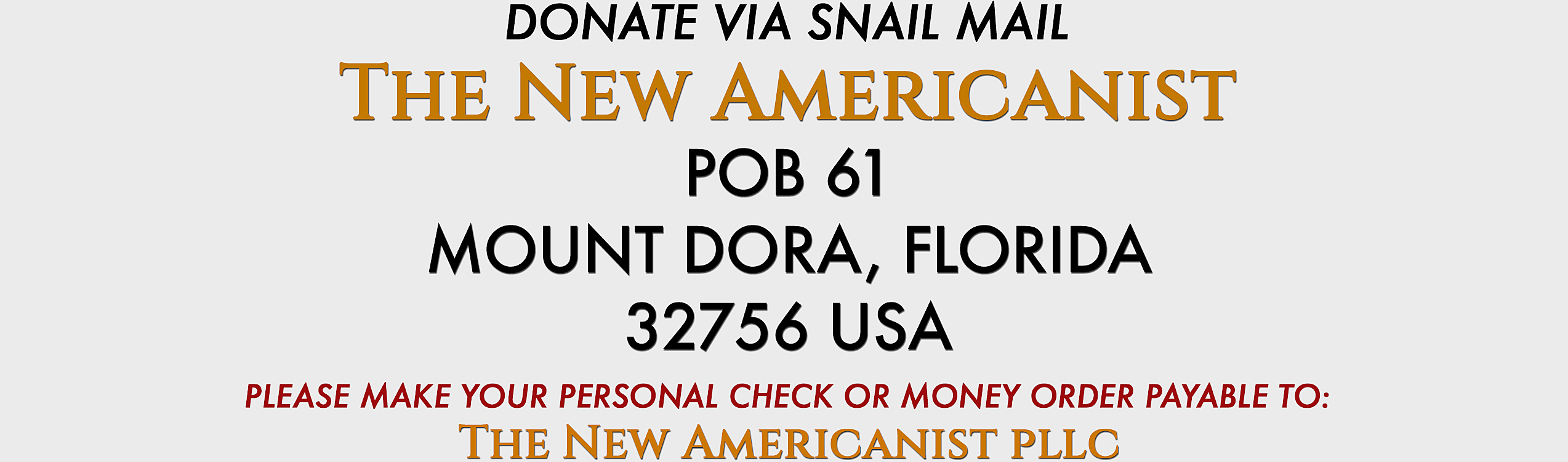
▶️ DONATE VIA SNAIL MAIL




▶️ RSBN LIVESTREAM LINK: JD Vance Rally In Council Bluffs, Iowa
⭐️ TokaiseBlessedPatriot
