




Joseph Raymond McCarthy (November 14, 1908–May 2, 1957)
✪ Joseph Raymond McCarthy was an American politician who served as a Republican U.S. Senator from the state of Wisconsin from 1947 until his death at age 48 in 1957. Beginning in 1950, McCarthy became the most visible public face of a period in the United States in which Cold War tensions fueled national concerns of widespread communist subversion. He alleged numerous communists, Soviet spies and sympathizers had infiltrated the United States Federal Government, universities, film and entertainment industries as elsewhere. Ultimately, he was censured by the Senate in 1954 for refusing to cooperate with, and abusing members of, the committee established to investigate whether or not he should be censured.
The term “McCarthyism,” was coined in 1950 in reference to McCarthy’s political practices and was soon applied to similar anti-communist activities.
McCarthy was born in 1908 on a farm in Grand Chute, Wisconsin, the fifth of nine children. His mother, Bridget McCarthy (nee Tierney), was from County Tipperary, Ireland. His father, Timothy McCarthy, was born in the United States, the son of an Irish father and a German mother. McCarthy dropped out of junior high school at the age 14 to help his parents manage their farm. He later entered Little Wolf High School, in Manawa, Wisconsin when he was 20 and graduated in only one year.
McCarty attended Marquette University from 1930 to 1935; and worked his way through college by coaching, boxing etc. He first studied electrical engineering for two years, then law, and finally received a Bachelor of Law degree in 1935 from Marquette University Law School in Milwaukee.
McCarthy was admitted to the State Bar in 1935. In 1936, while working at a law firm in Shawano, Wisconsin, he launched an unsuccessful campaign for District Attorney as a Democrat.
In 1939, McCarthy had more success when he ran for the nonpartisan elected post of 10th District circuit judge. McCarthy became the youngest circuit judge in the state’s history by defeating incumbent Edgar V. Werner, who had been a judge for 24 years.
McCarthy’s judicial career attracted some controversy because of the speed with which he dispatched many of his cases as he worked to clear the heavily backlogged docket he inherited from Werner.
Writing of Werner in Reds: McCarthyism In Twentieth-Century America, Ted Morgan wrote: “Pompous and condescending, he (Werner) was disliked by lawyers. His judgements had often been reversed by the Wisconsin Supreme Court, and he was so inefficient that he had piled up a huge backlog of cases.”
In 1942, shortly after the U.S. entered World War II, McCarthy joined the United States Marine Corps, despite the fact that his judicial office exempted him from military service. His college education qualified him for a direct commission, and he entered the Marines as a first lieutenant.
McCarthy’s close friend and campaign manager, attorney and judge Urban P. Van Susteren, applied for active duty in the U.S. Army Air Forces in early 1942; and advised McCarthy: “Be a hero—join the Marines.” When McCarthy seemed hesitant, Van Susteren asked, “You got shit in your blood?”
During the war, McCarthy served as an intelligence briefing officer for a dive bomber squadron VMSB-235 in the Solomon Islands and Bougainville for 30 months (August 1942–February 1945) holding the rank of captain by the time he resigned his commission in April 1945. He volunteered to fly twelve combat missions as a gunner-observer, acquiring the nickname “Tail-Gunner Joe.” McCarthy remained in the Marine Corps Reserve after the war, attaining the rank of lieutenant colonel.
McCarthy campaigned for the Republican Senate nomination in Wisconsin while still on active duty in 1944 but was defeated by Alexander Wiley, the incumbent. After he left the Marines in April 1945, five months before the end of the Pacific war in September 1945, McCarthy was reelected unopposed to his circuit court position. He then began a much more systematic campaign for the 1946 Republican Senate primary nomination.
In this campaign, McCarthy attacked the incumbent La Follette for not enlisting during the war, although La Follette was 46 years old when Pearl Harbor was bombed. He also claimed La Follette had made huge profits from his investments while he, McCarthy, had been away fighting for his country. La Follette’s investments consisted of partial interest in a radio station, which earned him a profit of $47,000 ($800,000 in 2024) over two years.
The suggestion La Follette was guilty of war profiteering was deeply damaging, and McCarthy won the primary nomination 207,935 votes to 202,557. It was during this campaign that McCarthy started publicizing his war-time nickname “Tail-Gunner Joe,” using the slogan, “Congress needs a tail-gunner.” Journalist Arnold Beichman later stated that McCarthy “was elected to his first term in the Senate with support from the Communist-controlled United Electrical, Radio and Machine Workers, CIO,” which preferred McCarthy to the anti-communist Robert M. La Follette.
During the early 1950s, McCarthy launched a series of attacks in the Senate on the CIA, claiming it had been infiltrated by communist agents. CIA Director Allen Dulles, who suspected McCarthy was using information supplied by Hoover, refused to cooperate.
In 1953, McCarthy married Jean Fraser Kerr, a researcher in his office. In January 1957, McCarthy and his wife adopted an infant. They named the baby girl Tierney Elizabeth McCarthy.
Senator McCarthy’s first three years in the Senate were undistinguished. McCarthy was a popular speaker, invited by many different organizations, covering a wide range of topics. His aides and many in the Washington social circle described him as charming and friendly, and he was a popular guest at cocktail parties. He was far less well liked among fellow senators, however, who found him quick-tempered and prone to impatience.
McCarthy was very active in labor-management issues, with a reputation as a moderate Republican. He fought against continuation of wartime price controls, especially on sugar. His advocacy in this area was associated by critics with a $20,000 personal loan McCarthy received from a Pepsi bottling executive, earning the Senator the derisive nickname “The Pepsi-Cola Kid.” McCarthy supported the Taft–Hartley Act over Truman’s veto, angering labor unions in Wisconsin but solidified his business base.
In an incident for which he would be widely criticized, McCarthy lobbied for the commutation of death sentences given to a group of Waffen-SS soldiers convicted of war crimes for carrying out the 1944 Malmedy Massacre of American prisoners of war. McCarthy was critical of the convictions because the German soldiers’ confessions were allegedly obtained through torture during the interrogations. He argued that the U.S. Army was engaged in a coverup of judicial misconduct, but never presented any evidence to fully support the accusation.
McCarthy experienced a meteoric rise in national profile beginning on February 9, 1950, when he gave a Lincoln Day speech to the Republican Women’s Club of Wheeling, West Virginia. His words in the speech are a matter of some debate, as no audio recording was saved. However, it is generally agreed that he produced a piece of paper that he claimed contained a list of known Communists working for the State Department. McCarthy is usually quoted to have said: “The State Department is infested with communists. I have here in my hand a list of 205—a list of names that were made known to the Secretary of State as being members of the Communist Party and who nevertheless are still working and shaping policy in the State Department.”
At the time of McCarthy’s speech, communism was a significant concern in the United States. This concern was exacerbated by the actions of the Soviet Union in Eastern Europe, the victory of the communists in the Chinese Civil War, the Soviets’ development of a nuclear weapon the year before, and by the contemporary controversy surrounding Alger Hiss and the confession of Soviet spy Klaus Fuchs. With this background and due to the sensational nature of McCarthy’s charge against the State Department, the Wheeling speech soon attracted a flood of press interest in McCarthy’s claim.
McCarthy himself was taken aback by the massive media response to the Wheeling speech, and he was accused of continually revising both his charges and figures.
During a five-hour speech, McCarthy presented a case-by-case analysis of 81 top “loyalty risks” employed at the State Department. It is widely accepted that most of McCarthy’s cases were selected from the so-called “Lee list,” a report that had been compiled three years earlier for the House Appropriations Committee. Led by a former Federal Bureau of Investigation agent named Robert E. Lee, the House investigators had reviewed security clearance documents on State Department employees, and had determined that there were “incidents of inefficiencies” in the security reviews of 108 employees.
In response to McCarthy’s charges, the Senate voted unanimously to investigate, and the Tydings Committee hearings were officially called. This was a subcommittee of the United States Senate Committee on Foreign Relations set up in February 1950 to conduct “a full and complete study and investigation as to whether persons who are disloyal to the United States are, or have been, employed by the Department of State.” Many prominent Democrats were incensed at McCarthy’s attack on the State Department of a sitting Democrat administration; and hoped to use the hearings as a vehicle to discredit him. The Democrat chairman of the subcommittee, Senator Millard Tydings, was reported to have said, “Let me have him [McCarthy] for three days in public hearings, and he’ll never show his face in the Senate again.”
From its beginning, the Tydings Committee was marked by intense partisan infighting. Its final report, written by the Democrat majority, concluded that the individuals on McCarthy’s list were neither Communists nor pro-communist, and said the State Department had an effective security program. The Tydings Report labeled McCarthy’s charges a “fraud and a hoax,” and described them as using incensing rhetoric—saying that the result of McCarthy’s actions was to “confuse and divide the American people … to a degree far beyond the hopes of the Communists themselves.” Republicans were outraged by the Democrat response. The full Senate voted three times on whether to accept the report, and each time the result of the voting was precisely divided along party lines.
From 1950 onward, McCarthy continued to exploit the fear of Communism and to press his accusations that the government was failing to deal with Communism within its ranks. McCarthy also began investigations into homosexuals working in the foreign policy bureaucracy, who were considered prime candidates for blackmail by the Soviets. These accusations received wide publicity, increased his approval rating, and gained him a powerful national following.
In Congress, there was little doubt that homosexuals did not belong in sensitive government positions. Since the late 1940s, the government had been dismissing about five homosexuals a month from civilian posts. By 1954, that number had grown twelve-fold. As historian David M. Barrett would write, “Mixed in with the hysterics were some logic, though: homosexuals faced condemnation and discrimination, and most of them—wishing to conceal their orientation—were vulnerable to blackmail.”
Director of Central Intelligence Roscoe Hillenkoetter was called to Congress to testify on homosexuals being employed at the CIA. He said, “The use of homosexuals as a control mechanism over individuals recruited for espionage is a generally accepted technique which has been used at least on a limited basis for many years.”
McCarthy’s methods also brought on the disapproval and opposition of many. Barely a month after McCarthy’s Wheeling speech, the term “McCarthyism” was coined by Washington Post cartoonist Herbert Block. Block and others used the word as a synonym for demagoguery, baseless defamation and mudslinging. Later, it would be embraced by McCarthy and some of his supporters. “McCarthyism is Americanism with its sleeves rolled,” McCarthy said in a 1952 speech, and later that year, he published a book titled McCarthyism: The Fight For America.
McCarthy and President Truman often clashed during the years both held office. McCarthy characterized Truman and the Democrat Party as soft on, or even in league with, Communists, and spoke of the Democrats’ “twenty years of treason.” Truman, in turn, once referred to McCarthy as “the best asset the Kremlin has;” calling McCarthy’s actions an attempt to “sabotage the foreign policy of the United States” in a Cold War and comparing it to shooting American soldiers in the back in a hot war. It was the Truman Administration’s State Department that McCarthy accused of harboring 205 “known Communists.”
During the Korean War, when Truman dismissed General Douglas MacArthur, McCarthy charged that Truman and his advisors must have planned the dismissal during late-night sessions when “they’ve had time to get the President cheerful” on bourbon and Bénédictine. McCarthy declared, “The son of a bitch should be impeached.”
One of the strongest bases of anti-Communist sentiment in the United States was the Catholic community, which constituted over 20% of the national vote. McCarthy identified himself as Catholic, and although the great majority of Catholics were Democrats, as his fame as a leading anti-Communist grew, he became popular in Catholic communities across the country, with strong support from many leading Catholics, diocesan newspapers, and Catholic journals.
McCarthy established a bond with the powerful Kennedy family, which had high visibility among Catholics. McCarthy became a close friend of Joseph P. Kennedy Sr., himself a fervent anti-Communist, He was also a frequent guest at the Kennedy compound in Hyannis Port, Massachusetts. He dated two of Kennedy’s daughters, Patricia and Eunice.
Unlike many Democrats, John F. Kennedy, who served in the Senate with McCarthy from 1953 until the latter’s death in 1957, never publicly attacked McCarthy. McCarthy did not campaign for Kennedy’s 1952 opponent, Republican incumbent Henry Cabot Lodge Jr., due to his friendship with the Kennedys.
During the 1952 presidential election, the Eisenhower campaign toured Wisconsin with McCarthy. In a speech delivered in Green Bay, Eisenhower declared that while he agreed with McCarthy’s goals, he disagreed with his methods.
With his victory in the 1952 presidential race, Eisenhower became the first Republican president in 20 years. The Republican Party also held a majority in the House of Representatives and the Senate. After being elected president, Eisenhower made it clear to those close to him that he did not approve of McCarthy and he worked actively to diminish his power and influence. Still, he never directly confronted McCarthy or criticized him by name in any speech.
With the beginning of his second term as senator in January 1953, McCarthy was made chairman of the Senate Committee on Government Operations. However, the Committee on Government Operations included the Senate Permanent Subcommittee on Investigations. The mandate of this subcommittee was sufficiently flexible to allow McCarthy to use it for his own investigations of Communists in the government. McCarthy appointed Roy Cohn as chief counsel and a 27-year-old Robert F. Kennedy as an assistant counsel to the subcommittee.
▶️ 46 Seconds
This subcommittee would become the scene of some of McCarthy’s most publicized exploits. The subcommittee first investigated allegations of Communist influence in the Voice of America, at that time administered by the State Department’s United States Information Agency. Many VOA personnel were questioned in front of television cameras and a packed press gallery.
A few VOA employees alleged Communist influence on the content of broadcasts, but none of the charges were substantiated. Morale at VOA was badly damaged, and one of its engineers committed suicide during McCarthy’s investigation.
Soon after receiving the chair to the Subcommittee on Investigations, McCarthy appointed J. B. Matthews as staff director of the subcommittee. One of the nation’s foremost anti-communists, Matthews had formerly been staff director for the House Un-American Activities Committee.
In autumn 1953, McCarthy’s committee began its ill-fated inquiry into the United States Army. This began with McCarthy opening an investigation into the Army Signal Corps laboratory at Fort Monmouth. McCarthy, newly married to Jean Kerr, cut short his honeymoon to open the investigation.
The hearings lasted for 36 days & were broadcast on live television by ABC and DuMont, with an estimated 20 million viewers tuning in. The hearings covered 32 witnesses and two million words of testimony,
The Army consulted with an attorney familiar with McCarthy to determine the best approach to attacking him. Based on his recommendation, it ultimately decided not to pursue McCarthy on the question of communists in government.
One of the most prominent attacks on McCarthy’s methods came during an episode of the television documentary series See It Now, hosted by journalist Edward R. Murrow, which was broadcast on March 9, 1954. Titled “A Report on Senator Joseph R. McCarthy,” the episode consisted largely of clips of McCarthy speaking. In these clips, McCarthy accused the Democrat Party of “twenty years of treason,” describing the American Civil Liberties Union as “listed as ‘a front for, and doing the work of’, the Communist Party”
At the conclusion of his program, Murrow said of McCarthy:
“No one familiar with the history of this country can deny that congressional committees are useful. It is necessary to investigate before legislating, but the line between investigating and persecuting is a very fine one, and the junior Senator from Wisconsin has stepped over it repeatedly. His primary achievement has been in confusing the public mind, as between the internal and the external threats of Communism. We must not confuse dissent with disloyalty. We must remember always that accusation is not proof and that conviction depends upon evidence and due process of law. We will not walk in fear, one of another. We will not be driven by fear into an age of unreason, if we dig deep in our history and our doctrine, and remember that we are not descended from fearful men—not from men who feared to write, to speak, to associate and to defend causes that were, for the moment, unpopular.”
On March 9, 1954, Vermont Republican senator Ralph E. Flanders gave a humor-laced speech on the Senate floor, questioning McCarthy’s tactics in fighting communism, likening McCarthyism to “house-cleaning” with “much clatter and hullabaloo.” He recommended that McCarthy turn his attention to the worldwide encroachment of Communism outside North America. In a June 1 speech, Flanders compared McCarthy to Adolf Hitler, accusing him of spreading “division and confusion” and saying, “Were the Junior Senator from Wisconsin in the pay of the Communists he could not have done a better job for them.” On June 11, Flanders introduced a resolution to have McCarthy removed as chair of his committees.
On December 2, 1954, the Senate voted to “condemn” McCarthy by a vote of 67 to 22. The Democrats present unanimously favored condemnation and the Republicans were split evenly. The only senator not on record was John F. Kennedy, who was hospitalized for back surgery. Kennedy never indicated how he would have voted. Immediately after the vote, Senator H. Styles Bridges, a McCarthy supporter, argued that the resolution was “not a censure resolution” because the word “condemn” rather than “censure” was used in the final draft.
McCarthy himself said, “I wouldn’t exactly call it a vote of confidence.” He added, “I don’t feel I’ve been lynched.”
After his condemnation and censure, McCarthy continued to perform his senatorial duties for another two and a half years. His career as a major public figure, however, had been ruined. His colleagues in the Senate avoided him; his speeches on the Senate floor were delivered to a near-empty chamber or received with intentional and conspicuous displays of inattention.
Still, McCarthy continued to rail against Communism and Socialism. He warned against attendance at summit conferences with “the Reds,” saying that “you cannot offer friendship to tyrants and murderers … without advancing the cause of tyranny and murder.” He declared that “co-existence with Communists is neither possible nor honorable nor desirable. Our long-term objective must be the eradication of Communism from the face of the Earth.”
McCarthy’s biographers agree that he was a changed man, for the worse, after the censure; declining both physically and emotionally, he became a “pale ghost of his former self” It was reported that McCarthy suffered from cirrhosis of the liver and was frequently hospitalized for alcohol abuse.
Journalist Richard Rovere (1959) wrote:
“He had always been a heavy drinker, and there were times in those seasons of discontent when he drank more than ever. But he was not always drunk. He went on the wagon (for him this meant beer instead of whiskey) for days and weeks at a time. The difficulty toward the end was that he couldn’t hold the stuff. He went to pieces on his second or third drink, and he did not snap back quickly.”
During this time, McCarthy had also become addicted to morphine. Harry J. Anslinger, head of the Federal Bureau of Narcotics, became aware of McCarthy’s addiction in the 1950s. Anslinger decided to give McCarthy access to morphine in secret from a pharmacy in Washington, DC. The morphine was paid for by the Federal Bureau of Narcotics, right up until the time of McCarthy’s death.
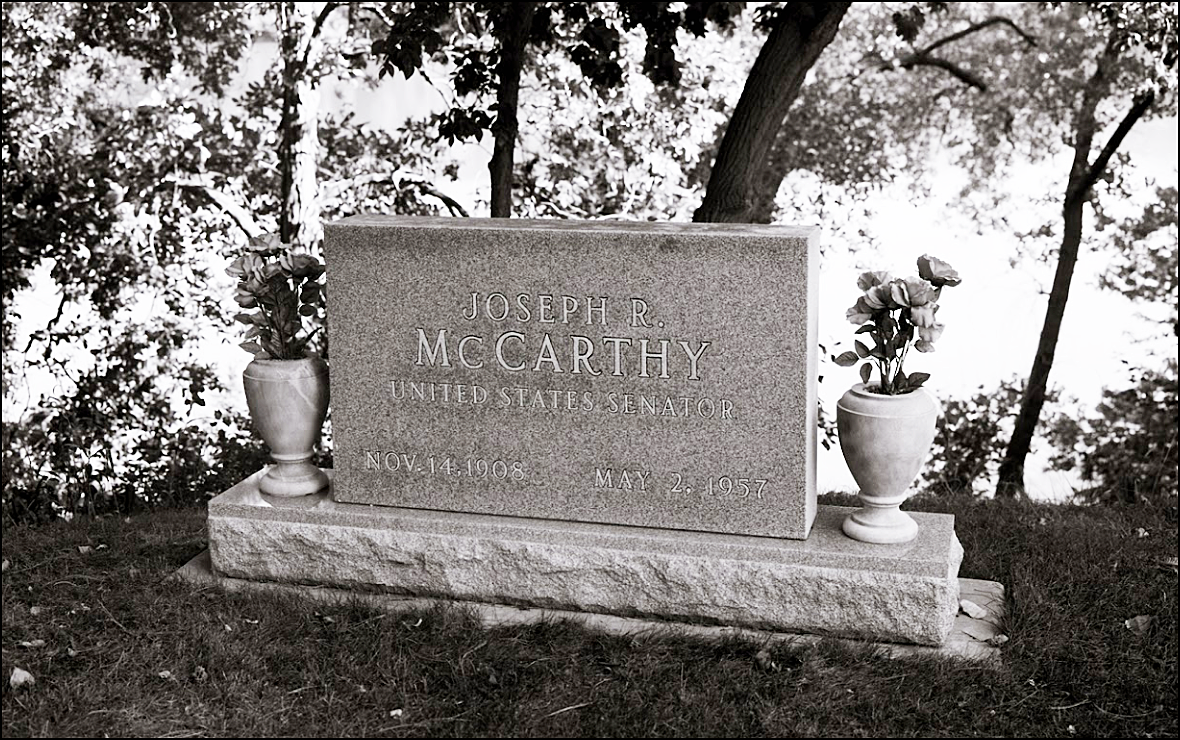
McCarthy died at Bethesda Naval Hospital on May 2, 1957, at the age of 48. His death certificate listed his cause of death as “Hepatitis, acute, cause unknown.’ Doctors had not previously reported him to be in critical condition. It was hinted in the press that he died of alcoholism (cirrhosis of the liver), an estimation that is now accepted by modern biographers.
He was given a state funeral that was attended by 70 senators, and a Solemn Pontifical Requiem Mass was celebrated before more than 100 priests and 2,000 others at Washington’s St. Matthew’s Cathedral. Thousands of people viewed his body in Washington as he lay in state. He was buried in St. Mary’s Parish Cemetery in Appleton, Wisconsin, where more than 17,000 people filed through St. Mary’s Church in order to pay him their last respects. ✪


















▶️ CLICK HERE TO VIEW


▶️ CLICK HERE TO VIEW
▶️ 49 Minutes 40 Seconds
▶️ 1 Hour 4 Minutes 30 Seconds
▶️ 28 Minutes 57 Seconds
▶️ 1 Hour 36 Minutes 21 Seconds
▶️ 28 Minutes 45 Seconds
▶️ 6 Minutes 56 Seconds
▶️ 5 Minutes 50 Seconds
▶️ 2 Minutes 50 Seconds
▶️ 26 Minute 56 Seconds
▶️ Premiere ⭐️ Bet1125
▶️ 22 Minutes 17 Seconds
▶️ 1 Hour 5 Minutes 31Seconds
▶️ 20 Minutes 1 Second ⭐️ wtd
▶️ 2 Minute 15 Seconds
▶️ 19 Minutes 10 Seconds
▶️ 40 Minutes 28 Seconds
▶️ 4 Minutes 10 Seconds
