


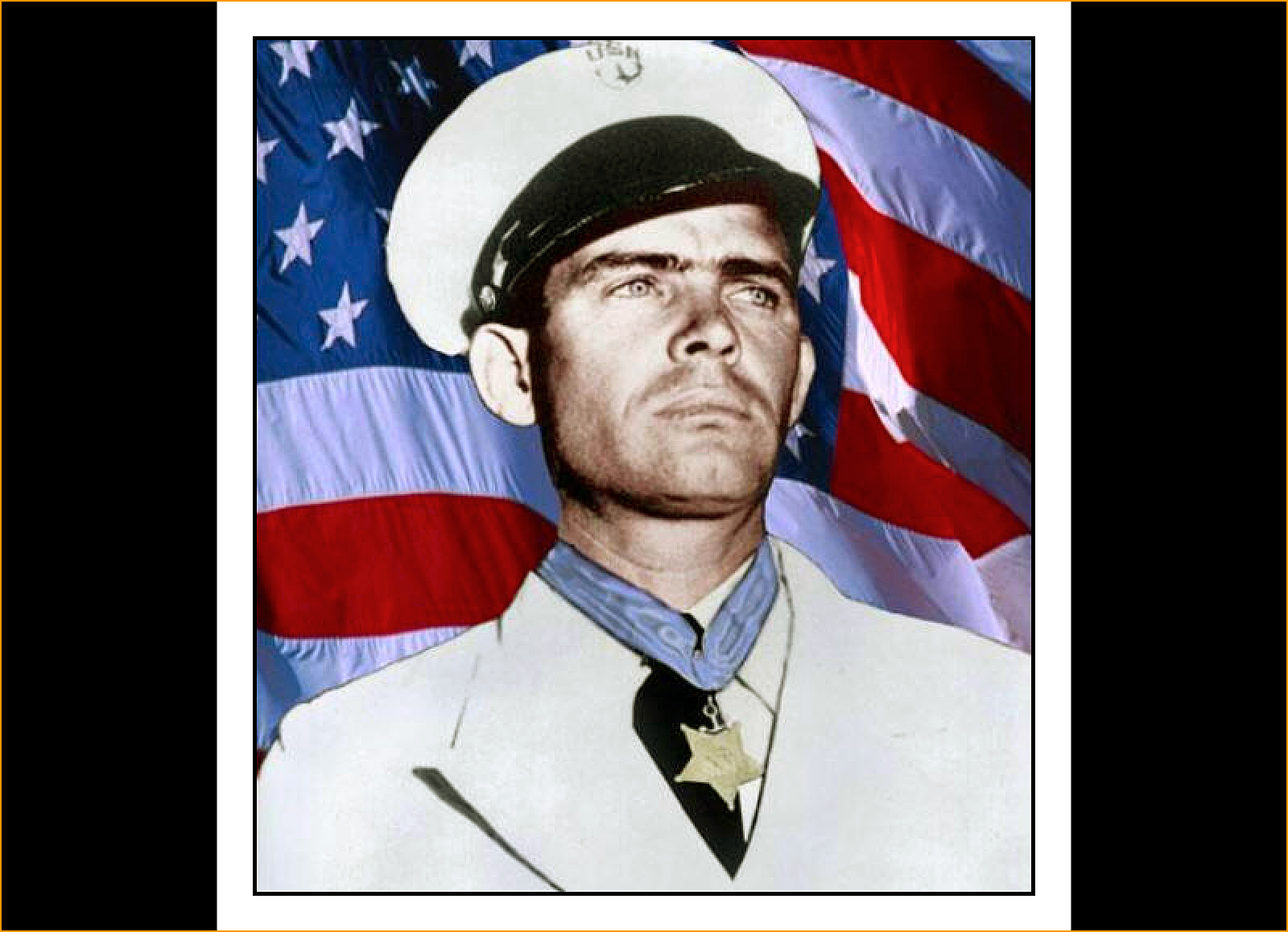

John William Finn: 24 July 24, 1909–May 27, 2010
✪ John William Finn was a sailor in the United States Navy who, as a chief petty officer and aviation ordnanceman, received the United States military’s highest decoration, the Medal of Honor, for his actions during the attack on Pearl Harbor in World War II.
Though ordnancemen are only responsible for performing maintenance on guns and handling of munitions, Finn earned the medal by firing a machine gun from an exposed position when the Japanese bombed Naval Air Station Kaneohe Bay during the 7 December attack despite being repeatedly wounded. He continued to serve in the Navy and in 1942 was commissioned an ensign. In 1947 he was reverted to chief petty officer, eventually rising to the rank of lieutenant before his 1956 retirement. In his later years he made many appearances at events honoring & celebrating veterans. At the time of his death, Finn was the oldest living Medal of Honor recipient, the last living medal recipient from the attack on Pearl Harbor, and the last living United States Navy medal recipient of World War II.
Finn was born onJuly 24, 1909 in Compton, California. His father was a plumber. Finn dropped out of school after the seventh grade and enlisted in the Navy in July 1926, shortly before his seventeenth birthday. He completed his recruit training in San Diego. After a brief stint with a ceremonial guard company, he attended General Aviation Utilities Training at Naval Station Great Lakes and graduated in December. By April 1927 he was back in the San Diego area, having been assigned to Naval Air Station North Island. He initially worked in aircraft repair before becoming an aviation ordnanceman and working on anti-aircraft guns. He then served on a series of ships: USS Lexington, USS Houston, USS Jason, USS Saratoga, and USS Cincinnati.
Finn was promoted to chief petty officer (E-7, the highest enlisted rank in the Navy at that time) in 1935 after only nine years of active duty. He later commented on his promotions, “Everybody thought I was a boy wonder. I was just in the right place at the right time.” As a chief, Finn served with patrol squadrons in San Diego, Washington and Panama.
In December 1941, Finn was stationed at Naval Air Station Kaneohe Bay on the island of Oahu in Hawaii. As a chief aviation ordnanceman, he was in charge of twenty men whose primary task was to maintain the weapons of VP-11, a PBY Catalina flying boat squadron. At 7:48 a.m. on the morning of Sunday, 7 December 1941, Finn was at his home, about a mile from the aircraft hangars, when he heard the sound of gunfire. Finn recalled how a neighbor was the first to alert him, when she knocked on his door saying, “They want you down at the squadron right away!” He drove to the hangars, catching sight of Japanese planes in the sky on the way, and found that the airbase was being attacked, with most of the PBYs already on fire.
Finn then found a movable platform used for gunnery training, attached the .50 caliber machine gun, and pushed the platform out into an open area from which he had a clear view to give the Japanese what he called a “warm welcome.” For more than 2 1/2 hours he fired at wave after wave of strafing Japanese Zeroes until the attack ended, even after being seriously wounded, because, as he later said, “I didn’t have enough sense to come in out of the rain.” In total, he received 21 distinct wounds, including a bullet wound in his left arm; a broken left foot; shrapnel to his chest, stomach, right elbow and thumb; and a laceration on his scalp.
He finally left his improvised machine gun post under specific orders to seek medical attention. After a few bandages, he returned to the hangar later that day to help arm the surviving American planes. He later spent two weeks in the hospital recovering from his wounds.
Finn’s men were trying to fight back by using the machine guns mounted in the PBYs, either by firing from inside the flaming planes or by detaching the guns and mounting them on improvised stands. Finn later explained that one of the first things he did was to take control of a machine gun from his squadron’s painter. “I said, ‘Alex, let me take that gun’ … knew that I had more experience firing a machine gun than a painter.”
“I got that gun and I started shooting at Jap planes,” Finn said in a 2009 interview. “I was out there shooting the Jap planes and just every so often I was a target for some,” he said, “In some cases, I could see their [the Japanese pilots’] faces.”
Finn’s actions during that day earned him the first Medal of Honor to be awarded in World War II. He was formally presented with the decoration on 14 September 1942, by Admiral Chester Nimitz, for courage and valor beyond the call of duty. The ceremony took place in Pearl Harbor on board the USS Enterprise.
In 1942 Finn was commissioned, and served as a Limited Duty Officer with the rank of ensign. In 1947 he was reverted to his enlisted rank of chief petty officer, eventually becoming a lieutenant with Bombing Squadron VB-102 and aboard USS Hancock. He retired from the Navy as a lieutenant in September 1956.
From 1956 until shortly before his death, Finn resided on a 90 acre ranch in Live Oak Springs, near Pine Valley, California. He and his wife became foster parents to five Native American children, causing him to be embraced by the Campo Band of Diegueño Mission Indians, a tribe of Kumeyaay people in San Diego. His wife, Alice Finn, died in 1998. John Finn was a member of the John Birch Society.
▶️ 7 Minutes 22 Seconds
In his retirement he made many appearances at events honoring veterans. On March 25, 2009, he attended National Medal of Honor Day ceremonies at Arlington National Cemetery. With the aid of walking sticks, he stood beside U.S. President Barack Obama during a wreath-laying ceremony at the Tomb of the Unknown Soldier. Later that day, Finn was a guest at the White House. It was his first visit to the White House, and his first time meeting a sitting president.
OnJune 27, 2009, a crowd of over 2,000 made up of family, friends and well-wishers came to Pine Valley to celebrate Finn’s 100th birthday. The Association of Aviation Ordnancemen presented him with an American flag which had flown on each of the 11 aircraft carriers then in active service.
When called a hero during a 2009 interview Finn responded:
That damned hero stuff is a bunch of crap, I guess. …You gotta understand that there’s all kinds of heroes, but they never get a chance to be in a hero’s position.
Finn died at the age of 100 on the morning of May 27, 2010, at the Chula Vista Veterans Home. He was buried beside his wife the at Saint Carmel Cemetery in Live Oak Springs, San Diego County, CA. after a memorial service in El Cajon. He was the last surviving Medal of Honor recipient from the attack on Pearl Harbor, the oldest living recipient, and the only aviation ordnanceman to have ever received the medal. ✪














COUNTDOWN TO INAUGURATION DAY 2025






▶️ CLICK HERE TO VIEW


▶️ CLICK HERE TO VIEW
▶️ 6 Minutes 47 Seconds
▶️ 9 Minutes 51 Seconds
▶️ 2 Minutes 51 Seconds
▶️ 1 Hour 6 Minutes 47 Seconds
▶️ 2 Minutes 26 Seconds
