


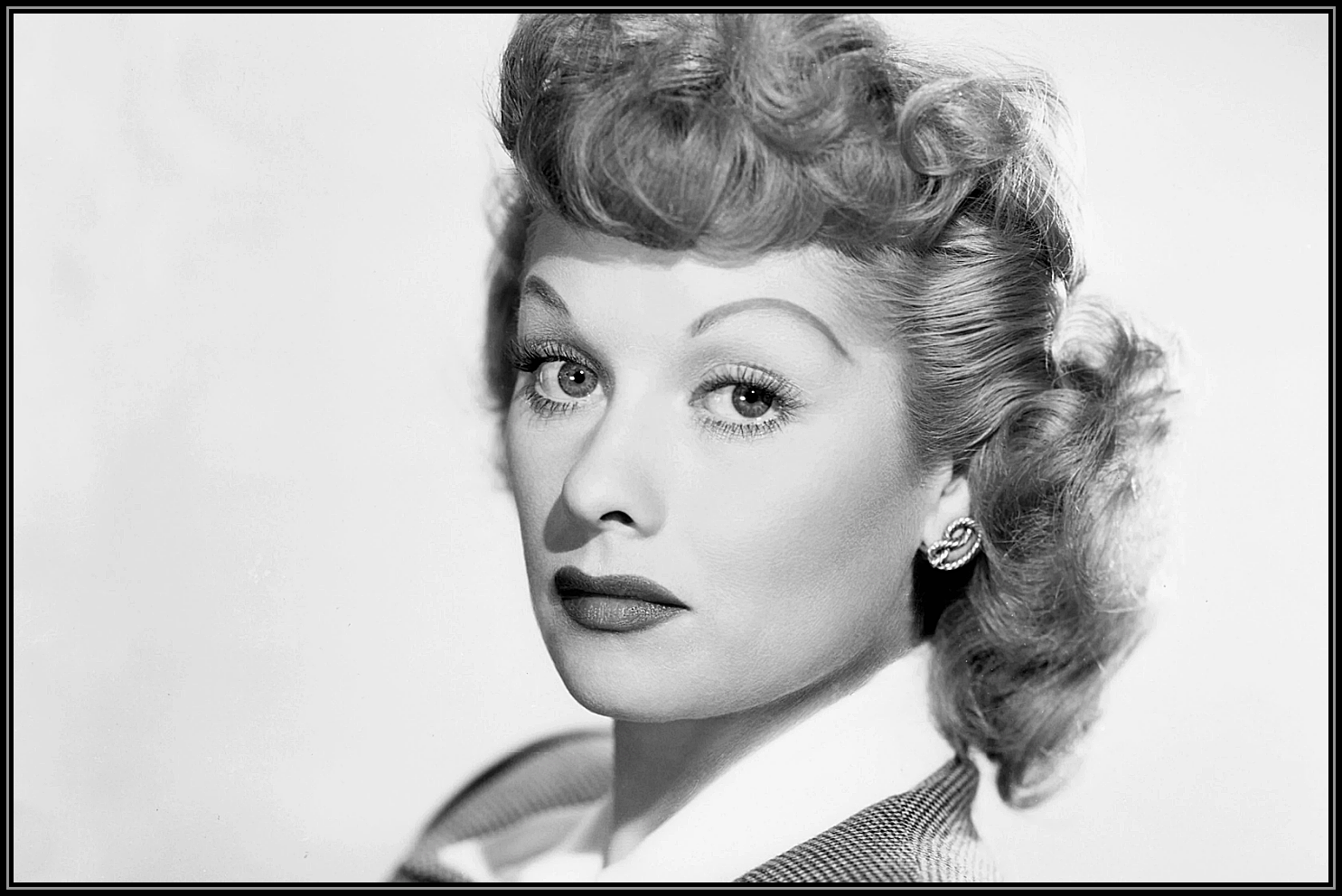

Lucille Désirée Ball: August 6, 1911–April 26, 1989
✪ Lucille Désirée Ball was an American actress, comedian, producer, and studio executive. She was recognized by Time in 2020 as one of the most influential women of the 20th Century for her accomplishments in all four of these areas. She was nominated for 13 Primetime Emmy Awards, won five and was the recipient of several other accolades, such as the Golden Globe Cecil B. DeMille Award and two stars on the Hollywood Walk of Fame. She earned many other honors, including the Women in Film Crystal Award, an induction into the Television Hall of Fame, a Kennedy Center Honor and the Governors Award from the Academy of Television Arts & Sciences.
Ball’s career began in 1929 when she landed work as a model. Shortly thereafter, she began her performing career on Broadway using the stage name Diane (or Dianne) Belmont. She later appeared in numerous films in the 1930s and 1940s as a contract player for RKO Radio Pictures. Often being cast as a chorus girl or in similar roles, with lead roles in B-pictures and supporting roles in A-pictures.
In the 1950s, Ball ventured into television, where she and Arnaz created I Love Lucy. In 1962, she became the first woman to run a major television studio, Desilu Productions, which produced many popular television series, including Mission: Impossible and Star Trek. Ball did not ever retire completely from acting. In 1985, she took on a dramatic role in the television film Stone Pillow. After her death, the American Comedy Awards were officially dubbed “The Lucy” in her honor.
Lucille Désirée Ball was born on Sunday, August 6, 1911, at 69 Stewart Avenue in Jamestown, New York, the first child and only daughter of Henry Durrell “Had” Ball, a lineman for Bell Telephone and Désirée Evelyn “DeDe” (née Hunt) Ball. Her family belonged to the Baptist Church. Ball was of mostly English ancestry with some Scottish, French and Irish.
Ball’s father’s Bell Telephone career frequently required the family to move during Lucy’s early childhood. Their first move was to Anaconda, Montana, and later to Trenton, New Jersey. On February 28, 1915, while living in Wyandotte, Michigan, Lucy’s father died of typhoid fever aged 27, when she was only three years old. At that time, DeDe was pregnant with her second child, Fred Ball (1915–2007). Lucille recalled little of the day her father died, except a bird becoming trapped inside her house, which caused her lifelong ornithophobia.
Four years after Henry Ball’s death, DeDe married Edward Peterson. While they looked for work in another city, Peterson’s parents cared for Lucy and Fred. Ball’s step-grandparents were a puritanical Swedish couple who banished all mirrors from the house except one over the bathroom sink. When Lucy was caught admiring herself in it, she was severely chastised for being vain. She later said that this period of time which lasted eight years affected her deeply.
When Lucy was 12, her stepfather encouraged her to audition for his Shriners organization which needed entertainers for the chorus line of its next show. While Ball was onstage, she realized that performing was a great way to gain praise. In 1927, her family was forced to move to a small apartment in Jamestown after their house and furnishings were sold to settle a legal judgment.
In 1925 when she was only 14, Ball started dating Johnny DeVita, a 21-year-old local hoodlum. Her mother was unhappy about the relationship, and hoped the romance, which she was unable to influence, would eventually burn out. After about a year, her mother tried to separate them by exploiting Ball’s desire to be in show business. Despite the family’s meager finances, in 1926, she enrolled Ball in the John Murray Anderson School for the Dramatic Arts, in New York City where Bette Davis was also a fellow student.
Ball later recalled, “All I learned in drama school was how to be frightened.” Ball’s instructors at the school told her she would never be successful in the entertainment business and that she should pursue a different career path.
In the face of this harsh criticism, Ball became determined to prove her teachers wrong. She returned to New York City in 1928. That same year, she began working for Hattie Carnegie as an in-house model. Carnegie ordered Ball to bleach her brown hair blond, and she complied. Of this time in her life, Ball said: “Hattie taught me how to slouch properly in a $1,000 hand-sewn sequin dress and how to wear a $40,000 sable coat as casually as rabbit.”
Her acting endeavors were temporarily placed on hold during this time when she became ill with rheumatic fever and was unable to work for two years.
In 1932, she moved back to New York City to resume her pursuit of an acting career, where she supported herself by again working for Carnegie and as the Chesterfield cigarette girl. Using the name Diane (sometimes spelled Dianne) Belmont, she also started getting chorus work on Broadway, but it did not last. Ball was hired — but then quickly fired — by both theater impresario Earl Carroll from his Vanities; and by Florenz Ziegfeld Jr. from a touring company of Rio Rita.
After an uncredited stint as a Goldwyn Girl in Roman Scandals (1933) starring Eddie Cantor and Gloria Stuart, Ball moved permanently to Hollywood to appear in films. There she had many small movie roles in the 1930s as a contract player for RKO Radio Pictures, including a two-reel comedy short with The Three Stooges (Three Little Pigskins, 1934) and a movie with the Marx Brothers (Room Service, 1938).
Like many budding actresses, Ball picked up radio work to supplement her income and gain exposure. In 1937, she appeared regularly on The Phil Baker Show. When its run ended in 1938, Ball joined the cast of The Wonder Show starring Jack Haley. There she began her 50-year friendship & professional relationship with the show’s announcer announcer, Gale Gordon.
In 1940, Ball starred in Dance, Girl, Dance and appeared as the lead in the musical Too Many Girls, where she met and fell in love with Cuban band leader Desi Arnaz, who played one of her character’s four bodyguards in the movie. They connected immediately, and eloped on November 30, 1940, two months after the film opened. Although Arnaz was drafted into the Army in 1942, he was classified for limited service due to a knee injury. He stayed in Los Angeles, organizing and performing USO shows for wounded G.I.s brought back from the Pacific.
Ball signed with Metro-Goldwyn-Mayer in the 1940s, but never achieved major stardom there. She was known in Hollywood circles as “Queen of the B’s (B-movies).” A title previously held by Fay Wray and later more closely associated with Ida Lupino.
In a 1944 Pathé News newsreel titled “Fund Raising for Roosevelt.” Ball was featured prominently among several stage and film stars at events in support of President Franklin D. Roosevelt’s fundraising campaign for the March of Dimes. She stated that in the 1952 United States presidential election, she voted for Republican Dwight D. Eisenhower.
On September 4, 1953, Ball met voluntarily with HUAC (The House Committee ON Unamerican Activities) investigator William A. Wheeler in Hollywood and gave him sealed testimony. She stated that she had registered to vote as a Communist “or intended to vote the Communist Party ticket” in 1936 only at her socialist grandfather’s insistence. However, she stated she “at no time intended to vote as a Communist.” Her testimony was forwarded to J. Edgar Hoover in an FBI memorandum.”
Ball stated she has never been a member of the Communist Party “to her knowledge” … [She] did not know whether or not any meetings were ever held at her home at 1344 North Ogden Drive; stated … [that if she had been appointed] as a delegate to the State Central Committee of the Communist Party of California in 1936 it was done without her knowledge or consent; [and stated that she] did not recall signing the document sponsoring EMIL FREED for the Communist Party nomination to the office of member of the assembly for the 57th District … A review of the subject’s file reflects no activity that would warrant her inclusion on the Security Index.
In 1948, Ball was cast as Liz Cooper, a wacky wife in My Favorite Husband, a radio comedy produced by CBS Radio. My Favorite Husband was extremely successful, and CBS asked Ball to develop it for television. She agreed, but insisted on working with her real-life husband, Arnaz. CBS executives were reluctant, thinking the public would not accept an Anglo-American redhead and a Cuban as a couple.
CBS was initially unimpressed with the pilot episode, produced by the couple’s Desilu Productions Company. So the pair went on the road to promote it with a vaudeville act, in which Lucy played the zany housewife, who wants to get into a Cuban band leader’s (Arnaz’s) show. The tour was a hit, and CBS put I Love Lucy into their lineup.
I Love Lucy ran on CBS from October 15, 1951, to May 6, 1957, and was not only a star vehicle for Lucille Ball, but also a potential means for her to salvage her marriage to Arnaz. Their relationship had become badly strained, in part because of their hectic performing schedules, which often kept them apart, but mostly due to Desi’s attraction to other women.
On July 17, 1951, less than three weeks prior to her 40th birthday, Ball gave birth to daughter Lucie Désirée Arnaz. A year and a half later, she gave birth to Desiderio Alberto Arnaz IV, known as Desi Arnaz, Jr.
CBS insisted that a pregnant woman could not be shown on television, nor should the word “pregnant” be spoken on-air. After input and approval from several religious figures, the network allowed the pregnancy story line, but insisted that the word “expecting” be used instead of “pregnant.” (Arnaz garnered laughs when he deliberately mispronounced it as “spectin.'”
The episode aired on the evening of January 19, 1953, with 44 million viewers watching Lucy Ricardo welcome little Ricky, while in real life Ball delivered her second child, Desi Jr., that same day in Los Angeles. The birth made the cover of the first issue of TV Guide for the week of April 3–9, 1953.
For the production of I Love Lucy, Ball and Arnaz wanted to remain in their Los Angeles home, but prime time in Los Angeles was too late to air a major network series live to be viewed on the East Coast.
Sponsor Philip Morris pressured the couple into relocating, not wanting day-old kinescopes airing in major East Coast markets, nor did they want to pay the extra cost that filming, processing and editing would require. Instead, the couple offered to take a pay cut to finance filming on better-quality 35 mm film, on the condition that Desilu would retain the rights of each episode once it aired.
▶️ 4 Minutes 54 Seconds
CBS agreed to relinquish the post-first-broadcast rights to Desilu, not realizing they were giving up a valuable and enduring asset. In 1957, CBS bought back the rights for $1,000,000 ($10.8 million in today’s terms), financing Ball and Arnaz’s down payment for the purchase of the former RKO Pictures Studios, which they turned into Desilu Studios.
A scene in which Lucy and Ricky practice the tango, in the episode “Lucy Does The Tango,” evoked the longest recorded studio audience laugh in the history of the show — so long that the sound editor had to cut that section of the soundtrack in half.
Along the way, Ball created a television dynasty and achieved several firsts in her industry. She was the first woman to head a TV production company, Desilu, which she formed with Arnaz. After their divorce in 1960, she bought out his share and became a very actively engaged studio head. Desilu and I Love Lucy pioneered a number of methods still in use in TV production today, such as filming before a live studio audience with more than one camera, and distinct sets, adjacent to each other. During this time, Ball also taught a 32-week comedy workshop at the Brandeis-Bardin Institute. She was quoted as saying, “You cannot teach someone comedy; either they have it or they don’t.”
Desilu produced several other popular shows, such as The Untouchables, Star Trek, and Mission: Impossible. Ball sold her shares of the studio to Gulf+Western in 1967 for $17,000,000 ($155 million in today’s dollars), and it was renamed Paramount Television.
Ball’s close friends in the business included perennial co-star Vivian Vance and film stars Judy Garland, Ann Sothern, and Ginger Rogers; and comedic television performers Jack Benny, Barbara Pepper, Ethel Merman, Mary Wickes, and Mary Jane Croft; all except Garland appeared at least once on her various series.
Ball was originally considered by Frank Sinatra for the role of Mrs. Iselin in the Cold War thriller The Manchurian Candidate. Director/producer John Frankenheimer, however, had worked with Angela Lansbury in a mother role in All Fall Down, and insisted on having her for the part.
In 1959, Ball became a friend and mentor to Carol Burnett. She guested on Burnett’s highly successful CBS-TV special Carol + 2 and the younger performer reciprocated by appearing on The Lucy Show. Ball was rumored to have offered Burnett a chance to star on her own sitcom, but in truth, she instead chose to create her own variety show. The two women remained close friends until Ball’s death on April 26, 1989, which was Carol’s birthday. Ball sent flowers every year on Burnett’s birthday.
Aside from her acting career, Ball became an assistant professor at California State University, Northridge in 1979.
In 1983, Lucille Ball and Gary Morton partnered to set up a film and television production house at 20th Century Fox that encompassed film and television productions as well as plans to produce plays.
Ball starred in a 1985 dramatic made-for-TV film about an elderly homeless woman, Stone Pillow, which received mixed reviews, but had strong viewership.
On April 18, 1989, Ball was admitted to Cedars-Sinai Medical Center in Los Angeles after experiencing chest pains. She was diagnosed with a dissecting aortic aneurysm and underwent a 7-hour surgery to repair her aorta and successfully install an aortic valve replacement.
Shortly after dawn on Wednesday, April 26, Ball awoke with severe back pain, then lost consciousness. She died at 5:47 AM PDT at age 77, only two years and 4 months after the death of Desi Arnaz. Doctors determined that Ball had succumbed to a ruptured abdominal aortic aneurysm not directly related to her surgery.
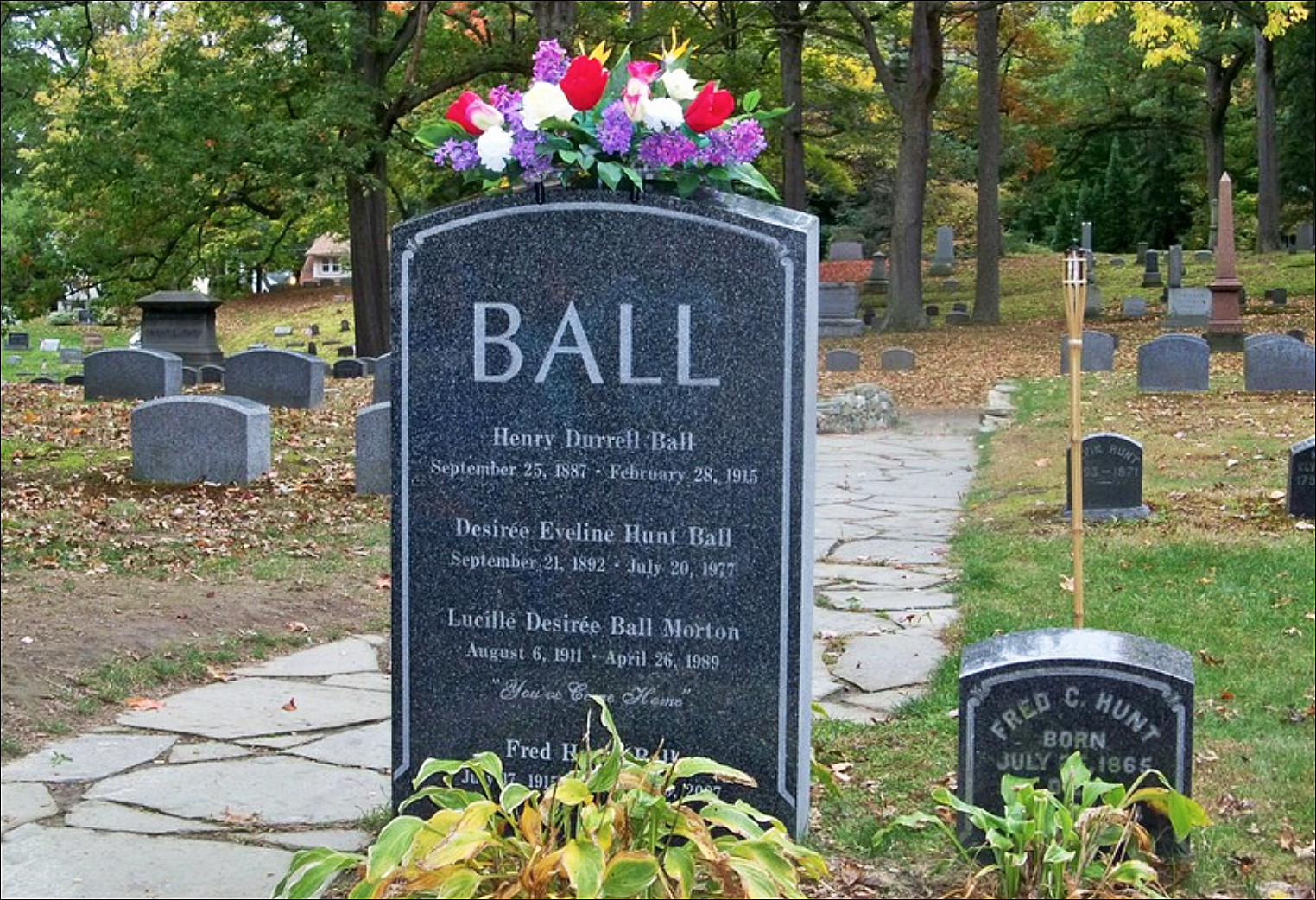
Ball’s and her mother’s remains were re-interred at the Hunt family plot at Lake View Cemetery in Jamestown, New York, in accordance with Ball’s wishes to be buried near her mother.
Ball received many tributes, honors, and awards throughout her career and posthumously. On February 8, 1960, she was given two stars on the Hollywood Walk of Fame. At 6436 Hollywood Boulevard, for contributions to motion pictures; and another at 6100 Hollywood Boulevard, for her contribution to the arts and sciences of television. On December 7, 1986, Ball was recognized as a Kennedy Center Honors recipient.
Posthumously, Ball received the Presidential Medal of Freedom from President George H. W. Bush on July 6, 1989 and The Women’s International Center’s Living Legacy Award. Ball was among Time magazine’s “100 Most Important People of the Century”
Ball appeared on 39 covers of TV Guide, more than any other person, including its first cover in 1953 with her baby son, Desi Arnaz Jr. TV Guide voted her the “Greatest TV Star of All Time,” and later commemorated the 50th anniversary of I Love Lucy with eight covers celebrating memorable scenes from the show.
I Love Lucy episodes have been dubbed in over 100 different languages & broadcast in over 120 countries. It remains the most highly syndicated program in television history and episodes continue to be broadcast somewhere in the world every minute of each day now just as it has been for the last 65 years.✪





















COUNTDOWN TO INAUGURATION DAY 2025







▶️ CLICK HERE TO VIEW
▶️ 1 Hour 15 Minutes 21 Seconds
▶️ 14 Minutes 1 Second
▶️ 54 Minutes 24 Seconds
▶️ 7 Minutes 14 Seconds
▶️ 8 Minutes 20 Seconds ⭐️ Gary Brown
▶️ 18 Minutes 22 Seconds ⭐️ Part One
▶️ 13 Minutes 23 Seconds ⭐️ Part Two
▶️ 15 Minutes 21 Seconds
▶️ 23 Minutes 03 Seconds
▶️ 2 Minutes 2 Seconds ⭐️ bet1125
▶️ 5 Minutes 24 Seconds
▶️ 3 Minutes 41 Seconds
