


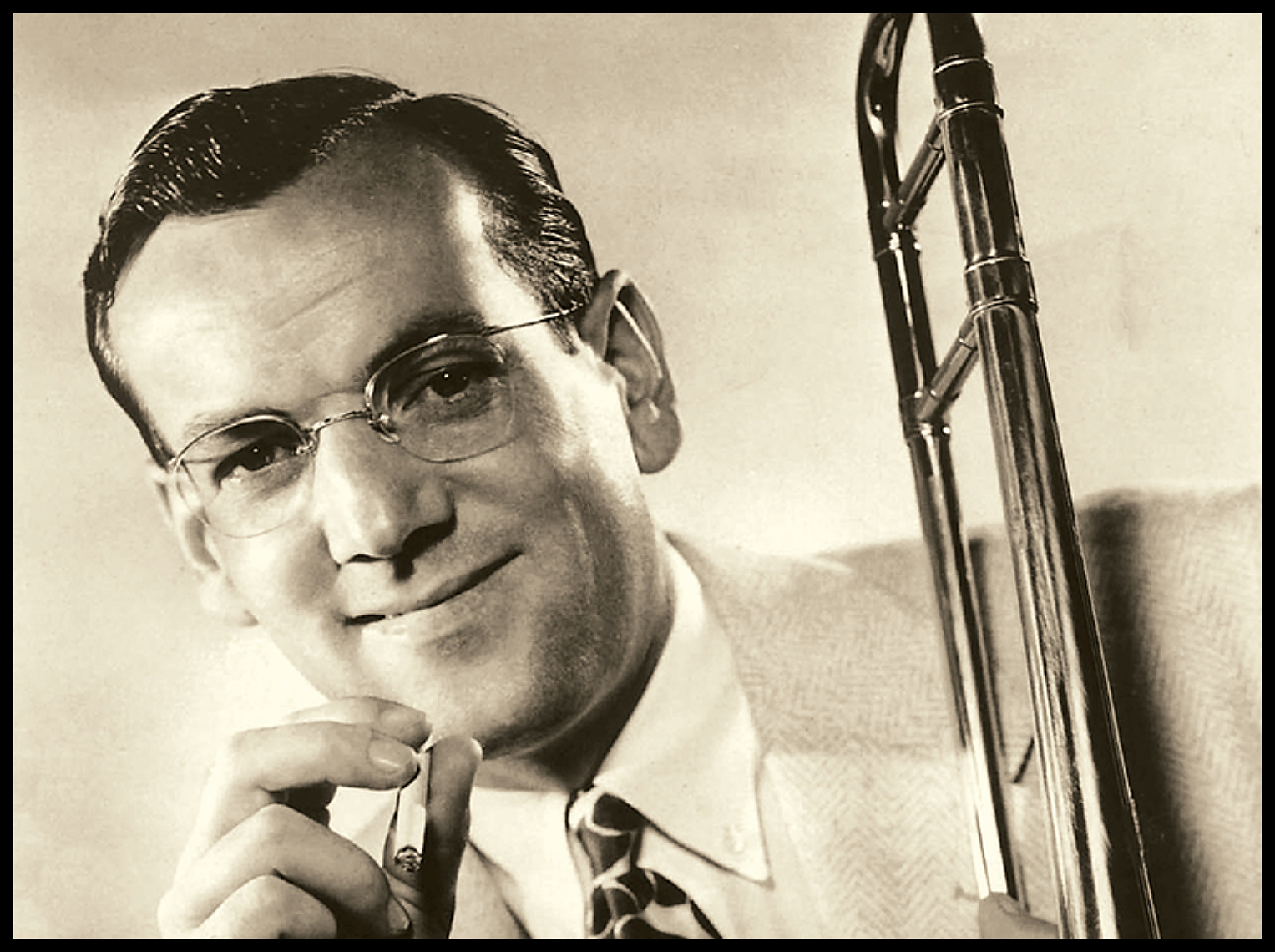

Alton Glen “Glenn” Miller: March 1, 1904–December 15, 1944
✪ Alton Glen “Glenn” Miller was an American Big Band conductor, arranger, composer, trombone player and recording artist before and during World War II, when he was an officer in the US Army Air Forces. His civilian band, Glenn Miller & His Orchestra was one of the most popular and successful bands of the 20th Century and the Big Band era.
Glenn Miller and His Orchestra was the best-selling recording band from 1939 to 1942. Miller’s civilian band did not have a string section like his military unit did, but it did have a slap bass in the rhythm section. It was also a touring band which played multiple radio broadcasts nearly every day. Their best-selling records include Miller’s theme song, “Moonlight Serenade” and the first gold record ever made, “Chattanooga Choo Choo,” as well as “String Of Pearls” and “In The Mood.”
▶️ 3 Minutes 31 Seconds
Miller is considered by music historians to be the father of modern US Military bands. In 1942, he volunteered to join the US military to entertain troops during World War II and ended up as a Major in the US Army Air Forces. Miller’s workload in the military was just as heavy as his civilian band’s. With a full string section added to his big band, the Major Glenn Miller Army Air Forces Orchestra became the forerunner of many modern US military big bands.
Alton Glen Miller was born on March 1, 1904 in Clarinda, Iowa to Mattie Lou (née Cavender) Miller and Lewis Elmer Miller. He added the second “n” to his middle name “Glenn” during high school. Like his father and his siblings, Miller went by his middle name, Glenn. As Dennis Spragg of the Glenn Miller Archives confirms, “Miller’s use of his first name, Alton, was necessary for legal and military purposes, which is logically why it shows up in formal documents such as his military documents, driver’s licenses, tax returns, etc.“
Miller attended grade school in North Platte, Nebraska. In 1915, his family moved to Grant City, Missouri. Around this time, he had made enough money from milking cows to buy his first trombone and played in the town orchestra. He originally taught himself cornet and mandolin, but switched to the trombone by 1916.
In 1918, Miller and his family moved again to Fort Morgan, Colorado, where he attended Fort Morgan High School. In the fall of 1919, he joined the F.M.H.S. Maroons, the high school football team which won the Northern Colorado American Football Conference in 1920. Miller was named Best Left End in Colorado in 1921. For two years, Miller was also one of the editors of his own high school yearbook, “Memories.” In each of the yearbooks he edited, his name was spelled both Glen with one n, and Glenn with a double n.
During his senior year, Miller became so interested in dance band music that he formed a band with some classmates. The high school orchestra was an after school activity, but he played there too. By the time he graduated from high school in 1921, he had decided to become a professional musician. He missed his own graduation because he was performing out of town. His mother accepted his diploma for him.
In 1923, Miller entered the University of Colorado at Boulder, where he joined the Sigma Nu fraternity. However, he spent most of his time away from school, attending auditions and playing any gigs he could get, including with Boyd Senter’s band in Denver. After failing three out of five classes including Harmony, he dropped out of school to formally pursue a career in music. He realized that his future was in arranging and composing. In 1928 he published a songbook in Chicago entitled 125 Jazz Breaks for Trombone.
Miller wrote his first composition, “Room 1411” along with with Benny Goodman. It was released by Brunswick Records as a 78 rpm record under the name “Benny Goodman’s Boys.”
In 1928, when the band arrived in New York City, he sent for and married his college sweetheart, Helen Burger. In 1930, he became a member of Red Nichols’ orchestra (Red Nichols and his Five Pennies) and because of Nichols, he was able to play in the pit bands of two Broadway shows, Strike Up the Band and Girl Crazy. That band also included Benny Goodman and Gene Krupa.
During the late 1920s and early 1930s, Miller worked as a freelance trombonist in several bands. On a March 21, 1928 in a Victor Records session, he played alongside Tommy Dorsey, Benny Goodman and Joe Venuti in the All-Star Orchestra.
In 1935, he was commissioned by British bandleader Ray Noble to assemble an American orchestra for developing the arrangement of lead clarinet over four saxophones that would eventually become the signature characteristic of his own big band sound.
Miller made his first movie appearance in The Big Broadcast of 1936 as a member of the Ray Noble Orchestra performing “Why Stars Come Out at Night.” The film included performances by Dorothy Dandridge and the Nicholas Brothers, who would appear with Miller again in two more movies for Twentieth Century Fox in 1941 & 1942.
In 1937, Miller compiled several arrangements and formed his first band. After failing to distinguish itself from the many bands of the time, it broke up after its last show at the Ritz Ballroom in Bridgeport, Connecticut on January 2, 1938.
As Benny Goodman recalled in a 1976 interview:
“In late 1937, before his band became popular, we were both playing in Dallas. Glenn was pretty dejected and came to see me. He asked, “What do you do? How do you make it?” I said, “I don’t know, Glenn. You just stay with it.”
Discouraged, Miller returned to New York. He realized that he needed to develop a unique sound and decided to make the clarinet play a melodic line with a tenor saxophone holding the same note, while three other saxophones harmonized within a single octave. With this new sound combination, Miller found a way to differentiate his band’s style from that of many bands that existed in the late 1930s.
Miller talked about his style in the May 1939 issue of Metronome Magazine:
“You’ll notice today some bands use the same trick on every introduction; others repeat the same musical phrase as a modulation into a vocal … We’re fortunate in that our style doesn’t limit us to stereotyped intros, modulations, first choruses, endings, or even trick rhythms. The fifth sax, playing the clarinet most of the time, lets you know whose band you’re listening to. And that’s about all there is to it.”
In September 1938, the Miller band began recording on the Bluebird label, a subsidiary of RCA Victor. In the spring of 1939, the band’s fortunes dramatically improved with a date at the Meadowbrook Ballroom in Cedar Grove, New Jersey, and then even more dramatically at the Glen Island Casino in New Rochelle, New York. According to author Gunther Schuller, the Glen Island performance attracted “a record-breaking opening-night crowd of 1800…”
The band’s popularity continued to grow. In 1939, Time magazine noted: “Of the 12 to 24 discs in each of today’s 300,000 U.S. jukeboxes, from two to six are usually Glenn Miller’s.” In 1940, the band’s version of “Tuxedo Junction” sold 115,000 copies in the first week. Miller’s success in 1939 culminated with an appearance at Carnegie Hall on October 6, with Paul Whiteman, Benny Goodman and Fred Waring also on the performance schedule.
From December 1939 to September 1942, Miller’s band performed three times a week during a quarter-hour broadcast for Chesterfield cigarettes on CBS radio; the first 13 weeks with the Andrews Sisters and then on their own. On February 10, 1942, RCA Victor presented Miller with the very first gold record for “Chattanooga Choo Choo.”
⭐️ 8 Minutes
Miller and his band appeared in two Twentieth Century Fox films. In 1941’s Sun Valley Serenade they were major members of the cast, which also featured comedian Milton Berle and Dorothy Dandridge with the Nicholas Brothers in the show-stopping song-and-dance number, “Chattanooga Choo Choo.” The Miller band returned to Hollywood to film 1942’s Orchestra Wives, featuring Jackie Gleason playing a part as the group’s bassist. Though contracted to do a third movie for Fox entitled Blind Date, Miller entered the US Army and this film was never made.
▶️ 2 Minutes 45 Seconds
Miller’s music was often criticized for being too commercial. His answer was, “I don’t want a jazz band.” In 1997, on a website administered by JazzTimes magazine, Doug Ramsey considered him overrated: “Miller discovered a popular formula from which he allowed little departure. A disproportionate ratio of nostalgia to substance keeps his music alive.”
However, many music critics have defended Miller from criticism. In an article written for The New Yorker magazine in 2004, critic Gary Giddins wrote:
“Miller exuded little warmth on or off the bandstand, but once the band struck up its theme, audiences were done for: throats clutched, eyes softened. The Miller sound was nevertheless very special and able to penetrate our collective awareness that few other sounds have…How much further [Miller’s] musical and financial ambitions might have carried him must forever remain conjectural. That it would have been significant, whatever form(s) it might have taken, is not unlikely.”
Louis Armstrong thought highly enough of Miller to carry around his recordings, transferred to seven-inch tape reels when he went on tour. Armstrong liked musicians who prized melody, and his selections ranged from Glenn Miller to Jelly Roll Morton to Tchaikovsky.
Frank Sinatra’s recording sessions from the late 1940s and early 1950s used some Miller musicians. In an interview with George T. Simon in 1948, Sinatra lamented the inferior quality of music he was recording in the late ’40s, in comparison with “those great Glenn Miller things.“
At the peak of his civilian career in 1942, Miller decided to join the armed forces, which meant forsaking an income of about $20,000 per week from his civilian band, Glenn Miller and His Orchestra (equivalent to $330,000 per week in 2022). At 38, married and needing corrective eyeglasses, Miller was classified 3-A for the draft and unlikely to be called to service.
He first applied for a commission in the US Navy but was turned down. At the time, the Navy was dealing with a scandal concerning celebrity commissions in exchange for draft avoidance. This had nothing to do with Miller, but it prevented the Navy from acting on his application.
Miller then applied to the US Army with whom he had privately explored the possibility of enlisting. On August 12, 1942, Miller sent a three-page letter to General Charles Young of the Army Service Forces, outlining his interest in “streamlining modern military music” and to express his “sincere desire to do a real job for the Army that is not actuated by any personal draft problem.”
The Army notified Miller of his commission on September 8, 1942. He received a one-month delay to settle his civilian business affairs.
Miller made his final commercial broadcast for Chesterfield Cigarettes on September 24, 1942. At the end of the program, he introduced competitor Harry James as his successor on the series, a gesture that a grateful James never forgot. On September 26, Miller made his final civilian broadcast on the Blue Network Coca Cola Victory Parade of Spotlight Bands. Glenn Miller and His Orchestra gave their final live performance at Central Theater in Passaic, New Jersey on September 27, 1942. On October 7, 1942, Miller reported to the Seventh Service Command at Omaha as a captain in the Army Specialist Corps.
Miller would form and direct the Second AAF Radio Production Unit and Orchestra, broadcasting and recording from New York. Its personnel were a talented mix of jazz musicians from major big bands and musicians from leading symphony orchestras. Miller would successfully attempt to fuse jazz, popular music and light classics, including strings, which was an evolutionary step beyond his civilian band.
In addition to the full concert orchestra, Miller’s AAF Training Command organization included a marching band for base activities. Miller’s marching band became famous by using Jeeps with drums and string bass aboard for public performances.
On May 24, 1944, Gen. Dwight D. Eisenhower sent a cable to Washington requesting transfer of the Miller AAF unit for the purposes of radio broadcasting and morale. With the impending D-Day invasion of northwest Europe, the Supreme Headquarters, Allied Expeditionary Force (SHAEF) was establishing a combined allied radio broadcasting service. Eisenhower cited the Miller organization as the “only organization capable of performing the mission required.” Miller and radio producer Sgt. Paul Dudley flew to London on June 19 and the band followed aboard the RMS Queen Elizabeth, which was serving as a troopship.
On July 9, 1944, Miller’s 51-piece orchestra and production personnel started broadcasting a series of musical programs under BBC technical supervision.
In England, Miller’s band kept an extensive schedule of personal appearances at primarily American air bases. Visiting American celebrities Bing Crosby and Dinah Shore appeared on their radio programs. Military service personnel of all ranks enjoyed the band. Their concert at Eighth Air Force Headquarters at Wycombe Abbey, England, was filmed by the American Forces Network on July 29, 1944. General James H. Doolittle, Commanding General of the Eighth Air Force, showed his appreciation as he famously announced, “Captain Miller, next to a letter from home, your band is the greatest morale booster in the European Theater.” This film is now in the care of the National Archives.
During November 1944, Miller received approval to move the unit from England to France. It was determined that reliable radio broadcasting could be accomplished from Paris and that the Miller orchestra could be seen in person at Paris-area hospitals and by ground troops on leave from the front lines. The move was set for mid-December.
The AAF band completed their pre-recordings and regular broadcasts on Tuesday, December 12, 1944, and prepared for the anticipated move to France. Miller was on standby for an earlier flight on December 13, but it was canceled due to bad weather in France. His reservation on December 14 was also canceled. Miller was frustrated and impatient, fearing that arrangements would not be made in time to accommodate the movement of his unit to France. On a telephone call to Haynes, he learned that a mutual acquaintance, Lieutenant colonel Norman Baessell of the Eighth Air Force Service Command at Milton Ernest, was flying to France on December 15. It was to be aboard a Noorduyn UC-64A Norseman assigned to him and piloted by Flight Officer John Stuart Morgan. Baessell invited Miller to join them.
Miller’s travel orders did not authorize him to board a “casual” flight and he did not report his intentions to his chain of command so the Army Air Force Command had no knowledge of his whereabouts.
Baessell and Miller took off at 13:55. The UC-64 and its occupants were never seen again. The next morning, the Battle of the Bulge began. The Eighth Air Force command did not realize that the UC-64 with Miller aboard was missing until three days later, on Monday, December 18, 1944.
Upon realizing the airplane and Miller were missing, Major General Orvil Anderson, Deputy Commander for Operations of the Eighth Air Force, who was married to Miller’s cousin Maude Miller Anderson, ordered a search and investigation. Meanwhile, Miller’s unit had flown safely from England to France aboard three C-47 transports and prepared to begin their broadcasting and concert duties. Since they were scheduled for a Christmas Day broadcast from Paris to England and via shortwave to the United States, news of Miller’s whereabouts would have to be released.
AAF Headquarters in Washington, D.C. notified Miller’s wife, Helen, of his disappearance on December 23, 1944, with an in-person visit to their home by two senior officers and a telephone call from Gen. H. H. Arnold. On December 24, 1944, at 18:00 BST, SHAEF announced Miller’s disappearance to the press, stressing that no members of his unit were with him aboard the missing airplane.
Helen Miller accepted her husband’s Bronze Star Medal at a ceremony at Miller’s New York business office on March 23, 1945. When Miller was officially declared dead in December 1945, Helen received a formal letter of condolence and appreciation from Gen. H. H. Arnold.
On January 20, 1945, an Eighth Air Force Board of Inquiry in England determined that the UC-64 airplane went down over the English Channel due to a combination of human error, mechanical failure and weather. Remains of the UC-64 and its passengers have never been found. The three officers were officially declared dead on the standard year and a day after they disappeared. This was published in a 1946 Army publication showing that Miller has a Finding of Death (FOD). He was missing in action (MIA) on December 15, 1944, and his remains were never recovered.
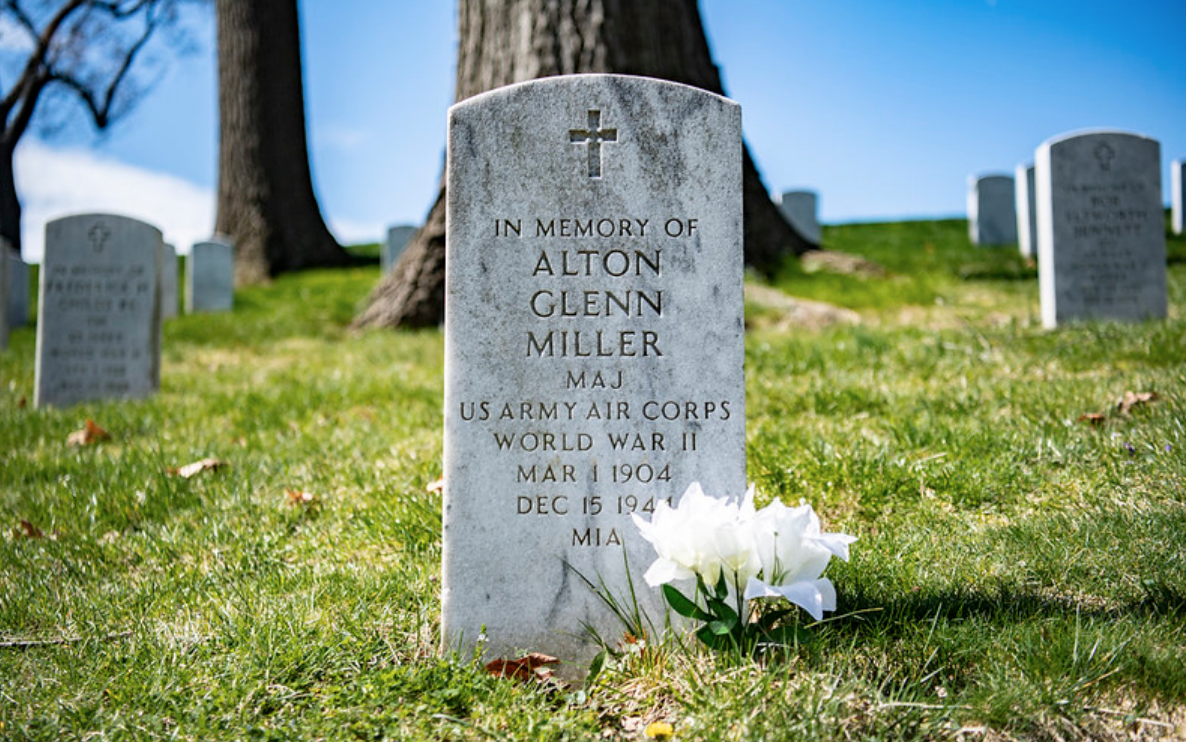
Miller’s name is engraved as Alton G. Miller on the “Tablets of the Missing” at the Cambridge American Cemetery and Memorial run by the American Battle Monuments Commission in Cambridge, England.
At his daughter’s request nearly 50 years later, an official, government-issued memorial headstone was placed for Major Alton Glenn Miller, US Army (Air Corps), in memorial Section H at the Army-run Arlington National Cemetery, Arlington, Virginia in 1992.
Miller and his music became an institution as Miller wished. His music is still played worldwide by professional and amateur musicians every day, including on BBC radio.
Around the world, the Glenn Miller Orchestra continues to tour today. In the United States, the leader since 2021 has been saxophonist Erik Stabnau. In the United Kingdom, the director is Ray McVay. In Europe, the leader has been Wil Salden since 1990. In Scandinavia, the director has been Jan Slottenäs since 2010.✪





















▶️ CLICK HERE TO VIEW
▶️ 16 Minutes 48 Seconds
▶️ 59 Minutes 2 Seconds
▶️ 25 Minutes 30 Seconds Part ONE
▶️ 23 Minutes 57 Seconds Part TWO
▶️ 9 Minutes 47 Seconds
▶️ 8 Minutes 43 Seconds
