
⭐️ puhiawa


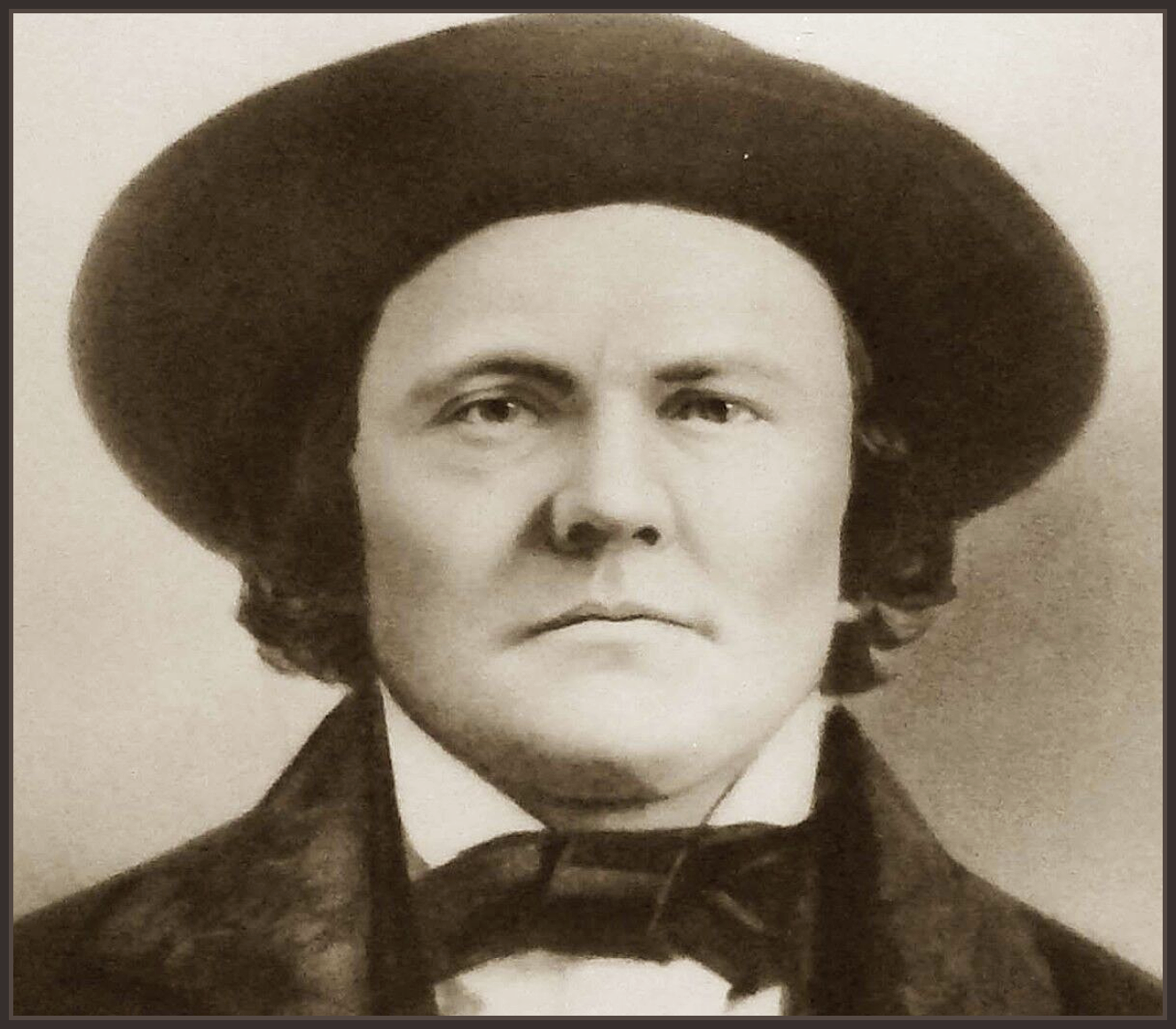

Christopher Houston Carson (December 24, 1809–May 23, 1868)
✪ Christopher Houston Carson was an American frontiersman. He was a fur trapper, wilderness guide, Indian agent and U.S. Army officer. He became a frontier legend during his own lifetime through numerous biographies and news articles. The exaggerated versions of his exploits were the subject of many popular dime novels. His understated nature belied confirmed reports of his fearlessness, combat skills, tenacity, as well as having a profound individual effect on the westward expansion of the United States. Although he was famous during much his life, historians in later years have written that Kit Carson did not like, want, or even fully understand the fame that he experienced in his own life.
Carson left home in rural Missouri at the age of 16 to become a mountain man and trapper in the West. In the 1830s, he accompanied Ewing Young on an expedition to Mexican California and joined fur-trapping expeditions into the Rocky Mountains. He lived among and married into the Arapaho and Cheyenne tribes.
Christopher Houston Carson was born on December 24, 1809, near Richmond, Madison County, Kentucky to parents father, Lindsay Carson and his second wife, Rebecca Robinson.
Lindsay Carson was of a Scots-Irish Presbyterian background. He was a farmer, a cabin builder; and was a veteran of the Mexican–American War, American Indian Wars and the American Civil War. He fought Natives on the American frontier and lost two fingers on his left hand in a battle with the Fox and Sauk Indians.
The Carson family moved to Boone’s Lick, Howard County, Missouri, when Kit was about a year old. The family settled on a tract of land owned by the sons of Daniel Boone, who had purchased the land from the Spanish. The Boone and Carson families became good friends and worked socialized, and even intermarried together.
At that time, Missouri was the frontier of American westward expansionism; cabins were “forted” with tall stockade fences to defend against Indian attacks. Sentries were posted with weapons to protect the farmers as the men worked in the fields. Carson later wrote in his Memoirs, “For two or three years after our arrival, we had to remain forted and it was necessary to have men stationed at the extremities of the fields for the protection of those that were laboring.”
In 1818, Lindsay Carson died instantly when a tree limb fell on him while he was clearing a field. Kit was about eight years old when he died. Despite being penniless, his mother took care of her children alone for four years. The decision was eventually made to apprentice Kit to David Workman, a saddler in Franklin, Missouri. Kit wrote in his Memoirs that Workman was “a good man, and I often recall the kind treatment I received.”
However, Carson found working in the saddlery not to his taste or liking: once saying that “the saddlery business did not suit me, and I concluded to leave.”
In August 1826, against his mother’s wishes, Kit ran away from his apprenticeship. He went west with a caravan of fur trappers and tended their livestock. They made their trek over the Santa Fe Trail to Santa Fe, the capital of Santa Fe de Nuevo México, reaching their destination in November 1826. He settled in Taos.
Carson was mentored by the famous trapper Kinkead in learning the skills of trapping and the necessary languages of the trade. Eventually, Carson became fluent in Spanish and several Native American Indian languages.
Between 1827 and 1829, Carson worked as cook, translator, and wagon driver in the southwest. He also worked at a copper mine near the Gila River, in southwestern New Mexico.
At the age of 19, Carson began his career as a mountain man. He traveled throughout many parts of the American West with famous mountain men like Jim Bridger and Old Bill Williams.
In addition to furs and the company of other mountain men, Carson sought out a lifestyle of action and adventure. Carson probably killed and scalped his first Indian combatant when he was 19. In August 1829, When the trapping party crosssed into Apache territory along the Gila River in August 1829, the expedition was attacked, giving Carson his first experience of combat.
Carson hunted and trapped in the West for about ten years. He was known as a reliable man and a very good fighter.
The life of a mountain man was not easy for for Carson. After collecting beavers from traps, he had to hold onto them for months at a time until the annual Rocky Mountain Rendezvous which was held in remote areas of the West like on the banks of the Green River in Wyoming. With the money made for the pelt sales, he funded all the necessities of an independent life, including fish hooks, flour and tobacco. As there was little or no medical access in the regions in which he worked, Carson had to dress his wounds and nurse himself.
Grizzly bears were one of the mountain man’s greatest enemies. In 1834, while Carson was hunting an elk alone, two bears crossed paths with him and quickly chased him up a tree.
Carson’s Memoirs are full of stories about hostile Indian encounters. Carson viewed the Blackfoot Nation as a hostile tribe and the greatest threat to his livelihood and safety. He hated them and would attack & kill them at every opportunity. The historian David Roberts wrote: “It was taken for granted that the Blackfeet were bad Indians; to shoot them whenever he could was a mountain man’s instinct and duty.”
However, Carson’s views about Indian would gradually soften over the years. More and more he found himself in their company as he aged: his attitude towards them became more respectful and humane. As an Indian agent in his later life, he saw to it that those under his watch were treated with honesty and fairness; clothed and properly fed. The historian David Roberts believes Carson’s first marriage to an Arapaho woman named Singing Grass, “softened the stern and pragmatic mountaineer’s opportunism.”
In April 1842, Carson went back to his childhood home in Missouri to place his daughter Adaline in the care of relatives. On the return trip, Carson met John C. Frémont aboard a steamboat on the Missouri River. Frémont was a US Army officer in the Corps of Topographical Engineers who was about to lead an expedition into the West. After a brief conversation, Frémont hired Carson as his guide at $100 a month, the best-paying job of Carson’s life. Frémont wrote:
“I was pleased with him and his manner of address at this first meeting. He was a man of medium height, broad-shouldered, and deep-chested, with a clear steady blue eye and frank speech and address; quiet and unassuming.”
In 1842, Carson guided Frémont across the Oregon Trail to South Pass, Wyoming. In 1843, Carson agreed to join Frémont’s second expedition. Carson guided Frémont across part of the Oregon Trail to the Columbia River in Oregon.
In 1845, Carson guided Frémont on their third expedition (Frémont later made a fourth, but without Carson). From Westport Landing, Missouri, crossing the Rockies, past the Great Salt Lake, and down the Humboldt River into the Sierra Nevadas of California and Oregon.
In June 1846, Frémont and Carson participated in the California uprising against Mexico known as the Bear Flag Revolt during which Mexico ordered all Americans to leave California. American settlers in California responded by declaring independence from the Mexican government & California as an independent republic.
From 1846 to 1848, Carson served as courier traveling three times from California to the East and back. Frémont wrote, “This was a service of great trust and honor… and great danger also.”
In 1847, the future General William Tecumseh Sherman met Carson in Monterey, California. Sherman wrote:
“His fame was then at its height,… and I was very anxious to see a man who had achieved such feats of daring among the wild animals of the Rocky Mountains, and still wilder Indians of the plains…. I cannot express my surprise at beholding such a small, stoop-shouldered man, with reddish hair, freckled face, soft blue eyes, and nothing to indicate extraordinary courage or daring. He spoke but little and answered questions in monosyllables.”
Returning to California after a short visit with his family in Taos, Carson followed the Old Spanish Trail to Los Angeles. He was dispatched a third time as government courier leaving Los Angeles in May 1848 via the Old Spanish Trail and reached Washington, D.C., with important military messages, which included an official report of the discovery of gold in California.
Newspapers often reported on Carson’s travels with some exaggeration, including stories he had been killed by Plains Indians in July 1848. Lt. George Brewerton accompanied Carson on part of this trip and published in Harper’s Magazine (1853) an account that boosted his now-growing celebrity status. In 1848, as Carson’s fame grew, a Baltimore hat maker offered a “Kit Carson Cap, after the unique style of the domestic one worn by that daring pioneer” At the St. Louis Jockey Club where one could bet on a horse “as swift as the wind,” named “Kit Carson.”
Carson joined Freemasonry in the Santa Fe Territory of New Mexico, petitioning in Montezuma Lodge No. 101. He was initiated an Entered Apprentice on April 22, 1854, passed to the degree of Fellowcraft June 17, 1854, and raised to the sublime degree of Master Mason on December 26, 1854, just two days after his 42nd birthday.
The Mexican–American War transferred possession of California and New Mexico to the United States. After the war, Carson returned to Taos to transition into a career as a businessman and rancher. He developed a small rancho at Rayado, east of Taos, and raised beef.
In the summer of 1850, he sold a herd of horses to the military at Ft. Laramie, Wyoming. The following year, he took wagons on a trading expedition to Missouri and back along the Santa Fe Trail. In 1852, for old times sake, he and a few of the veteran trappers made a loop trapping expedition through Colorado and Wyoming.
In mid-1853, Carson left New Mexico with 7,000 thin legged churro sheep for the California Trail across Wyoming, Utah, Nevada and into California. He was taking them to settlers in northern California and southern Oregon. Upon his arrival in Sacramento, he was surprised to learn of his elevation, again, to a hero of the Conquest of California. Over the rest of his life he would continue to be recognized as a celebrated frontiersman, an image developed by publications of varied accuracy.
Between January 1854 and May 1861, Carson served as one of the first Federal Indian Agents in the Far West. He sold his interest in the Rayado ranch and opened an office in a room of his Taos home, gratis—an office which would be perpetually underfunded. His jurustiction was responsible for the Maoche Ute people, Jicarilla Apache, and Taos Pueblo tribes living in a vast expanse of northern New Mexico Territory (which then included southwest Colorado). His duties were broad and insurmountable: “prevent conflict as far as possible, to persuade the Indians to submit to the government’s will, and to solve problems arising from contact between Indians and whites.”
In April 1861, when the American Civil War broke out, many officers from the South in the United States Army resigned their commissions and offered their services to the Confederate States of America or their home states.
When Confederate forces captured southern New Mexico Territory, the Union military commander, Colonel Edward Canby, ordered the governor to call for volunteers to defend the territory. Carson resigned his position as agent to the Ute Indian Tribe agent and volunteered to defend the Territory.
On February 19, 1862, Carson led his regiment east across the Rio Grande to occupy high ground across from Fort Craig to protect the post from a Confederate-turning move. Two days later, the Confederate forces sought to cross the Rio Grande to the west bank at the Valverde ford, about six miles north of Fort Craig.
The governor of the Territory appointed Carson the Lieutenant Colonel of the First New Mexico Volunteer Infantry. During the summer of 1861, Carson worked to organize the regiment of approximately one thousand men, most of whom were from prominent Hispanic families, at Fort Union in northeast New Mexico Territory. On September 21, the regiment’s colonel resigned, and Carson assumed command.
Carson’s fame spread throughout the United States with government reports, dime novels, newspaper accounts, and by word of mouth. The first accounts were published for popular audiences as serial extracts from Frémont’s explorations reports as reprinted in newspapers of the period.
Newspapers throughout the US and England reprinted syndicated excerpts about wild tales of buffalo hunts, vast new landscapes and indigenous peoples. Carson’s heroics more often than not, enlivened the pages.
In 1854, Lt. Brewerton encouraged Carson to send him a sketch of his life, and offered to polish it into a book. Carson dictated a personal “memoir” of some 33,000 words over the next few years, but moved on to another collaborator.
In 1858, Dr. DeWitte Clinton Peters (1829–1876), a U. S. Army surgeon who had met Carson in Taos, acquired the memoirs manuscript and with Charles Hatch Smith (1829–1882), a Brooklyn lawyer turned music teacher, sometime preacher, and author rewrote it for publication. The biography was titled Kit Carson, the Nestor of the Rocky Mountains, from Facts Narrated by Himself.
Originally offered by subscription magazine installments by Smith’s publisher, W. R. C. Clark & Co., New York City, it quickly earned rave reviews: not for its prose but its adventurous subject matter. The first run, at a pricey $2.50 gilt edition or $4 antiqued copy, included a note signed (maybe) by Carson authenticating the story .
In 1861, that great house of inexpensive novels and questionable nonfiction, Beadle’s Dime Library, brought out The Life and Times of Kit Carson, the Rocky Mountain Scout and Guide by Edward S. Ellis, one of the most stable of writers used by the firm. It is unknown if Carson profited directly from any of these publications based on his memoirs.
One study, “Kit Carson and Dime Novels, the Making of a Legend” by Darlis Miller, notes some 70 dime novels about Carson were either published, re-published with new titles, or incorporated into new works over the period 1860–1901. The usual blood-and-thunder tales exploited Carson’s name to sell copies.
▶️ 2 Minutes 27 Seconds
Grand popular culture imagery of Carson, also expressed itself through Hollywood cinema, began with the 1928 silent film Kit Carson from Paramount, a purported real-life story of Carson and the conquest of California. It was followed with a talking movie series begun in 1933, with 12 chapters, titled Fighting with Kit Carson with a cast including Johnny Mack Brown (as Kit) and both Noah Beery and Noah Beery Jr., with “plenty of stunts and action.” Paramount’s crew converted the series into a feature-length film, Fighting with Kit Carson, in 1946. These popular matinee westerns strove for entertainment, not for accuracy, and exploited the Kit Carson name and myth to the fullest.
Many people who personally met Carson were taken aback by how much Carson’s actual image so greatly differed from that of his bigger than life literary identity. Carson stood only five feet one half inch tall and weighing 140 pounds. He was by all accounts soft spoken, deliberate and introspective. Despite being fluent in multiple European and Indian languages, Carson was illiterate. He was embarrassed by this and tried to hide it. In 1856, he dictated his Memoirs to another and stated: “I was a young boy in the school house when the cry came, Injuns! I jumped to my rifle and threw down my spelling book, and thar it lies.”
Carson often enjoyed having other people read to him; preferring the poetry of Lord Byron. Carson thought that Sir Walter Scott’s long poem, The Lady of the Lake was “the finest expression of outdoor life.” Carson eventually learned to write out “C. Carson”, but it was very difficult for him. He would instead make his mark on official papers, to be then witnessed by a clerk or other official.
When the Civil War ended, and the Indian Wars campaigns were in a lull, Carson was appointed brevet brigadier general (dated March 13, 1865) and appointed commandant of Ft. Garland, Colorado, located in the heart of Ute territory. Carson had many Ute friends in the area and assisted in government/tribe relations.
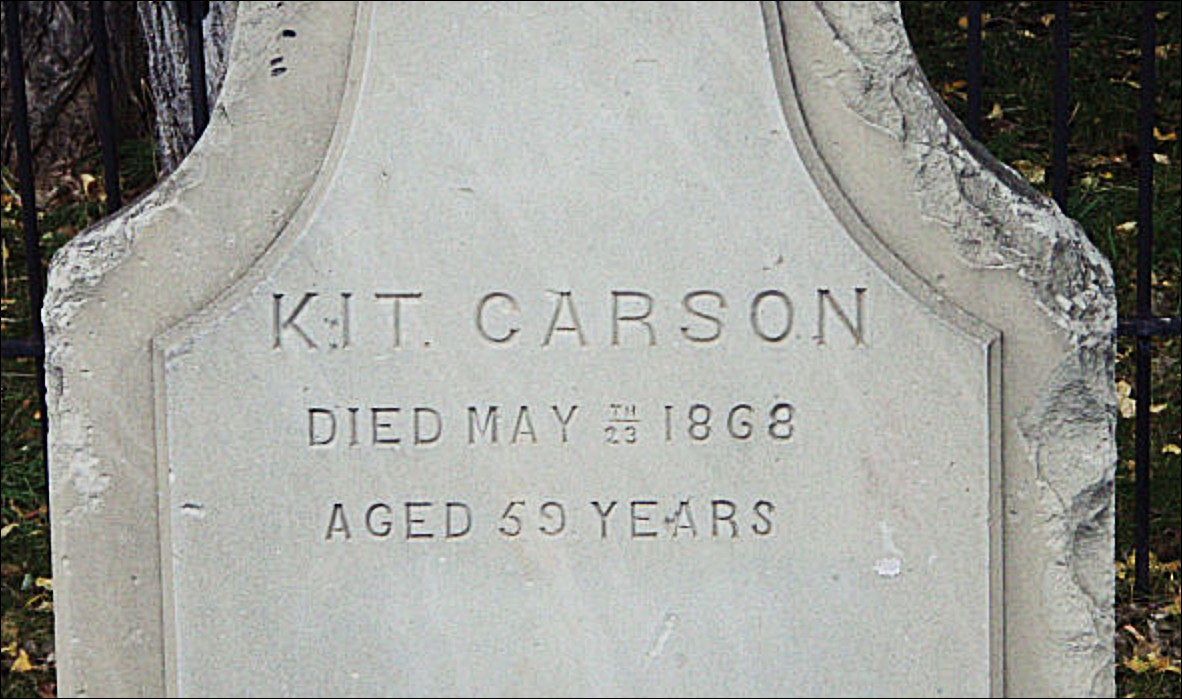
His wife, Josefa, died from complications after giving birth to their eighth child. Her death came as a crushing blow to Carson. According to Carson’s son, Charles, “he just seemed to pine away after Mother died.” The combination of a long and exhausting journey with the passing of his wife had a devastating effect on Carson. He died a month later, age 59, on May 23, 1868, in the surgeon’s quarters at Fort Lyon, Colorado. His last words were “Goodbye, friends. Adiós, compadres.” The cause of death was abdominal aortic aneurysm. His resting place is next to his third wife, Josefa in Taos, New Mexico. ✪













▶️ JANUARY 2025 SUPPORT CHALLENGE

✪ 2025 CHARTER TNA ANNUAL PATRON LISTING STILL OPEN THRU JANUARY 31ST
If you’d like to help support the site by making a donation of $500 or more anytime during the month of January, we’ll honor you as a Charter TNA Annual Patron with your own special personal listing appearing in the bottom page footer every day for the remainder of 2025.

As a TNA Annual Patron you can list either your real life or online username, business name including web address (sorry no phone numbers) or a tribute to a living or deceased love one. If you have any questions, please contact me via email.
✪ NEW MONTHLY CHALLENGE AMOUNT FOR FEB – DEC 2025
I am requesting a new monthly challenge goal amount in 2025 of $2500 beginning in February. Creating and maintaining TNA each day is a full time job position which requires between 60-80 hours per week researching, rewriting, editing, graphics, formatting and publishing. Final challenge totals for 2024 consistently averaged between $2100-2300 each month. This new monthly amount will allow me to continue to make quality the top priority.
✪ NEW NON PAYPAL DONATION OPTION
If you don’t care for PayPal’s woke business culture & attitude; or their fees, you can now use ZELLE to easily make online purchases or donations. ZELLE is already installed inside your online banking. There’s no need to register, create an account or enter any debit or credit card information. ZELLE provides safe, secure and immediate electronic transfers directly between your bank and your recipients. It’s also completely FREE and already built into your bank or credit union’s online banking account page. If you haven’t used ZELLE before, you only need to activate it. A simple, two minute process which can be found at this link:

THANK YOU FOR YOUR CONTINUING SUPPORT
YOUR DONATIONS KEEP US GOING STRONG!
▶️ DONATE VIA PAYPAL (DEBIT OR CREDIT CARD)
ALL PayPal Transactions Are Encrypted For Card Holder Privacy & Security
▶️ DONATE VIA ZELLE (DIRECT DIGITAL CASH TRANSFER)
ZELLE is a simple, secure, easy, fast and FREE way to send money directly to recipients directly from your online banking page or app without a middleman.
If you’ve already activated ZELLE in your bank or credit union account, you may donate by using The New Americanist ZELLE Address:
vip@thenewamericanist.com
If you haven’t yet activated ZELLE in your bank or credit union account, easy to follow instructions (a simple two minute process) may be found here:
▶️ DONATE VIA SNAIL MAIL





▶️ CLICK HERE TO VIEW
▶️ 43 Minutes 45 Seconds
▶️ 31 Minutes 5 Seconds
▶️ 44 Minutes 2 Second
▶️ 8 Minutes 2 Second ⭐️ Gary Brown
▶️ 51 Minutes 21 Seconds
▶️ 1 Hour 10 Minutes 16 Seconds
▶️ 12 Minutes 56 Seconds
▶️ 3 Minutes 52 Seconds
▶️ 6 Minutes 9 Seconds
▶️ 5 Minutes 21 Seconds
▶️ 50 Seconds
