




William McKinley: January 29, 1843–September 14, 1901
✪ William McKinley was the 25th President of the United States who served from 1897 until his assassination in 1901. A member of the Republican Party, McKinley led a national realignment effort which made Republicans largely dominant in the industrial states and nationwide for decades. He successfully led the U.S. in the Spanish–American War, overseeing a period of American expansionism which included the annexations of Puerto Rico, Guam, the Philippines and Hawaii. McKinley also rejected inflationary plans such as free silver in favor of keeping the nation on the Gold Standard, while raising protective tariffs.
McKinley was the last president to serve in the American Civil War; and, he was the only one to begin his service as an enlisted man and ending as a brevet major. Historians regard McKinley’s political victory as a realigning election in which the political stalemate of the post-Civil War era gave way to the Republican-dominated Fourth Party System. After the Civil War, McKinley settled in Canton, Ohio, where he practiced law and married Ida Saxton.
McKinley’s presidency oversaw a period of rapid economic growth. He promoted the 1897 Dingley Tariff to protect American manufacturers and factory workers from foreign competition; and, in 1900, secured the passage of the Gold Standard Act. He attempted to persuade Spain to grant independence to rebellious Cuba without conflict. However, when negotiations failed, he requested and signed Congress’s declaration of war to begin the Spanish-American War of 1898, in which the United States achieved a quick and decisive victory. As part of the peace settlement, Spain turned over to the United States its main overseas colonies of Puerto Rico, Guam and the Philippines, while Cuba was promised independence but remained under the control of the United States Army until May 1902.
The United States also annexed the independent Republic of Hawaii in 1898, and it officially became a United States territory in 1900.
William McKinley Jr. was born in 1843 in Niles, Ohio, the seventh of nine children of William McKinley Sr. and Nancy (née Allison) McKinley. The McKinleys were of English and Scots-Irish descent whose ancestors settled in western Pennsylvania during the 18th Century.
The McKinley family trade on both sides was iron making. McKinley senior operated numerous foundries throughout Ohio: New Lisbon, Niles, Poland and finally Canton. The McKinley household was, like many from Ohio’s Western Reserve, steeped in Whiggish and abolitionist sentiment, the latter based on the family’s staunch Methodist beliefs.
The younger William also followed in his family’s Methodist tradition. He was a lifelong pious Methodist, becoming active in the local Methodist church at the age of sixteen.
After graduating from Poland Seminary in 1859, McKinley enrolled the following year at Allegheny College in Meadville, Pennsylvania. There, he became an honorary member of the Sigma Alpha Epsilon fraternity. He remained at Allegheny for only one year, returning home in 1860 after becoming ill and depressed. He also studied at Mount Union College, now the University of Mount Union, in Alliance, Ohio, where he later served as a member of the board of trustees. Although his health recovered, the McKinley family finances declined, and McKinley was unable to return to Allegheny. He began working as a postal clerk and later took a job teaching at a school near Poland, Ohio.
When the Confederate states seceded and the American Civil War began in 1861, thousands of men in Ohio volunteered for service. Among them were McKinley and his cousin William McKinley Osbourne, who enlisted as privates in the newly formed Poland Guards in June 1861. McKinley quickly took to the soldier’s life: writing a series of letters to his hometown newspaper extolling the army and the Union cause.
McKinley’s first contact with the enemy came in September when the Poland Guards drove back Confederate troops at Carnifex Ferry in present-day West Virginia. That September, McKinley’s regiment was called east to reinforce General John Pope’s Army of Virginia at the Second Battle of Bull Run. Delayed in passing through Washington, D.C., the 23rd Ohio Regiment failed to arrive in time for the battle but joined the Army of the Potomac as it hurried north to cut off Robert E. Lee’s Army of Northern Virginia as it advanced into Maryland.
Just before the war’s end, McKinley received his final promotion, a brevet commission as Major. In July, the Veterans Corps was mustered out of service, and McKinley and Carroll were relieved of their duties.
After the war ended in 1865, McKinley decided on a career in the law and began began to study law in the office of an attorney in Poland, Ohio. The following year, he continued his studies by attending Albany Law School in New York state. After studying there for less than a year, McKinley returned home and in March 1867 was admitted to the bar in Warren, Ohio.
That same year, he moved to Canton, the county seat of Stark County, Ohio to set up a small office. His practice was successful enough for him to buy a block of buildings on Main Street in Canton, which provided him with a small but consistent rental income for decades.
As McKinley’s professional career progressed, his social life began to blossom: he courted Ida Saxton, a daughter of a prominent Canton family and they were married on January 25, 1871 in the newly built First Presbyterian Church of Canton. Ida would soon join her husband in his Methodist faith. Their first child, Katherine, was born on Christmas Day 1871. A second daughter, Ida, followed in 1873 but died the same year.
Two years later, Katherine died of typhoid fever. Ida never recovered from their daughters’ deaths, and the McKinleys had no more children. Ida McKinley developed epilepsy around the same time and came to depend strongly on her husband’s presence. He remained a devoted husband, tending to his wife’s medical and emotional needs for the rest of his life.
McKinley took his first congressional seat in October 1877, when President Hayes summoned Congress into special session. With the Republicans in the minority, McKinley was given unimportant committee assignments, which he undertook conscientiously.
From his first term in Congress, McKinley was a strong advocate of protective tariffs. The primary intention of such imposts was not to raise revenue, but to allow American manufacturing to develop by giving it a price advantage in the domestic market over foreign competitors.
McKinley introduced and supported bills which raised protective tariffs and opposed those that lowered them or imposed tariffs simply to raise revenue. Garfield’s election as president in 1880 created a vacancy on the House Ways and Means Committee and McKinley was selected to fill it, gaining a spot on the most powerful committee after only two terms in Congress.
McKinley increasingly became a significant figure in national politics. In 1880, he served a brief term as Ohio’s representative on the Republican National Committee. In 1884, he was elected a delegate to that year’s Republican convention,
In 1889, with the Republicans in the majority, McKinley sought election as Speaker of the House. He failed to gain the post, which went to Thomas B. Reed of Maine; however, Speaker Reed appointed McKinley chairman of the Ways and Means Committee. The Ohioan guided the McKinley Tariff of 1890 through Congress; although McKinley’s work was altered in the final version of the bill through the influence of special interests in the Senate, it still imposed a number of protective tariffs on foreign goods.
Recognizing McKinley’s potential oppositional threat, the Democrats, whenever they controlled the Ohio legislature, sought to gerrymander or redistrict him out of office.
Even before McKinley completed his term in Congress, he met with a delegation of Ohioans urging him to run for governor. Ohio’s governor had relatively little power—for example, he could recommend legislation, but not veto it—but with Ohio a key swing state, its governor was a major figure in national politics.
McKinley campaigned widely for Republicans in the 1894 midterm congressional elections; many party candidates in districts where he spoke were successful.
It is unclear when William McKinley began to seriously prepare a run for president. As McKinley biographer Kevin Phillips notes, “No documents, no diaries, no confidential letters to Mark Hanna (or anyone else) contain his secret hopes or veiled stratagems.” McKinley quietly built support for a presidential bid through 1895 and into early 1896.
By the time the national Republican convention began in St. Louis on June 16, 1896, McKinley already had an ample majority of the delegates. The former governor, who remained in Canton, followed events at the convention closely by telephone.
When Ohio was reached in the roll call of states, its votes gave McKinley the nomination, which he celebrated by hugging his wife and mother as his friends fled the house, anticipating the first of many crowds that gathered at the Republican candidate’s home. Thousands of partisans came from Canton and surrounding towns that evening to hear McKinley speak from his front porch.
Before the Republican convention, McKinley had been a “straddle bug” on the currency question, favoring moderate positions on silver such as accomplishing bimetallism by international agreement. In the final days before the convention, McKinley decided, after hearing from politicians and businessmen, that his platform should instead endorse the Gold Standard.
McKinley always considered himself to be a tariff man and expected that the monetary issue would fade away in a month. He was mistaken, silver and gold dominated the campaign of 1896.
The bad economic times had continued and strengthened the hand of forces for free silver. The issue bitterly divided the Democrat Party; President Cleveland firmly supported the Gold Standard, but an increasing number of rural Democrats wanted silver, especially in the South and West. The silverites took control of the 1896 Democratic National Convention and chose William Jennings Bryan as their nominee for president
Bryan’s campaign had at most an estimated $500,000. With his eloquence and youthful energy his major assets in the race, Bryan decided on a whistle-stop political tour by train on an unprecedented scale.
Instead of going to the people, McKinley would remain at home in Canton and allow the people to come to him. According to historian R. Hal Williams in his book on the 1896 election, “it was, as it turned out, a brilliant strategy. McKinley’s ‘Front Porch Campaign’ became a legend in American political history.”
The 1896 presidential election was a realigning election, in which McKinley’s view of a stronger central government building American industry through protective tariffs and a dollar based on gold triumphed.The voting patterns established then displaced the near-deadlock the major parties had seen since the Civil War in the Third Party System. The new Republican dominance began the Fourth Party System that would end in 1932, another realigning election with the ascent of Franklin Roosevelt and the New Deal coalition.
McKinley was sworn in as president on March 4, 1897, as his wife and mother looked on. The new president gave a lengthy inaugural address; he urged tariff reform and stated that the currency issue would have to await tariff legislation. He warned against foreign interventions, “We want no wars of conquest. We must avoid the temptation of territorial aggression.”
However for decades, rebels in Cuba had waged an intermittent campaign for freedom from Spanish colonial rule. By 1895, the conflict had expanded to a full war for Cuban independence.
While general public opinion favored war to liberate Cuba, McKinley favored a more peaceful approach; hoping that through negotiation, Spain might be convinced to grant Cuba independence, or at least to allow the Cubans some measure of autonomy,
In January 1898, Spain promised some concessions to the rebels, but when American consul Fitzhugh Lee reported riots in Havana, McKinley agreed to send the battleship USS Maine. On February 15, the Maine exploded and sank with 266 men killed. Public attention focused on the crisis and the consensus was that regardless of who set the bomb, Spain had lost control over Cuba.
McKinley insisted that a court of inquiry first determine whether the explosion was accidental. Negotiations with Spain continued as the court considered the evidence, but on March 20, the court ruled that the Maine was blown up by an underwater mine.
He did not ask for war, but Congress made the decision and declared war on April 20, with the addition of the Teller Amendment, which blocked any intentions of annexing Cuba. Nick Kapur says that McKinley’s actions were based on his values of arbitrationism, pacifism, humanitarianism and manly self-restraint, and not on external pressures.
The expansion of the telegraph and the development of the telephone gave McKinley greater control over the day-to-day management of the war than previous presidents had enjoyed, and he used the new technologies to direct the army’s and navy’s movements as far as he was able.
Meanwhile, in the Caribbean theater, a large force of regulars and volunteers gathered near Tampa, Florida, for an invasion of Cuba. After lengthy delays, the army, led by Major General William Rufus Shafter, on June 22, landed near Santiago de Cuba. Shafter’s army engaged the Spanish forces on July 2 in the Battle of San Juan Hill. Shafter laid siege to the city of Santiago, which surrendered on July 17, placing Cuba under effective American control.
McKinley also ordered an invasion of Puerto Rico, which met little resistance when it landed in July. The distance from Spain and the destruction of the Spanish Navy made resupply impossible, and the Spanish government began to look for a way to end the war.
During the war, McKinley also pursued the US annexation of the Republic of Hawaii. The new republic, dominated by business interests, had overthrown the Queen in 1893 when she attempted to restore the powers of the monarchy by nullifying the bayonet constitution. There was strong American support for annexation, and the need for Pacific bases in wartime became clear after the Battle of Manila. McKinley came to office as a supporter of annexation, and lobbied Congress to act, warning that to do nothing would invite a royalist counter-revolution or a Japanese takeover.
Even before peace negotiations began with Spain, McKinley asked Congress to set up a commission to examine trade opportunities in Asia and espoused an “Open Door Policy,” in which all nations would freely trade with China and none would seek to violate that nation’s territorial integrity
McKinley had built his reputation in Congress on high tariffs, promising protection for American business and well-paid U.S. factory workers. With the Republicans in control of Congress, Ways and Means chairman Dingley introduced the Dingley Act, which would raise tariff rates on wool, sugar, and luxury goods. Congress passed the legislation with McKinley’s support, and he signed it into law on July 24, 1897, less than five months into his presidency.
McKinley’s popularity in his first term assured him of renomination for a second.
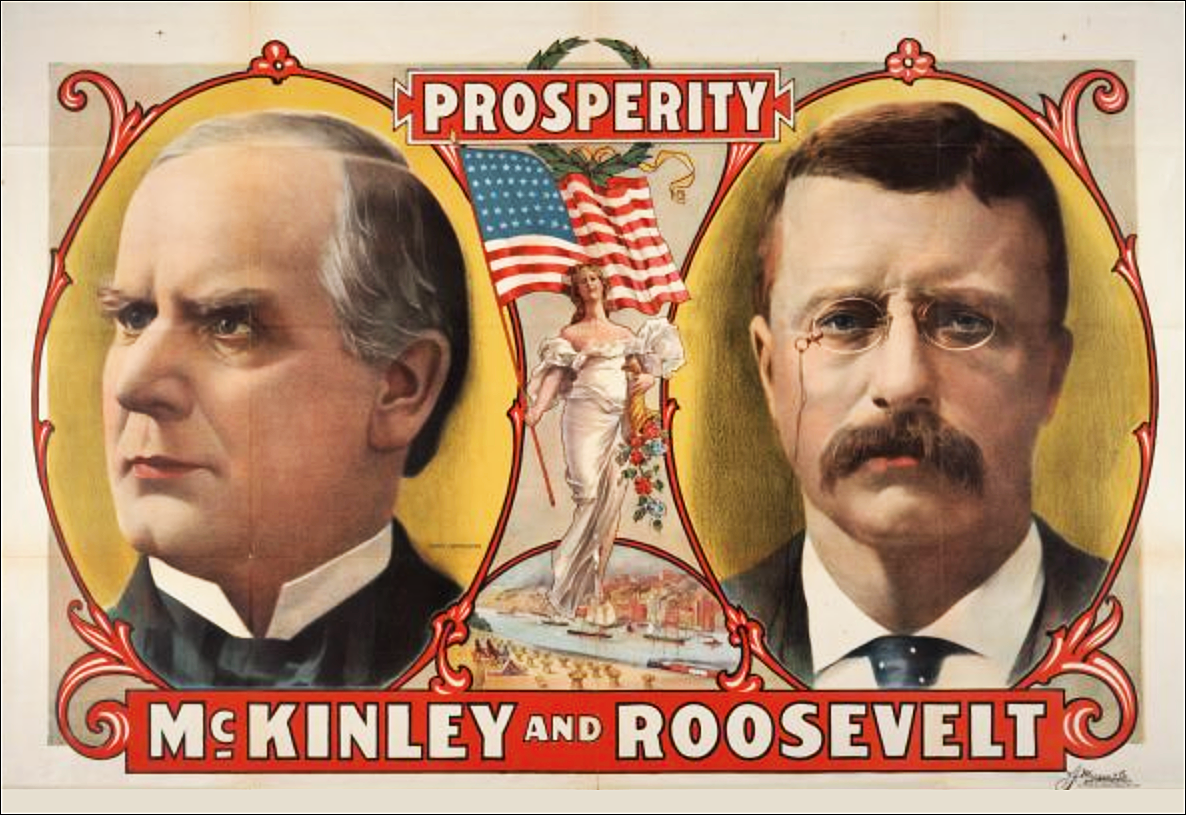
1900 Election Placard
In his 1900 re-election bid, McKinley considered other prominent candidates for potential vice presidents, but none were as popular as the Republican party’s rising star, Theodore Roosevelt. After a stint as Assistant Secretary of the Navy, Roosevelt had resigned and raised a cavalry regiment; they fought bravely in Cuba, and Roosevelt returned home a hero covered in glory. Elected governor of New York on a reform platform in 1898, Roosevelt had his eye on the presidency. Many supporters recommended him to McKinley for the second spot on the ticket, and Roosevelt believed it would be an excellent stepping stone to the presidency in 1904.
On June 21, McKinley was unanimously renominated and Roosevelt was nominated as his vice president on the first ballot. the Republicans focused on victory in war and prosperity at home as issues they believed favored their party. On November 6, 1900, he was proven correct, winning the largest victory for any Republican since 1872.
Soon after his second inauguration on March 4, 1901, William and Ida McKinley undertook a six-week tour of the nation. Traveling mostly by rail, the McKinleys were to travel through the South to the Southwest, and then up the Pacific coast and east again, to conclude with a visit on June 13, 1901, to the Pan-American Exposition in Buffalo, New York.
On September 5, McKinley delivered his address at the fairgrounds before a crowd of 50,000. In his final speech, McKinley urged reciprocity treaties with other nations to assure American manufacturers access to foreign markets. He intended the speech as a keynote to his plans for a second term.
A man in the crowd named Leon Czolgosz hoped to assassinate McKinley. After hearing a speech by anarchist Emma Goldman in Cleveland, Czolgosz had decided to take action that he believed would advance the anarchist cause. He managed to get close to the presidential podium, but did not fire, uncertain of hitting his target.
After his failure to get close enough on September 5, Czolgosz waited until the next day at the Temple of Music on the exposition grounds, where the president was to meet the public. Czolgosz concealed his gun in a handkerchief and, when he reached the head of the line, shot McKinley twice in the abdomen at close range.
McKinley urged his aides to break the news gently to Ida, and to call off the mob that had set upon Czolgosz, a request that may have saved his assassin’s life. McKinley was taken to the exposition aid station, where the doctor was unable to locate the second bullet. Although a primitive X-ray machine was being exhibited on the exposition grounds, it was not used. McKinley was then taken to the home of John G. Milburn, president of the Pan-American Exposition Company.
In the days after the shooting, McKinley appeared to improve and doctors issued increasingly optimistic bulletins. Members of the Cabinet, who had rushed to Buffalo on hearing the news, dispersed, and Vice President Roosevelt departed on a camping trip to the Adirondacks.
However, on the morning of September 13, McKinley’s condition suddenly deteriorated. Specialists were summoned; although at first some doctors hoped that McKinley might survive with a weakened heart, by afternoon they knew that the case was hopeless. Unknown to the doctors, gangrene was growing on the walls of McKinley’s stomach and slowly poisoning his blood. McKinley drifted in and out of consciousness all day, but when awake he was a model patient. By evening, McKinley too knew he was dying, “It is useless, gentlemen. I think we ought to have prayer.” Relatives and friends were called gathered around his death bed. The First Lady sobbed over him, saying, “I want to go, too. I want to go, too.” Her husband replied, “We are all going, we are all going. God’s will be done, not ours.”
At 2:15 a.m. on September 14, 1901, McKinley died. Theodore Roosevelt rushed back to Buffalo and took the oath of office as president. Czolgosz, put on trial for murder nine days after McKinley’s death, was found guilty, sentenced to death on September 26 and executed by electric chair on October 29, 1901.
▶️ 13 Minutes 51 Seconds
According to Gould, “The nation experienced a wave of genuine grief at the news of McKinley’s passing.” The stock market, faced with sudden uncertainty, suffered a steep decline that went nearly unnoticed in the mourning. The nation focused its attention on the casket that first lay in the East Room of the Executive Mansion and then lay in state in the Capitol before being transported to Canton by train.
Approximately 100,000 people passed by the open casket in the Capitol Rotunda, many having waited hours in the rain. In Canton, an equal number did the same at the Stark County Courthouse on September 18. The following day, a funeral service was held at the First Methodist Church. The casket was next sealed and taken to the McKinley house, where family and relatives paid their final respects. It was then transported to the receiving vault at West Lawn Cemetery in Canton.
There was a widespread expectation that Ida McKinley would not long survive her husband; one family friend stated, as William McKinley lay dying, that they should be prepared for a double funeral. However, this did not occur, and the former First Lady accompanied her husband on the funeral train. Leech noted “the circuitous journey was a cruel ordeal for the woman who huddled in a compartment of the funeral train, praying that the Lord would take her with her Dearest Love.” She was thought too weak to attend the services in Washington or Canton, although she listened at the door to the service for her husband in her house on North Market Street. She remained in Canton for the remainder of her life, setting up a shrine in her house and often visiting the receiving vault, until her death at age 59 on May 26, 1907.
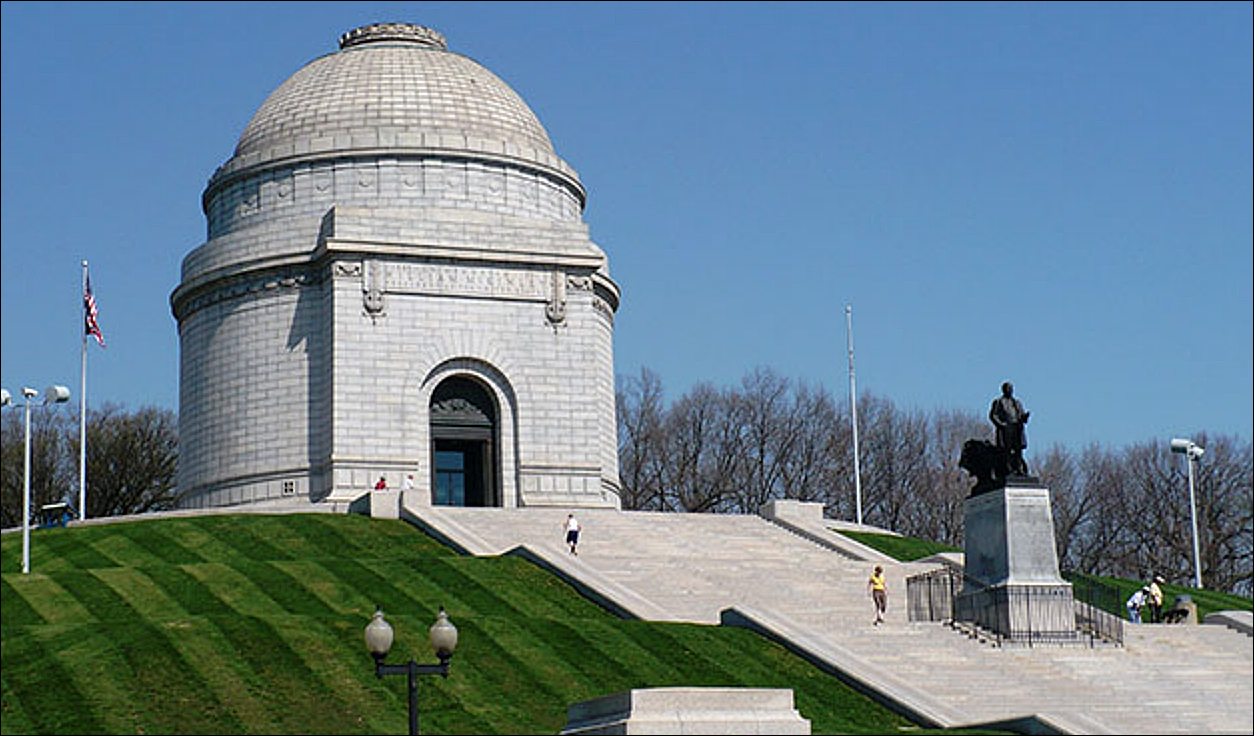
She died only months before the completion of the large marble monument to her husband in Canton, which was dedicated by President Roosevelt on September 30, 1907. William and Ida McKinley are interred there with their daughters atop a hillside overlooking the city of Canton.
▶️ 5 Minutes 50 Seconds
McKinley’s biographer H. Wayne Morgan remarks that McKinley died the most beloved president in history. ✪










▶️ DONATE VIA PAYPAL (DEBIT & CREDIT CARD)
ALL PayPal Transactions Are Encrypted For Card Holder Privacy & Security
▶️ DONATE VIA ZELLE (DIRECT BANK CASH TRANSFER)
ZELLE is the perfect online alternative to PayPal. It’s an incredibly simple, secure, easy, fast and FREE way to send or receive money to recipients directly from your online banking account without a middleman. Best of all, there’s NO fees.
ZELLE is a service provided by your bank and is already built in to your online banking account. You only need to activate it first before using. If you’ve already activated ZELLE in your online bank or credit union account, you can donate to The New Americanist by using our ZELLE address:
vip@thenewamericanist.com
To activate your ZELLE, follow these easy instructions (a simple two minute process):

▶️ DONATE VIA SNAIL MAIL







▶️ CLICK HERE TO VIEW
▶️ i Hour 13 Minutes 50 Seconds
▶️ 11 Minutes 48 Seconds
▶️ 33 Minutes 17 Seconds
▶️ 15 Minutes 3 Seconds
▶️ 17 Minutes 18 Seconds
▶️ 57 Minutes 51 Seconds
▶️ 13 Minutes 13 Seconds
▶️ 21 Minutes 55 Seconds
▶️ 5 Minutes 50 Seconds
▶️ 4 Minutes 34 Seconds
▶️ 9 Minutes 35 Seconds
▶️ 1 Hour 29 Minutes 59 Seconds
▶️ 1 Hour 20 Minutes 14 Seconds
▶️ 6 Minutes 20 Seconds
▶️ 8 Minutes 2 Seconds
▶️ 12 Minutes 58 Seconds
▶️ 47 Minutes 45 Seconds
▶️ 13 Minutes 2 Seconds
▶️ 9 Minutes 6 Seconds
▶️ 8 Minutes 23 Seconds
▶️ 1 Hour 19 Minutes ⭐️ Deplorables Know Libs Suck
▶️ 5 Minutes 21 Seconds
