


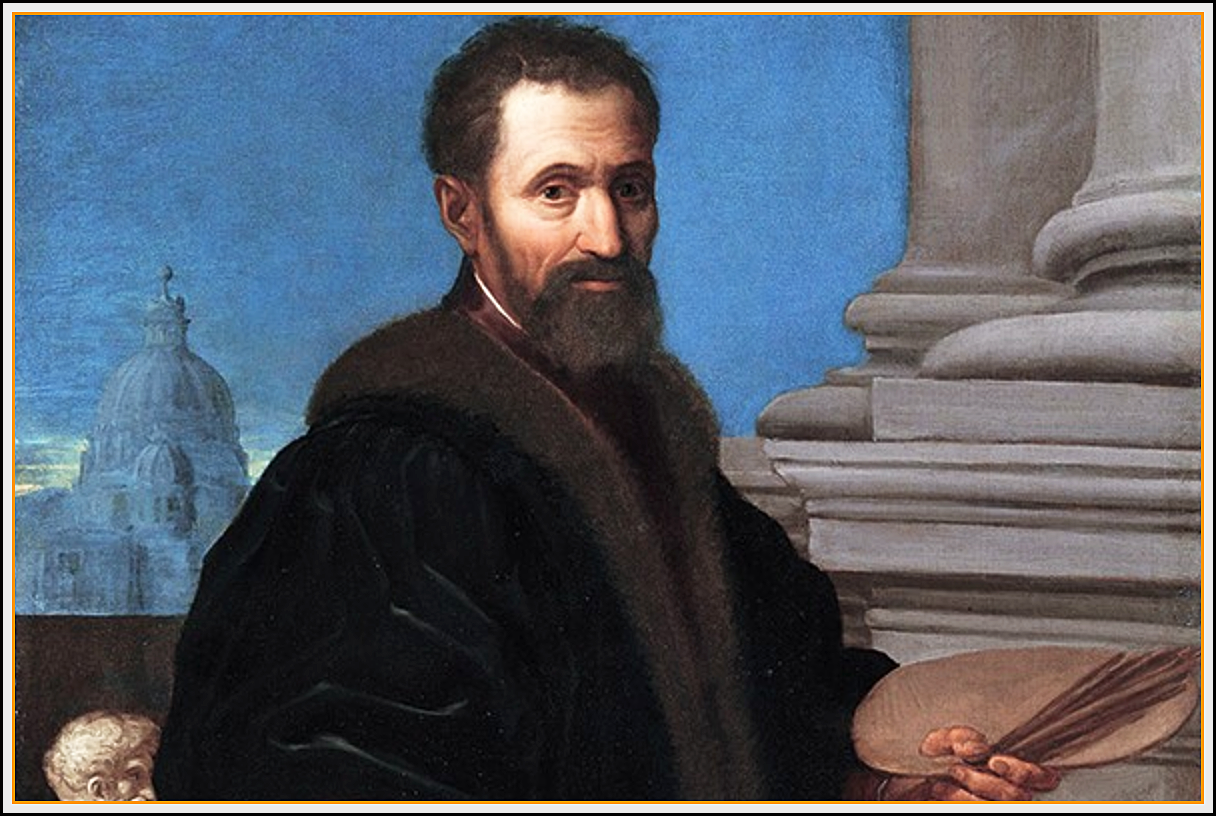

Michelangelo di Lodovico Buonarroti Simoni: March 6, 1475–February 18, 1564
✪ Michelangelo was an Italian sculptor, painter, architect and poet of the High Renaissance. Born in the Republic of Florence, his work was inspired by models from classical antiquity and has had a lasting influence on Western art. Michelangelo’s creative abilities and mastery in a range of artistic arenas define him as an archetypal Renaissance man, along with his rival and elder contemporary, Leonardo da Vinci. Given the sheer volume of surviving correspondence, sketches, and reminiscences, Michelangelo is also one of the best-documented artists of the 16th Century. He has been lauded by contemporary biographers as the most accomplished artist of his era.
In his lifetime, Michelangelo was often called Il Divino (“the divine one”). His contemporaries admired his terribilità—his ability to instill a sense of awe in viewers of his art. Michelangelo was the first Western artist whose biography was published while he was still living. I total, three biographies were published during his lifetime.
Michelangelo di Lodovico Buonarroti Simoni was born on March 6, 1475 in Caprese, known today as Caprese Michelangelo, a small town situated near Arezzo, Tuscany. For several generations, his family were small-scale bankers in Florence; but eventually the family bank failed, and his father Ludovico briefly took a government post in Caprese to support the family. At the time of Michelangelo’s birth, his father was the town’s judicial administrator and podestà (local administrator). Michelangelo’s mother was Francesca di Neri del Miniato di Siena.
Several months after Michelangelo’s birth, his family returned to Florence, where he was raised. During his mother’s later prolonged illness; and after her death in 1481 (when he was six years old), Michelangelo lived with a nanny and her husband, a stonecutter, in the town of Settignano. There, his father owned a marble quarry and a small farm. There the young boy first gained his love for marble. As his biographer Giorgio Vasari quotes him:
“If there is some good in me, it is because I was born in the subtle atmosphere of your country of Arezzo. Along with the milk of my nurse I received the knack of handling chisel and hammer, with which I make my figures.”
As a young boy, Michelangelo was sent to the city of Florence to study grammar. However, he showed no interest in his schooling, preferring instead to copy paintings from churches and seek the company of other painters. Florence was at that time Italy’s greatest centre of the arts and learning. Art was sponsored by the Signoria (the town council), the merchant guilds and wealthy patrons such as the Medici and their banking associates.
During Michelangelo’s childhood, a team of painters had been called from Florence to the Vatican to decorate the walls of the Sistine Chapel. Among them was Domenico Ghirlandaio, a master in fresco painting, perspective, figure drawing and portraiture who had the largest workshop in Florence. In 1488, at the age of 13, Michelangelo was apprenticed to Ghirlandaio. The next year, his father persuaded Ghirlandaio to pay Michelangelo as an artist, which was rare at that time for someone that young.
From 1490 to 1492, Michelangelo attended the Platonic Academy, a Humanist academy founded by the Medicis. There, his work and outlook were influenced by many of the most prominent philosophers and writers of the day. At this time, Michelangelo sculpted the reliefs Madonna of the Stairs and Battle of the Centaurs. The latter based on a theme suggested by Poliziano and commissioned by Lorenzo de’ Medici.
▶️ 13 Minutes 2 Seconds
Lorenzo de’ Medici’s death on 8 April 1492 changed Michelangelo’s circumstances. He left the security of the Medici court and returned to his father’s house. Between 1493 and 1494, Michelangelo bought a block of marble, and carved a larger-than-life statue of Hercules.
On 20 January 1494, after heavy snowfalls, Lorenzo’s heir, Piero de Medici, commissioned a statue made of snow. Michelangelo returned to Florence but received no commissions from the new city government.
He returned to the employment of the Medici. During the half-year he spent in Florence, he worked on two small statues, a child St. John the Baptist and a sleeping Cupid. Lorenzo di Pierfrancesco de’ Medici, for whom Michelangelo had sculpted St. John the Baptist, asked that Michelangelo “fix it so that it looked as if it had been buried” so he could “send it to Rome … pass [it off as] an ancient work and … sell it much better.”
Cardinal Raffaele Riario, to whom Lorenzo sold it, discovered it was a fraud, but was so impressed by the quality of the sculpture that he invited the artist to Rome. Michelangelo arrived in Rome on 25 June 1496 at the age of 21.
In November 1497, the French ambassador to the Holy See, Cardinal Jean de Bilhères-Lagraulas, commissioned him to carve a Pietà, a sculpture showing the Virgin Mary grieving over the body of Jesus. The subject, which is not part of the Biblical narrative of the Crucifixion, was still a common theme in religious sculpture of medieval northern Europe and would have been very familiar to the Cardinal.
The Pieta would soon come to be regarded as one of the world’s great masterpieces of sculpture, “a revelation of all the potentialities and force of the art of sculpture.” Contemporary opinion was summarized by Vasari: “It is certainly a miracle that a formless block of stone could ever have been reduced to a perfection that nature is scarcely able to create in the flesh.” The Pieta is Michelangelo’s only work known to have been signed, his name on Mary’s sash and is now located in St Peter’s Basilica.
Michelangelo returned to Florence again in 1499 when he was asked by the consuls of the Guild of Wool to complete an unfinished project begun 40 years earlier by Agostino di Duccio: a colossal statue of Carrara marble portraying David as a symbol of Florentine freedom to be placed on the gable of Florence Cathedral.
Michelangelo responded by completing his most famous work, the statue of David, in 1504. The masterwork definitively established his prominence as a sculptor of extraordinary technical skill and strength of symbolic imagination.
In 1505 Michelangelo was invited back to Rome by the newly elected Pope Julius II and commissioned to build the Pope’s tomb, which was to include forty statues and scheduled to be finished in five years. Under the patronage of the pope, Michelangelo experienced constant interruptions to his work on the tomb in order to accomplish numerous other tasks.
By this time, Michelangelo was established as an artist, Both he and Julius II had hot tempers and soon began to argue. On 17 April 1506, Michelangelo left Rome in secret for Florence, remaining there until the Florentine government pressed him to return to the pope. Although Michelangelo worked on the tomb for 40 years, it was never finished to his satisfaction.
During the same period, Michelangelo painted the ceiling of the Sistine Chapel, which took approximately four years to complete (1508–1512).
Michelangelo persuaded Pope Julius II to give him a free hand and proposed a different and more complex scheme, representing the Creation, the Fall of Man, the Promise of Salvation through the prophets, and the genealogy of Christ. The work is part of a larger scheme of decoration within the chapel that represents much of the doctrine of the Catholic Church.
The composition stretches over 500 square metres of ceiling and contains over 300 figures. At its centre are nine episodes from the Book of Genesis, divided into three groups: God’s creation of the earth; God’s creation of humankind and their fall from God’s grace; and lastly, the state of humanity as represented by Noah and his family.
In 1520, the Medici came back to Michelangelo with another grand proposal, this time for a family funerary chapel in the Basilica of San Lorenzo. For posterity, this project, which would occupy the artist for much of the 1520s and 1530s, was more fully realized.
In 1527, Florentine citizens, encouraged by the sacking of Rome, threw out the Medici and restored the republic. A siege of the city ensued and Michelangelo went to the aid of his beloved Florence by working on the city’s fortifications from 1528 to 1529. However, the city fell in 1530 and the Medici were restored to power, with the young Alessandro Medici becoming the first Duke of Florence.
Pope Clement, a Medici, sentenced Michelangelo to death. It is thought that Michelangelo hid for two months in a small chamber under the Medici chapels in the Basilica of San Lorenzo with light from just a tiny window, making many charcoal and chalk drawings which remained hidden until the room was rediscovered in 1975, and opened to small numbers of visitors in 2023. Michelangelo was eventually pardoned by the Medicis and his death sentence lifted, so that he could complete work on the Sistine Chapel and the Medici family tomb. He left Florence for Rome in 1534.
In Rome, Michelangelo lived near the church of Santa Maria di Loreto. Shortly before his death in 1534, Pope Clement VII commissioned Michelangelo to paint a fresco of The Last Judgment on the altar wall of the Sistine Chapel. His successor, Pope Paul III, was instrumental in seeing that Michelangelo began and completed the project, which he laboured on from 1534 to October 1541. The fresco depicts the Second Coming of Christ and his Judgement of the souls. Michelangelo ignored the usual artistic conventions in portraying Jesus, portraying him instead as a massive, muscular figure, youthful, beardless and naked.
Once completed, the depiction of Christ and the Virgin Mary naked was considered sacrilegious. Cardinal Carafa and Monsignor Sernini campaigned to have the fresco removed or censored, but the Pope resisted. At the Council of Trent, shortly before Michelangelo’s death in 1564, it was decided to obscure the genitals and Daniele da Volterra, an apprentice of Michelangelo, was commissioned to make the alterations.
While still working on the Last Judgment, Michelangelo received yet one last commission for the Vatican. In 1546, Michelangelo was appointed architect of St. Peter’s Basilica, Rome. Successive architects had worked on it, but little progress had been made. Michelangelo was persuaded to take over the project. The dome, not completed until after his death, has been called by Banister Fletcher, “the greatest creation of the Renaissance.”
Michelangelo was a devout Catholic whose faith deepened at the end of his life. Along with Raphael, he was enrolled in the Secular Franciscan Order.
His poetry includes the following closing lines from what is known as poem 285 (written in 1554): “Neither painting nor sculpture will be able any longer to calm my soul, now turned toward that divine love that opened his arms on the cross to take us in.”
Michelangelo was modest & moderate in his personal life, and once told his apprentice, Ascanio Condivi: “However rich I may have been, I have always lived like a poor man.” Michelangelo’s bank accounts and numerous deeds of purchase show that his net worth was about 50,000 gold ducats, more than most princes and dukes of his time.
His biographer Paolo Giovio says he was indifferent to food and drink, eating “more out of necessity than of pleasure” and that he “often slept in his clothes and … boots.”
“His nature was so rough and uncouth that his domestic habits were incredibly squalid, and deprived posterity of any pupils who might have followed him.” This, however, may not have affected him, as he was by nature a solitary and melancholy person, bizzarro e fantastico, a man who “withdrew himself from the company of men.”
In his old age, Michelangelo created a number of Pietàs in which he apparently reflects upon mortality. They are heralded by the Victory, perhaps created for the tomb of Pope Julius II but left unfinished.

Detail of Rondanini Pietà, Michelangelo’s final work (unfinished)
The last sculpture that Michelangelo worked on (six days before his death), the Rondanini Pietà, could never be completed because Michelangelo carved it away until there was insufficient stone. The legs and a detached arm remain from a previous stage of the work.

Michelangelo died in Rome on 18 February 1564, at the age of 88. His body was taken from Rome for interment at the Basilica of Santa Croce, fulfilling the maestro’s last request to be buried in his beloved Florence.
Michelangelo, with Leonardo da Vinci and Raphael, is one of the three giants of the Florentine High Renaissance. Although their names are often cited together, Michelangelo was younger than Leonardo by 23 years, and eight years older than Raphael. Because of his reclusive nature, he had little to do with either artist and outlived both of them by more than 40 years.✪















▶️ DONATE VIA PAYPAL (DEBIT & CREDIT CARD)
ALL PayPal Transactions Are Encrypted For Card Holder Privacy & Security
▶️ DONATE VIA ZELLE (DIRECT BANK CASH TRANSFER)
ZELLE is the perfect online alternative to PayPal. It’s an incredibly simple, secure, easy, fast and FREE way to send or receive money to recipients directly from your online banking account without a middleman. Best of all, there’s NO fees.
ZELLE is a service provided by your bank and is already built in to your online banking account. You only need to activate it first before using. If you’ve already activated ZELLE in your online bank or credit union account, you can donate to The New Americanist by using our ZELLE address:
vip@thenewamericanist.com
To activate your ZELLE, follow these easy instructions (a simple two minute process):

▶️ DONATE VIA SNAIL MAIL







▶️ CLICK HERE TO VIEW
▶️ 1 Hour 13 Minutes 21 Seconds ⭐️ Long Version
▶️ 22 Minutes 14 Seconds ⭐️ Short Version
▶️ 33 Minutes 33 Seconds
▶️ 3 Minutes 51 Seconds
▶️ 5 Minutes 44 Seconds
▶️ 15 Minutes
▶️ 19 Minutes 57 Seconds
▶️ 16 Minutes 48 Seconds
▶️ 2 Hours 15 Minutes 51 Seconds
▶️ 11 Minutes 8 Seconds
▶️ 11 Minutes 14 Seconds
▶️ 5 Minutes 49 Seconds
▶️ 8 Minutes 7 Seconds
▶️ 11 Minutes 10 Seconds ⭐️ Groucho
▶️ 29 Minutes 18 Seconds ⭐️ The New Logical Show
A NEW video podcast produced by TNA’s very own bet125. Make certain you SUBSCRIBE & LIKE.
Let’s all support new Conservative Media. 😎
