⭐️ Ron Mackie * Americalsgt

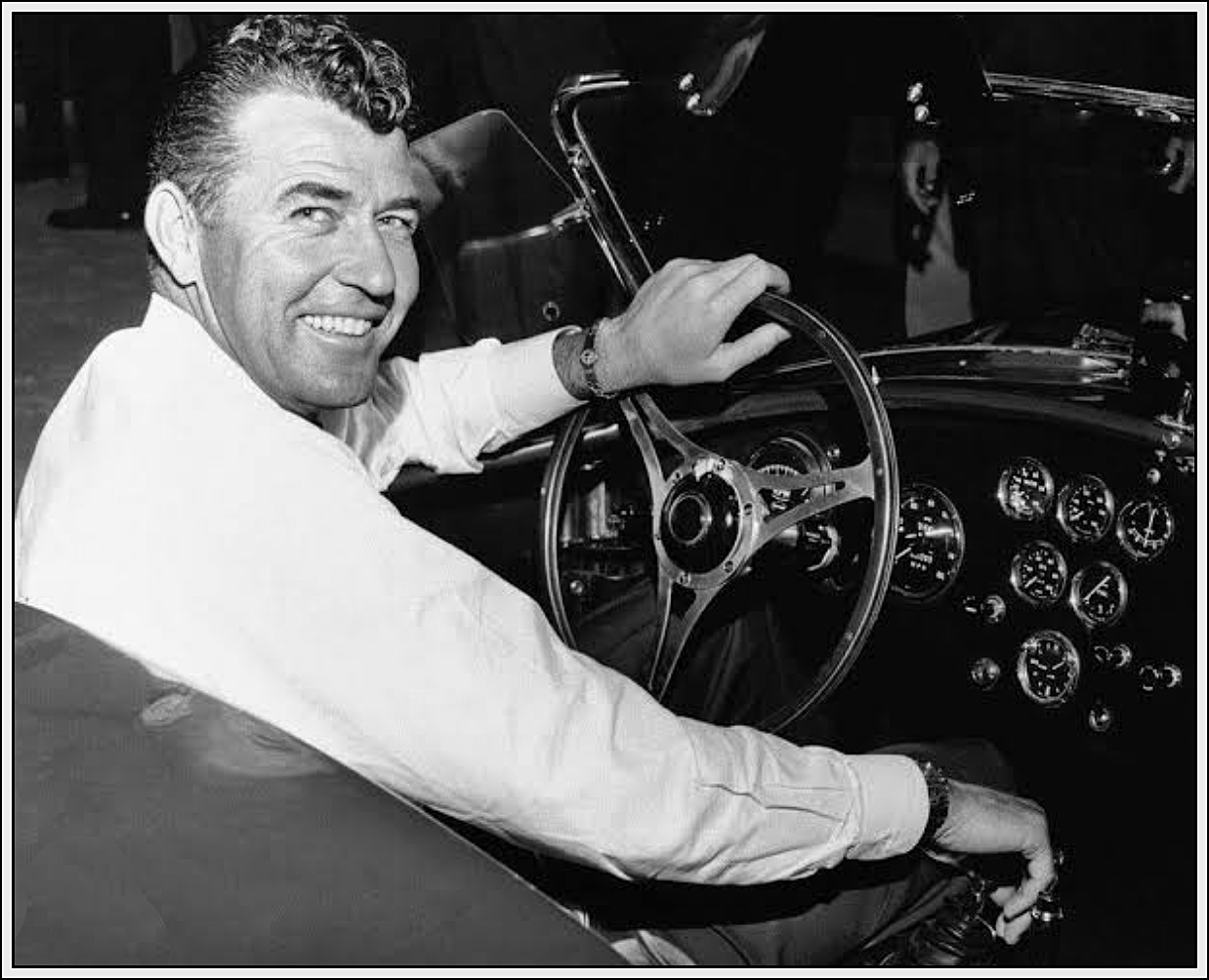

Carroll Hall Shelby: January 11, 1923–May 10, 2012
✪ Carroll Hall Shelby was an American automotive designer, racing driver and entrepreneur. Shelby was involved with the AC Cobra and Mustang for Ford Motor Company. With driver Ken Miles, he developed the Ford GT40, the car that won the 24 Hours of Le Mans in 1966, 1967, 1968 and 1969. As of 2024, it remains the only American-built car to win at Le Mans.
Shelby later wrote:
“Winning the Twenty-four Hours was probably the greatest thrill I ever got out of racing. I can think of plenty of other races that carry their quota of thrills for the winner, but when you win this one, it kind of gives you license to go out and tell people you’re good, and that often helps get some other deals together.”
In 1962, Shelby established Shelby American to manufacture and market high performance vehicles. His autobiography, The Carroll Shelby Story, was published in 1967.
Carroll Shelby was born on January 11, 1923, to Warren Hall Shelby, a rural mail carrier, and his wife, Eloise Shelby (born Lawrence), in Leesburg, Texas. The younger Shelby suffered from a congenital heart valve leakage defect and related heart complications throughout his entire life.
From a very young age, Shelby was fascinated with speed, which led to an avid interest in cars and airplanes. At age seven, he moved to Dallas, Texas; and around age 10, he rode his bicycle to dirt tracks near his house to watch races. By the time he turned 15, he was already driving and taking care of his father’s Ford. Shelby honed his driving skills with his Willys automobile while attending Woodrow Wilson High School in Dallas, Texas. He graduated in 1940.
He then enrolled at The Georgia Institute of Technology in the Aeronautical Engineering program.
On April 11, 1941, Shelby enlisted in the United States Army Air Corps, eight months before the Japanese attack on Pearl Harbor. He began his pilot training that November at Randolph Air Force Base, Texas. He graduated with the rank of staff sergeant pilot in September 1942 at Ellington Field. After more training, he was commissioned as a second lieutenant in December 1942.
During World War II, Shelby served as a flight instructor and test pilot in the Beechcraft AT-11 Kansan and Curtiss-Wright AT-9 Jeep. He was posted to several other air bases in Texas, including Kelly Field, Cuero Field, Perrin Army Air Field, Ellington Field, and Childress Army Airfield. He also trained bombardiers and navigators. He would go on to receive his certifications to fly the Douglas B-18 Bolo, the North American B-25 Mitchell, the Douglas A-26 Invader; and finally, the Boeing B-29 Superfortress at Denver, Colorado.
Discharged after V-J Day. Shelby started a dump truck business, and worked as an oil-well roughneck from 1948 to 1949. In 1952, he started a poultry farm but went bankrupt.
▶️ 22 Minutes 31 Seconds
Shelby began his racing career as an amateur. In January 1952, Shelby raced his friend Ed Wilkin’s MG TC at the Grand Prairie Naval Air Station drag meet. Later in the year, he raced Charles Brown’s Cadillac-Allards at Caddo Mills, Texas. By the end of 1952, Shelby had won four races, taking home only trophies and accepting no prize money.
The following year, he drove in the Mil Kilometros de la Ciudad de Buenos Aires, sponsored by the Automobile Club of Argentina and the Sports Car Club of America.
In August, Shelby drove for Donald Healey and his team in an Austin-Healey 100S and supercharged 100S, setting Class D National speed records at the Bonneville Salt Flats. Shelby, Healey, Captain G.E.T. Eyston, Mortimer Morris Goodall and Roy Jackson-Moore set about 70 records, with Shelby setting 17 on his own. Later, Shelby would be severely injured in a crash while racing another Austin-Healey in the Carrera Panamericana.
In 1955, amid eight months of surgical operations, Shelby continued driving professionally, winning ten races and mounting a second-place showing at Sebring while driving Allen Guiberson’s Ferrari Monza.
In 1956, he won 30 more races with the Ferrari and opened Carroll Shelby Sports Cars in Dallas. He was honored as Sports Illustrated magazine’s driver of the year in 1956.
In September 1957, he raced in John Edgar’s 4.5-liter Maserati at the Riverside International Raceway, where he was involved in a serious crash causing injuries which required 72 stitches and plastic surgery to reconstruct broken bones in his nose and cheekbones. He returned in November to win at the same course driving the same car. He was made Sports Illustrated driver of the year for a second time.
The 1959 Grand Prix season saw Shelby driving the Aston Martin DBR4 in the Dutch Grand Prix in May, followed by the British Grand Prix at Aintree in July. Shelby then drove in the Portuguese Grand Prix in August, followed by the Italian Grand Prix in September.
In January 1960, he drove Temple Buell’s Maserati 250F in the New Zealand Grand Prix, then Camoradi’s Porsche in the Cuban Gran Premio Libertad, then their 2.9-liter Birdcage Maserati at Sebring. He won the Grand Prix at Riverside driving one of “Lucky” Cassner’s Birdcage Maseratis. The Los Angeles Times Grand Prix of that year was his last professional race.
He also opened the Shelby-American Performance Equipment and Customization company in the Los Angeles area. Shelby’s visits to European limited-production car factories led him to believe that “America was missing a big bet, a winning bet: the design and production of an all-purpose, all-American sports or grand touring car that you could drive to market and also race during the weekend…” Shelby’s starting point to design such a vehicle was putting a 300-brake horsepower V8 on an Austin Healey-type chassis, so that the combination weighed less than 2,600 pounds.
Shelby soon became interested in the potential of the AC Ace chassis, especially after Bristol Aeroplane Company stopped building automobile engines; and sales the Ford Zephyr engine were declining in September 1961. Shelby contacted Charles Hurlock of AC, who agreed to provide the chassis on credit. Dave Evans of Ford Motor Company agreed to provide 221-cubic-inch and 260-cubic-inch V8 engines with transmissions also on credit. The new car, called the Carroll Shelby Experimental or CSX0001, was marketed as the Shelby AC Cobra, then AC Cobra, and eventually, the Ford Cobra. Production began in March 1962, with 75 cars sold by the end of the year. By April 1963, one hundred cars had already been built. The first 75 with the 260-cubic-inch engine, followed by the remaining 25 with the 289-cubic-inch engine. The 427 Cobra prototype was built in October 1964.
Racing experience from 1963 indicated further design modifications were necessary to make the Cobra competitive with the Ferrari GT cars; in particular, the AC roadster body needed to be replaced with a lower-drag enclosed coupe body for high-speed circuits. The result was the Shelby Daytona Coupe, which took three GT class wins on the 1964 World Sportscar Championship GT circuit, including Le Mans and the Tourist Trophy at Goodwood, plus the Sports Car Club of America’s U.S. GT Championship. Then in 1965, Shelby American Cobra won the International Championship for GT Manufacturers.
After the success with the Daytona Coupe in 1964, Shelby-American became more heavily involved in Ford’s GT40 Sports Prototype racing program, which up to that point had experienced disappointing results. Shelby made changes to running gear, particularly transmissions, to improve reliability.
Shelby’s early racing successes led to a joint effort between Ford and Shelby-American to produce the Mustang-based Shelby GT350, starting in 1965, then the Shelby GT500, starting in 1967. Shelby would produce those cars through 1968, then subsequent cars with the Shelby GT brand were produced exclusively in-house by Ford.
After parting with Ford, Shelby moved on to help develop performance cars within the divisions of the two other Big 3 American companies: Dodge (Chrysler) and Oldsmobile (General Motors).
In 1991, Shelby was inducted into the International Motorsports Hall of Fame. In 1992 the Motorsports Hall of Fame of America and the Automotive Hall of Fame, In 2009, Shelby was inducted into the Diecast Hall of Fame. He was also inducted posthumously into the SCCA Hall of Fame on March 2, 2013.
In 2003, the Ford Motor Company and Carroll Shelby resumed collaborative ties when he became technical advisor to the Ford GT project. In that same year, he formed Carroll Shelby International, Inc., based in Nevada.
Shelby began his work with Dodge at the request of Chrysler Corporation chairman Lee Iacocca. Iacocca had previously been responsible for bringing Shelby in to work on the Ford Mustang. After almost a decade of tuning work, Shelby was brought on board as the “Performance Consultant” on the Dodge Viper Technical Policy Committee.
Shelby unveiled the Series 1 roadster at the 1997 Los Angeles Auto Show, with the intention for it to be a modern day reinterpretation of the original Shelby AC Cobra. The Series 1 used Oldsmobile’s 4.0 L L47 Aurora V8, which was chosen because it was the selected engine by Indy for that year but was poorly supported by the ailing GM division.
The Series 1 is the only car ever produced by Carroll Shelby from a clean sheet of paper and built completely from the ground up. All other Shelbys were re-engineered models produced by other manufacturers and then modified afterwards by Shelby.
Before manufacturing the Series 1, substantial expenses were accrued for the purpose of conducting tests and obtaining certification in order to comply with the 1999 Federal Motor Vehicle Safety Standards. Shelby American built a total of 249 production Series 1 cars as model year 1999 cars.

The Shelby Series 1 Convertible: The ‘Ferrari Killer’
The Series 1 was produced in both supercharged and normally aspirated versions. Supercharged cars were also outfitted by the factory with larger brakes and a heavy-duty clutch. Performance is near “supercar” category with a 0 to 60 mph time at 4.1 seconds for the supercharged version.The Series 1 had power steering, power disc brakes, factory air conditioning, power windows, and an AM/FM/CD audio system. The convertible top folded away in a compartment located behind the cockpit. Some component cars were sold as roadsters, with no convertible top.
After the 1999 Federal Motor Vehicle Safety Standards certificate expired, the cost to re-certify the car became prohibitive and all Series 1’s produced after that date were completed as “component cars” (delivered with no engine or transmission).
In 2004, a new Ford Shelby Cobra Concept was shown off at U.S. car shows. Built with a retro body mimicking the 1960s Cobras mixed with modern touches, it was based on the Ford GT chassis (reworked for front engine/rear wheel drive) and powered by a 6.4 L V10 engine that produced 605 hp (451 kW). It received overwhelmingly positive press reviews and won the “Best In Show” award at the Detroit International Auto Show.
At the 2005 New York International Auto Show, Ford introduced the Shelby GT500, the first official collaboration between Shelby and Ford on a Mustang since 1971. It became available in the summer of 2006 as part of the model year 2007 lineup. It was powered by a supercharged and intercooled Modular 5.4L V8 engine. The GT500 started at an MSRP of $40,930 for the coupe, and $45,755 for the convertible. Although Carroll Shelby had no hands-on involvement in the design of the car, he provided Ford and SVT (Special Vehicle Team) input on what would improve the performance of the car.
In his later years, Shelby brought several lawsuits against companies that were making copies of the Cobra body for use on kit cars; ostensibly for copyright, trademark and patent violations. Despite the litigation, the Cobra kit car industry still continues to thrive today.
Shelby also licensed his name to many non-automotive products. His name and other trademarks associated with him are licensed to other companies by Carroll Shelby Licensing, a subsidiary of holding company Carroll Shelby International.
Shelby is an original founder of the Terlingua International Chili Championship. In 1967, Shelby marketed “Carroll Shelby’s Pit-Stop … a Real Man’s Deodorant” that was promoted in car magazines.
Shelby produced a line of eight-spoke alloy wheels for Saab automobiles in the early to mid-1980s. They were available in gold (Goldvane), hammered silver (Silvervane) finish, and a black hammered finish. These wheels were available through Saab dealers and could be fitted to Saab 99 and Saab 900 models manufactured through 1987.
Shelby was married seven times; the first and last marriages lasted 15 years before divorce proceedings.
Shelby established the Carroll Shelby Children’s Foundation to cover medical bills of children who have heart disease but are unable to pay for treatment.
In 2008, Shelby began funding scholarships for the automotive program at Northeast Texas Community College, the local community college in his hometown of Leesburg, which renamed the program for him. The Carroll Shelby Foundation continues to fund scholarships.
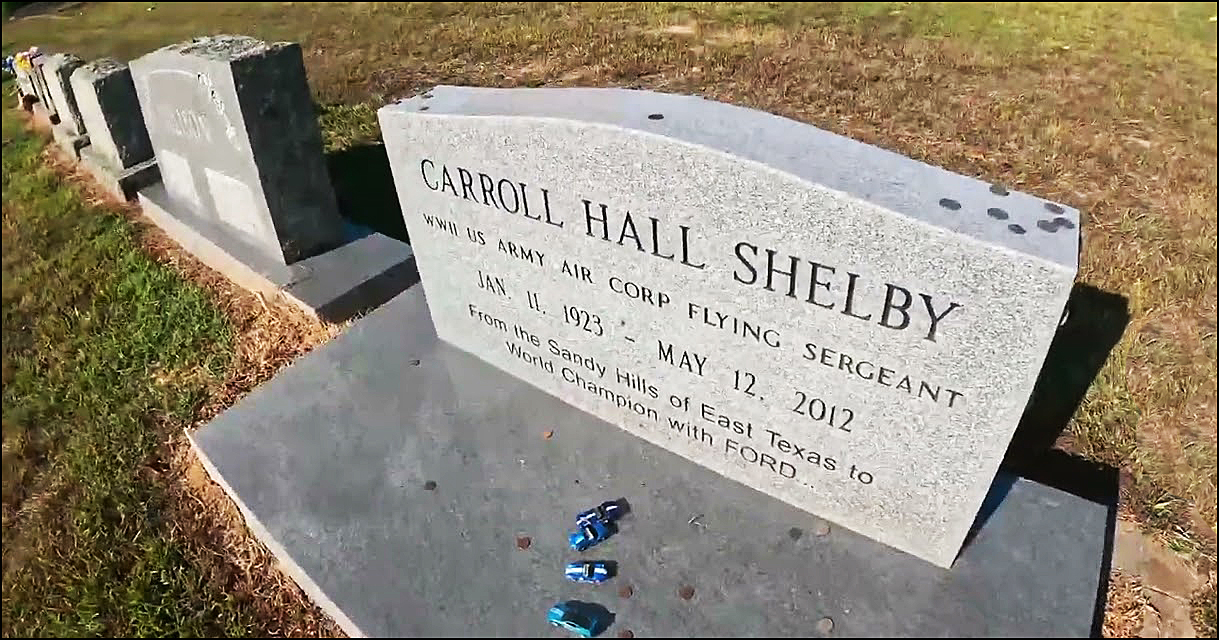
Shelby received a heart transplant in 1990, and a kidney transplant in 1996. Shelby died on May 10, 2012, at the age of 89 after suffering from serious heart ailments for decades. He is interred at Leesburg Cemetery in Leesburg, Texas. ✪













▶️ DONATE VIA PAYPAL (DEBIT & CREDIT CARD)
ALL PayPal Transactions Are Encrypted For Card Holder Privacy & Security
▶️ DONATE VIA ZELLE (DIRECT BANK CASH TRANSFER)
ZELLE is the perfect online alternative to PayPal. It’s an incredibly simple, secure, easy, fast and FREE way to send or receive money to recipients directly from your online banking account without a middleman. Best of all, there’s NO fees.
ZELLE is a service provided by your bank and is already built in to your online banking account. You only need to activate it first before using. If you’ve already activated ZELLE in your online bank or credit union account, you can donate to The New Americanist by using our ZELLE address:
vip@thenewamericanist.com
To activate your ZELLE, follow these easy instructions (a simple two minute process):

▶️ DONATE VIA SNAIL MAIL