⭐️ DN


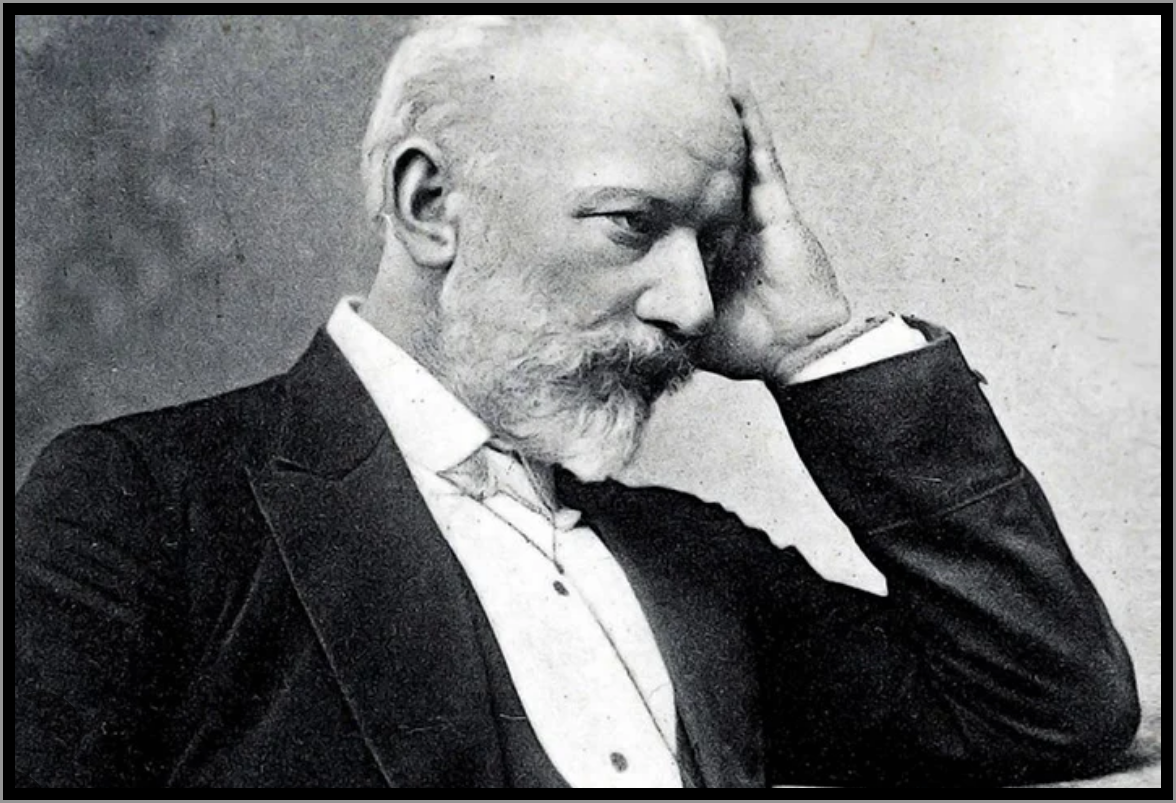

Pyotr Ilyich Tchaikovsky: May 7, 1840–November 6 1893
✪ Pyotr Ilyich Tchaikovsky was a Russian composer during the Romantic Period. He was the first Russian composer whose music won him international during his own lifetime. Tchaikovsky wrote some of the most popular concert and theatrical music pieces in the classical repertoire, including the ballets Swan Lake and The Nutcracker, the 1812 Overture, his First Piano Concerto, Violin Concerto, the Romeo and Juliet Overture-Fantasy, several symphonies, and the opera Eugene Onegin.
Although musically precocious, Tchaikovsky first received an education intended to prepare him for a civil servant career as there were few opportunities at that time for a professional musical career in Russia and no public music education system. When the opportunity for a musical education finally arose, he entered the nascent Saint Petersburg Conservatory, from which he graduated in 1865. The formal Western-oriented teaching Tchaikovsky received there set him apart from other composers of the contemporary Nationalist movement.
Tchaikovsky’s music displayed a wide stylistic and emotional range; from light salon works to grand symphonies. Some of his works employ a “Classical” form reminiscent of 18th-century composers such as Mozart (his favorite composer). Other compositions, such as his Little Russian symphony and his opera Vakula the Smith, flirt with musical practices more akin to traditional Russian folk songs. Still other works, such as Tchaikovsky’s last three symphonies, employ a personal musical idiom that facilitated intense emotional expression.
Despite his many popular successes, Tchaikovsky’s life was punctuated by personal crises and depression. Contributory factors included his early separation from his mother for boarding school followed by her early death, the death of his close friend and colleague Nikolai Rubinstein, his failed marriage to Antonina Miliukova, and the collapse of his 13-year association with the wealthy patroness Nadezhda von Meck.
American music critic and journalist Harold C. Schonberg wrote of Tchaikovsky’s “sweet, inexhaustible, supersensual fund of melody,” a feature that has ensured his music’s continued success with audiences.
Tchaikovsky’s main concern was how his music affected his listeners on an aesthetic level, at specific moments in the piece; and, on a cumulative level once the music had finished. In Tchaikovsky’s music, the listeners’ experience on an emotional or visceral level became an end in itself. Considering that he lived and worked in what was probably the last 19th-century feudal nation, this statement is not actually that surprising.
While his music has remained popular among audiences, critical opinions were initially mixed. Some Russians did not feel it sufficiently represented native musical values and expressed suspicion that Europeans accepted the music for its Western elements. In an apparent reinforcement of that claim, some Europeans lauded Tchaikovsky for offering music which transcended the stereotypes of Russian classical music. Others dismissed Tchaikovsky’s music as deficient because it did not stringently follow Western principles.
Tchaikovsky was born on May 7, 1840 in Votkinsk, a small town in Vyatka Governorate during the Russian Empire. His father, Ilya Petrovich Tchaikovsky, served as a lieutenant colonel and engineer in the Department of Mines and managed the Ironworks in Kamsko-Votkinsk. Tchaikovsky’s mother, Alexandra Andreyevna (née d’Assier), was the second of Ilya’s three wives; his first wife died several years before Pyotr’s birth. Both Ilya and Alexandra were trained in the arts, including music.
In 1844, the family hired Fanny Dürbach, a 22-year-old French governess. Four and a half-year-old Tchaikovsky was initially thought too young to study alongside his older brother Nikolai and a niece of the family. However, his insistence convinced Dürbach otherwise. By age six, he was already fluent in both French and German. Tchaikovsky became very attached to Dürbach; as her affection for him reportedly counterbalanced his mother’s coldness and emotional distance; though others assert that his mother doted on her son. Dürbach saved much of Tchaikovsky’s earliest works from this period, including his earliest known compositions.
Tchaikovsky began piano lessons at the age of five. Within three years he became as adept at reading sheet music as his teacher. Tchaikovsky’s parents, initially supportive, hired a tutor, bought an orchestrion, a form of barrel organ that could imitate elaborate orchestral effects; and encouraged his piano study for both aesthetic and practical reasons. But in 1850 they sent Tchaikovsky to the Imperial School of Jurisprudence in Saint Petersburg.
His parents believed this form of education would prepare Tchaikovsky for a career as a civil servant. Regardless of talent, the only musical careers available in Russia at that time; except for the affluent aristocracy, were as teacher in an academy or as an instrumentalist in one of the Imperial Theaters. Both were considered to be the lowest rank of the social ladder, with individuals in them enjoying no more rights than peasants.
As the minimum age for acceptance was 12 and Tchaikovsky was only 10 at the time, he was required to spend two years boarding at the Imperial School of Jurisprudence’s preparatory school, 800 miles from his family. Once those two years had passed, Tchaikovsky transferred to the Imperial School of Jurisprudence to begin a formal seven-year course of study. Tchaikovsky was told to finish his courses and then apply for a post in the Ministry of Justice.
Tchaikovsky’s early separation from his mother, despite the aforementioned alleged distant relationship, would cause him emotional trauma which would last the rest of his life and was intensified by her death from cholera in 1854, when he was only 14. The loss of his mother also prompted Tchaikovsky to make his first serious attempt at composition, a waltz in her memory.
Music, while not an official priority at school, also bridged the gap between Tchaikovsky and his peers. They regularly attended the opera together and Tchaikovsky improvised at the school’s harmonium on themes he and his friends had sung during choir practice.
On 10 June 1859, the 19-year-old Tchaikovsky graduated as a titular counselor, a low rung on the civil service ladder. Appointed to the Ministry of Justice, he became a junior assistant within six months and a senior assistant two months later. He would remain a senior assistant for the rest of his three-year civil service career.
Meanwhile, the Russian Musical Society (RMS) was founded in 1859 and in 1861, Tchaikovsky began attending RMS classes. These classes were a precursor to his continuing musical education at the Saint Petersburg Conservatory, which opened in 1862. Tchaikovsky enrolled at the Conservatory as part of its premiere class. He was awarded a silver medal for his thesis, a cantata on Schiller’s “Ode to Joy”
The Conservatory benefited Tchaikovsky in two ways. First, it transformed him into a musical professional, with tools to help him thrive as a composer. Second, the in-depth exposure to European principles and musical forms at the school gave him a sense that his art was not exclusively Russian or Western. This mindset became important in Tchaikovsky’s reconciliation of Russian and European influences as his compositional style developed.
Once Tchaikovsky graduated the Conservatory in 1865, he was offered the post of Professor of Music Theory at the soon-to-open Moscow Conservatory. While the salary for his professorship there was only 50 rubles a month, the offer itself boosted Tchaikovsky’s morale and he accepted the post eagerly.
From 1867 to 1878, Tchaikovsky combined his professorial duties with music criticism while continuing to compose. This activity exposed him to a range of contemporary music and also afforded him the opportunity to travel abroad. In his reviews, he praised Beethoven, considered Brahms overrated and despite his admiration, took Schumann to task for poor orchestration.
Another factor that helped Tchaikovsky’s music become popular was a shift in attitude among Russian audiences. Whereas they had previously been satisfied with flashy virtuoso performances of technically demanding but musically lightweight works, they gradually began listening with increasing appreciation of the composition itself.
However, the infrequency of Tchaikovsky’s musical successes, won with tremendous effort, exacerbated his lifelong sensitivity to criticism. As his popularity grew, more first-rate artists became willing to perform his compositions. During the late 1860s, Tchaikovsky began to compose operas.
Tchaikovsky remained abroad for an entire year after the disintegration of his marriage. He returned briefly to the Moscow Conservatory in the autumn of 1879. For the next few years, assured of a regular patron income from von Meck, he traveled incessantly throughout Europe and rural Russia, mainly alone, and avoided social contact whenever possible.
During this time, Tchaikovsky’s foreign reputation grew and a positive reassessment of his music also took place in Russia, thanks in part to Russian novelist Fyodor Dostoevsky’s call for “universal unity” with the West at the unveiling of the Pushkin Monument in Moscow in 1880. Before Dostoevsky’s speech, Tchaikovsky’s music had been considered “overly dependent on the West.” As Dostoevsky’s message spread throughout Russia, this stigma toward Tchaikovsky’s music evaporated. The unprecedented acclaim for him even drew a cult following among the young intelligentsia of Saint Petersburg.
⭐️ 16 Minutes 31 Seconds
For the 1882 Moscow Arts and Industry Exhibition which was in the planning stage, Nikolai Rubinstein suggested that Tchaikovsky compose a grand commemorative piece. Tchaikovsky agreed and finished it within six weeks. He wrote to his patron Nadezhda von Meck that this piece, the 1812 Overture, would be “very loud and noisy, but I wrote it with no warm feeling of love, and therefore there will probably be no artistic merits in it.” Nevertheless, the overture would become for many, “the piece by Tchaikovsky they know best.”
In 1884, Tchaikovsky began to slowly shed his unsociability and restlessness. That March, Emperor Alexander III conferred upon him the Order of Saint Vladimir, which included a title of hereditary nobility and a personal audience with the Tsar. Tchaikovsky was awarded a lifetime annual pension of 3,000 rubles from the Tsar and was made the premier court composer.
▶️ 7 Minutes 31Seconds
Despite Tchaikovsky’s disdain for public life, he now participated in it as part of his increasing celebrity and out of a duty he felt to promote Russian music. He served as director of the Moscow branch of the Russian Musical Society during the 1889–1890 season.
During this period, Tchaikovsky also began promoting Russian music as a conductor. Within a year, he was in considerable demand for his conducting skills throughout Europe and Russia. These appearances helped him overcome a life-long struggle with stage fright and boosted his self-assurance. In 1891, conducting eventually brought him to the United States, where he led the New York Music Society’s orchestra in his Festival Coronation March at the inaugural concert of Carnegie Hall.
▶️ 1 Minute 12 Seconds
In January 1890, a wax cylinder recording which included Tchaikovsky was made in Moscow by Julius Block on behalf of Thomas Edison. According to musicologist Leonid Sabaneyev, Tchaikovsky was not comfortable with being recorded for posterity and tried to shy away from it. On an apparently separate visit from the one related above, Block asked the composer to play something on a piano or at least say something. Tchaikovsky refused saying, “I am a bad pianist and my voice is raspy. Why should one want to eternalize it?”
In 1892, Tchaikovsky was voted a member of the Académie des Beaux-Arts in France, only the second Russian subject to ever be so honored. The following year, the University of Cambridge in England awarded Tchaikovsky an honorary Doctor of Music degree.
For most of his life, Tchaikovsky lived as a bachelor. In 1868, he met Belgian soprano Désirée Artôt with whom he considered marriage; but owing to various circumstances, the relationship ended. Tchaikovsky later claimed she was the only woman he ever really loved. In 1877, at the age of 37, he wed a former student, Antonina Miliukova. The marriage turned out to be a mismatch of conflicting personal psychologies. The couple lived together for only two and a half months before Tchaikovsky left, overwrought emotionally and suffering from an acute case of writer’s block.
Tchaikovsky was also aided by Nadezhda von Meck, the widow of a railway magnate, who had begun contact with him not long before the marriage. As well as an important friend and emotional support, she became his patroness for the next 13 years, allowing him to focus his creative efforts exclusively on composition. Although Tchaikovsky called her his “best friend,” they agreed never to meet in person under any circumstances.
On October 23, 1893, Tchaikovsky conducted the premiere of his Sixth Symphony, the Pathétique, in Saint Petersburg. Nine days later, on 6 November, he died there at the age of 53. He was interred in Tikhvin Cemetery at the Alexander Nevsky Monastery, near the graves of fellow-composers Alexander Borodin, Mikhail Glinka, and Modest Mussorgsky. Later, Nikolai Rimsky-Korsakov and Mily Balakirev were also buried nearby.
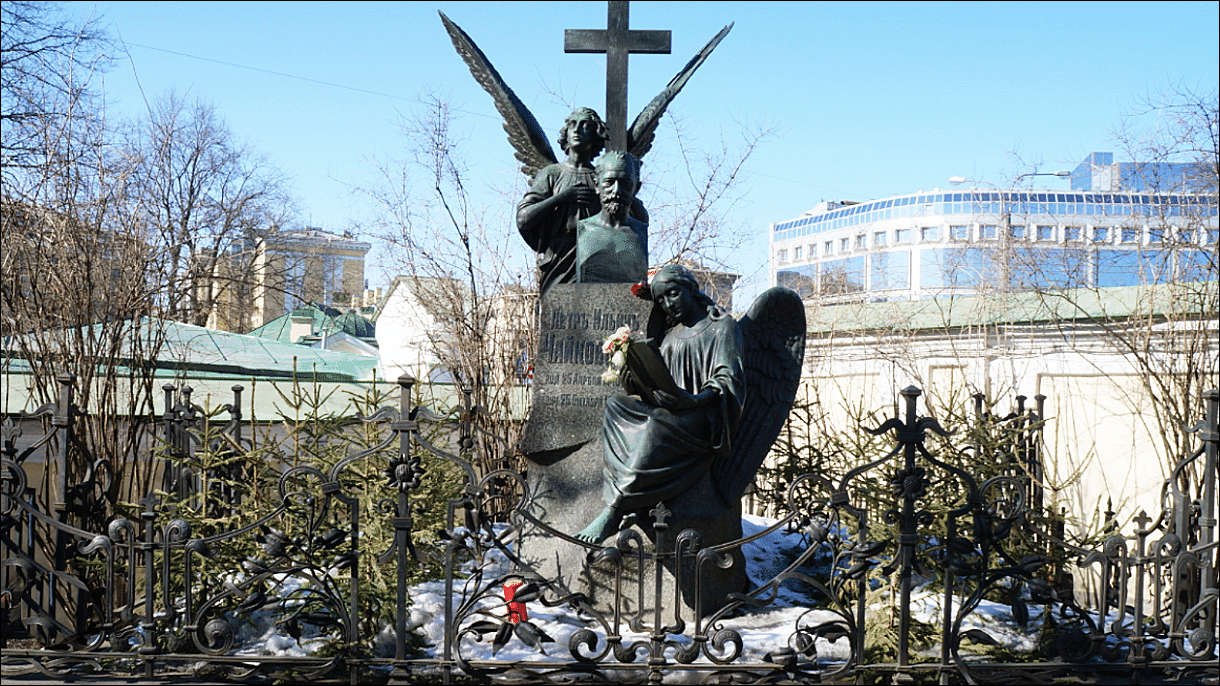
Tchaikovsky’s death is historically attributed to cholera caused by drinking unboiled water at a local restaurant. In the 1980s in Britain, however, there was a popular academic speculation that he killed himself, either with poison or by contracting cholera intentionally. In the New Grove Dictionary of Music, Roland John Wiley wrote:
“The polemics over Tchaikovsky’s death have reached an impasse … . As for illness, problems of evidence offer little hope of satisfactory resolution: the state of diagnosis; the confusion of witnesses; disregard of long-term effects of smoking and alcohol. We do not know how Tchaikovsky died. We may never find out.”✪

















▶️ DONATE VIA PAYPAL (DEBIT & CREDIT CARD)
ALL PayPal Transactions Are Encrypted For Card Holder Privacy & Security
▶️ DONATE VIA ZELLE (DIRECT BANK CASH TRANSFER)
ZELLE is the perfect online alternative to PayPal. It’s an incredibly simple, secure, easy, fast and FREE way to send or receive money to recipients directly from your online banking account without a middleman. Best of all, there’s NO fees.
ZELLE is a service provided by your bank and is already built in to your online banking account. You only need to activate it first before using. If you’ve already activated ZELLE in your online bank or credit union account, you can donate to The New Americanist by using our ZELLE address:
vip@thenewamericanist.com
To activate your ZELLE, follow these easy instructions (a simple two minute process):

▶️ DONATE VIA SNAIL MAIL