⭐️ Warren Teed


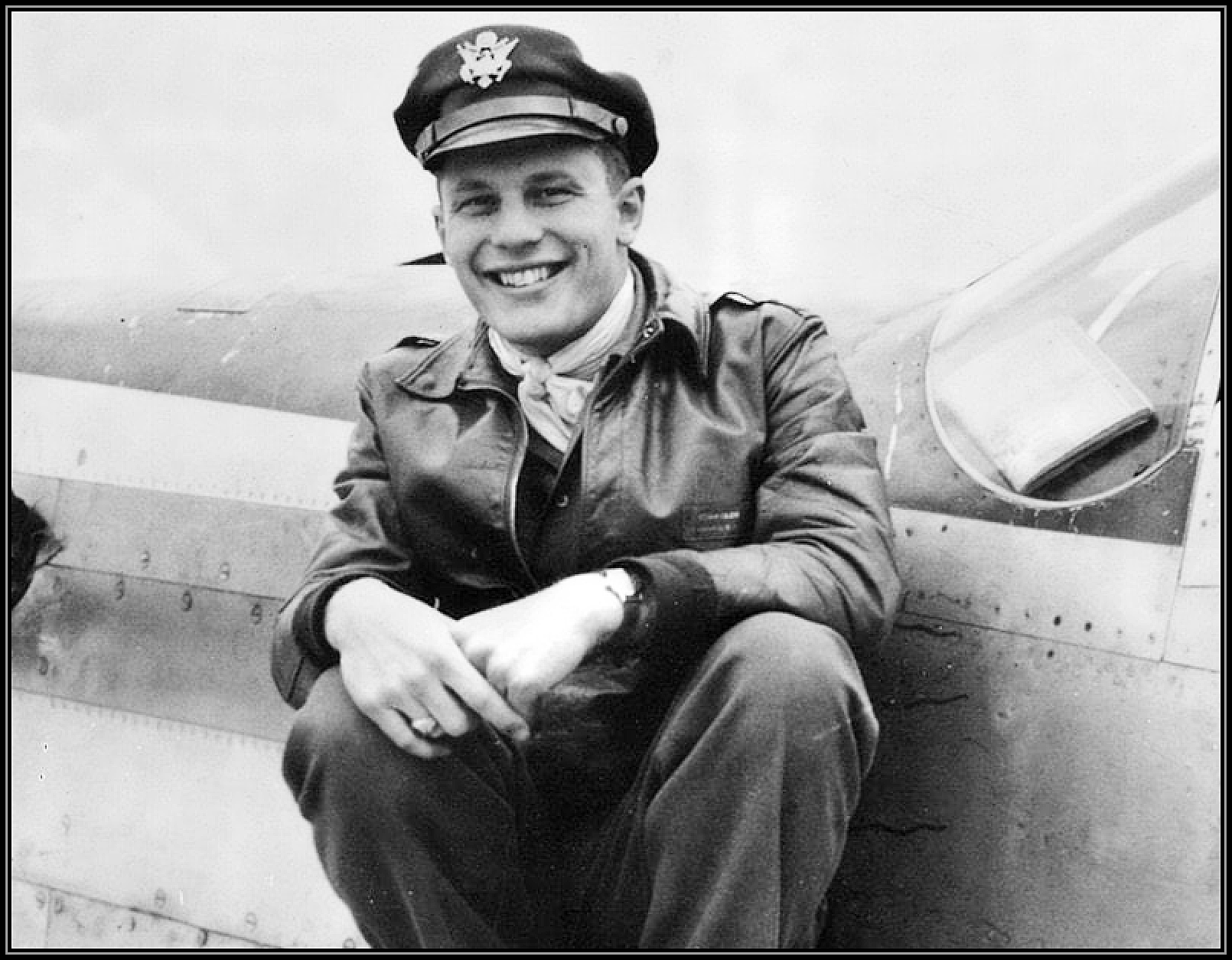

Robert Oldys Jr: July 14, 1922–June 14, 2007
✪ Robin Olds (born Robert Oldys Jr) was an American fighter pilot and general officer in the United States Air Force (USAF). He was a “triple ace,” with a combined total of 17 victories in World War II and the Vietnam War.
The son of U.S. Army Air Forces Major General Robert Olds, he was educated at West Point, and the product of a military family upbringing during the early years of the U.S. Army Air Corps. Olds epitomized the national image of the youthful World War II fighter pilot. He remained in the service as it became the United States Air Force, despite often being at odds with its leadership; and, was one of its pioneer jet pilots. Rising to the command of two fighter wings, Olds is regarded among aviation historians, and his peers, as the best wing commander of the Vietnam War, for both his air-fighting skills and reputation as a combat leader.
Olds was promoted to brigadier general after his return from Vietnam but did not hold another major command. The remainder of his career was spent in non-operational positions, as the Commandant of Cadets at the United States Air Force Academy and as an official in the Air Force Inspector General’s Office. His inability to rise higher as a general officer is attributed to both his maverick views and his penchant for drinking.
Olds enjoyed a highly publicized career and life, including a marriage to Hollywood actress Ella Raines. As a young man he was also recognized for his athletic abilities in both high school and college. He was named an All-American as a lineman in college football. He retired in 1973 after 30 years of military service.
Olds was born Robert Oldys Jr. in Honolulu, Hawaii, on July 14, 1922, into an army family and spent much of his boyhood in Hampton, Virginia, where he attended elementary and high school. His father was Captain (later Major General) Robert Oldys (later Olds), a training instructor pilot in France during World War I and former aide to Brigadier General Billy Mitchell from 1922 to 1925. Olds became a leading advocate for strategic bombing while in the Air Corps.
Olds’ father was made commander of the pioneer Boeing B-17 Flying Fortress equipped 2nd Bombardment Group at Langley Field on March 1, 1937 and promoted to lieutenant colonel on March 7. His mother, Eloise Karine Oldys, died when Robin was four and he was raised by his father.
Growing up primarily at Langley Field, Virginia, Olds virtually made daily contact with the small group of officers who would ultimately lead the U.S. Army Air Forces in World War II (one of his neighbors was Major Carl Spaatz, who would become the first Chief of Staff of the USAF); and as a result, became imbued with an unusually strong dedication to the air service.
On November 10, 1925, Olds’ father appeared as a witness on behalf of Billy Mitchell during Mitchell’s court-martial in Washington, D.C, where he brought along three-year-old Robin with him to court, dressed in an Air Service uniform, and posed with him for newspaper photographers before testifying.
Olds first flew at the age of eight, in an open cockpit biplane operated by his father. At the age of 12, Olds decided he would attend the U.S. Military Academy at West Point as his objective to accomplish his goals of becoming an officer and a military aviator, as well as playing football.
Olds attended Hampton High School where he was elected the president of his class three successive years. He also played varsity high school football and won the state championship of Virginia in 1937. Olds was an aggressive player, and subsequently received offers to attend Virginia Military Institute and Dartmouth College on football scholarships.
Instead of entering college directly after graduating high school in 1939, Olds enrolled at Millard Preparatory School for West Point in Washington, D.C. A school established to prepare young men for the entrance examinations to the military academies.
When Nazi Germany invaded Poland in 1939, Olds attempted to join the Royal Canadian Air Force but was thwarted by his father’s refusal to approve his enlistment papers. Instead, Olds completed Millard Prep and applied for admission to the United States Military Academy at West Point.
Olds passed the West Point entrance examination and was accepted into the Class of 1944 on June 1, 1940. He entered the academy a month later after the Japanese attack on Pearl Harbor. Olds was next sent to the Spartan School of Aeronautics in Tulsa, Oklahoma, for flight training which ended a year later by Christmas 1942. Olds then returned to West Point, hoping to graduate early and see action in the war.
Olds played varsity college football in both 1941 and 1942. At 6 feet 2 inches in height and weighing 205 pounds, he played tackle on both offense and defense, lettering both seasons. In 1942 he was named by Collier’s Weekly as its “Lineman of the Year” and by Grantland Rice as “Player of the Year.” Olds was also selected as an All-American. In 1985 Olds was enshrined in the College Football Hall of Fame.
Olds’ father died of complications from pneumonia on April 28, 1943, after hospitalization for constrictive pericarditis and Libman-Sacks endocarditis, at the age of 46, just prior to Olds’ graduation from West Point.
Olds completed his primary training in the summer of 1942 at the Spartan School of Aviation and his basic and advanced training at Stewart Field, New York. 208 cadets including Olds completed the course, while five classmates died in accidents. On May 30, 1943, Olds received his pilot’s wings personally from Gen. Henry H. Arnold and graduated on June 1 as a member of the Class of June 1943; 194th in general merit of 514 graduates.
Second lieutenant Olds completed his fighter pilot training with the 329th Fighter Group, an operational training unit based at Grand Central Air Terminal in Glendale, California.
On December 1, 1943, Olds was promoted to the rank of first lieutenant. In early 1944 he became part of the cadre assigned to build up the newly activated 434th Fighter Squadron and its parent 479th Fighter Group, based at Lomita, California. Olds logged 650 hours of flying time during training, which included 250 hours in the P-38 Lightning, while the 479th built its proficiency as a combat group.
The 479th arrived in Scotland on May 14, 1944, and entrained for RAF Wattisham, in eastern England, The 479th began combat duty on May 26, flying bomber escort missions and attacking transportation targets in occupied France in advance of the invasion of Normandy. Olds flew a new P-38J Lightning he nicknamed Scat II.
Olds also insisted his aircraft be waxed to reduce air resistance and helped his maintenance crew carry out their tasks. On July 24 Olds was promoted to captain and became a flight and later squadron leader. on August 14, Olds shot down his first German aircraft, a pair of Focke-Wulf Fw 190s.
The 479th FG converted to the P-51 Mustang in mid-September. On his second transition flight, at the point of touchdown during landing, Olds learned a lesson in “false confidence” when the powerful torque of the single-engined fighter forced him to ground loop after the Mustang veered off the runway. Olds shot down an Fw 190 in his new Scat VI on October 6 during a savage battle near Berlin in which he was nearly shot down by his own wingman. He completed his first combat tour on November 9, 1944, accruing 270 hours of combat time and six kills.
Promoted to major on February 9, 1945, Olds claimed his seventh victory southeast of Magdeburg, Germany the same day, downing another Bf 109. On February 14, he claimed three more victories, two Bf 109s and an Fw 190. His final World War II aerial kill occurred on April 7, 1945.
Returning to the United States after the war, Olds was assigned at West Point as an assistant football coach. Apparently resented by many on the staff for his rapid rise in rank and plethora of combat decorations, Olds transferred in February 1946 to the 412th Fighter Group at March Field, California, to fly the Lockheed P-80 Shooting Star, which began a career-long professional struggle with superiors he viewed as more promotion than warrior-minded.
In 1946, while based at March Field, Olds met Hollywood actress (and pin-up girl) Ella Raines on a blind date in Palm Springs. They married in Beverly Hills on February 6, 1947 and had 3 children; although their last child in 1958 was born stillborn.
Olds went to England under the U.S. Air Force/Royal Air Force Exchange Program in 1948. Flying the Gloster Meteor jet fighter, he commanded No. 1 Squadron at Royal Air Force Station Tangmere between October 20, 1948, and September 25, 1949. He was the first foreigner to command an RAF unit in peacetime.
Promoted to lieutenant colonel on February 20, 1951, and colonel April 15, 1953, while just thirty years of age and just short of ten years from his graduation from West Point, Olds served unenthusiastically in several staff assignments until finally returning to flying in 1955.
Olds held administrative and staff duty assignments at the Pentagon between 1958 and 1962 as the Deputy Chief, Air Defense Division, Headquarters USAF. In this assignment he prepared a number of papers, iconoclastic at the time, which soon became prophetic, including identifying the need for upgraded conventional munitions (foretelling the “bomb shortage” of the Vietnam War), and the lack of any serious tactical air training in conventional warfare.
Olds next became commander of the 81st Tactical Fighter Wing at RAF Bentwaters, England, a McDonnell F-101 Voodoo fighter-bomber wing, on September 8, 1963. The 81st TFW was a major combat unit in United States Air Forces Europe, having both a tactical nuclear and conventional bombing role supporting NATO. Olds commanded the wing until July 26, 1965.
On September 30, 1966, Olds took command of the 8th Tactical Fighter Wing, based at Ubon Royal Thai Air Force Base. A lack of aggressiveness and sense of purpose in the wing had led to the change in command (Olds’ predecessor had flown only 12 missions during the 10 months the wing had been in combat). The 44-year-old colonel also set the tone for his command stint by immediately placing himself on the flight schedule as a rookie pilot under officers junior to himself, then challenging them to train him properly because he would soon be leading them.
On May 4, Olds destroyed a MiG-21 over Phúc Yên. Two weeks later, on May 20, he destroyed two MiG-17s in what one of his pilots described as a “vengeful chase” after they shot down his wingman during a large dogfight, bringing his total to 16 confirmed kills (12 in World War II and four in Vietnam) and making him a triple ace.
He was awarded a fourth Silver Star for leading a three-aircraft low-level bombing strike on March 30, 1967, and the Air Force Cross for an attack on the Paul Doumer Bridge in Hanoi on August 11, one of five awarded to Air Force pilots for that mission. He flew his final combat mission over North Vietnam on September 23, 1967.
▶️ 14 Minutes 4 Seconds
Olds was known for his extravagantly waxed (decidedly non-regulation) handlebar moustache he sported in Vietnam. It was a common superstition among airmen to grow a “bulletproof mustache.” However, Olds also considered his to be “a gesture of defiance. The kids on base loved it. Most everybody grew a mustache.”
When he reported to his first interview with Air Force Chief of Staff General John P. McConnell, McConnell walked up to him, stuck a finger under his nose and said, “Take it off.” Olds replied, “Yes, sir.”
For his part, Olds was not upset with the order, recalling:
“To tell the truth, I wasn’t all that fond of the damned thing by then, but it had become a symbol for the men of the 8th Wing. I knew McConnell understood. During his visits to Ubon over the past year he had never referred to my breach of military standards, just seemed rather amused at the variety of ‘staches sported by many of the troops. (It) was the most direct order I had received in twenty-four years of service.”
After relinquishing command of the 8th TFW on September 23, 1967, Olds reported for duty to the United States Air Force Academy in Colorado Springs, Colorado, in December 1967. There, he served as commandant of cadets for three years and sought to restore morale in the wake of a major cheating scandal. Olds was promoted to brigadier general on June 1, 1968.
During his retirement at Steamboat Springs, Colorado, Olds pursued his love of skiing and served on the city’s planning commission. He was also active in public speaking, making 21 events as late in his life as 2005 and 13 in 2006.
Olds’ fondness for alcohol was well known. John Darrell Sherwood, in his book Fast Movers: Jet Pilots and the Vietnam Experience, posits that Olds’ heavy drinking may have hurt his post-Vietnam career. On July 12, 2001, Olds was arrested for driving under the influence of alcohol and resisting arrest near his home in Steamboat Springs.
Olds, briefly hospitalized during the incident for facial cuts, pleaded guilty in return for charges of weaving and felony vehicular eluding being dropped. Olds was placed on one year probation, and ordered to pay almost $900 in fines and costs, attend an alcohol education course, and perform 72 hours of community service. Days later on July 21, 2001, Olds was enshrined at Dayton, Ohio, in the National Aviation Hall of Fame Class of 2001.
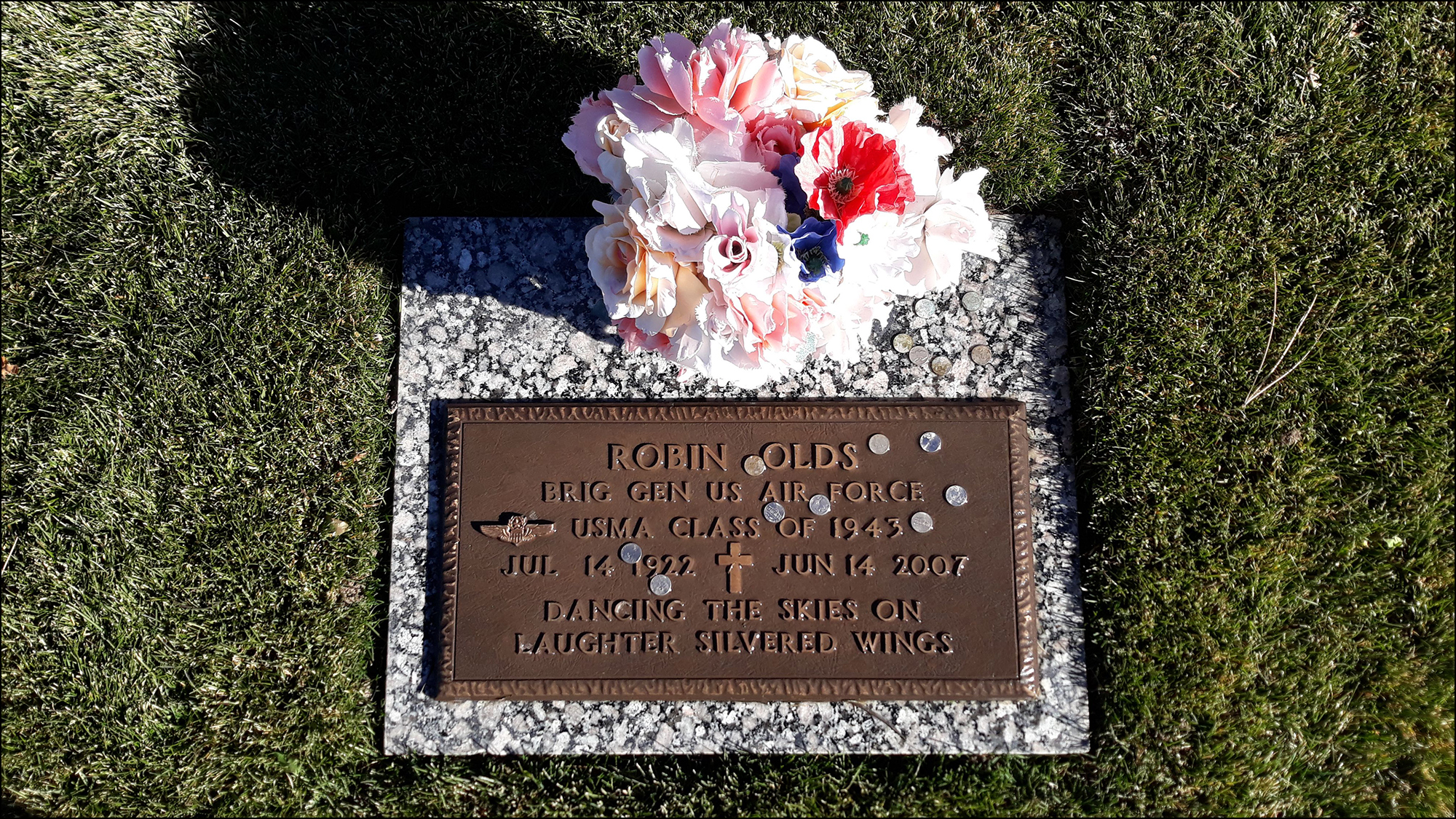
In March 2007 Olds was hospitalized in Colorado for complications of Stage 4 prostate cancer. On the evening of June 14, 2007 he died from congestive heart failure in Steamboat Springs, Colorado, a month before his 85th birthday. He was honored with a flyover which included the traditional “missing man” formation. On June 30, 2007 services were held at the United States Air Force Academy Cemetery to honor the interment of his ashes. ✪














▶️ DONATE VIA PAYPAL (DEBIT & CREDIT CARD)
ALL PayPal Transactions Are Encrypted For Card Holder Privacy & Security
▶️ DONATE VIA ZELLE (DIRECT BANK CASH TRANSFER)
ZELLE is the perfect online alternative to PayPal. It’s an incredibly simple, secure, easy, fast and FREE way to send or receive money to recipients directly from your online banking account without a middleman. Best of all, there’s NO fees.
ZELLE is a service provided by your bank and is already built in to your online banking account. You only need to activate it first before using. If you’ve already activated ZELLE in your online bank or credit union account, you can donate to The New Americanist by using our ZELLE address:
vip@thenewamericanist.com
To activate your ZELLE, follow these easy instructions (a simple two minute process):

▶️ DONATE VIA SNAIL MAIL