
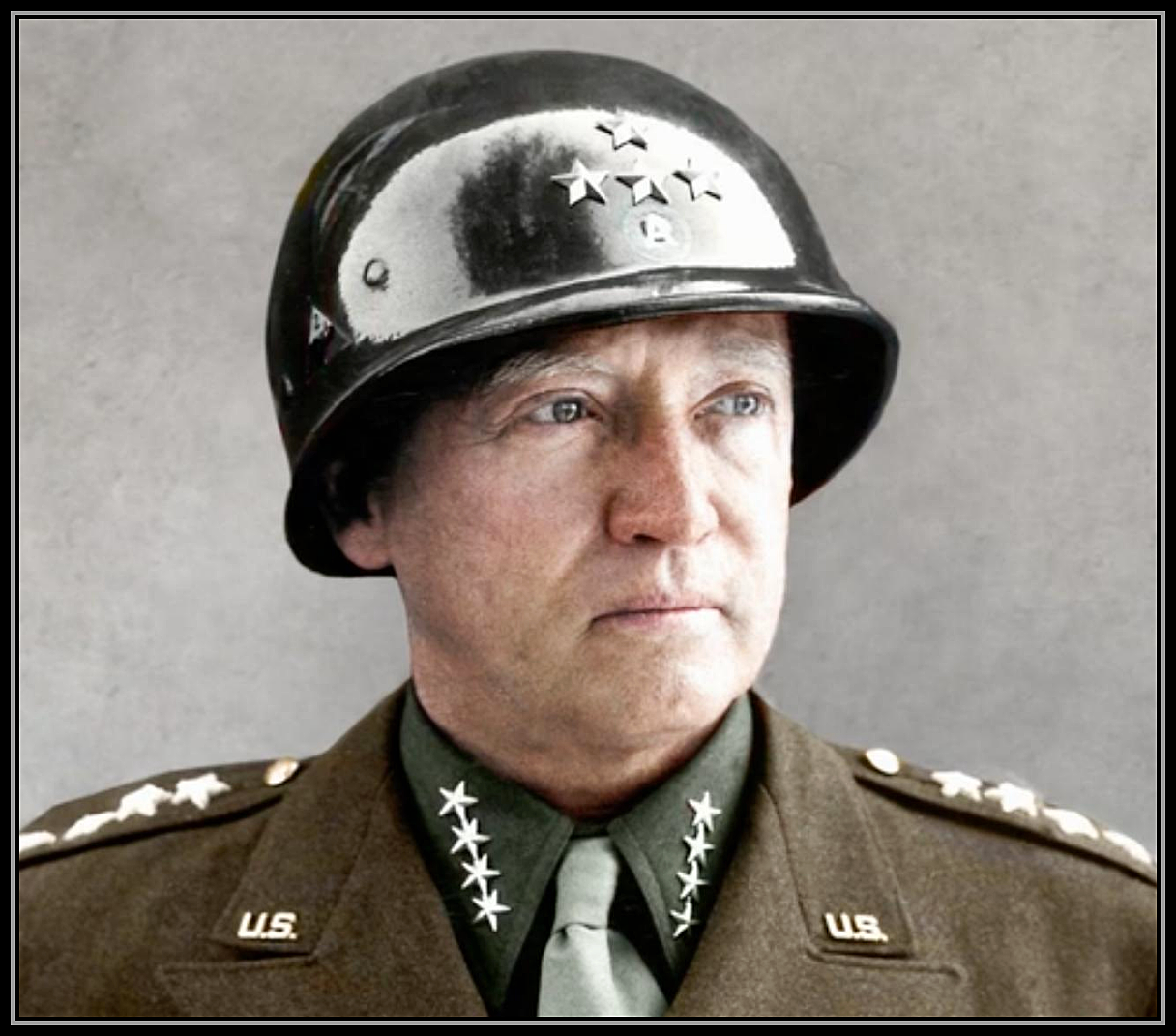

George Smith Patton Jr. (11 November 1885–21 December 1945)
✪ George Smith Patton Jr. was a general in the United States Army who commanded the Seventh Army in the Mediterranean Theater of World War II, then the Third Army in France and Germany after the Allied invasion of Normandy in June 1944.
Born in 1885, Patton attended the Virginia Military Institute and the United States Military Academy at West Point. He studied fencing and designed the M1913 Cavalry Saber, more commonly known as the “Patton Saber.” He competed in the modern pentathlon in the 1912 Summer Olympics in Stockholm, Sweden, finishing in fifth place.
Patton entered combat during the Pancho Villa Expedition of 1916, the United States’ first military action using motor vehicles. He fought in World War I as part of the new United States Tank Corps of the American Expeditionary Forces. He commanded the U.S. tank school in France, then led tanks into combat and was wounded near the end of the war. In the interwar period, Patton became a central figure in the development of the army’s armored warfare doctrine, serving in numerous staff positions throughout the country. At the United States’ entry into World War II, he commanded the 2nd Armored Division.
During the Allied occupation of Germany, Patton was named military governor of Bavaria, but was relieved for making aggressive statements towards the Soviet Union and questioning denazification.
He commanded the United States Fifteenth Army for slightly more than two months. Severely injured in an auto accident, he died in Germany twelve days later, on 21 December 1945.
Patton’s colorful image, hard-driving personality, and success as a commander were at times overshadowed by his controversial public statements. His philosophy of leading from the front, and his ability to inspire troops with attention-getting, vulgarity-laden speeches, such as his famous address to the Third Army, were received favorably by his troops, but much less so by a sharply divided Allied high command.
His emphasis on rapid and aggressive offensive action proved effective, and he was regarded highly by his opponents in the German High Command.
George Smith Patton Jr. was born on 11 November 1885 in the Los Angeles suburb of San Gabriel, California to George S. Patton and his wife, Ruth Wilson, the daughter of Benjamin Davis Wilson, the second mayor of Los Angeles, and Margaret Hereford, a widow from Virginia.
The wealthy Patton family resided at Lake Vineyard, built by Benjamin Wilson, on 128 acres in present-day San Marino, California. Patton had a younger sister, Anne, nicknamed “Nita.” Nita became engaged to John J. Pershing, Patton’s mentor, in 1917, but the engagement ended because of their separation during Pershing’s time in France during World War I.
As a child, Patton had difficulty learning to read and write, but eventually overcame this and was known in his adult life to be an avid reader. He was tutored from home until the age of eleven, when he was enrolled for six years in Stephen Cutter Clark’s Classical School for Boys, a private school in Pasadena.
Patton was described as an intelligent boy and was widely read in classical military history, particularly the exploits of Hannibal, Scipio Africanus, Julius Caesar, Joan of Arc, and Napoleon Bonaparte, as well as those of family friend John Singleton Mosby, who frequently stopped by the Patton family home when George was a child. Patton was also a avid horseback rider.
At the age of seventeen he sought an appointment to the United States Military Academy at West Point, New York. He also applied to several universities with military corps of cadet programs, and was accepted to Princeton, but eventually decided on Virginia Military Institute (VMI), which his father and grandfather had attended. He attended the school from 1903 to 1904, and though he struggled with reading and writing, performed exceptionally in uniform and appearance inspection, as well as military drill.
Patton graduated number 46 out of 103 cadets at West Point on 11 June 1909, and received a commission as a second lieutenant in the Cavalry branch of the United States Army.
At age 24, Patton married Beatrice Banning Ayer, the daughter of Boston industrialist Frederick Ayer, on 26 May 1910, in Beverly Farms, Massachusetts. They had three children. Patton was an Episcopalian.
Patton’s first military posting was with the 15th Cavalry at Fort Sheridan, Illinois, where he established himself as a diligent leader who impressed superiors with his dedication. In late 1911, Patton was transferred to Fort Myer, Virginia, where many of the Army’s senior leaders were stationed.
For his skill in running and fencing, Patton was selected as the Army’s entry for the first modern pentathlon at the 1912 Olympic Games in Stockholm, Sweden. Patton was the only American among the 42 pentathletes, who were all officers. Patton placed twenty-first on the pistol range, seventh in swimming, fourth in fencing, sixth in the equestrian competition, and third in the footrace, finishing fifth overall and first among the non-Swedish competitors.
Following the 1912 Olympics, Patton traveled to Saumur, France, where he learned fencing techniques from Adjutant Charles Cléry, a French “master of arms” and instructor of fencing at the cavalry school there. Bringing these lessons back to Fort Myer, Patton redesigned saber combat doctrine for the U.S. cavalry, favoring thrusting attacks over the standard slashing maneuver and designing a new sword for such attacks. He was temporarily assigned to the Office of the Army Chief of Staff, and in 1913, the first 20,000 of the Model 1913 Cavalry Saber—popularly known as the “Patton saber”—were ordered.
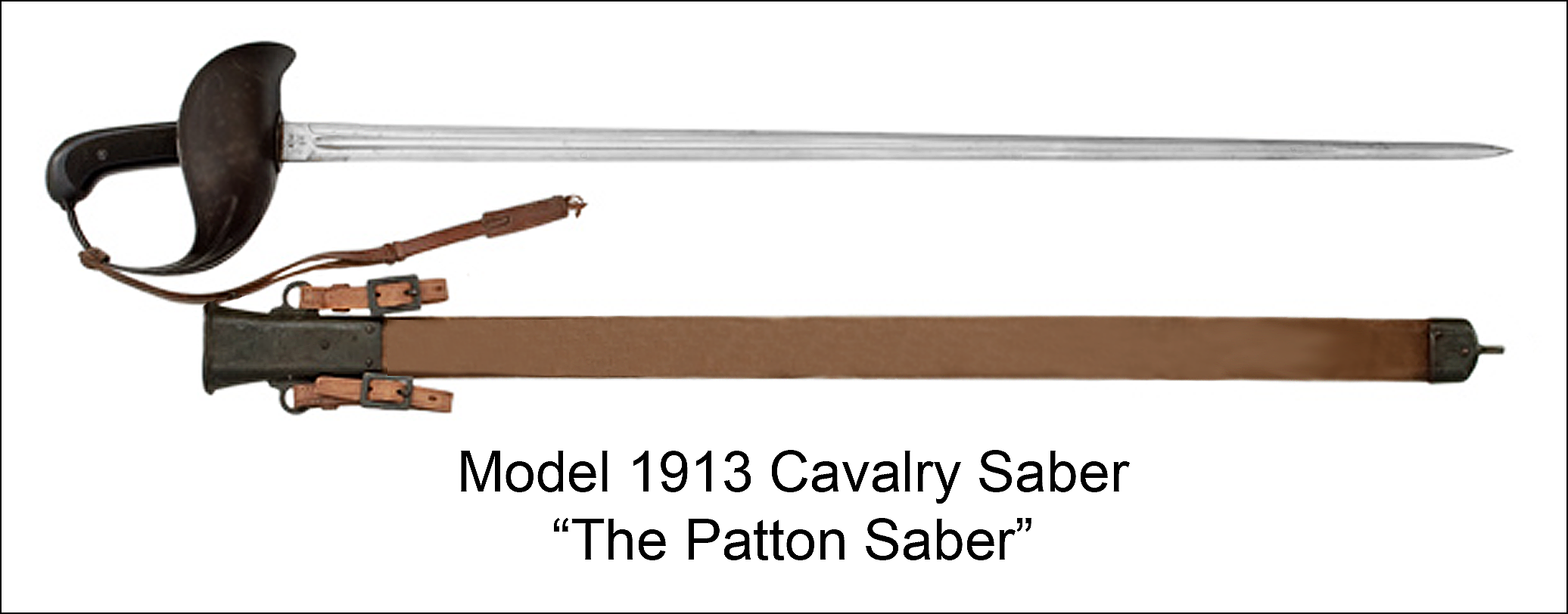
Patton was the first Army officer to be designated “Master of the Sword,” a title denoting the school’s top instructor in swordsmanship. Arriving in September 1913, he taught fencing to other cavalry officers, many of whom were senior to him in rank.
Patton graduated from this school in June 1915. He was originally intended to return to the 15th Cavalry which was bound for the Philippines. Fearing this assignment would dead-end his career, Patton instead travelled to Washington, D.C., during 11 days of leave and convinced influential friends to arrange a reassignment for him to the 8th Cavalry at Fort Bliss, Texas, anticipating that instability in Mexico might boil over into a full-scale civil war.
In March 1916, Mexican forces loyal to Pancho Villa crossed into New Mexico and raided the border town of Columbus. The violence in Columbus killed several Americans. In response, the U.S. launched the Pancho Villa Expedition into Mexico. Chagrined to discover that his unit would not participate, Patton appealed to expedition commander John J. Pershing, and was named his personal aide for the expedition.
Patton modeled much of his military leadership style after Pershing, who favored strong, decisive actions and commanding from the front. As an aide, Patton oversaw the logistics of Pershing’s transportation and acted as his personal courier.
After the Villa Expedition, Patton was detailed to Front Royal, Virginia, to oversee horse procurement for the army, but Pershing intervened on his behalf. After the United States entered World War I, in April 1917, and Pershing was named commander of the American Expeditionary Forces (AEF) on the Western Front, Patton requested to join his staff. Patton was promoted to captain on 15 May 1917, and left for Europe, among the 180 men of Pershing’s advance party.
Patton’s brigade was then moved to support I Corps for the upcoming Meuse–Argonne offensive, which began on September 26. He personally led a troop of tanks through thick fog as they advanced 5 miles (8 km) into German lines. Around 09:00, Patton was wounded while leading six men and a tank in an attack on German machine guns near the town of Cheppy.
After the war, Patton was assigned to Camp Meade, Maryland, and reverted to his permanent rank of captain on 30 June 1920. During this time he developed a belief that tanks should be used not as infantry support, but rather as an independent fighting force. Loathing duty as a peacetime staff officer, he spent much time writing technical papers and giving speeches on his combat experiences at the General Staff College.
Following the German Army’s invasion of Poland and the outbreak of World War II in Europe in September 1939, the U.S. military entered a period of mobilization, and Colonel Patton sought to build up the power of U.S. armored forces. Patton was promoted to brigadier general on 2 October, made acting division commander in November.
In December 1940, he staged a high-profile mass exercise in which 1,000 tanks and vehicles were driven from Columbus, Georgia, to Panama City, Florida, and back. He repeated the exercise with his entire division of 1,300 vehicles the next month. Patton earned a pilot’s license and, during these maneuvers, observed the movements of his vehicles from the air to find ways to deploy them effectively in combat. His exploits earned him a spot on the cover of Life magazine..
It was around this time that a reporter, after hearing a speech where Patton said that it took “blood and brains” to win in combat, began calling him “blood and guts.” The nickname would stick & follow him for the rest of his life. Soldiers under his command were known at times to have quipped, “our blood, his guts.” Nonetheless, he was known to be admired widely by the men under his charge.
Under Lieutenant General Dwight D. Eisenhower, the Supreme Allied Commander, Patton was assigned to help plan the Allied invasion of French North Africa as part of Operation Torch in the summer of 1942.
Patton commanded the Western Task Force, consisting of 33,000 men in 100 ships, in landings centered on Casablanca, Morocco. The landings, which took place on 8 November 1942, were opposed by Vichy French forces, but Patton’s men quickly gained a beachhead and pushed through fierce resistance. Casablanca fell on 11 November and Patton negotiated an armistice with French General Charles Noguès.
Patton immediately introduced sweeping changes, ordering all soldiers to wear clean, pressed and complete uniforms, establishing rigorous schedules, and requiring strict adherence to military protocol. He continuously moved throughout the command talking with men, seeking to shape them into effective soldiers. He pushed them hard, and sought to reward them well for their accomplishments.
For Operation Husky, the invasion of Sicily, Patton commanded the Seventh United States Army, dubbed the Western Task Force. Patton’s I Armored Corps was officially redesignated the Seventh Army just before his force of 90,000 landed before dawn on D-Day, 10 July 1943, on beaches near the town of Licata. The armada was hampered by wind and weather, but despite this the three U.S. infantry divisions involved, the 3rd, 1st and 45th, all secured their respective beaches.
The German High Command had more respect for Patton than for any other Allied commander and considered him to be central to any plan to invade Europe from England. Because of this, Patton was made a prominent figure in the deception scheme called Operation Fortitude during the first half of 1944. Through the British spy network of double-agents, the Allies fed German intelligence a steady stream of false reports about troop sightings and that Patton had been named commander of the First United States Army Group (FUSAG), all designed to convince the Germans that Patton was preparing this massive command for an invasion at Pas de Calais.
FUSAG was in reality an intricately constructed fictitious army of decoys, props, and fake radio signal traffic based around Dover to mislead German reconnaissance planes and to make Axis leaders believe that a large force was massing there. This helped to mask the real location of the invasion in Normandy.
As a result of Operation Fortitude, the German 15th Army remained at the Pas de Calais to defend against Patton’s supposed attack. So strong was their conviction that this was the main landing area that the German army held its position there even after the invasion of Normandy on 6 June 1944, believing it to be a diversionary force.
In December 1944, the German army, under the command of German Field Marshal Gerd von Rundstedt, launched a last-ditch offensive across Belgium, Luxembourg, and northeastern France. On 16 December 1944, it massed 29 divisions totaling 250,000 men at a weak point in the Allied lines, and during the early stages of the ensuing Battle of the Bulge.
By February, the Germans were in full retreat. On 23 February 1945, the U.S. 94th Infantry Division crossed the Saar River and established a vital bridgehead at Serrig, through which Patton pushed units into the Saarland. Patton had insisted upon an immediate crossing of the Saar River against the advice of his officers.
On 26 March 1945, Patton sent Task Force Baum, consisting of 314 men, 16 tanks, and assorted other vehicles, 50 miles behind German lines to liberate the prisoner of war camp OFLAG XIII-B, near Hammelburg.
The Third Army was later ordered toward Bavaria and Czechoslovakia, anticipating a last stand by German forces there. Patton was reportedly appalled to learn that the Red Army would take Berlin. In its advance from the Rhine to the Elbe, Patton’s Third Army, which numbered between 250,000 and 300,000 men at any given time, captured 32,763 square miles of German territory with losses of 2,102 killed, 7,954 wounded, and 1,591 missing. German losses in the fighting against the Third Army totaled 20,100 killed, 47,700 wounded, and 653,140 captured.
Between becoming operational in Normandy on 1 August 1944, and the end of hostilities on 9 May 1945, the Third Army was in continuous combat for 281 days. In that time, it crossed 24 major rivers and captured 81,500 square miles of territory, including more than 12,000 cities and towns. The Third Army claimed to have killed, wounded, or captured 1,811,388 German soldiers, six times its own numbers in personnel.
Patton was appointed as military governor of Bavaria, where he led the Third Army in denazification efforts. Patton was particularly upset when learning of the end of the war against Japan, writing in his diary, “Yet another war has come to an end, and with it my usefulness to the world.” Unhappy with his position and depressed by his belief that he would never fight in another war, Patton’s behavior and statements became increasingly erratic. Various explanations beyond his disappointments have been proposed for Patton’s behavior at this point. Carlo D’Este wrote that “it seems virtually inevitable … that Patton experienced some type of brain damage from too many head injuries” from a lifetime of numerous auto- and horse-related accidents, especially one suffered while playing polo in 1936.
Patton, in his new role, oversaw the displaced persons camps in Bavaria, which contained a majority of Jews who had survived Germany’s concentration camps in the Holocaust.
Patton faced questions from the press about his reluctance to denazify post-war Germany, but he noted that most of the people with experience in infrastructure management had been compelled to join the party in the war. He compared Nazis to Democrats and Republicans, bringing negative press stateside and angering Eisenhower. Eisenhower ordered him to hold a press conference correcting his statements, but Patton instead repeated them.
On 28 September 1945, Patton had a heated exchange with Eisenhower over the denazification controversy, so Eisenhower relieved him of his military governorship. He was relieved of command of the Third Army on 7 October, and he concluded his farewell remarks by saying, “All good things must come to an end. The best thing that has ever happened to me thus far is the honor and privilege of having commanded the Third Army.”
Patton’s chief of staff Major General Hobart Gay invited him on a pheasant hunting trip on 9 December 1945 near Speyer, Germany to lift his spirits. He noted derelict cars along the side of the road and said, “How awful war is. Think of the waste.” Moments later, the 1938 Cadillac limousine driven by PFC Horace Woodring collided with an American army truck driven by T/5 Robert L. Thompson.
Patton hit his head on the glass partition that separated the front and back seats. He began bleeding from a gash to the head and complained that he was paralyzed and having trouble breathing. He was taken to a hospital in Heidelberg where he was found to have a compression fracture and dislocation of the cervical third and fourth vertebrae, resulting in a broken neck and cervical spinal cord injury that rendered him paralyzed from the neck down.
Patton spent most of the next 12 days in spinal traction to decrease the pressure on his spine. All non-medical visitors were forbidden except his wife Beatrice, who had flown from the U.S. Patton had been told that he had no chance to ever again ride a horse or resume normal life, and he commented, “This is a hell of a way to die.” He died in his sleep of pulmonary edema and congestive heart failure at about 6:00 pm on 21 December 1945 at age 60.
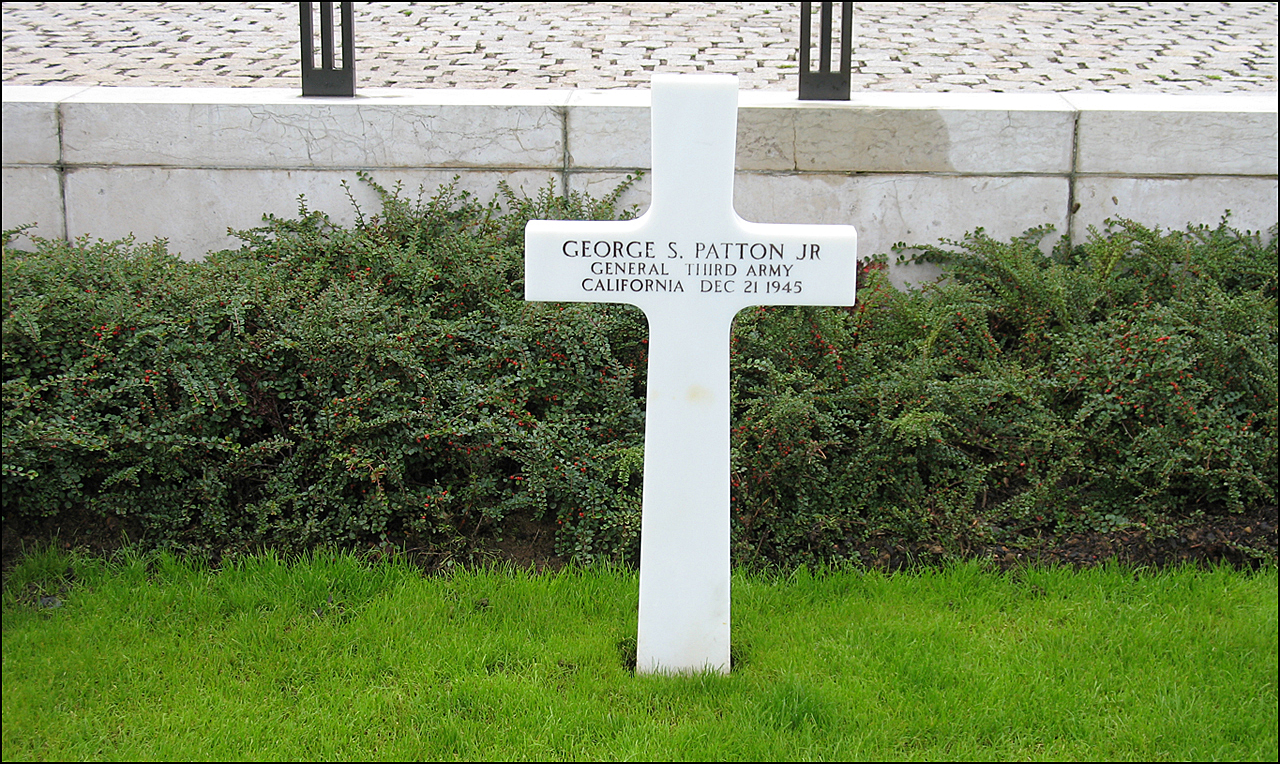
On 24 December, Patton was buried at the Luxembourg American Cemetery and Memorial in the Hamm district of Luxembourg City, alongside some wartime casualties of the Third Army, in accordance with his request to be buried with his men. He was initially buried in the middle of a plot like every other service member, but the large number of visitors to his grave damaged the cemetery grounds, so his remains were moved to their current location. ✪

















▶️ DONATE VIA PAYPAL (DEBIT & CREDIT CARD)
ALL PayPal Transactions Are Encrypted For Card Holder Privacy & Security
▶️ DONATE VIA ZELLE (DIRECT BANK CASH TRANSFER)
ZELLE is the perfect online alternative to PayPal. It’s an incredibly simple, secure, easy, fast and FREE way to send or receive money to recipients directly from your online banking account without a middleman. Best of all, there’s NO fees.
ZELLE is a service provided by your bank and is already built in to your online banking account. You only need to activate it first before using. If you’ve already activated ZELLE in your online bank or credit union account, you can donate to The New Americanist by using our ZELLE address:
vip@thenewamericanist.com
To activate your ZELLE, follow these easy instructions (a simple two minute process):

▶️ DONATE VIA SNAIL MAIL