
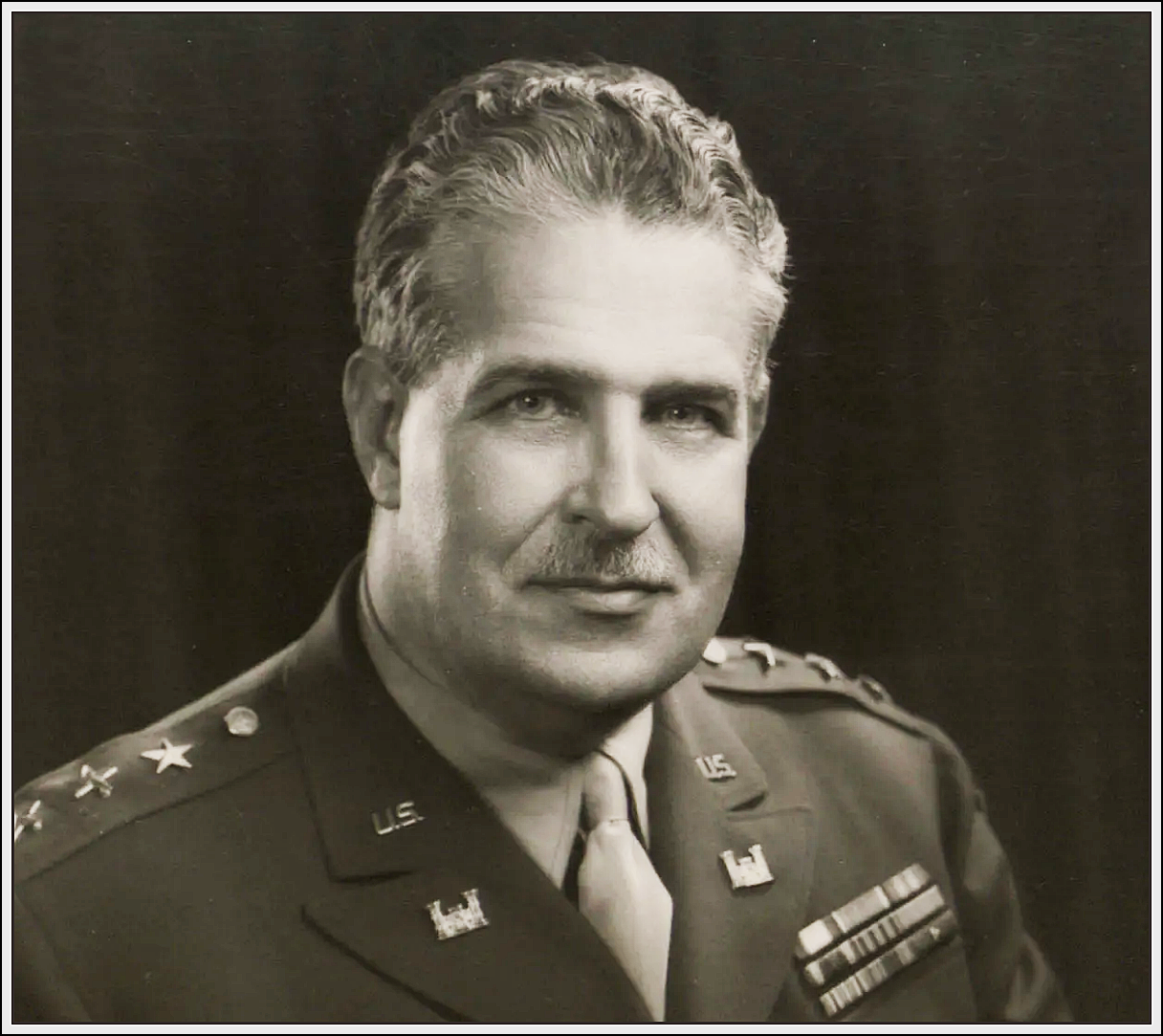

Leslie Richard Groves Jr. (17 August 1896 – 13 July 1970)
✪ Leslie Richard Groves Jr. was a United States Army Corps of Engineers officer who oversaw the construction of the Pentagon and directed the Manhattan Project, the top secret research government/military project which developed the atomic bomb during World War II.
The son of a U.S. Army chaplain, Groves grew up living at various Army posts & bases during his childhood. In 1918, he graduated fourth in his class at the United States Military Academy at West Point and was commissioned into the United States Army Corps of Engineers.
Leslie Richard Groves Jr. was born in Albany, New York, on 17 August 1896; the third son of four children of a pastor, Leslie Richard Groves Sr., and his wife Gwen née Griffith. Groves was half Welsh and half English, with some French Huguenot ancestors who came to the United States in the 17th century. Leslie Groves Sr. resigned as pastor of the Sixth Presbyterian Church in Albany in December 1896 to become a United States Army chaplain. He was posted to the 14th Infantry at Vancouver Barracks in Washington State in 1897.
Following the outbreak of the Spanish–American War in 1898, Chaplain Groves was deployed to Cuba along with the 8th Infantry. On returning to Vancouver Barracks, he was ordered to rejoin the 14th Infantry in the Philippines. Extended service in the Philippine–American War and the Boxer Rebellion followed. The 14th Infantry returned to the United States in 1901 and located to Fort Snelling, Minnesota. The family then relocated to there from Vancouver, then moved to Fort Hancock, New Jersey, and returned to Vancouver again in 1905. Chaplain Groves was hospitalized with tuberculosis at Fort Bayard in 1905.
At Fort Harrison, the younger Groves met Grace (Boo) Wilson, the daughter of Colonel Richard Hulbert Wilson, a career Army officer who had served with his father, Chaplain Groves during the 8th Infantry’s posting to Cuba. In 1913, the 14th Infantry moved once more, this time to Fort Lawton in Seattle, Washington.
They were married in St. Clement’s Episcopal Church in Seattle on 10 February 1922 and had two children: a son, Richard Hulbert, born in 1923, and a daughter, Gwen, born in 1928.
Groves entered Queen Anne High School in 1913, and graduated in 1914. While completing high school, he enrolled in courses at the University of Washington to prepare himself in anticipation of attempting to gain an appointment to the United States Military Academy. He earned a nomination from President Woodrow Wilson, which allowed him to compete for a vacancy, but he failed to score a high enough mark on the examination to be admitted.
Instead, Groves enrolled at the Massachusetts Institute of Technology (MIT) and planned to re-take the West Point entrance exam. In 1916, When Groves tested again, he attained a passing score and was accepted. He later said “Entering West Point fulfilled my greatest ambition. I had been brought up in the Army, and in the main had lived on Army posts all my life.”
At MIT he had played tennis informally, but at West Point he could not skate for ice hockey, did not like basketball, and was not good enough for baseball or track. Football was his only collegiate sport.
Groves’ class entered West Point on June 15th, 1916. His nickname at West Point was Greasy. The United States declaration of war on Germany in April 1917 led to their program of instruction being shortened as the War Emergency Course (WEC), which graduated on 1 November 1918, a year and a half ahead of schedule. Groves finished fourth in his class, which earned him a commission as a second lieutenant in the Corps of Engineers, the first choice of most high ranking cadets
After the traditional month’s leave following his graduation from West Point, Groves reported to Camp A. A. Humphreys, Virginia in December 1918. He was promoted there to rank of first lieutenant on 1 May 1919. He was sent to France in June on an educational tour of the European battlefields of World War I. After returning from Europe, Groves became a student officer at the Engineer School at Camp Humphreys in September 1919. On graduation he was posted to the 7th Engineers at Fort Benning, Georgia, as a company commander.
In November 1922, Groves received his first overseas posting, as a company commander with the 3rd Engineers at the Schofield Barracks in Hawaii. He earned a commendation for his work there, constructing a trail from Kahuku to Pupukea.
In November 1925 he was posted to Galveston, Texas, as an assistant to the District Engineer, Major Julian Schley. Groves’s duties included opening the channel at Port Isabel and supervising dredging operations in Galveston Bay.
In 1929, Groves departed for Nicaragua in charge of a company of the 1st Engineers as part of an expedition whose purpose was to conduct a survey for the Inter-Oceanic Nicaragua Canal. Following the 1931 Nicaragua earthquake, Groves took over responsibility for Managua’s water supply system, for which he was awarded the Nicaraguan Presidential Medal of Merit. On October 20, 1934, Groves was promoted to the rank of captain. He attended the Command and General Staff School at Fort Leavenworth, Kansas during 1935 and 1936. On 1 July 1939, he was posted to the War Department General Staff in Washington, D.C.
Groves was next promoted to major on 1 July 1940. Three weeks later, he became special assistant for construction to the Quartermaster General, Major General Edmund B. Gregory. At this point, the US Army was about to embark on a large national mobilization war effort; and it was the task of the Construction Division of the Quartermaster Corps to prepare the necessary accommodations and training facilities for the vast army that would be created.
The enormous construction program had been dogged by bottlenecks, shortages, delays, spiralling costs, and poor living conditions at the construction sites. Newspapers began publishing accounts charging the Construction Division with incompetence, ineptitude, corruption and inefficiency. Groves, who “had a reputation as a doer, a driver, and a stickler for duty,” was one of a number of engineer officers brought in to turn the project around. He was tasked with inspecting construction sites and checking on their progress.
Groves instituted a series of imporant administrative reforms. He installed phone lines for the Supervising Construction Quartermasters, demanded weekly reports on progress, ordered that reimbursement vouchers be processed within a week, and sent expediters to sites reporting shortages. He ordered his contractors to hire whatever special equipment they needed and to pay premium prices if necessary to guarantee quick delivery. Instead of allowing construction of camps to proceed in whatever order the contractors saw fit, Groves laid down schedules and priorities for completion of camp facilities, so that the troops could begin moving in even while construction was still under way.
By mid-December, the worst of the construction crisis Groves inherited had passed. Over half a million men had been mobilized and essential accommodations and facilities for an additional two million men were 95 per cent complete.
On 19 August 1941, Groves was summoned to a meeting with the head of the Construction Division, Brigadier General Brehon B. Somervell. The focus of that meeting was to discuss the construction of an enormous, new office complex to house the War Department 40,000 staff together in one building, a five-story, five-sided structure, which would ultimately become the Pentagon.
The Pentagon would have a total square footage of 5,100,000 square feet; twice that of the Empire State Building – making it the largest office building in the world. The estimated cost was originally budgeted at $35 million ($748,200,000 equivalent in 2020 adjusted for inflation). At its peak, the project employed 13,000 persons. By the end of April, the first occupants were already moving in and 1,000,000 square feet of space was made ready by the end of May.
During the construction phase of the Pentagon, Groves steadily overcame one crisis after another; dealing with strikes, shortages, competing priorities and engineers who were not up to their tasks. He worked six days a week in his office in Washington, D.C. During the week he would determine which project was in the greatest need of personal attention and pay it a visit on Sunday. Groves later recalled that he was “hoping to get to a war theater so I could finally find a little peace.”
On the August 16, 1942, the Manhattan Engineer District (MED) was formally established by the Chief of Engineers, Major General Eugene Reybold. The name was chosen by Groves and MED’s district engineer, Colonel James C. Marshall. Unlike other projects, the name of the project did not infer spedcific geographic boundaries, only a mission: to develop an atomic bomb.
▶️ 1 Minute 8 Seconds
Groves would be promoted to brigadier general, as it was felt the title of “general” would hold more sway with the academic scientists working on the Manhattan Project. Groves therefore waited until his promotion came through on 23 September 1942 before assuming his new command authority so the scientists (in academia the prerogatives of rank were more important than in the Army) would think of him as a general rather than only as a promoted colonel. Groves was given authority to sign contracts for the project starting on 1 September 1942.
Construction expenses accounted for roughly 90 percent of the Manhattan Project’s total costs. The day after Groves assumed command, he and Marshall took a train to Tennessee to inspect the site that Marshall had chosen for the proposed production plant at Oak Ridge. Groves was suitably impressed with the site and steps were taken to condemn the land. The protests, legal appeals, and congressional inquiries which ultimately followed were to no avail. By mid-November U.S. Marshals were tacking notices to vacate on farmhouse doors, and construction contractors were moving in.
Meanwhile, Groves had a meeting with J. Robert Oppenheimer, a physicist at the University of California, Berkeley, to discuss the creation of a laboratory where the atomic bomb could be designed and tested. Groves was impressed with the breadth of Oppenheimer’s knowledge of atomic physics.
Groves saw Oppenheimer thoroughly understood the issues & logistics involved in setting up a laboratory in a remote area. These features Groves found lacking in other scientists he interviewed; and he knew that a broad knowledge would be vital in an interdisciplinary project that would involve not just physics, but chemistry, metallurgy, ordnance, and engineering.
In October 1942 Groves and Oppenheimer inspected several potential sites in New Mexico, where they selected a suitable location for the new laboratory at Los Alamos. Unlike Oak Ridge, the ranch school at Los Alamos, along with 54,000 acres of surrounding forest and grazing land, was soon acquired. Groves also detected in Oppenheimer something that many others did not, an “overweening ambition” which Groves reckoned would supply the drive necessary to push the project to a successful conclusion. Over time, Groves became convinced that Oppenheimer was the best and only man to run the laboratory.
However, in 1942 few agreed with him. Oppenheimer had very little administrative experience; and, unlike other potential candidates, had never been awarded the Nobel Prize. There was also concern about whether Oppenheimer would be a security risk, as many of his associates were communists, including his brother Frank Oppenheimer, his wife Katherine Oppenheimer, and his girlfriend Jean Tatlock.
However, Groves’s faith in Oppenheimer was ultimately borne out and justified. Oppenheimer’s inspirational leadership fostered practical approaches to designing and building bombs. Asked years later why Groves chose him, Oppenheimer replied that the general “had a fatal weakness for good men.”
The Combined Development Trust was established by the governments of the United Kingdom, United States and Canada in June 1944, with Groves as its chairman, to procure uranium and thorium ores on international markets. In 1944, the trust purchased 3,440,000 pounds of uranium oxide ore from companies operating mines in the Belgian Congo.
Concerned over the heavy losses occurring during the Battle of the Bulge, in late December 1944, President Franklin D. Roosevelt requested atomic bombs be dropped on Germany during his only meeting with Groves during the war. Groves informed him the first workable bomb was still more than six months away.
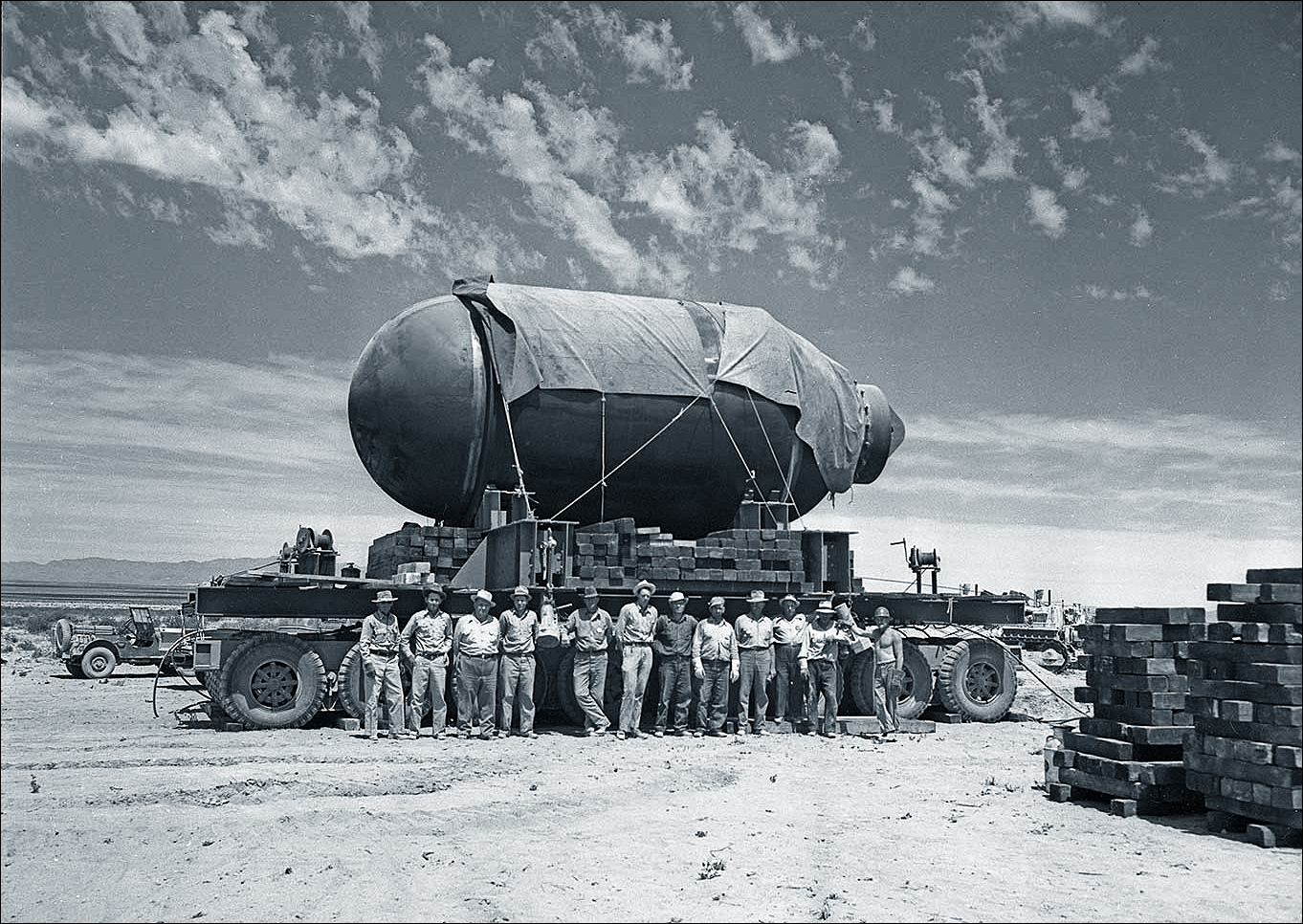
In 1943, the Manhattan District became responsible for collecting military intelligence on Axis atomic research. Groves created Operation Alsos, special intelligence teams that would follow in the wake of the advancing armies, rounding up enemy scientists and collecting what technical information and technology they could. Alsos teams ultimately operated in Italy, France and Germany.
A joint Manhattan District – USAAF targeting committee was established to determine which cities in Japan should be the first atomic targets. That committee recommended Kokura, Hiroshima, Niigata, and Kyoto.
At this point, Secretary of War Henry L. Stimson intervened, announcing that he would make the final targeting decision; and that he would not authorize the bombing of Kyoto. Groves attempted to get him to change his mind several times and Stimson still refused each time. Kyoto had been the ancient capital of Japan for centuries, and was of great cultural and religious significance to the Japanese. In the end, Groves asked Arnold to remove Kyoto not just from the list of nuclear targets, but from targets for conventional bombing as well. Nagasaki was then substituted for Kyoto as a target.
Groves was promoted to temporary major general on 9 March 1944. After the atomic bombing of Hiroshima and Nagasaki became public knowledge, he was awarded the Distinguished Service Medal. Groves had previously been nominated for the Distinguished Service Medal for his work on the Pentagon, but in order to avoid drawing unnecessary attention to the Manhattan Project, he was not awarded at the time. After the war, the Decorations Board decided to change it to a Legion of Merit. In recognition of his work on the project, the Belgian government also made Groves a Commander of the Order of the Crown and the British government made him an honorary Companion of the Order of the Bath.
On January 1, 1947, responsibility for nuclear power and nuclear weapons was transferred from the Manhattan District to the Atomic Energy Commission. On January 29, 1947, the Secretary of War, Robert P. Patterson, and the Secretary of the Navy, James V. Forrestal, issued a joint directive creating the Armed Forces Special Weapons Project (AFSWP) to control the military aspects of nuclear weapon development. Groves was appointed chief of the project on 28 February 1947. In April, AFSWP moved from the New War Department Building to the fifth floor of the Pentagon.
Groves realized in the rapidly shrinking postwar military he would not be given any assignments similar in importance to the ones he had held in the Manhattan Project, as such posts would go to combat commanders returning from overseas. As a result he decided to retire and leave the Army. In recognition of his leadership of the Manhattan Project, he received an honorary promotion to lieutenant general by special Act of Congress effective 24 January 1948, just before his official retirement on 29 February 1948. However, the date of that rank was backdated to 16 July 1945, the date of the Trinity nuclear test.
Groves went on in the private sector to become a vice president at Sperry Rand, an equipment and electronics firm. He moved to Darien, Connecticut in 1948 to take the position. He retired from Sperry Rand in 1961 at the age of 65. He also served as a president of the West Point Alumni Organization, the Association of Graduates.
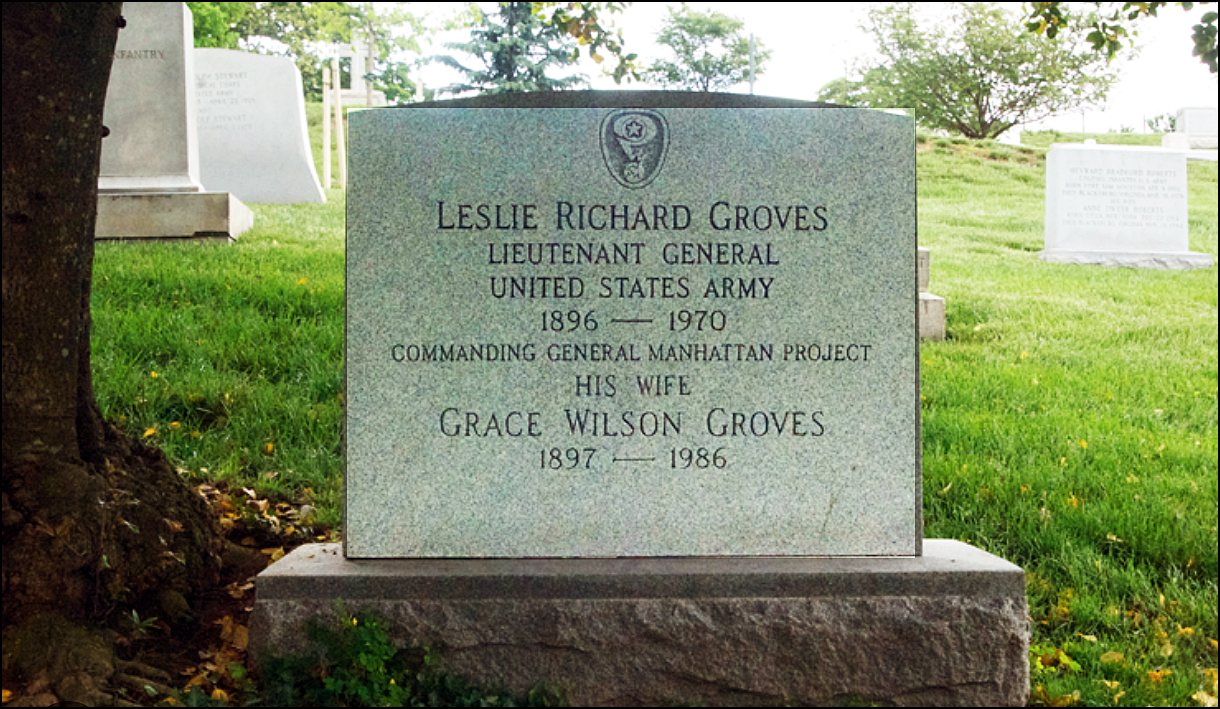
On July 13, 1970, Groves suffered a heart attack caused by chronic calcification of the aortic valve. He was rushed to Walter Reed Army Medical Center in Washington, D.C., where he died that night at age 73. A funeral service in his honor was held in the military chapel at Fort Myer, Virginia; after which Groves was interred in Arlington National Cemetery next to his brother Allen, who died of pneumonia in 1916.✪



















▶️ DONATE VIA PAYPAL (DEBIT & CREDIT CARD)
ALL PayPal Transactions Are Encrypted For Card Holder Privacy & Security
▶️ DONATE VIA ZELLE (DIRECT BANK CASH TRANSFER)
ZELLE is the perfect online alternative to PayPal. It’s an incredibly simple, secure, easy, fast and FREE way to send or receive money to recipients directly from your online banking account without a middleman. Best of all, there’s NO fees.
ZELLE is a service provided by your bank and is already built in to your online banking account. You only need to activate it first before using. If you’ve already activated ZELLE in your online bank or credit union account, you can donate to The New Americanist by using our ZELLE address:
vip@thenewamericanist.com
To activate your ZELLE, follow these easy instructions (a simple two minute process):

▶️ DONATE VIA SNAIL MAIL