


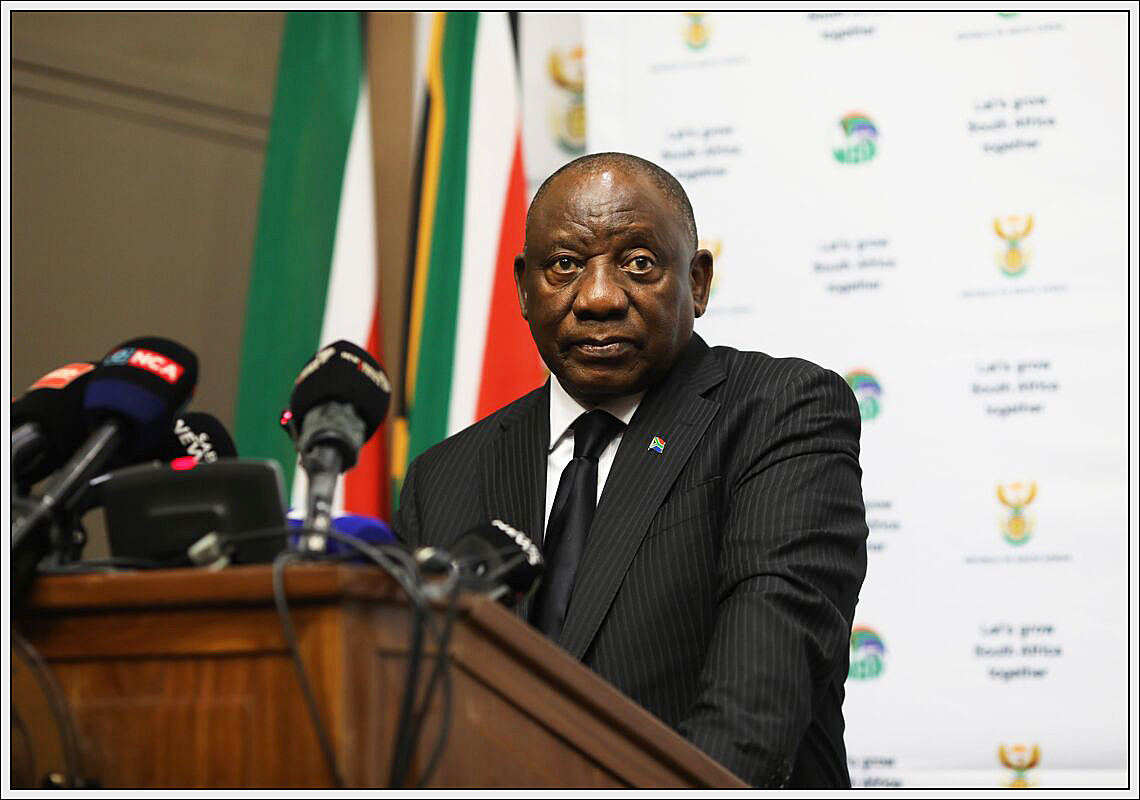

✪✪✪ South Africa has regressed into an ideologically-driven socialist-communist abyss of poverty, crime, corruption and systemic dysfunction at all levels: local, state and national – in only 30 years since the end of Apartheid...
▶️ CLICK HERE FOR FEATURE STORY

nnn
nce the leading economic power in all of Africa, South Africa is now regarded as the most corrupt country on the continent. It resembles a typical “banana republic” in many ways; little different from other failed or collapsing states in the region, particularly its northern neighbor of Zimbabwe; a Marxist dictatorial hellhole.
According to an independent body, the South African Institution of Civil Engineering:
“Ten years ago rated South Africa’s infrastructure as C, and now it has deteriorated to a D rating. On its current path, the country is heading towards an E, meaning unfit for purpose.”
As the Daily Investor notes, “South Africa’s infrastructure is collapsing in front of everyone’s eyes.” The basis of any economy is infrastructure because it allows trade and workers to travel. With “unfit” infrastructure: roads, ports, airports, and bridges and so on, the South African economy will eventually fail.
Regardless, powered by its Marxist-themed National Democratic Revolution (NDR) charter, the leading political party, the African National Congress (ANC), has been accelerating its collectivist program to control all aspects of the economy; whether public or private. While the private sector still has some freedoms, they continue diminishing under attack by the day.
History demonstrates the inevitable consequences of radical socialist-communist policies is economic collapse and social discord. These outcomes should not be surprising when considering the ANC’s political strategy is fully within the Marxist playbook: res delenda est – everything must be destroyed, re-fabricated and brought to fulfillment into a communist state, to create a new order for the nation.
The demise of major private sector companies with long histories there, appears to be a direct result of nationalistic government policies coupled to aggressive and ideologically driven trade unions; which presumably, would rather see companies closed down than accept lesser wage contracts for their allegedly “oppressed” workers.
Unionized South African workers are among the best paid in Africa, due to unions always bargaining for above inflation wage growth; ostensibly to narrow the long-term, large inequality gap. At the same time, the ANC Government has enacted detrimental labor laws which make it difficult for private companies to hire and fire. This development has had a dampening effect on hiring in the private sector and has thus further escalated unemployment.
Result of draconian labor laws is an official unemployment rate which exceeds 33% (more than 8 million potential workers). While the rate for unemployed younger workers exceeds 60%. These figures consistently rate among the world’s highest and confirm for millions that they have little or no future employment prospects in their own country of birth.
Over the past 25 years, more than 70,000 important companies have also entered liquidation with more than 2.8 million jobs lost directly due to adverse government policies. According to Haroon Bhorat, director of the Development Policy Research Unit at the University of Cape Town, these figures are an “underlying indicator of de-industrialization.”
As the deindustrialization of Africa’s most industrialized country accelerates, the unemployment rate will increase accordingly and even more people will become reliant on government entitlement in order to survive. The centralized ANC state has citizens exactly where they want them; under their control and dependent upon the government for daily life. In this way future votes are secured, leading to the perpetuation of one party ANC control; a typical seditious device to remain in power indefinitely used in other nations in Africa.
Even the Economic Freedom Fighters (EFF), a radical far-leftist political party of the “Kill the farmer, kill the Boer” fame laments over this economic catastrophe:
“What we are witnessing is the destruction of the little industry South Africa has left, a collapse that will hollow out communities and deepen mass unemployment… The government cannot continue to wash its hands while South Africa’s industrial backbone is dismantled.”
However, the irony of their complaint is seemingly lost on the EFF: as it was their policies which significantly contributed to the economic demise and deindustrialization of the country. The party’s leader, Julius Malema, calls for supporters to “cut the throat of whiteness” and “shoot the Boer,” while advocating ongoing land-grabs without compensation, particularly of white-owned farmland.
In 2022 Malema’s revolutionary slogan, such as “Kill the Farmer” was ruled by the Equality Court not as hate speech, but simply an exercise in freedom of speech. However, in August this year a High Court did find Malema guilty of hate speech.
This issue was raised by US President Donald Trump at the White House meeting in May 2025 when South African President Cyril Ramaphosa dismissed allegations of hate speech directed at whites.
In addition to the closing or restructuring of corporate stalwarts such as Goodyear, Dunlop Tires, Glencore, Mango Airlines, supermarket chain Pick n Pay, Group Five Construction, MultiChoice Media, the South African Broadcasting Corporation, Cell C, the South African Post Office, Stefanutti Stocks Construction, the analytic and data group Nielsen, other notable entities in financial distress include:
Murray & Roberts, a construction giant with an international footprint and an icon in South Africa for over 120 years, went into receivership this year, laying-off some 1,400 workers.
ArcelorMittal, a major steel company; the largest and oldest in the nation since 1928 is now in the process of closing various plants. As CEO Kobus Verster explained:
“Around 3,500 jobs would be lost directly, while studies estimate that as many as 80,000 people could be affected indirectly as downstream businesses, mines, quarries, schools, and small guesthouses dependent on the industry.”
Economic collateral damage also includes leading iron ore mines due to the fact that ArcelorMittal is their main customer.
Ford Motor Company in South Africa advises the public that it will be firing nearly 500 workers due to slowing demand. Ford is a major manufacturer of motor vehicles in the country and has had a presence there for over 100 years. A spokesman for the Solidarity Trade Union commented:
“When an automotive giant like Ford takes such drastic steps, it is a warning to the entire industry… We fear that further retrenchments may be inevitable if conditions do not improve quickly.”
The sad truth is the economy is “imploding, with key industries falling one by one like a set of dominoes, after 15 years of mismanagement and poor government policy,” notes journalist Shaun Jacobs.
There are currently no internal indications whatsoever that the socialist-driven centralized economy will improve “quickly” if ever at all. In fact, it will probably continue to deteriorate; unless the West intervenes. If there is to be any hope for South Africa, and the ANC is to relinquish power or remedy their destructive policies, it lies largely with the current US Administration.
To bring about fundamental change in South Africa, the country must change from its alliance with totalitarian regimes to one closer to those nations reflecting Western interests in the liberal democratic tradition. The country is too important to the West for it to remain aligned with the anti-Western powers of China, Russia, Iran and North Korea; and for these despotic nations to take advantage of America’s absence of influence in southern Africa.
The West has long been sympathetic to South Africa; arguably at times, too sympathetic — and has mainly treated it gently despite its recent alignment with BRICS, a group of 11 emerging economies: Brazil, Russia, India, China, South Africa, Egypt, Ethiopia, Iran, Saudi Arabia, the United Arab Emirates and Indonesia — that bonded together on economic and geopolitical issues presumably as a counterbalance to the West, and purportedly to increase development.
Despite much international criticism, Ramaphosa declared in February that, “We are not daunted. We will not be deterred. We will speak in defense of our national interests.” Despite being the US’s largest trade partner in Africa, he was clearly verbalizing the ANC’s defiant attitude towards the West.
South Africa has also cozied up to totalitarian nations. South Africa’s anti-Western stance, however, was made clear at the United Nations when it openly supported resolutions contrary to Western interests.
Trump took notice of this contrary stance and decided to take action. On May 21, 2025, at a Trump meeting at the White House, the US deemed it a suitable occasion to confront Ramaphosa over South Africa’s radical policies, including the 140 racist employment and business restrictions on white males.
Other issues raised in Washington included hate speech against minorities, which has resulted in a mass exodus of the white educated class. Assaults on white farmers have also forced many farmers to take advantage of America’s refugee program to relocate in the US. A further contentious issue was the ANC decision to expropriate private property without compensation; a disastrous policy which economically crippled neighboring Zimbabwe by creating too much uncertainty; resulting in the death of foreign investment.
Also of concern was South Africa’s military co-operation with ideological “soulmates” such as Iran, Russia, and Communist China. The ANC boasts “one of the strongest party-to-party relationships in Africa.” It’s a policy which has surely led to the country being further ostracized by western investors.
The televised meeting at the White House turned into complete calamity for South Africa. Ramaphosa was unable to explain to a global audience why such racist policies are not only permitted, but enacted into law. This, after the West supported the liberation struggle against Apartheid policies — to end racial discrimination in the country against blacks — enabling the ANC to take power. Instead, a situation of reverse-Apartheid; of apparent revenge, against whites seems to have emerged in its place.
Despite being criticized in front of a wide international audience and at risk of being sanctioned by the US; an ANC spokesperson doubled-down on the government’s radical agenda:
“We hear there is a good lobby around sanctions, but throughout our struggle we know that leaders and members of the liberation movement had to sacrifice. Even in this particular period, we will continue to pay the price of standing for justice, humanity, equality and respect for the rule of law.”
These may sound like commendable words but are totally misleading. The ANC’s contradicts itself on human rights and their blatant racism against white minorities.
The ANC’s statement of intent sadly reveals they have no intentions of ever wavering from their ideological stance despite threat of sanctions and punitive US trade tariffs. The spokesman for the Institute of Race Relations, John Endres, commented about the ANC:
“The party misses no opportunity to reaffirm its commitment to the National Democratic Revolution, a programme designed to turn South Africa first into a socialist and then into a communist state.”
Facing possible US sanctions, the ANC is fast losing political support both domestically and internationally. Political commentator Hermann Pretorious predicts due to its contrarian ideological stance, the ANC is on a “death spiral.” Its share of votes is estimated to have fallen from almost 70% in 2004, to 40% in 2024, and 2025 is estimated to be around 30%. Pretorius says of the ANC:
“Instead of renewal, it has chosen entrenchment. Instead of pragmatism, dogma. Instead of growth, redistribution without production. Instead of survival, an overdose of toxic ideology.”
Determining what the next dominant political party in South Africa will be is fraught with complexities. The main contenders are the Democratic Alliance (DA), a centrist party supported by 22% of the electorate but with limited appeal to a black majority; the far-left and vehemently anti-White EFF which commanded only 9% in the 2024 national election, and the MK Party, a Zulu ethnic-focused group polling at 15%, but based mainly in one state. The outcome will probably be a coalition of convenience, not of ideology, and thus subject to early fracture.
The weakening of the ANC’s authority could lead to other challenges. Endres predicts:
“The party would resort to ever more extreme versions of the NDR – more state intervention, more regulation, more race-based laws, more threats to property rights – in an effort to reassert its power. It would be more tempted to get into bed with the EFF and MK to shore up its support.”
In this scenario, extreme leftist parties would dominate national politics and the centrist DA would be left shut out in the backwaters of irrelevance.
A possible alternative to the current constitutional structure is the implementation of a federalized system with independence of the nine states, much like the US. However, this too is unlikely as voters would probably prefer to splinter according to tribal or ethnic affiliation.
With the looming demise of ANC dominance, a power vacuum might also result, accelerating the prospect of more intense social conflicts. Given the nation’s current enormously high unemployment rate and endemic poverty, it might only take a spark to set mass social discord alight.
In such an event, the ANC’s may use the military to take control, or simply take over the entire country in order to reinstate ANC dominance by force; a similar communist ploy already used in Zimbabwe and other countries.
As it is, the military has recently engaged in activities outside the scope of its neutral position and accountability to the executive. A few weeks ago, General Rudzani Maphwanya, chief of the South African National Defence Force (SANDF), apparently took it upon himself to pay an official visit to Iran. Respected political commentator William Saunderson-Meyer commented:
“In Tehran, Maphwanya blatantly entered the civilian arena of governance to punt military and diplomatic cooperation. Emphasising that his trip was ‘not only a military one’ but had been ‘carried out at the best possible time’ to convey ‘a political message’, Maphwanya delivered personal greetings from Ramaphosa and Motshekga to the ‘peace-loving nation of Iran’ with which, he said, South Africa shares ‘common goals.'”
Ramaphosa should have been outraged at this usurpation of the executive’s role and fired Maphwanya. In an ominous development for South Africa’s democracy and separation of powers, Ramaphosa instead called a meeting of no consequence with the Maphwanya, not even a “slap on the wrist.” Similarly, Rear Admiral Prince Tshabalala, the SANDF’s director of Defence Corporate Communication, “made it clear the SANDF sees a future political role for itself.”
Saunderson-Meyer therefore believes “the ANC might not be able to prevent the military from acting as it sees fit.”
The ANC is now reportedly trying to forge a “deal” with Trump to enlist deeper US involvement & investment in South Africa. However, the future of South Africa should remain of serious concern to its citizens, West & the World.✪















▶️ DONATE VIA PAYPAL (DEBIT & CREDIT CARD)
ALL PayPal Transactions Are Encrypted For Card Holder Privacy & Security
▶️ DONATE VIA ZELLE (DIRECT BANK CASH TRANSFER)
ZELLE is the perfect online alternative to PayPal. It’s an incredibly simple, secure, easy, fast and FREE way to send or receive money to recipients directly from your online banking account without a middleman. Best of all, there’s NO fees.
ZELLE is a service provided by your bank and is already built in to your online banking account. You only need to activate it first before using. If you’ve already activated ZELLE in your online bank or credit union account, you can donate to The New Americanist by using our ZELLE address:
To activate your ZELLE, follow these easy instructions (a simple two minute process):
vip@thenewamericanist.com

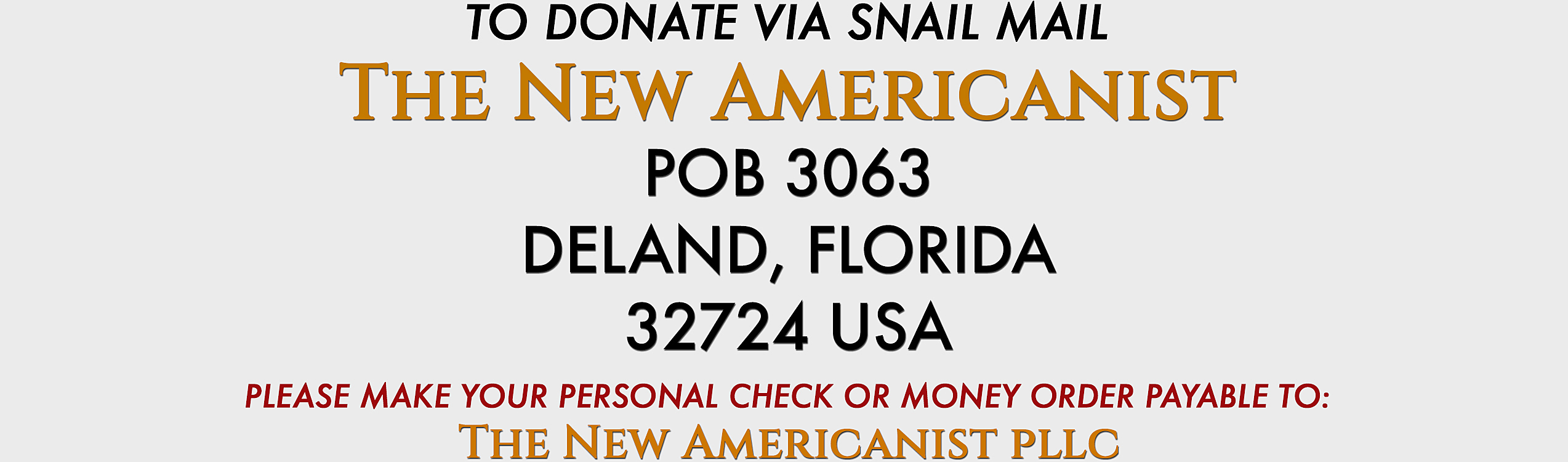
▶️ DONATE VIA SNAIL MAIL






▶️ CLICK HERE TO VIEW
▶️ 32 Minutes 27 Seconds
▶️ 5 Minutes 50 Seconds
▶️ 1 Hour & Minutes 45 Seconds
▶️ 25 Minutes 7 Seconds
▶️ 10 Minutes 34 Seconds
▶️ 10 Minutes 46 Seconds
▶️ 59 Minutes 42 Seconds
▶️ 10 Minutes 11 Seconds
▶️ 8 Minutes 42 Seconds
▶️ 49 Minutes 18 Seconds
▶️ 8 Minute 9 Seconds
▶️ 8 Minutes 31 Seconds
▶️ 17 Minutes 47 Seconds
▶️ 11 Minutes 1 Seconds
▶️ 9 Minutes 11 Seconds
▶️ 13 Minutes 22 Seconds
▶️ 28 Minutes 11 Seconds
▶️ 24 Minutes 50 Seconds
▶️ 10 Minutes 6 Seconds
▶️ 12 Minutes 02 Seconds
▶️ 8 Minutes 30 Seconds ⭐️ Gary Brown
▶️ 19 Minutes 05 Seconds
▶️ 10 Minutes 42 Seconds
▶️ 1 Minutes 48 Seconds
▶️ 12 Minutes 27 Seconds
▶️ RSBN LIVESTREAM LINK: Trump Presser With Kash Patel
RSBN LIVESTREAM LINK: White House Ballroom Dinner
⭐️ TokaiseBlessedPatriot
