⭐️ Huck Funn


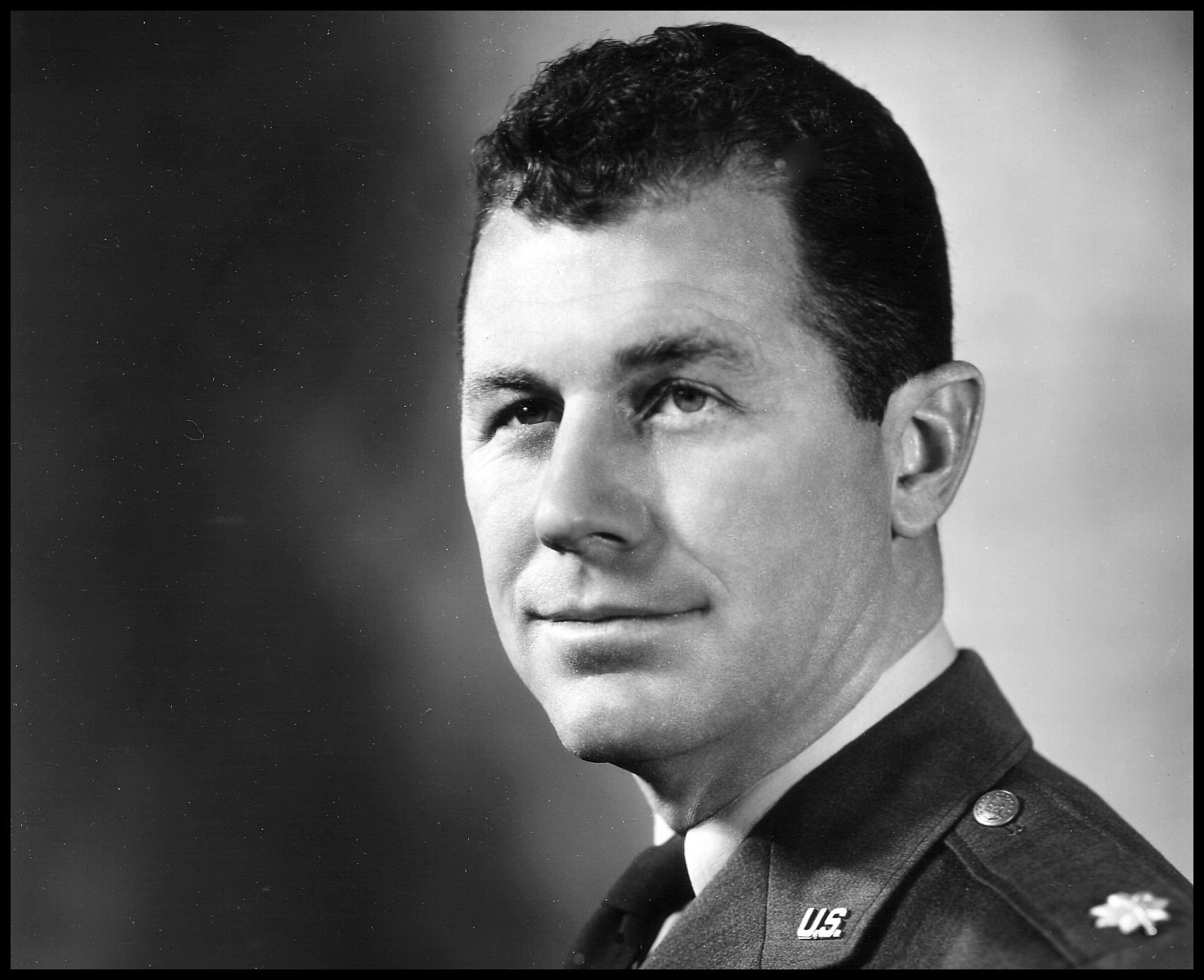

Charles Elwood Yeager: February 13, 1923 – December 7, 2020
✪ Brigadier General Charles Elwood Yeager was a United States Air Force officer, flying ace, and record-setting test pilot who in October 1947 became the first pilot in history confirmed to have exceeded the speed of sound in level flight.
Yeager is regaurded by many as one of the greatest pilots of all time, and was ranked fifth on Flying Magazine’s list of the 51 Heroes of Aviation in 2013. Over a 70-year period, he flew more than 360 different types of aircraft; and continued to fly for two decades after his retirement as a consultant pilot for the United States Air Force.
Yeager was raised in Hamlin, West Virginia. His career began in World War II as a private in the United States Army, assigned to the Army Air Forces in 1941. In September 1942, after serving as an aircraft mechanic, he entered enlisted pilot training and upon graduation was promoted to the rank of flight officer (the World War II Army Air Force version of the Army’s warrant officer), later achieving most of his aerial victories as a P-51 Mustang fighter pilot on the Western Front, where he was credited with shooting down 11.5 enemy aircraft. The half credit is from a second pilot assisting him in a single shootdown. On October 12, 1944, he attained “ace in a day” status, shooting down five enemy aircraft in one mission.
After the war, Yeager became a test pilot and flew many different types of aircraft, including experimental rocket-powered aircraft for the National Advisory Committee for Aeronautics (NACA). Through the NACA program, he became the first human to officially break the sound barrier on October 14, 1947, when he flew the experimental Bell X-1 at Mach 1.05 at an altitude of 45,000 ft. For this achievement, he won both the Collier and Mackay trophies in 1948. He would go on to break several other speed and altitude records in the following years. In 1962, he became the first commandant of the USAF Aerospace Research Pilot School, which trained and produced astronauts for NASA and the Air Force.
Yeager later commanded fighter squadrons and wings in Germany, as well as in Southeast Asia during the Vietnam War. In recognition of his achievements and the outstanding performance ratings of those units, he was promoted to brigadier general in 1969 and inducted into the National Aviation Hall of Fame in 1973. He officially retired from the Air Force on March 1, 1975; the date chosen for its colloquial similarity to “Mach 1.” His three-war active-duty flying career spanned more than 30 years and took him to many parts of the world, including the Korean War zone and the Soviet Union during the height of the Cold War.
Yeager was born February 13, 1923, in Myra, West Virginia, to farming parents Albert Hal Yeager (1896–1963) and Susie Mae Yeager (née Sizemore; 1898–1987). When he was five years old, his family moved to Hamlin, West Virginia. Yeager had two brothers, Roy and Hal Jr., and two sisters, Pansy lee & Doris Ann (who was accidentally killed at age two by four-year-old Roy playing with a firearm).
Yeager attended Hamlin High School, where he played basketball and football, receiving his best grades in geometry and typing. He graduated from high school in June 1941.
His first experience with the military was as a teen at the Citizens Military Training Camp at Fort Benjamin Harrison, Indianapolis, Indiana, during the summers of 1939 and 1940. On February 26, 1945, Yeager married Glennis Dickhouse. The couple had four children. Glennis Yeager died in 1990.
On September 12, 1941, Yeager enlisted as a private in the U.S. Army Air Forces (USAAF) and became an aircraft mechanic at George Air Force Base in Victorville, California. At enlistment, Yeager was not eligible for flight training because of his age and educational background, but the entry of the U.S. into World War II less than three months later prompted the USAAF to alter its recruiting standards. Yeager had unusually sharp vision with his visual acuity rated 20/10, which once enabled him to shoot a deer at 600 yards.
Prior to January 1942, when his Engineering Officer invited him on a test flight after maintenance of an AT-11, Yeager had never been in an airplane. He related that he became very sick on the flight. He recalled later, “After puking all over myself I said, ‘Yeager, you made a big mistake.'”
At the time of his flight training acceptance, he was a crew chief on an AT-11. He received his pilot wings and a promotion to flight officer at Luke Field, Arizona, where he graduated from Class 43C on March 10, 1943. Assigned to the 357th Fighter Group at Tonopah, Nevada, he initially trained as a fighter pilot, flying Bell P-39 Airacobras. He was grounded for seven days for clipping a farmer’s tree during a training flight) and shipped overseas with the group on November 23, 1943.
Stationed in the United Kingdom at RAF Leiston, Yeager flew P-51 Mustangs in combat with the 363d Fighter Squadron. He named his aircraft Glamorous Glennis after his girlfriend, Glennis Faye Dickhouse, who became his wife in February 1945. Yeager gained one victory before he was shot down over France in his first aircraft (P-51B-5-NA s/n 43-6763) on March 5, 1944, on his eighth mission. He escaped to Spain on March 30, 1944, with the help of the Maquis (French Resistance) and returned to England on May 15, 1944. During his stay with the Maquis, Yeager assisted the guerrillas in duties that did not involve direct combat; helping to construct bombs for the group, a skill that he had learned from his father.
Despite a regulation prohibiting “evaders” (escaped pilots) from flying over enemy territory again, the purpose of which was to prevent resistance groups from being compromised by giving the enemy a second chance to possibly capture him, Yeager was reinstated to flying combat. He joined another evader, fellow P-51 pilot 1st Lt Fred Glover, in speaking directly to the Supreme Allied Commander, General Dwight D. Eisenhower, on June 12, 1944. “I raised so much hell that General Eisenhower finally let me go back to my squadron” Yeager said. “He cleared me for combat after D Day, because all the free Frenchmen – Maquis and people like that – had surfaced.”
Yeager demonstrated outstanding flying skills and combat leadership. On October 12, 1944, he became the first pilot in his group to make “ace in a day,” downing five enemy aircraft in a single mission. Two of these victories were scored without firing a single shot when he flew into firing position against a Messerschmitt Bf 109 and the pilot of the aircraft panicked, breaking to port and colliding with his wingman. Yeager said both pilots bailed out. He finished the war with 11.5 official victories, including one of the first air-to-air victories over a jet fighter, a German Messerschmitt Me 262 that he shot down as it was on final approach for landing.
In his 1986 memoirs, Yeager recalled with disgust that “atrocities were committed by both sides,” and said he went on a mission with orders from the Eighth Air Force to “strafe anything that moved.” During the mission briefing, he whispered to Major Donald H. Bochkay, “If we are going to do things like this, we sure as hell better make sure we are on the winning side.” Yeager said, “I’m certainly not proud of that particular strafing mission against civilians. But it is there, on the record and in my memory.” He also expressed displeasure & bitterness at his treatment in England during World War II, describing the British as “arrogant” and “nasty.”
Yeager was commissioned a second lieutenant while at Leiston, and was promoted to captain before the end of his tour. He flew his 61st and final mission on January 15, 1945, and returned to the United States in early February 1945.
After the war, Yeager remained in the U.S. Army Air Forces. Upon graduating from Air Materiel Command Flight Performance School (Class 46C), Yeager became a test pilot at Muroc Army Air Field (now Edwards Air Force Base).
the USAAF selected the 24-year-old Yeager to fly the rocket-powered Bell XS-1 in a NACA program to research high-speed flight. Under the National Security Act of 1947, the USAAF became the United States Air Force (USAF) on September 18. Yeager’s flight was scheduled for October 14. Two nights before his flight, Yeager went horseback riding with his wife and fell off his horse, breaking two ribs under his right arm. Worried the injury would disqualify him from the mission, Yeager had a civilian doctor in nearby Rosamond tape his ribs.
However, to seal the hatch on the XS-1, the pilot needed to hold the hatch in position and use their right arm to slam down a heavy lever. Yeager would not be able to seal the hatch with his broken ribs, so Yeager secretly asked his friend and fellow project pilot Jack Ridley for a solution. Ridley sawed off the end of a broom handle for Yeager to use as a lever to seal the hatch.
▶️ 6 Minutes 19 Seconds
On October 14, 1947, Yeager broke the sound barrier in level flight while piloting the X-1 Glamorous Glennis at Mach 1.05 at an altitude of 45,000 ft over the Rogers Dry Lake of the Mojave Desert in California.
The success of the mission would still not be announced to the public for nearly eight months, until June 10, 1948. The X-1 he flew that day was later put on permanent display at the Smithsonian Institution National Air and Space Museum. During 1952, Yeager attended the Air Command and Staff College.
On November 20, 1953, the U.S. Navy program involving the Douglas D-558-II Skyrocket and its pilot, Scott Crossfield, became the first team to reach double the speed of sound. After they were bested, Ridley and Yeager decided to beat rival Crossfield’s speed record in a series of test flights that they dubbed “Operation NACA Weep.” Not only did they beat Crossfield by setting a new record at Mach 2.44 on December 12, 1953; but also did so in time to spoil a celebration planned for the 50th anniversary of flight, at which Crossfield was scheduled to be honored as “the fastest man alive.”
However, that new flight record did not entirely go as planned, since shortly after reaching Mach 2.44, Yeager lost control of the X-1A at about 80,000 ft due to inertia coupling, a phenomenon largely unknown at the time. With the aircraft simultaneously rolling, pitching, and yawing out of control, Yeager dropped 51,000 ft in less than a minute before regaining control at around 29,000 ft. He then managed to land without further incident. For this feat, Yeager was awarded the Distinguished Service Medal in 1954.
Yeager was foremost a fighter pilot and held several squadron and wing commands from 1954 to 1957. He was a full colonel in 1962, after completion of a year’s studies and final thesis on STOL aircraft at the Air War College. He became the first commandant of the USAF Aerospace Research Pilot School, which trained and produced astronauts for NASA and the USAF.
In April 1962, Yeager made his only flight with Neil Armstrong. Their job was to fly a T-33 and evaluate Smith Ranch Dry Lake in Nevada for use as a possible emergency landing site for the North American X-15.
In his autobiography, Yeager wrote that he knew the lake bed was unsuitable for landings after recent rains, but Armstrong insisted on flying out anyway. As Armstrong suggested that they do a touch-and-go, Yeager advised against it, telling him “You may touch, but you ain’t gonna go!” When Armstrong did touch down, the wheels became stuck in the mud, bringing the plane to a sudden stop and provoking Yeager to fits of laughter. They had to wait for rescue.
Between December 1963 and January 1964, Yeager completed five flights in the NASA M2-F1 lifting body. An accident during a December 1963 test flight in one of the school’s NF-104s resulted in serious injuries. After climbing to a near-record altitude, the plane’s controls became ineffective, and it entered a flat spin. After several turns, and an altitude loss of approximately 95,000 feet, Yeager ejected from the plane. During the ejection, the seat straps released normally, but the seat base slammed into Yeager, with the still-hot rocket motor breaking his helmet’s plastic faceplate and causing his emergency oxygen supply to catch fire. The resulting burns to his face required extensive and agonizing medical care. This was Yeager’s last attempt at setting test-flight records.
In 1966, Yeager took command of the 405th Tactical Fighter Wing at Clark Air Base, the Philippines, whose squadrons were deployed on rotational temporary duty (TDY) in South Vietnam and elsewhere in Southeast Asia. There he flew 127 missions. In February 1968, Yeager was assigned command of the 4th Tactical Fighter Wing at Seymour Johnson Air Force Base, North Carolina, and led the McDonnell Douglas F-4 Phantom II wing in South Korea during the Pueblo crisis.
In July 1969, Yeager was promoted to brigadier general and assignedas the vice-commander of the Seventeenth Air Force.
From 1971 to 1973, at the behest of Ambassador Joseph Farland, Yeager was assigned as the Air Attache in Pakistan to advise the Pakistan Air Force. He arrived in Pakistan at a time when tensions with India were at a high level. After hostilities broke out in 1971, he decided to stay in West Pakistan to contin ue overseeing the PAF’s operations. Yeager recalled “the Pakistanis whipped the Indians’ asses in the sky… the Pakistanis scored a three-to-one kill ratio, knocking out 102 Russian-made Indian jets and losing 34 airplanes of their own.”
During the war, he also flew around the western front in a helicopter documenting wreckages of Indian aircraft of Soviet origin, which included Sukhoi Su-7s and MiG-21s. These aircraft were later transported to the United States after the war for analysis. Yeager also flew around in his Beechcraft Queen Air, a small passenger aircraft that assigned to him by the Pentagon, picking up shot-down Indian fighter pilots.
On March 1, 1975, Yeager retired from the Air Force at Norton Air Force Base, California.
Yeager made a cameo appearance in the movie The Right Stuff (1983). He played “Fred,” a bartender at “Pancho’s Place,” which was most appropriate, because he said, “if all the hours were ever totaled, I reckon I spent more time at her place than in a cockpit over those years.”
For several years in the 1980s, Yeager was professionally connected to General Motors, as a spokesperson for ACDelco, the company’s automotive parts division. In 1986, he was invited to drive the Chevrolet Corvette pace car for the 70th running of the Indianapolis 500. In 1988, Yeager was invited again to drive the pace car; this time at the wheel of an Oldsmobile Cutlass Supreme. In 1986, President Reagan appointed Yeager to the Rogers Commission that investigated the explosion of the Space Shuttle Challenger.
On October 14, 1997 on the 50th anniversary of his historic flight past Mach 1, he flew a new Glamorous Glennis III, an F-15D Eagle, past Mach 1. At the end of his speech to the crowd at that event, Yeager concluded, “All that I am … I owe to the Air Force.”
On October 14, 2012, on the 65th anniversary of breaking the sound barrier, Yeager did it again at the age of 89, flying as co-pilot in a McDonnell Douglas F-15 Eagle piloted by Captain David Vincent out of Nellis Air Force Base.
In 1966, Yeager was inducted into the International Air & Space Hall of Fame.He was inducted into the International Space Hall of Fame in 1981. He was inducted into the Aerospace Walk of Honor 1990 inaugural class. Yeager Airport in Charleston, West Virginia, is named in his honor.
In 1973, Yeager was inducted into the National Aviation Hall of Fame, arguably aviation’s highest honor. In 1974, Yeager received the Golden Plate Award of the American Academy of Achievement. In December 1975, the U.S. Congress awarded Yeager a silver medal “equivalent to a noncombat Medal of Honor … for contributing immeasurably to aerospace science by risking his life in piloting the X-1 research airplane faster than the speed of sound on October 14, 1947.” President Gerald Ford presented the medal to Yeager in a ceremony at the White House on December 8, 1976.
Yeager never attended college and was often modest about his background, but is considered by many, including Flying Magazine, the California Hall of Fame, the State of West Virginia, National Aviation Hall of Fame, several U.S. presidents, and the United States Army Air Force, to be one of the greatest pilots of all time.
Flying Magazine ranked Yeager number 5 on its 2013 list of The 51 Heroes of Aviation; for many years, he was the highest-ranked living person on the list.
Yeager named his plane after his wife, Glennis, as a good-luck charm: “You’re my good-luck charm, hon. Any airplane I name after you always brings me home.” Yeager and Glennis moved to Grass Valley, California, after his retirement from the Air Force in 1975. There, the couple prospered as a result of Yeager’s best-selling autobiography, speaking engagements, and commercial ventures. Glennis Yeager died of ovarian cancer in 1990.
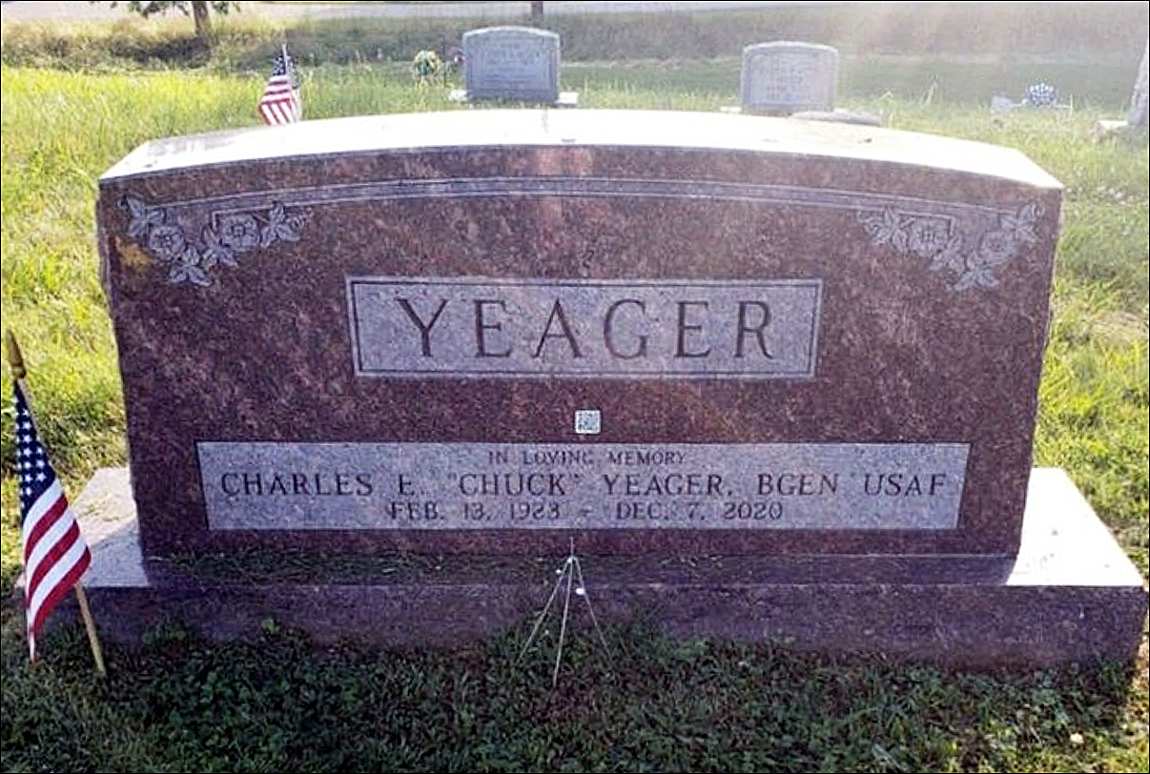
Yeager lived in Grass Valley, Northern California and died of natural causes on the afternoon of December 7, 2020 (National Pearl Harbor Remembrance Day), at the age of 97 in a Los Angeles hospital. Following his death, President Donald Trump issued a statement of condolences proclaiming Yeager “was one of the greatest pilots in history, a proud West Virginian, and an American original who relentlessly pushed the boundaries of human achievement.” At the request of his family, Yeager was buried at the Lincoln Memorial Cemetery in his childhood hometown Hamlin, West Virginia instead of Arlington National Cemetery. ✪

















▶️ DONATE VIA PAYPAL (DEBIT & CREDIT CARD)
ALL PayPal Transactions Are Encrypted For Card Holder Privacy & Security
▶️ DONATE VIA ZELLE (DIRECT BANK CASH TRANSFER)
ZELLE is the perfect online alternative to PayPal. It’s an incredibly simple, secure, easy, fast and FREE way to send or receive money to recipients directly from your online banking account without a middleman. Best of all, there’s NO fees.
ZELLE is a service provided by your bank and is already built in to your online banking account. You only need to activate it first before using. If you’ve already activated ZELLE in your online bank or credit union account, you can donate to The New Americanist by using our ZELLE address:
vip@thenewamericanist.com
To activate your ZELLE, follow these easy instructions (a simple two minute process):

▶️ DONATE VIA SNAIL MAIL