
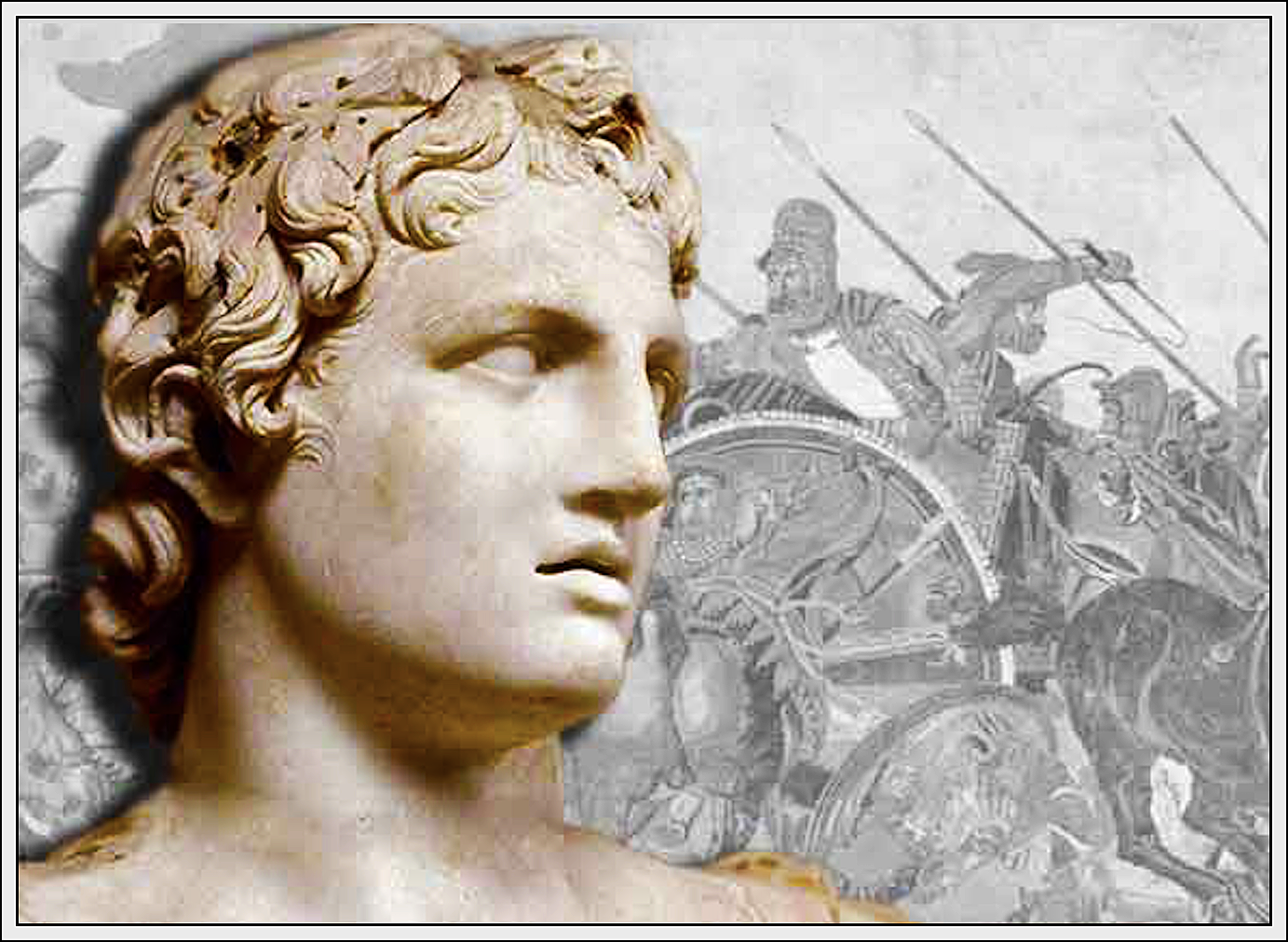

Alexander III of Macedon: 20/21 July 356 BC-10/11 June 323 BC
✪ Alexander III of Macedon, most commonly known as Alexander the Great, was a king of the ancient Greek kingdom of Macedon. He succeeded his father Philip II to the throne in 336 BC at the age of 20 and spent most of his ruling years conducting a lengthy military campaign throughout Western Asia, Central Asia, parts of South Asia, and Egypt. By the age of 30, he had created one of the largest empires in history, stretching from Greece to northwestern India. He was undefeated in battle and is widely considered to be one of history’s greatest and most successful military commanders.
Alexander was tutored by Aristotle until the age of sixteen. In 335 BC, shortly after his assumption of kingship over Macedon, he campaigned in the Balkans and reasserted control over Thrace before marching on the city of Thebes in Egypt, which was subsequently destroyed in battle. Alexander then led the League of Corinth, using his authority to launch the pan-Hellenic project envisaged by his father by assuming leadership over all Greeks in their conquest of Persia.
In 334 BC, Alexander invaded the Achaemenid Persian Empire and began a series of campaigns which lasted 10 years. Following his conquest of Asia Minor, Alexander broke the power of Achaemenid Persia in a series of decisive battles, and conquered the Achaemenid Empire in its entirety. After the fall of Persia, the Macedonian Empire commanded a vast area of territory between the Adriatic Sea and the Indus River. Alexander endeavored to reach the “ends of the world and the Great Outer Sea.” He subsequently invaded India in 326 BC and achieved a decisive victory over Porus, an ancient Indian king of what is now present-day Punjab. Due to the mutiny of his homesick troops, he eventually turned back at the Beas River and later died in 323 BC in the city of Babylon, Mesopotamia where he had planned to establish as his empire’s capital.
Alexander’s death left an additional series of planned military and mercantile campaigns unexecuted and unrealized which would have included the Greek invasion of Arabia. In the years following his death, a series of civil wars broke out across the Macedonian Empire, eventually leading to its disintegration and downfall.
Alexander has became legendary as a classical hero in the same mould of Achilles; and is represented prominently in the historical and mythical traditions of both Greek and non-Greek cultures. His military achievements and unprecedented enduring successes in battle made him the measure against which many later military leaders would compare themselves. His tactics still remain a significant subject of study in military academies worldwide.
Legends of Alexander’s exploits coalesced into the third-century story telling traditions now known as the Alexander Romance which; in their premodern era, went through over one hundred recensions and derivations and was translated into almost every European vernacular and every language in the Islamic world. For centuries, it was the most popular form of European literature, second only to the Bible.
Alexander III was born in Pella, the capital of the Kingdom of Macedon, on the sixth day of the ancient Greek month of Hekatombaion, which probably corresponds to 20 July 356 BC (although the exact date is uncertain). He was the son of Philip II, the king of Macedon and his fourth wife, Olympias.
Several fascinating legends surround the advents of Alexander’s birth and childhood. According to the ancient Greek biographer Plutarch, on the eve of the consummation of her marriage to Philip, Olympias dreamed that her womb was struck by a thunderbolt that caused a flame to spread “far and wide” before dying away. Sometime after the wedding, Philip is said to have seen himself, in a dream, securing his wife’s womb with a seal engraved with a lion’s image.
On the day Alexander was born, Philip received news that his general Parmenion had defeated the combined Illyrian and Paeonian armies and that his horses had won at the Olympic Games. It was also said that on that day, the Temple of Artemis in Ephesus, one of the Seven Wonders of the Ancient World, burnt down.
Both of Alexander’s parents encouraged his ambitions. His father Philip was probably Alexander’s most immediate and influential role model, as the young Alexander watched him campaign practically every year, winning victory after victory while ignoring the severe wounds he received in battle.
In his early years, Alexander was raised by a nurse, Lanike, the sister of one of Alexander’s future general Cleitus the Black. Later in his childhood, Alexander would be tutored by the strict Leonidas and raised in the manner of noble Macedonian youths; learning to read, play the lyre, ride, fight and hunt. When Alexander was ten years old, a trader from Thessaly brought a horse to his father Philip, which he offered to sell for thirteen talents. However, the horse was unbroken and refused to be mounted; Philip ordered it away. Detecting the horse was afraid of its own shadow, Alexander asked his father to be allowed to tame the horse, which he eventually managed successfully.
Plutarch stated that Philip, overjoyed at this display of courage and ambition, kissed his son tearfully, declaring: “My boy, you must find a kingdom big enough for your ambitions because Macedon is too small for you,” and bought the horse for him. Alexander named ithe horse Bucephalas, which means “ox-head.” Bucephalas would go on to carry Alexander through all of his campaigns and conquests as far as India. According to Plutarch, when Bucephalas finally died of old age, Alexander named a city after him, Bucephala.
When Alexander was thirteen years old, Philip began searching for a tutor for him. Philip chose Aristotle and provided the Temple of the Nymphs at Mieza as his classroom. As payment in return for teaching Alexander, Philip rebuild Aristotle’s hometown of Stageira, which was razed in an earlier battle.
Mieza became a boarding school for Alexander and the children of other Macedonian nobles, such as Ptolemy, Hephaestion, and Cassander. Many of his fellow students at Mieza would become his friends and future generals; and, are often known as the “Companions.” Aristotle taught Alexander and his companions about medicine, philosophy, morals, religion, logic, and art. Under Aristotle’s tutelage, Alexander developed a passion for the works of Homer; the Iliad in particular. Aristotle gave him an annotated copy, which Alexander would later always carry with him on his campaigns. Alexander was also known to be able to quote Euripides from memory.
Alexander’s education under Aristotle ended at age sixteen. While his father Philip II waged war against the Thracians to the north, Alexander was left in charge as regent and heir apparent to his father’s Macedon authority. Later, Alexander was dispatched with his own small force to subdue revolts in southern Thrace. Alexander reportedly once saved his father’s life during a campaign against the Greek city of Perinthus.
In the 24th day of the Macedonian month Dios, which probably corresponds to 25 October 336 BC, while at Aegae attending the wedding of his daughter Cleopatra to Olympias’s brother, Alexander I of Epirus, Philip was assassinated by the captain of his bodyguards. At the age of twenty, Alexander was immediately proclaimed king by the nobles and army.
News of Philip’s death roused many states in the Macedon Empire into revolt, including Thebes, Athens, Thessaly, and the Thracian tribes north of Macedon. When news of the revolts reached Alexander, he responded quickly. Though advised to use diplomacy, he instead mustered 3,000 Macedonian cavalry and rode south towards Thessaly.
The famous encounter between Alexander and Diogenes the Cynic occurred during Alexander’s stay in Corinth. When Alexander asked Diogenes what he could do for him, the philosopher disdainfully asked Alexander to stand a little to the side, as he was blocking the sunlight. This reply apparently delighted Alexander who is reported to have said, “But verily, if I were not Alexander, I would like to be Diogenes.”
Alexander’s invasion of Persia as a whole has been denoted as a supreme example of a “strategic line” of conducting war; a line formed by “the chain of logic that connects operations into a single whole.” In his book Strategy, Soviet military officer and historical theorist Alexander Svechin details Alexander’s strategic steps. After securing his Greek base and the Balkans by subjugating his political opponents, and securing his army’s rear through the conquest of all the Afro-Asian coastline, where the Persian fleet was based and from which it was supplied, Alexander moved to directly confront the Persians. In doing so, he resolved the eternal logistical problem of how an invading army is able to conduct operations deep into enemy territory; as Svechin states, “in an exemplary manner.”
After his initial victory against Persian forces at the Battle of the Granicus, Alexander accepted the surrender of the Persian provincial capital and treasury of Sardis. He then proceeded along the Ionian coast, granting autonomy and democracy after freeing the cities.
After a long illness in the spring of 333 BC, Alexander marched on towards Syria and proceeded to take possession of Syria, in addition to most of the coast of the Levant. In the following year, 332 BC, he was forced to attack Tyre, which he succeeded in capturing after a long and difficult siege.In Tyre, the men of military age were massacred; the women and children sold into slavery
After Alexander destroyed Tyre, most of the towns along his route to Egypt quickly capitulated. However, Alexander was met with resistance at Gaza where the stronghold was heavily fortified and built on a hill, requiring a siege. When his engineers pointed out to him that because of the height of the mound it would be impossible… this encouraged Alexander all the more to make the attempt. After three unsuccessful assaults, the stronghold finally fell, but not before Alexander had received a serious shoulder wound. As in Tyre, men of military age in Gaza were put to the sword; and the women and children were sold into slavery.
Egypt was only one of another in a large number of territories conquered and taken from the Persians by Alexander. After his trip to Siwa, Alexander was crowned in the temple of Ptah at Memphis. It appears that the Egyptian people were not disturbed by the fact he was a foreigner; nor that he was absent for virtually his entire reign. Alexander restored the temples there neglected by the Persians and dedicated new monuments to the Egyptian gods.
During his brief months in Egypt, Alexander reformed the taxation system on the Greek models and organized the military occupation of the country. However in early 331 BC he left for Asia in pursuit of the Persians.
Alexander advanced on Egypt again later in 332 BC and he was received as a liberator. To legitimize taking power and be recognized as the descendant of the long line of pharaohs, Alexander made sacrifices to the gods at Memphis. During his stay in Egypt, he also founded the city of Alexandria, which would become the prosperous capital of the Ptolemaic Kingdom after his death.
After leaving Egypt in 331 BC, Alexander marched eastward into Achaemenid Assyria in Upper Mesopotamia (now northern Iraq). Babylonian astronomical diaries say that “the king of the world, Alexander” sent his scouts with a message to the people of Babylon before entering the city stating, “I shall not enter your houses.”
During this time, Alexander would adopt some elements of the Persian dress and customs at his court, notably the custom of proskynesis; either a symbolic kissing of the hand or prostration on the ground which Persians showed to their social superiors. This was one aspect of Alexander’s broad strategy aimed at securing the aid and support of the Iranian upper classes.
When Alexander set out for Asia, he left his general Antipater, an experienced military and political leader, part of Philip II’s “Old Guard,” in charge of Macedon. Alexander’s sacking of Thebes ensured that Greece remained quiet during his absence.
In general, Greece enjoyed a period of peace and prosperity during Alexander’s campaign in Asia. Alexander sent back vast sums from his conquest, which stimulated the economy and increased trade across his empire. However, Alexander’s constant demands for troops and the migration of Macedonians throughout his empire eventually depleted Macedon’s strength, greatly weakening it in the years after Alexander, and ultimately led to its subjugation by Rome after the Third Macedonian War (171–168 BC).
The conquest by Philip II of Pangaeum, and then of the island of Thasos between 356 and 342 BC also brought rich gold and silver mines under Macedonian control.
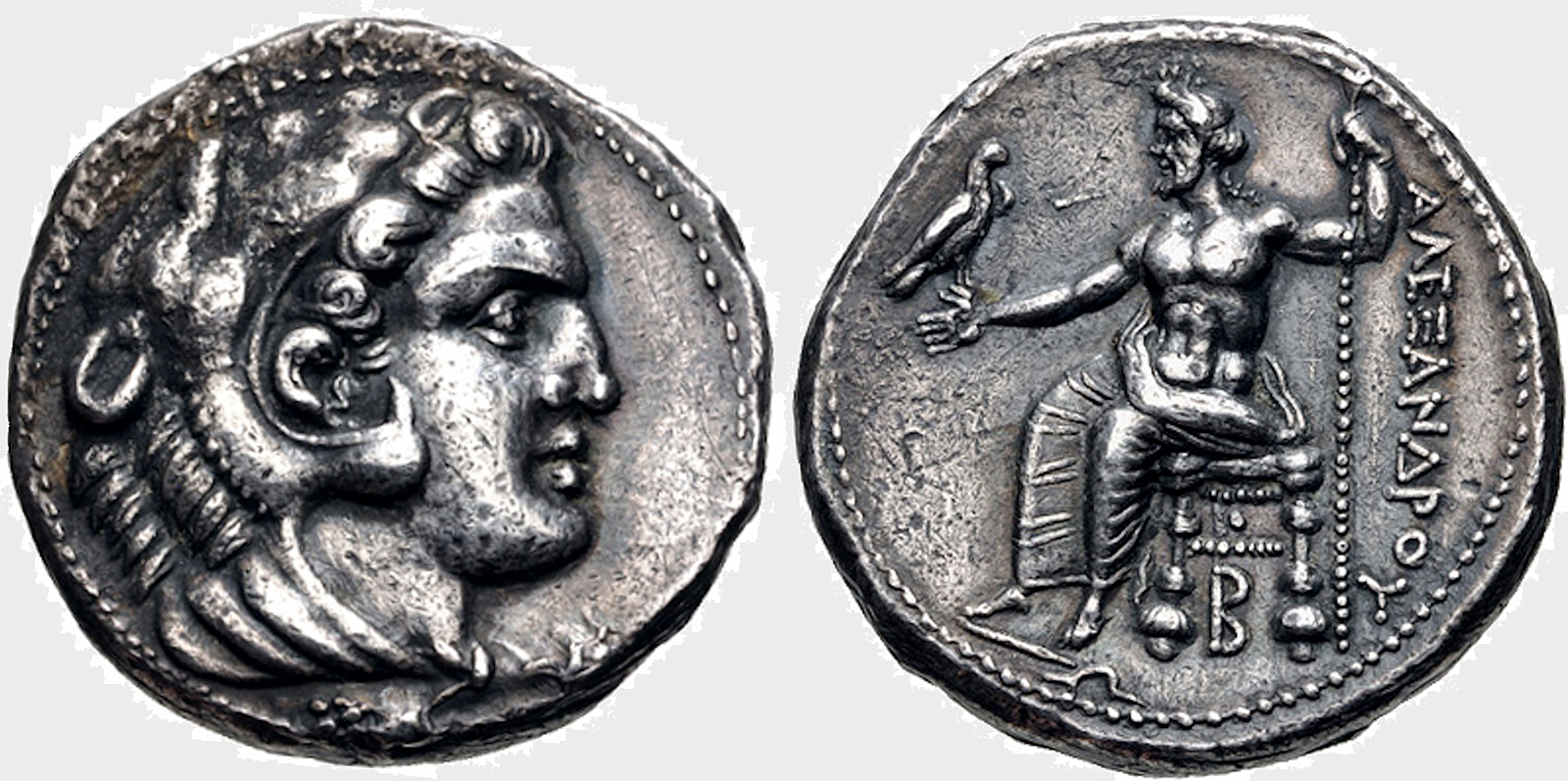
Alexander appears to have introduced a new coinage after the Battle of Issus in 333 BC, which went on to become the main coinage of his empire. Alexander minted gold staters, silver tetradrachms and drachims, and various fractional bronze coins.
Alexander next turned to the Indian subcontinent. He invited the chieftains of the former satrapy of Gandhara (a region presently straddling eastern Afghanistan and northern Pakistan), to come to him and submit to his authority. One of these chieftains, Ambhi hastened to relieve Alexander of his apprehension and met him with valuable presents, placing himself and all his forces at his disposal. Alexander not only returned Ambhi his title and the gifts but he also presented him with a wardrobe of “Persian robes, gold and silver ornaments, 30 horses and 1,000 talents in gold.”
The fort of Massaga was reduced after days of bloody fighting in which Alexander was seriously wounded in the ankle. According to written records, “Not only did Alexander slaughter the entire population of Massaga, but also did he reduce its buildings to rubble.”
Near the Ganges River, was the Nanda Empire of Magadha, and further east, the Gangaridai Empire of the Bengal region of the Indian subcontinent. Fearing the prospect of facing other large armies and exhausted by years of campaigning, Alexander’s army mutinied at the Hyphasis River (Beas), refusing to march farther east. This river thus marks the easternmost extent of Alexander’s conquests.
Alexander tried to persuade his soldiers to march farther, but his general Coenus pleaded with him to change his opinion and return. The men, he said, “longed to again see their parents, their wives and children, their homeland.” Alexander eventually agreed and turned south, marching along the Indus.
Meanwhile, upon his return to Persia, Alexander learned that guards of the tomb of Cyrus the Great in Pasargadae had desecrated it; and he swiftly executed them. Alexander had admired Cyrus the Great from an early age for Cyrus’s heroism in battle and governance as a king and legislator. During his visit to Pasargadae, Alexander ordered his architect Aristobulus to decorate the interior of the sepulchral chamber of Cyrus’s tomb.
Afterwards, Alexander travelled to Ecbatana to retrieve the bulk of the Persian treasure. where his closest friend, Hephaestion, died of either illness or poisoning. Hephaestion’s death devastated Alexander and he ordered the preparation of an expensive funeral pyre in Babylon along with a decree for public mourning. Back in Babylon, Alexander planned a series of new campaigns, beginning with an invasion of Arabia.
On either 10 or 11 June 323 BC, Alexander died in the palace of Nebuchadnezzar II, in Babylon, at age 32. There are two different versions of Alexander’s death, differing slightly in details. Given the propensity of the Macedonian aristocracy to assassination and Alexander’s relatively young age, foul play featured in multiple accounts of his death. Plutarch’s account is that roughly 14 days before his death, Alexander entertained admiral Nearchus and spent the night and next day drinking.
Alexander then developed a fever, which worsened until he was unable to speak. The common soldiers, anxious about his health, were granted the right to file past him as he silently waved at them. In the second account, Diodorus recounts that Alexander was struck with pain after downing a large bowl of unmixed wine in honour of Heracles followed by 11 days of weakness; he did not develop a fever, instead dying after some agony.
Several natural causes (diseases) have been suggested, including malaria and typhoid fever. A 1998 article in the New England Journal of Medicine attributed Alexander’s death to typhoid fever complicated by a bowel perforation and ascending paralysis. A 2004 analysis suggested pyogenic (infectious) spondylitis or meningitis. Other illnesses also fit the symptoms, including acute pancreatitis, West Nile virus and Guillain-Barré syndrome. Natural-cause theories also tend to emphasize that Alexander’s health may have been in general decline after years of heavy drinking and severe battle wounds.
Alexander’s body was laid in a gold anthropoid sarcophagus that was filled with honey, which was in turn placed in a gold casket. According to Aelian, a seer called Aristander foretold that the land wherever Alexander was laid to rest “would be happy and unvanquishable forever.”
Pompey, Julius Caesar and Augustus all visited the tomb in Alexandria where Augustus, allegedly, accidentally knocked the nose off of Alexander’s mummified body. Caligula was said to have taken Alexander’s breastplate from the tomb for his own use. Around AD 200, Emperor Septimius Severus closed Alexander’s tomb to the public. His son and successor, Caracalla, a great admirer, visited the tomb during his own reign. After this, details on the fate of the tomb become hazy.
Alexander’s death was so sudden that when reports of his death reached Greece, they were not immediately believed. Alexander had no obvious or legitimate heir. Alexander’s companions asked him on his deathbed to whom he bequeathed his kingdom; his laconic reply was “tôi kratistôi”—”to the strongest.”
Alexander’s last plans called for military expansion into the southern and western Mediterranean, monumental constructions, and the intermixing of Eastern and Western populations. It included:
- Construction of 1,000 ships larger than triremes, along with harbours and a road running along the African coast all the way to the Pillars of Hercules, to be used for an invasion of Carthage and the western Mediterranean.
- Erection of great temples in Delos, Delphi, Dodona, Dium, Amphipolis, all costing 1,500 talents, and a monumental temple to Athena at Troy.
- Amalgamation of small settlements into larger cities and the “transplant of populations from Asia to Europe and in the opposite direction from Europe to Asia, in order to bring the largest continent to common unity and to friendship by means of intermarriage and family ties.”
- Construction of a monumental tomb for his father Philip, “to match the greatest of the pyramids of Egypt.”
- The conquest of Arabia.
- Circumnavigation of Africa.
The enormous scale of these plans has led many scholars to doubt their authenticity. Ernst Badian argued that they were exaggerated in order to ensure that the Macedonian troops voted not to carry them out. Other scholars have proposed that they were invented by later authors within the tradition of the Alexander Romance.
Alexander perhaps earned the epithet “the Great” due to his unparalleled success as a military commander because he never lost a battle, despite typically always being greatly outnumbered. This was due to his use of terrain, phalanx and cavalry tactics, bold strategy, and the fierce loyalty of his troops.
Alexander also recognized the potential for disunity among his diverse army, which employed various languages and weapons. He overcame this by being personally involved in battle in the traditional manner of a Macedonian king.
Historical sources frequently give conflicting accounts of Alexander’s appearance, and the earliest sources are the most scant in their detail. For example, Arrian describes him simply as “very handsome.” During his lifetime, Alexander carefully curated his image by commissioning works from famous and great artists of the time.
Contemporary coins of his time portray Alexander with “a straight nose, a slightly protruding jaw, full lips and eyes deep set beneath a strongly pronounced forehead.” He is also described as having a slight upward tilt of his head to the left. It is also sometimes claimed that Alexander had one blue and one brown eye.
Alexander was erudite and patronized both arts and sciences. However, he had little interest in sports or the Olympic Games (unlike his father). He had great charisma and force of personality, characteristics which made him a great leader.
During his final years, and especially after the death of his best friend Hephaestion, Alexander began to exhibit signs of megalomania and paranoia. His extraordinary achievements, coupled with his own ineffable sense of destiny and the flattery of his companions, may have combined to produce this condition His delusions of grandeur are readily visible in his will and in his desire to conquer the world, in as much as he is by various sources described as having boundless ambition.
He appears to have believed himself a deity, or at least sought to deify himself. His mother Olympias always impressed upon him he was the son of Zeus; an idea apparently confirmed to him by the oracle of Amun at Siwa. He began to identify himself as the son of Zeus-Ammon.
Alexander and his exploits were admired by many Romans, especially generals, who wanted to associate themselves with his achievements. The diffusion of Greek culture and language cemented by Alexander’s conquests in West Asia and North Africa served as a “precondition” for the later Roman expansion into these territories and the entire basis for the Byzantine Empire.
Alexander’s legacy extended beyond his military conquests, and his reign marked a turning point in European and Asian history. His campaigns greatly increased contacts and trade between the East and West: and vast areas to the east were significantly exposed and infused by Greek civilization and influence. Some of the cities he founded became major cultural centers and many survive today into the 21st Century.✪





















▶️ DONATE VIA PAYPAL (DEBIT & CREDIT CARD)
ALL PayPal Transactions Are Encrypted For Card Holder Privacy & Security
▶️ DONATE VIA ZELLE (DIRECT BANK CASH TRANSFER)
ZELLE is the perfect online alternative to PayPal. It’s an incredibly simple, secure, easy, fast and FREE way to send or receive money to recipients directly from your online banking account without a middleman. Best of all, there’s NO fees.
ZELLE is a service provided by your bank and is already built in to your online banking account. You only need to activate it first before using. If you’ve already activated ZELLE in your online bank or credit union account, you can donate to The New Americanist by using our ZELLE address:
vip@thenewamericanist.com
To activate your ZELLE, follow these easy instructions (a simple two minute process):

▶️ DONATE VIA SNAIL MAIL