
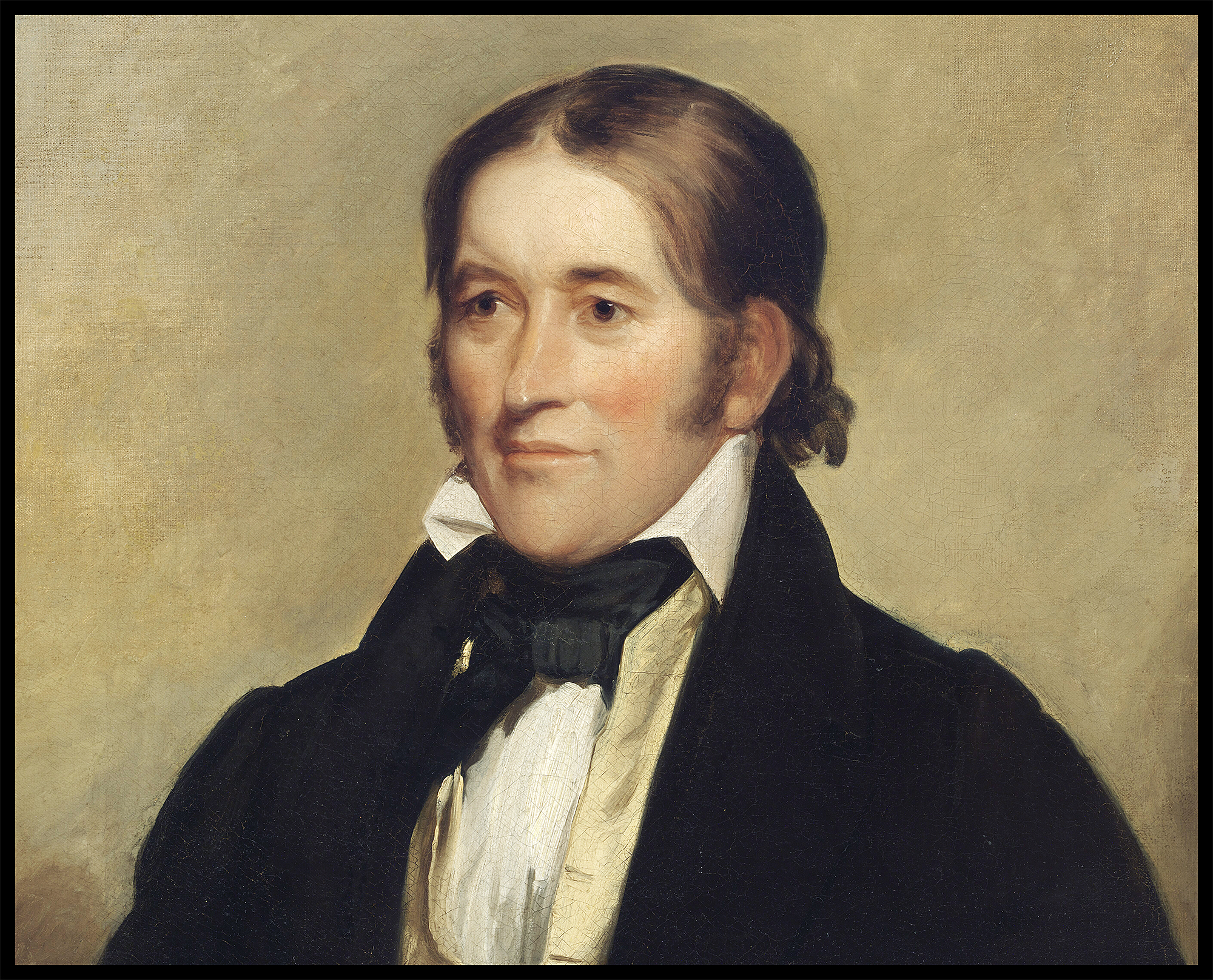

David Crockett: August 17, 1786 – March 6, 1836
✪ David Crockett was an American politician, militia officer and frontiersman. Often referred to in popular culture as the “King of the Wild Frontier,” he represented Tennessee in the United States House of Representatives and fought in the Texas Revolution.
Crockett grew up in East Tennessee, where he gained a popular reputation for hunting and storytelling. He was commissioned as a colonel in the militia of Lawrence County, Tennessee, and was elected to the Tennessee state legislature to represent that county in 1821. In 1827, Crockett was elected to the U.S. Congress where he vehemently opposed many of the policies of President Andrew Jackson, especially the Indian Removal Act. Crockett’s opposition to Jackson’s policies led to his eventual defeat in the 1831 elections. However, he was re-elected in 1833, and then narrowly lost in 1835; prompting his angry departure to Texas (then the Mexican state of Tejas) shortly thereafter. In early 1836, he took part in the Texas Revolution and died at the Battle of the Alamo.
Crockett became famous during his lifetime for his larger than life exploits popularized by stage plays and almanacs. After his death, he continued to be credited with acts of historical impact & proportion. In the 20th Century, these stories continued to be popularized in dramatic television and film portrayals. Crockett is one of the best-known American folk heroes.
Davy Crockett’s father John Crockett was of French and Scotch-Irish descent, while his mother was of English descent. The Crocketts were mostly of French-Huguenot ancestry, although the family originally settled in Ulster in the north of Ireland before migrating to the Americas.
Crockett’s English ancestry comes from his mother Rebecca Hawkins, as her earliest ancestor arrived in Gloucester County, Virginia in 1658.
Davy’s father John was born in 1753 in Frederick County, Virginia. In 1768, the Crockett family moved to Tryon County, North Carolina. In 1776, the family moved once again to northeast Tennessee, in the area of modern Hawkins County. John Crockett was one of the Overmountain Men who fought in the Battle of Kings Mountain during the American Revolutionary War. He was away serving as a militia volunteer in 1777 when his parents David and Elizabeth were killed at their home near modern Rogersville by a war party of Creek Indians and Chickamauga Cherokees led by war chief Dragging Canoe. John’s brother Joseph was wounded in the skirmish and his brother James was taken prisoner and held captive by the Indians for seventeen years.
John Crockett married Rebecca Hawkins in 1780 and their son David (nicknamed Davy) was born August 17, 1786, the fourth out of nine children. Davy was named after John’s father.
Davy Crockett was born on August 17, 1786 close to the Nolichucky River and near the community of Limestone in what is now Greene County, Tennessee.
When Davy was 12 years old, his father indentured him to Jacob Siler in order to help pay down the Crockett family indebtedness. Davy worked tending Siler’s cattle as a cowboy on a 400-mile trip to Natural Bridge in Virginia. Crockett was well treated and paid for his services but, after several weeks in Virginia, he decided to return home to Tennessee. The next year, John enrolled his sons in school, but Davy played hooky after an altercation with a fellow student. Upon learning of this, John attempted to whip him but was outrun by his son. Davy then left home again to join another cattle drive to Front Royal, Virginia.
In 1800 Crockett ran away from home at age 13 due to problems that he was having with his father. In 1802, he journeyed by foot back to his father’s tavern in Tennessee. At the time, his father was in debt to Abraham Wilson for $36 (equivalent to $791 in 2024). Once again, Davy was hired out to pay off his father’s debt. Later, Davy worked off another $40 debt of his father’s to John Canady. Once all the debts were paid, John Crockett told his son that he was free to leave. Davy returned to Canady’s employment, where he stayed for four years.
Davy Crockett met Polly Finley and her mother Jean at a harvest festival. Although friendly towards him in the beginning, Jean Finley eventually felt Crockett was not the man for her daughter. Crockett declared his intentions to marry Polly, regardless of whether the ceremony was allowed to take place in her parents’ home or performed elsewhere. He arranged for a justice of the peace and took out a marriage license on August 12, 1806. On August 16, he rode to Polly’s house with family and friends, determined to take Polly and ride off to be married elsewhere.
The newlyweds settled on land near Polly’s parents, and their first child, John Wesley Crockett, who became a United States Congressman, was born July 10, 1807. Their second child, William Finley Crockett, was born November 25, 1808. In October 1811, the family relocated to Lincoln County where their third child Margaret Finley (Polly) Crockett was born on November 25, 1812. in 1813, the Crocketts then moved again to Franklin County where Davy named their new home on Beans Creek “Kentuck.” After Polly died in March 1815, Crockett asked his brother John and his sister-in-law to move in with him to help care for the children. That same year, he married the widow Elizabeth Patton.
In 1802, Andrew Jackson was appointed major general of the Tennessee Militia. Thee Fort Mims massacre occurred near Mobile, Mississippi Territory, on August 30, 1813, and became a rallying cry for the Creek War. On September 20, Crockett left his family to enlist as a scout for a term of 90 days with Francis Jones’s Company of Mounted Rifleman; part of the Second Regiment of Volunteer Mounted Riflemen. They served under Colonel John Coffee in the war, marching south into present-day Alabama and taking an active part in the fighting. Crockett often hunted wild game for the soldiers, and felt better suited to that role than killing Creek warriors. He served until December 24, 1813.
In 1817, Crockett moved the family to new acreage in Lawrence County, where he first entered public office as a commissioner helping to configure the new county’s boundaries. On November 25, the state legislature appointed him county justice of the peace. On March 27, 1818, he was elected lieutenant colonel of the Fifty-seventh Regiment of Tennessee Militia, defeating candidate Daniel Matthews for the position.
By 1819, Crockett was operating multiple businesses in the area and felt his public responsibilities were beginning to consume so much of his time and energy that he had little left for either family or business. He resigned from the office of justice of the peace and from his position with the regiment. Crockett was a member of the National Republican Party (also known as Anti-Jacksonians) before joining the Whig Party in 1833.
In 1821, he resigned as commissioner and successfully ran for a seat in the Tennessee General Assembly. He was appointed to the Committee of Propositions and Grievances on September 17, 1821, and served through the first session that ended November 17, as well as the special session called by the governor in the summer of 1822, ending on August 24. He favored legislation to ease the tax burden on the poor. Crockett spent his entire legislative career fighting for the rights of impoverished settlers who he felt dangled on the precipice of losing title to their land due to the state’s complicated system of grants.
In 1823, Crockett ran against Andrew Jackson’s nephew-in-law William Edward Butler and won a seat in the Tennessee General Assembly. On October 25, 1824, Crockett notified his constituents of his intention to run in the 1825 election for a seat in the U.S. House of Representatives. However, he lost that election to incumbent Adam Rankin Alexander. A chance meeting in 1826 gained him the encouragement of Memphis mayor Marcus Brutus Winchester to try again to win a seat in Congress.
The Jackson Gazette published a letter from Crockett on September 15, 1826, announcing his intention of again challenging Rankin; and stating his opposition to the policies of President John Quincy Adams, Secretary of State Henry Clay and to Rankin’s position on the cotton tariff.
Crockett arrived in Washington, D.C. and took up residence at Mrs. Ball’s Boarding House, where a number of other legislators lived when Congress was in session. Crockett was re-elected for the 1829–1831 session, once again defeating Adam Rankin Alexander.
While serving in the United States House of Representatives, Crockett became a Freemason. He entrusted his masonic apron to a friend in Tennessee before leaving for Texas, and it was inherited by the friend’s descendant in Kentucky.
Crockett opposed Jackson’s 1830 Indian Removal Act and was the only member of the Tennessee delegation to vote against it. Cherokee chief John Ross sent Crockett a letter on January 13, 1831, expressing his thanks for his vote. As his vote was not popular within his own district, he was defeated in the 1831 election by William Fitzgerald. Crockett ran against Fitzgerald again in the 1833 election and was returned to Congress, serving until 1835.
During his last term in Congress, Crockett collaborated with Kentucky Congressman Thomas Chilton to write his autobiography, which was published by E. L. Carey and A. Hart in 1834 as A Narrative of the Life of David Crockett, Written by Himself, and he went east to promote the book. In 1836, newspapers published the now-famous quotation attributed to Crockett upon his return to his home state:
“I told the people of my district that I would serve them as faithfully as I had done; but if not, they might go to hell, and I would go to Texas.”
By December 1834, Crockett was writing to friends about his intention and plans to move to Texas if Jackson’s chosen successor Martin Van Buren was elected president. The next year, he discussed with his friend Benjamin McCulloch raising a company of volunteers to take to Texas in the expectation that a revolution was imminent. His departure to Texas was delayed by a court appearance in the last week of October as co-executor of his deceased father-in-law’s estate.
Crockett finally left his home near Rutherford in West Tennessee with three other men on November 1, 1835, to explore Texas. His youngest child Matilda later wrote that she distinctly remembered the last time she saw her father:
“He was dressed in his hunting suit, wearing a coonskin cap, carrying a fine rifle presented to him by friends in Philadelphia. He seemed very confident the morning he went away that he would soon have us all to join him in Texas.”
Crockett traveled with 30 well-armed men to Jackson, Tennessee, where he gave a speech from the steps of the Madison County courthouse. They then traveled west, arriving in Little Rock, Arkansas, on November 12, 1835. The local newspapers reported that hundreds of people swarmed into town to get a look at Crockett, and a group of leading citizens put on a dinner in his honor that night at the Jeffries Hotel where Crockett spoke “mainly to the subject of Texan independence,” as well as Washington politics.
Crockett arrived in Nacogdoches, Texas, in early January 1836. On January 14, he and 65 other men signed an oath before Judge John Forbes to the Provisional Government of Texas for six months: “I have taken the oath of government and have enrolled my name as a volunteer and will set out for the Rio Grande in a few days with the volunteers from the United States.” In return, each man was promised about 4,600 acres of land as payment. On February 6, Crockett and five other men rode into San Antonio de Bexar and camped just outside the town.
Crockett arrived at the Alamo Mission in San Antonio on February 8. A Mexican army arrived on February 23 led by General Antonio López de Santa Anna. The army surprised the men garrisoned in the Alamo, and the Mexican soldiers immediately initiated a siege. Santa Anna ordered his artillery to keep up a near-constant bombardment while the guns were slowly moved closer to the Alamo each day, increasing their effectiveness.
There were limited stores of powder and shot inside the Alamo, and Alamo commander William Barret Travis ordered the artillery to stop returning fire on February 26 so as to conserve precious ammunition. Crockett and his men were encouraged to keep shooting, as they were unusually effective.
The siege ended on March 6 when the Mexican army attacked just before dawn while the defenders were sleeping. The daily artillery bombardment was suspended, perhaps a ploy to encourage the natural human reaction to a cessation of constant strain. However, the garrison awakened and the final fight began. Most of the noncombatants gathered in the church sacristy for safety.
According to historians, Crockett paused briefly in the chapel to say a prayer before running to his post. The Mexican soldiers climbed up the north outer walls of the Alamo complex, and most of the Texans fell back to the barracks and the chapel, as previously planned. Crockett and his men, however, were caught too far from the barracks to take shelter and were the last remaining group to be left out in the open. They defended the low wall in front of the church, using their rifles as clubs and relying on knives, as the action was too furious to allow reloading. After a volley and a charge with bayonets, Mexican soldiers finally pushed the few remaining defenders back toward the church.
The Battle of the Alamo only lasted 90 minutes; and all of the defenders were killed. Santa Anna ordered his men to take their bodies to a nearby stand of trees, where they were stacked together and wood piled on top. That evening, they lit a fire their bodies were burned to ashes. The ashes were left undisturbed until February 1837, when Juan Seguin and his cavalry returned to Bexar to examine the remains. A local carpenter created a simple coffin, and ashes from the funeral pyres were placed inside. The names of Travis, Crockett and Bowie were inscribed on the lid. The coffin is thought to have been buried in a peach tree grove, but the spot was not marked and can no longer be identified.
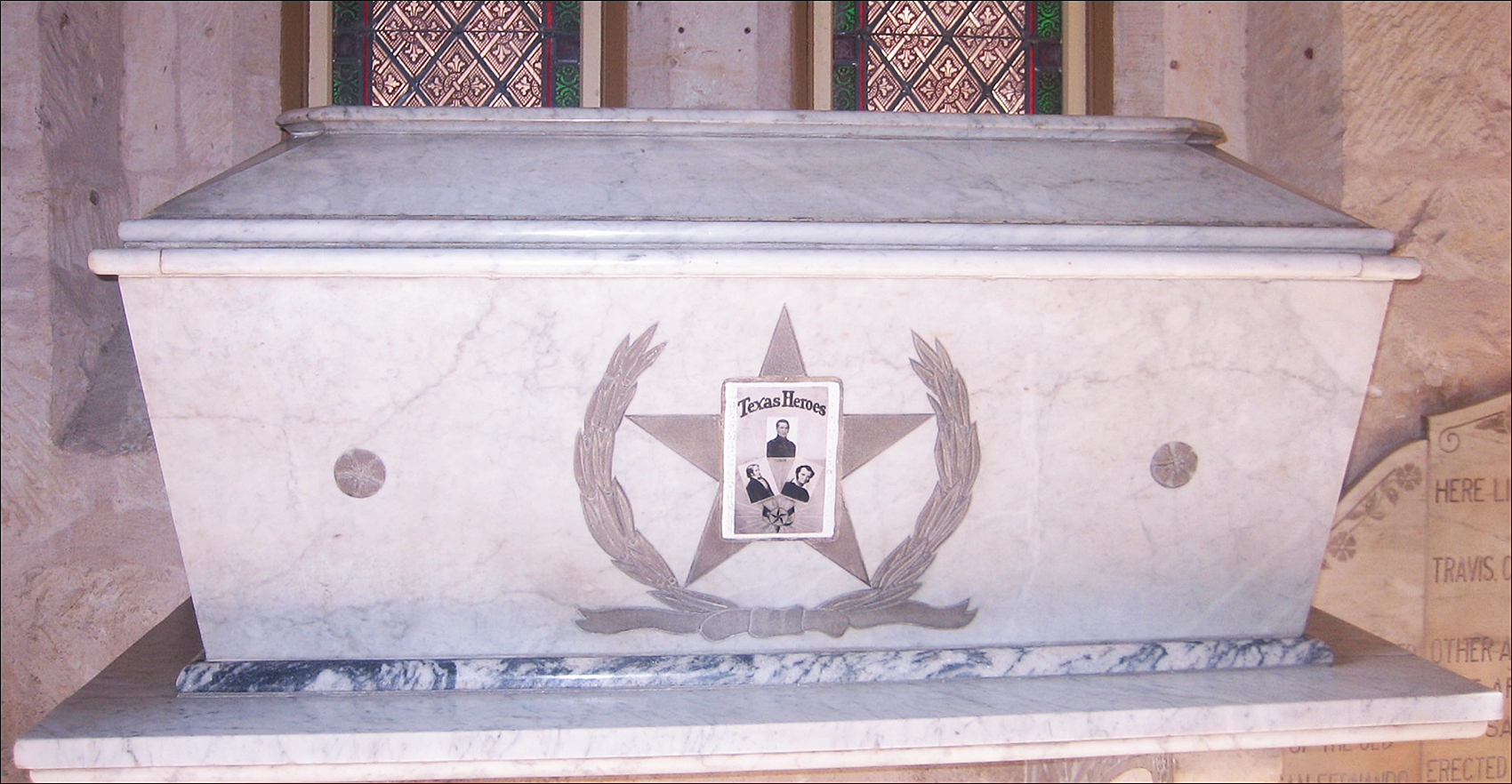
David Crockett died at the Alamo on the morning of March 6, 1836, at the age of 49. Accounts from survivors of the battle differ on the manner of Crockett’s death, with stories ranging from Crockett putting up a heroic last stand to the account that he surrendered along with several other men and was executed. To further confusion, historians have been able to back up opposing theories with “voluminous evidence.”
The popular mythology of Crockett’s death in American culture is one of a heroic last stand, a tale that is backed up by significant historical evidence. For example, a former African-American slave named Ben, who had acted as cook for one of Santa Anna’s officers, maintained that Crockett’s body was found in the barracks surrounded by “no less than sixteen Mexican corpses,” with Crockett’s knife buried in one of them.
Several other survivors and first-hand witnesses to the battle also claimed Crockett fought to the death. Furthermore, no other officer under Santa Anna’s command mentions Crockett’s surrender, not even his personal secretary Ramon Caro. Later in life, Santa Anna wrote in his memoir only stating that Davy Crockett’s body was “among the corpses” without giving any specific context as to how he died. Santa Anna further wrote “Not one soldier showed signs of desiring to surrender.” ✪

















▶️ ◼️◼️◼️◼️◼️◼️◼️◼️◼️ ✪✪✪ DONATE ✪✪✪ ◼️◼️◼️◼️◼️◼️◼️◼️◼️◼️

▶️ DONATE VIA PAYPAL (DEBIT & CREDIT CARD)
ALL PayPal Transactions Are Encrypted For Card Holder Privacy & Security
▶️ DONATE VIA ZELLE (DIRECT BANK CASH TRANSFER)
ZELLE is the perfect online alternative to PayPal. It’s an incredibly simple, secure, easy, fast and FREE way to send or receive money to recipients directly from your online banking account without a middleman. Best of all, there are NO fees.
ZELLE is a service provided by your bank and is already built in to your online banking account. You only need to activate it first before using. If you’ve already activated ZELLE in your online bank or credit union account, you can donate to The New Americanist by using our ZELLE address:
vip@thenewamericanist.com
To activate your ZELLE, follow these easy instructions (a simple two minute process):

▶️ DONATE VIA SNAIL MAIL