
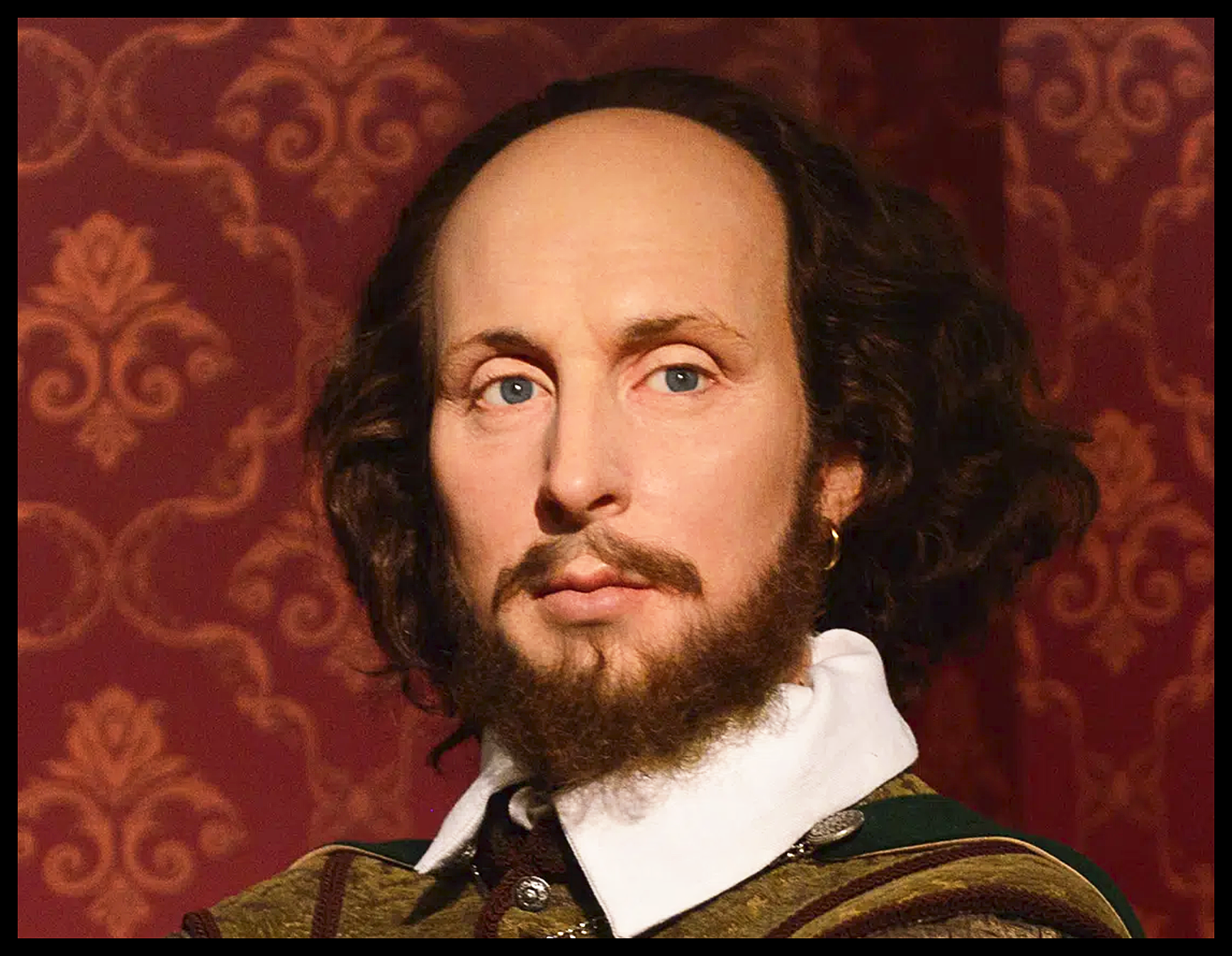

William Shakespeare:(April 23,1564 – April 23,1616)
✪ William Shakespeare was an English playwright, poet and actor. He is widely regarded as the greatest writer in the English language and the world’s pre-eminent dramatist. He is often called England’s national poet and the “Bard of Avon” or simply “the Bard.” His extant works, including collaborations with other playwrights, consist of some 39 plays, 154 sonnets, three long narrative poems and a few other verses; some of uncertain & undocumented authorship.
His plays have been translated into every major living language and are performed more often than those of any other playwright. Shakespeare remains arguably the most influential writer in the English language, and his works still continue to be widely studied, performed and reinterpreted four hundred years after his death.
Shakespeare produced most of his known works between 1589 and 1613. His early plays were primarily comedies and histories; and are regarded as some of the best works produced in these genres. He later wrote mainly tragedies until 1608, among them Hamlet, Othello, King Lear and Macbeth, which are considered to be among the finest works in English. In the last phase of his career, he primarily wrote tragicomedies (also known as romances), which include the well known The Winter’s Tale and The Tempest.
During his lifetime, many of Shakespeare’s plays were published in editions of varying quality and accuracy; however in 1623, John Heminges and Henry Condell, two fellow actors and friends of Shakespeare, published a more definitive text known as the First Folio; a posthumous collected edition of Shakespeare’s dramatic works which includes 36 of his plays. Its preface includes a prescient poem by Ben Jonson, a former rival of Shakespeare, who hailed Shakespeare with the now-famous epithet: “not of an age, but for all time.”
William Shakespeare was the son of John Shakespeare, an alderman and a successful glover (glove-maker) originally from Snitterfield in Warwickshire, and Mary Arden, the daughter of an affluent landowning family which was influential in the Recusant Catholic community. He was the third of eight children, and the eldest surviving son. Shakespeare was born in Stratford-upon-Avon, where records indicate he was baptized on April 26, 1564. The exact date of birth is unknown but is traditionally observed on April 23, which is also Saint George’s Day. This date, which can be traced to William Oldys and George Steevens, has proven appealing to his biographers because Shakespeare also died on the same date in 1616.
Although no attendance records for the period survive, most biographers agree Shakespeare was probably educated at the King’s New School in Stratford, a free school chartered in 1553 and located about a quarter-mile from his family’s home in Stratford’s guildhall. Grammar schools varied in quality during the Elizabethan era, but their curricula were largely similar; as the basic Latin text was standardized by royal decree. This means the school would have provided an intensive education in grammar based upon Latin classical authors.
At the age of 18, Shakespeare married 26-year-old Anne Hathaway. The consistory court of the Diocese of Worcester issued a marriage license on November 24, 1582. The next day, two of Hathaway’s neighbors posted bonds guaranteeing no lawful claims of debt would impede the marriage. Their wedding ceremony may have been arranged in some haste; as the Worcester chancellor allowed the marriage banns to be read only once instead of the usual three times. Six months after their marriage, Anne gave birth to a daughter, Susanna, who was baptized May 26, 1583. Twins, son Hamnet and daughter Judith, followed almost two years later and were baptized on February 2, 1585. However, Hamnet died of unknown causes at the age of 11 and was buried August 11, 1596.
After the birth of the twins, Shakespeare left few historical traces until he is mentioned as part of the London theatre scene in 1592. The exception is the appearance of his name in the “complaints bill” of a law case before the Queen’s Bench court at Westminster dated Michaelmas Term 1588 and October 9, 1589. Scholars refer to these years between 1585 and 1592 as Shakespeare’s “lost years.”
Shakespeare’s first biographer, Nicholas Rowe, recounted a Stratford legend that Shakespeare fled the town for London to escape prosecution for deer poaching in the estate of local squire Thomas Lucy. Shakespeare is also supposed to have taken his revenge on Lucy by writing a scurrilous ballad about him. Another 18th-century story has Shakespeare starting his theatrical career minding the horses of theatre patrons in London. John Aubrey reported Shakespeare had also worked as a country schoolmaster. Little evidence substantiates such stories other than vocal traditions recorded after his death, and Shakespeare was a common name in the Lancashire area
It is not known definitively when Shakespeare began writing, but contemporary allusions and records of performances show that several of his plays were on the London stage by 1592. After 1594 Shakespeare’s plays were performed at The Theatre, in Shoreditch, only by the Lord Chamberlain’s Men, a company owned by a group of players, including Shakespeare, which soon became the leading performance company in London. After the death of Queen Elizabeth in 1603, the company was awarded a royal patent by the new king James I, and changed its name to the King’s Men.
In 1599, a partnership of the company members built their own theatre on the south bank of the River Thames, which they named the Globe. In 1608 the partnership also took over the Blackfriars indoor theatre. Extant records of Shakespeare’s property purchases and investments indicate that his association with the company was very successful and made him a wealthy man. In 1597, he purchased the second-largest house in Stratford, New Place, and in 1605 invested in a share of the parish tithes in Stratford.
Some of Shakespeare’s plays were published in quarto editions, beginning in 1594. By 1598 his name had become a selling point and began to appear on the title pages. Shakespeare continued to act in his own and other plays after his success as a playwright. The 1616 edition of Ben Jonson’s Works names him on the cast lists for Every Man in His Humour (1598) and Sejanus His Fall (1603).
However, the First Folio of 1623 lists Shakespeare as one of “the Principal Actors in all these Plays,” some of which were first staged after Volpone, although one cannot know for certain which roles he played. In 1610, John Davies of Hereford wrote that “good Will” played many “kingly” roles. In 1709 Rowe passed down a tradition that Shakespeare played the ghost of Hamlet’s father. Later traditions maintain that he also played Adam in As You Like It, and the Chorus in Henry V, though some scholars doubt the sources of those claims.
Throughout his career, Shakespeare divided his time between London and Stratford. In 1596, the year before he bought New Place as his family home in Stratford, Shakespeare lived in the parish of St Helen’s, Bishopsgate, north of the River Thames. By 1599, he moved across the river to Southwark, the same year his company constructed the Globe Theatre there. By 1604 he had moved again, north of the river to an area north of St Paul’s Cathedral with many fine houses. There he rented rooms from a French Huguenot named Christopher Mountjoy who was a maker of women’s wigs and other headgear.
The first recorded works of Shakespeare are Richard III and the three parts of Henry VI, written in the early 1590s during a vogue for historical drama. However, many of Shakespeare’s plays are difficult to date precisely and studies of the texts suggest Titus Andronicus, The Comedy of Errors, The Taming of the Shrew, and The Two Gentlemen of Verona may also belong to Shakespeare’s earliest period.
His first histories, which draw heavily on the 1587 edition of Raphael Holinshed’s Chronicles of England, Scotland, and Ireland, dramatize the destructive results of weak or corrupt rule.
Shakespeare’s early classical and Italianate comedies, containing tight double plots and precise comic sequences, give way in the mid-1590s to the romantic atmosphere of his most acclaimed comedies.A Midsummer Night’s Dream is a witty mixture of romance, fairy magic, and comic lowlife scenes.
Shakespeare’s next comedy, the equally romantic The Merchant of Venice, contains a portrayal of the vengeful Jewish moneylender Shylock, which reflects dominant Elizabethan views. The wit and wordplay of Much Ado About Nothing, the charming rural setting of As You Like It, and the lively merrymaking of Twelfth Night complete Shakespeare’s sequence of great comedies.
After the lyrical Richard II, written almost entirely in verse, Shakespeare introduced prose comedy into the histories of the late 1590s. His characters become more complex and tender as he switches deftly between comic and serious scenes, prose and poetry, and achieves the narrative variety of his mature work. This period begins and ends with two tragedies: Romeo and Juliet, the famous romantic tragedy of sexually charged adolescence, love, and death; and Julius Caesar—based on Sir Thomas North’s 1579 translation of Plutarch’s Parallel Lives; which introduced a new kind of drama.
Many critics believe Shakespeare’s tragedies represent the peak of his art. Hamlet has probably been analyzed more than any other Shakespearean character, especially for his famous soliloquy which begins “To be or not to be; that is the question.” Unlike the introverted Hamlet, whose fatal flaw is hesitation, Othello and Lear are undone by hasty errors of judgement. The plots of Shakespeare’s tragedies often hinge on such fatal errors or flaws, which overturn order and destroy the hero and those he loves.
In his final period, Shakespeare turned to romance or tragicomedy and completed three more major plays: Cymbeline, The Winter’s Tale, and The Tempest. Less bleak than the tragedies, these four plays are graver in tone than the comedies of the 1590s, but they end with reconciliation and the forgiveness of potentially tragic errors.
It is not clear for which companies Shakespeare wrote his early plays. After the plagues of 1592–93, Shakespeare’s plays were performed by his own company at The Theatre and the Curtain in Shoreditch, north of the Thames. When the company found themselves in dispute with their landlord, they pulled The Theatre down and used the timbers to construct the Globe Theatre, the first playhouse built by actors for actors, on the south bank of the Thames at Southwark. The Globe opened in the autumn of 1599, with Julius Caesar one of the first plays staged. Most of Shakespeare’s greatest post-1599 plays were written for the Globe, including Hamlet, Othello, and King Lear.
Published in 1609, the Sonnets were the last of Shakespeare’s non-dramatic works to be printed. Scholars are not certain when each of the 154 sonnets was composed, but evidence suggests that Shakespeare wrote sonnets throughout his career for a private readership. Few analysts believe that the published collection follows Shakespeare’s intended sequence. He seems to have planned two contrasting series: one about uncontrollable lust for a married woman of dark complexion (the “dark lady”), and one about conflicted love for a fair young man (the “fair youth”). It remains unclear if these figures represent real individuals, or if the authorial “I” who addresses them represents Shakespeare himself,
Shakespeare combined poetic genius with a practical sense of the theatre. Like all playwrights of the time, he dramatized stories from sources such as Plutarch and Raphael Holinshed. He reshaped each plot to create several centers of interest and to show as many sides of a narrative to the audience as possible. This strength of literary design ensured a Shakespearean play can survive translation, cutting, and wide interpretation without loss to its core drama.
Shakespeare’s work has made a significant and lasting impression on later theatre and literature. In particular, he expanded the dramatic potential of characterisation, plot, language, and genre. His work heavily influenced later poetry. The Romantic poets attempted to revive Shakespearean verse drama, though with little success. The critic George Steiner described all English verse dramas from Samuel Taylor Coleridge to Alfred, Lord Tennyson, as “feeble variations on Shakespearean themes.” John Milton, considered by many to be the most important English poet after Shakespeare, wrote in tribute: “Thou in our wonder and astonishment/ Hast built thyself a live-long monument.”
Shakespeare also influenced novelists such as Thomas Hardy, William Faulkner and Charles Dickens. The American novelist Herman Melville’s soliloquies owe much to Shakespeare; his Captain Ahab in Moby-Dick is a classic tragic hero, inspired by King Lear.
Scholars have also identified 20,000 pieces of music linked to and influenced by Shakespeare’s works, including Felix Mendelssohn’s overture and incidental music for A Midsummer Night’s Dream and Sergei Prokofiev’s ballet Romeo and Juliet. His work has inspired several operas, among them Giuseppe Verdi’s Macbeth, Otello and Falstaff, whose critical standing compares with that of the source plays.
▶️ 3 Minutes 28 Seconds
Shakespeare has been a rich source for filmmakers; Akira Kurasaw adapted Macbeth and King Lear as Throne of Blood and Ran. Other examples of Shakespeare in film include Max Reinhardt’s A Midsummer Night’s Dream, Laurence Olivier’s Hamlet and Al Pacino’s documentary Looking For Richard. Orson Welles, a lifelong lover of Shakespeare, directed and starred in Macbeth, Othello and Chimes at Midnight. The last, in which he plays John Falstaff, was Welles’ favorite of his films.
In Shakespeare’s time English grammar, spelling and pronunciation were less standardized than they are now; and his use of language helped to shape modern English. Expressions such as “with bated breath” (Merchant of Venice) and “a foregone conclusion” (Othello) have found their way into everyday English speech. Shakespeare was not revered in his lifetime, but he received a large amount of praise.
Shakespeare’s influence extends far beyond his native England and the English language. His reception in Germany was particularly significant; as early as the 18th century Shakespeare was widely translated and popularized in Germany. According to Guinness World Records, Shakespeare remains the world’s best-selling playwright, with sales of his plays and poetry believed to have achieved in excess of four billion copies in the almost 400 years since his death. He is also the third most translated author in history, with his plays translated into over 80 languages, from major world tongues such as German, Hindi, and Japanese.
Shakespeare conformed to the official state religion, but his private views on religion have been the subject of much debate. Shakespeare’s will uses a Protestant formula: and he was a confirmed member of the Church of England, where he married, his children were baptized, and where his family is buried.
No written contemporary description of Shakespeare’s physical appearance exists; and no evidence suggests that he ever commissioned a personal portrait. From the 18th century, the desire for authentic Shakespeare portraits has fueled claims various surviving pictures depicted Shakespeare.
Nicholas Rowe was the first biographer to record the tradition, repeated by Samuel Johnson, that Shakespeare retired to Stratford “some years before his death.’ He was still working as an actor in London in 1608; However, it is perhaps relevant that the bubonic plague raged in London throughout 1609. The London public playhouses were repeatedly closed during extended outbreaks of the plague (a total of over 60 months closure between May 1603 and February 1610).
After 1610 Shakespeare wrote fewer plays, and none are attributed to him after 1613. He retired in 1613, before the Globe Theatre burned down during the performance of Henry VIII on June 29th of that same year.
Shakespeare signed his last will and testament on March 25 1616, The following day, Thomas Quiney, his new son-in-law, was found guilty of fathering an illegitimate son by Margaret Wheeler, and Margaret and her son both died during childbirth. Thomas was ordered by the church court to do public penance, which would have caused much shame and embarrassment for the Shakespeare family.
Shakespeare died on 23 April 1616, at the age of 52. He died within a month of signing his will, a document which he begins by describing himself as being in “perfect health.” No extant contemporary source explains how or why he died. Half a century later, John Ward, the vicar of Stratford, wrote in his notebook: “Shakespeare, Drayton, and Ben Jonson had a merry meeting and, it seems, drank too hard, for Shakespeare died of a fever there contracted” Of the tributes from fellow authors, one refers to his relatively sudden death: “We wondered, Shakespeare, that thou went’st so soon / From the world’s stage to the grave’s tiring room.”
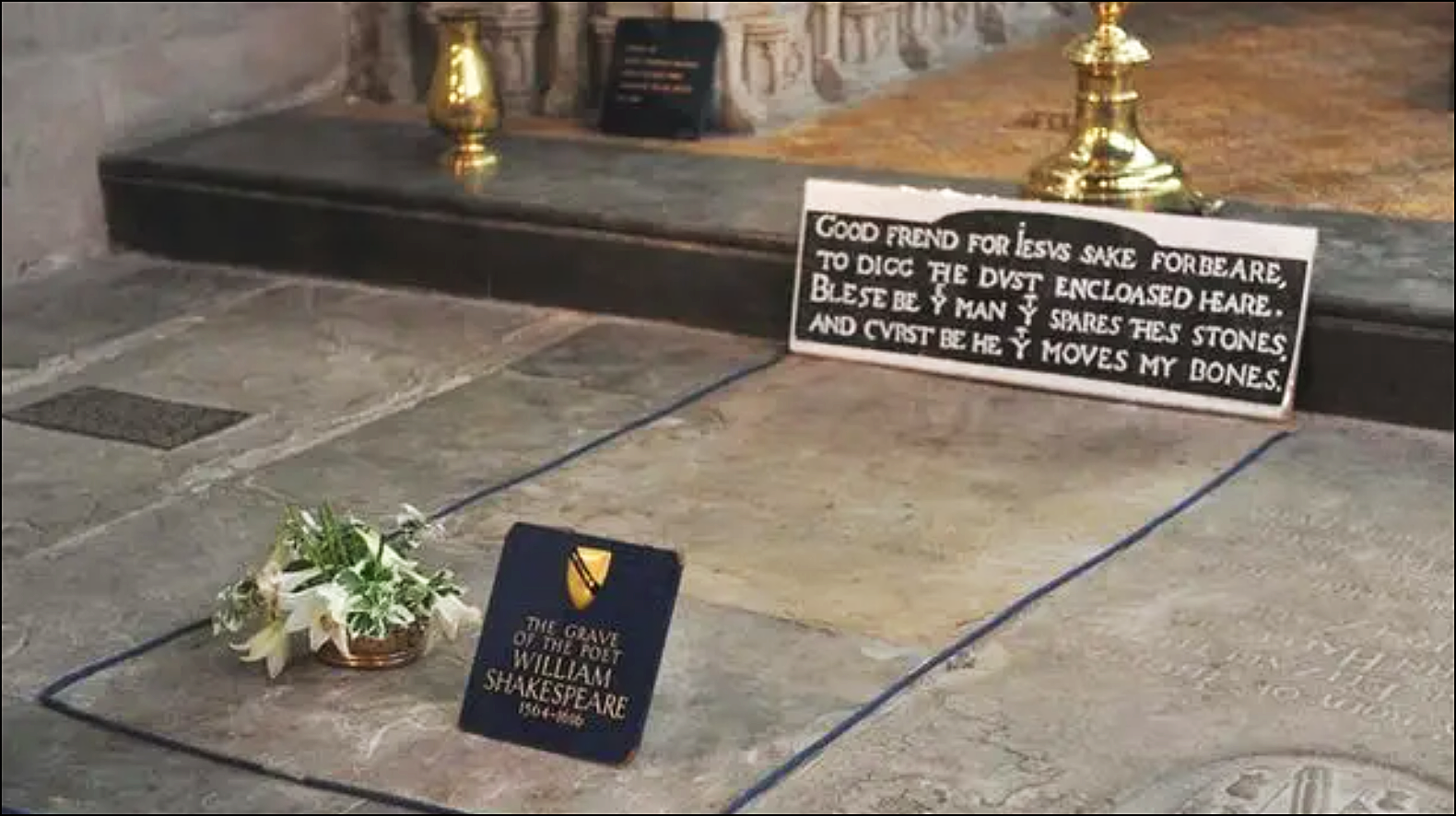
Shakespeare was buried in the chancel of the Holy Trinity Church two days after his death. The epitaph carved into the stone slab covering his grave includes a curse against moving his bones, which was carefully avoided during restoration of the church in 2008:
Good frend for Iesvs sake forbeare,
To digg the dvst encloased heare.
Bleste be yͤ man yͭ spares thes stones,
And cvrst be he yͭ moves my bones.
Translation:
Good friend, for Jesus’ sake forbear,
To dig the dust enclosed here.
Blessed be the man that spares these stones,
And cursed be he that moves my bones.
Some time before 1623 a funerary monument was erected in his memory on the north wall, with a half-effigy of him in the act of writing. ✪
















▶️ ◼️◼️◼️◼️◼️◼️◼️◼️◼️ ✪✪✪ DONATE ✪✪✪ ◼️◼️◼️◼️◼️◼️◼️◼️◼️◼️

▶️ DONATE VIA PAYPAL (DEBIT & CREDIT CARD)
ALL PayPal Transactions Are Encrypted For Card Holder Privacy & Security
▶️ DONATE VIA ZELLE (DIRECT BANK CASH TRANSFER)
ZELLE is the perfect online alternative to PayPal. It’s an incredibly simple, secure, easy, fast and FREE way to send or receive money to recipients directly from your online banking account without a middleman. Best of all, there are NO fees.
ZELLE is a service provided by your bank and is already built in to your online banking account. You only need to activate it first before using. If you’ve already activated ZELLE in your online bank or credit union account, you can donate to The New Americanist by using our ZELLE address:
vip@thenewamericanist.com
To activate your ZELLE, follow these easy instructions (a simple two minute process):

▶️ DONATE VIA SNAIL MAIL