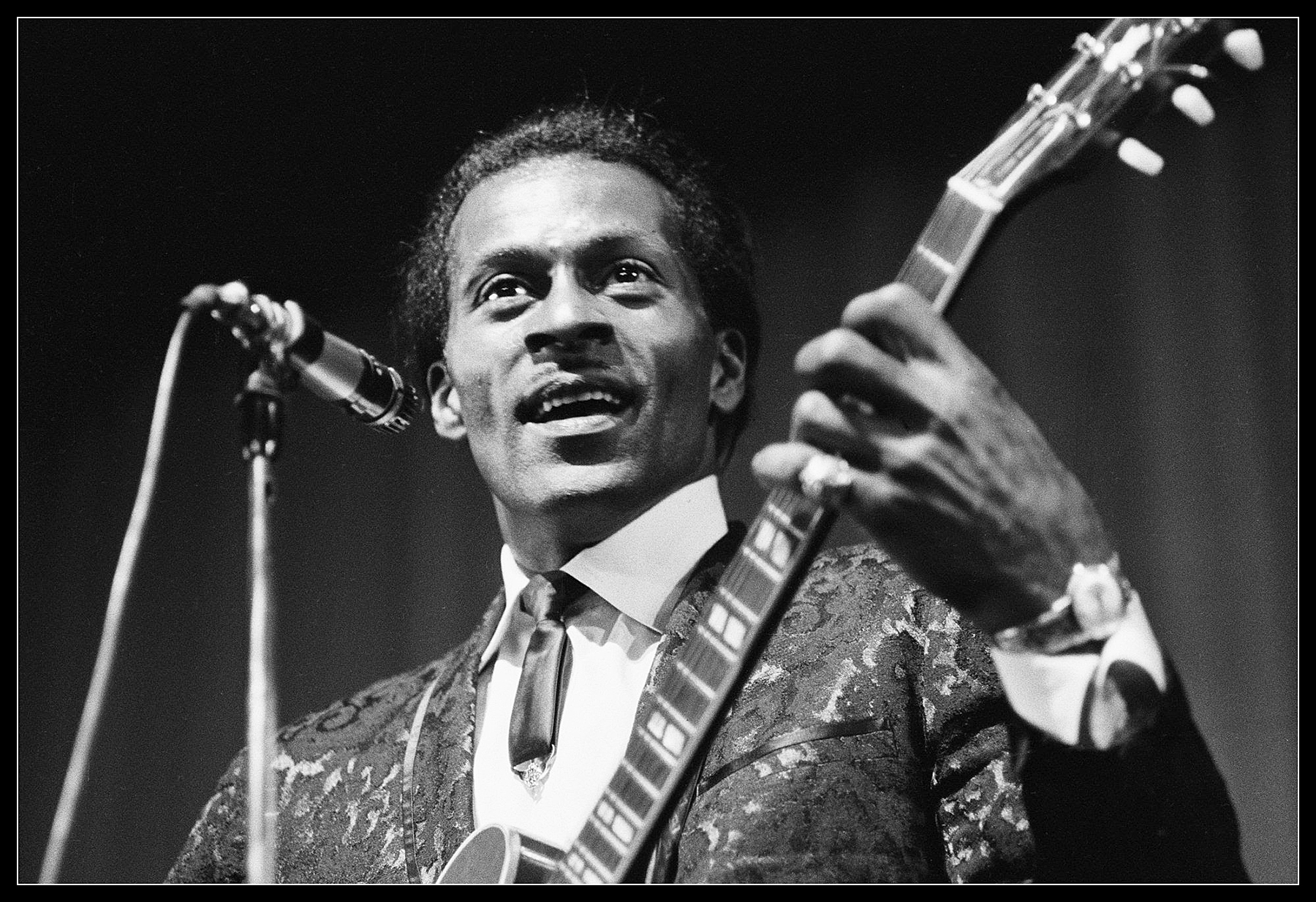

Charles Edward Anderson Berry: October 18, 1926 – March 18, 2017
✪ Charles Edward Anderson Berry (known by his performer’s name, Chuck Berry) was an American guitarist, singer, and songwriter who was one of the early pioneers of Rock and Roll. Nicknamed the “Father of Rock and Roll,” Berry refined and developed rhythm and blues into the major elements which made the Rock and Roll sound distinctive with songs such as “Maybellene” (1955), “Roll Over Beethoven” (1956), “Rock and Roll Music” (1957), and “Johnny B. Goode” (1958). Berry wrote song lyrics which focused on teen life of that time, and developed a musical style which included guitar solos and stage showmanship. Berry became a major musical & stylistic influence on an entire generations of musicians who followed him.
Berry was also among the first musicians to be inducted into the Rock and Roll Hall of Fame at its opening in 1986; where he was cited for having “laid the groundwork for not only the Rock and Roll sound but also the Rock and Roll stance.” Berry is included in several of Rolling Stone magazine’s “Greatest Of All Time” lists; including ranked fifth on their 2004 and 2011 lists of the 100 Greatest Artists of All Time and 2nd Greatest Guitarist Of All Time in 2023. The Rock and Roll Hall of Fame’s 500 Songs That Shaped Rock and Roll includes three of Berry’s songs: “Johnny B. Goode, Maybellene” and “Rock and Roll Music.” “Johnny B. Goode” is the only rock-and-roll song included on the Voyager Golden Record.
Charles Edward Anderson Berry was born on October 18, 1926, in St. Louis, the youngest child of Henry William Berry and Martha Bell Berry (née Banks). He grew up in the north St. Louis neighborhood known as the Ville; an area where many middle-class people lived. His father, Henry (1895–1987) was a contractor and deacon of a nearby Baptist church. His mother Martha (1894–1980), was a certified public school principal.
Berry’s upbringing allowed him to pursue his interest in music from an early age. He gave his first public performance in 1941 while still a student at Sumner High School in St. Louis. He was still a student there in 1944, when he was arrested for armed robbery after robbing three shops in Kansas City, Missouri; and then stealing a car at gunpoint with some friends. Berry’s personal account in his autobiography claims his car broke down. He then flagged down a passing car and stole it at gunpoint using a non-functional pistol. He was convicted and sent to the Intermediate Reformatory for Young Men (now the Algoa Correctional Center) in Jefferson City, Missouri, where he formed a singing quartet and was an avid boxer. The reformatory singing group became competent enough that the authorities allowed it to perform outside the detention facility. Berry was released from the reformatory on his 21st birthday in 1947.
On October 28, 1948, Berry married Themetta “Toddy” Suggs, who gave birth to Darlin Ingrid Berry on October 3, 1950 Chuck supported his family by taking various odd jobs in St. Louis. He worked briefly as a factory worker at two automobile assembly plants and also as a janitor in the apartment building where he and his wife lived. Afterwards, he trained and became a licensed beautician at the Poro College of Cosmetology. By 1950, Berry was doing well enough to buy a “small three room brick cottage with a bath” on Whittier Street, which is now listed as the Chuck Berry House on the National Register of Historic Places. Berry and Toddy remained married for 68 years until his death inn 2017. Toddy passed away in 2024 at the age of 97.
By the early 1950s, Berry was working with local bands in clubs in St. Louis as an extra source of income. He had been playing blues since his teens, and borrowed both guitar riffs and showmanship techniques from the blues musician T-Bone Walker. He also took guitar lessons from his friend, jazz guitarist Ira Harris, which would ultimately lay the foundations for his guitar style. By early 1953, Berry was performing with Johnnie Johnson’s trio, which began a long-time, professional collaboration with the pianist. Johnson’s band played blues and ballads as well as country. Berry later wrote, “Curiosity provoked me to lay a lot of our country stuff for our predominantly black audience and some of them began whispering ‘who is that black hillbilly at the Cosmo?’ After they laughed at me a few times, they began requesting the hillbilly stuff and enjoyed dancing to it.”
Berry’s showmanship, along with a mix of country tunes and R&B tunes, which he sung in the style of Nat King Cole set to the music of Muddy Waters brought in a wider audience, particularly affluent white people.
In May 1955, Berry traveled to Chicago, where he met Muddy Waters who suggested he contact Leonard Chess, of Chess Records. Berry thought his blues music would interest Chess, but Chess was more interested in Berry’s version of “Ida Red.” On May 21, 1955, Berry recorded a cover adaptation of “Ida Red” under the title of “Maybellene.” “Maybellene” sold over a million copies, reaching number one on Billboard magazine’s rhythm and blues chart and number five on its Best Sellers in Stores chart for September 10, 1955. Berry said, “It came out at the right time when Afro-American music was spilling over into the mainstream pop.”
At the end of June 1956, “Roll Over Beethoven” reached number 29 on the Billboard‘s Top 100 chart, and Berry went on tour as one of the “Top Acts of ’56” during which he and Carl Perkins became close friends. Perkins said that “I knew when I first heard Chuck that he’d been influenced by country music. I respected his writing; his records were very, very great.” In late 1957, Berry performed in Alan Freed’s “Biggest Show of Stars for 1957,” touring the United States with the Everly Brothers, Buddy Holly, and others. He was also a guest on ABC’s Guy Mitchell Show. The hits for Berry continued from 1957 to 1959, with him scoring over a dozen chart singles during this period.
▶️ 4 Minutes 21 Seconds
His performance of “Sweet Little Sixteen” at the Newport Jazz Festival in 1958 was captured in the motion picture Jazz on a Summer’s Day
By the end of the 1950s, Berry had become a high-profile, established performer with several hit records, film appearances and a lucrative touring career. He opened a racially integrated St. Louis nightclub called Berry’s Club Bandstand, and invested in St Louis real estate. However, in December 1959, he was arrested and charged under the Mann Act after allegations surfaced he had sex with a 14 year old Apache waitress, Janice Escalante; whom he had transported across state lines to work as a hatcheck girl at his club.
After two appeals failed, Berry served one and one-half years in prison from February 1962 to October 1963. He continued recording and performing during the trials; but his creative output slowed as his popularity declined due to bad press. His last single released before he was imprisoned was “Come On.”
After Berry was released from prison in 1963, his return to recording and performing was made easier because British invasion bands; notably the Beatles and the Rolling Stones: who helped to sustain interest in his music by releasing cover versions of his songs. In 1964 and 1965, Berry released eight singles, including three which became commercial successes; reaching the top 20 of the Billboard 100. Between 1966 and 1969, Berry released five albums for Mercury Records, including his second live album (and first recorded entirely onstage), Live at Fillmore Auditorium. For the live album, he was backed by the Steve Miller Band.
Berry remained a top concert draw. In May 1964, he successfully toured the UK, but when he returned in January 1965, his behavior had become erratic and moody; and his touring style of using unrehearsed local backing bands and a strict nonnegotiable contract earned him a poor reputation as a difficult and demanding performer.
Berry returned to Chess Records from 1970 to 1973. There were no hit singles from the 1970 album Back Home; but in 1972, Chess released a live recording of “My Ding-a-Ling,” a novelty song Berry recorded in a different version as “My Tambourine” on his 1968 LP From St. Louie to Frisco. The track became his only number-one single. A live recording of “Reelin’ and Rockin,” issued as a follow-up single in the same year, would be his last Top 40 hit in both the US and the UK.
Berry’s second tenure with Chess ended with the 1975 album Chuck Berry; after which, he did not make a studio record until Rockit for Atco Records in 1979. Rockit would be his last studio album for 38 years.
In the 1970s, Berry toured on the strength of his earlier career successes. He remained on the road for many years, carrying only his Gibson guitar; confident he could hire a band which already knew his music no matter where he went.
In 1979 Berry pleaded guilty to evading nearly $110,000 in Federal income tax owed on his 1973 joint earnings of $374,982. He was sentenced to 120 days in prison.
Berry continued playing 70 to 100 one-nighters per year through the 1980s; still traveling solo and requiring local bands to back him at each stop. In 1986, Taylor Hackford made a documentary film, Hail! Hail! Rock ‘n’ Roll, of a celebration concert for Berry’s sixtieth birthday, organized by Keith Richards. Eric Clapton, Etta James, Julian Lennon, Robert Cray, and Linda Ronstadt, among others, appearing with Berry on stage and in the film.
In the late 1980s, Berry bought the Southern Air, a restaurant in Wentzville, Missouri. In 2008, Berry toured Europe with stops in Sweden, Norway, Finland, the United Kingdom, the Netherlands, Ireland, Switzerland, Poland, and Spain. In mid 2008, he performed at the Virgin Festival in Baltimore. During a concert on New Year’s Day 2011 in Chicago, Berry, suffering from exhaustion, passed out and had to be helped off stage.
Berry lived in Ladue, Missouri, approximately 10 miles (16 km) west of St. Louis. He also had a home at “Berry Park,” near Wentzville where he lived part-time since the 1950s and was the home in which he died. His home with the guitar-shaped swimming pool, is seen in scenes near the end of the film Hail! Hail! Rock ‘n’ Roll. When Berry performed he often required payment up front in a paper bag which he immediately transferred to an attaché case. PBS on In Their Own Words, relates; he remarked in interviews where he talked about having been ripped off during his early career. Cash up front was his preferred method of protecting his interests.
From 1996 to 2014, Berry regularly performed one Wednesday each month at Blueberry Hill, a restaurant and bar located in the Delmar Loop neighborhood of St. Louis. , he announced the release of his first new studio album since Rockit in 1979, entitled Chuck. His first new record in 38 years on which he includes his children, Charles Berry Jr. and Ingrid, on guitar and harmonica with songs “covering the spectrum from hard-driving rockers to soulful thought-provoking time capsules of a life’s work” and dedicated to his wife Toddy.
Among the honors Berry received were the Grammy Lifetime Achievement Award in 1984 and the Kennedy Center Honors in 2000. He was ranked seventh on Time magazine’s 2009 list of the 10 best electric guitar players of all time.
The journalist Chuck Klosterman has argued that in 300 years Berry will still be remembered as the rock musician who most closely captured the essence of rock and roll. Time magazine said, “There was no one like Elvis. But there was ‘definitely’ no one like Chuck Berry.”
On March 18, 2017, Berry was found unresponsive at his home near Wentzville in St. Charles County, Missouri. Emergency workers called to the scene were unable to revive him, and he was pronounced dead by his personal physician. The cause of death noted on his death certificate is cardiac arrest.
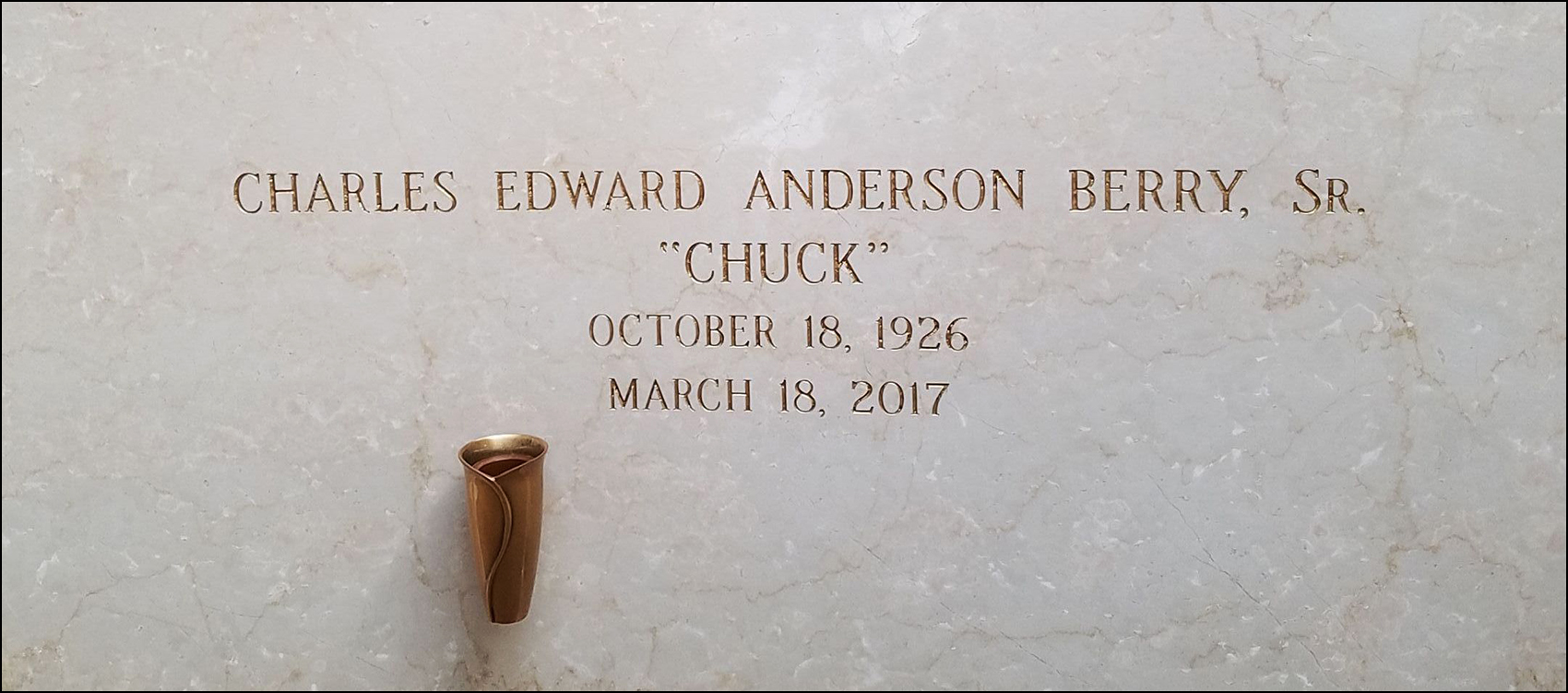
Berry’s funeral was held on April 9, 2017, at The Pageant, in Berry’s home town of St. Louis. He was remembered with a public viewing by family, friends, and fans. He was viewed and buried with a new cherry-red Gibson ES-355 guitar like the one he used throughout his career, bolted to the inside lid of the coffin and with flower arrangements which included one sent by the Rolling Stones in the shape of a guitar. Afterwards, a private service was held in the club celebrating Berry’s life and musical career, with the Berry family inviting 300 members of the public into the service. Berry is interred in a mausoleum in Bellerive Gardens Cemetery in St. Louis. ✪




















▶️ ◼️◼️◼️◼️◼️◼️◼️◼️◼️ ✪✪✪ DONATE ✪✪✪ ◼️◼️◼️◼️◼️◼️◼️◼️◼️◼️
▶️ DONATE VIA PAYPAL (DEBIT & CREDIT CARD)
ALL PayPal Transactions Are Encrypted For Card Holder Privacy & Security
▶️ DONATE VIA ZELLE (DIRECT BANK CASH TRANSFER)
ZELLE is the perfect online alternative to PayPal. It’s an incredibly simple, secure, easy, fast and FREE way to send or receive money to recipients directly from your online banking account without a middleman. Best of all, there are NO fees.
ZELLE is a service provided by your bank and is already built in to your online banking account. You only need to activate it first before using. If you’ve already activated ZELLE in your online bank or credit union account, you can donate to The New Americanist by using our ZELLE address:
vip@thenewamericanist.com
To activate your ZELLE, follow these easy instructions (a simple two minute process):

▶️ DONATE VIA SNAIL MAIL