⭐️ Jim In Tucson


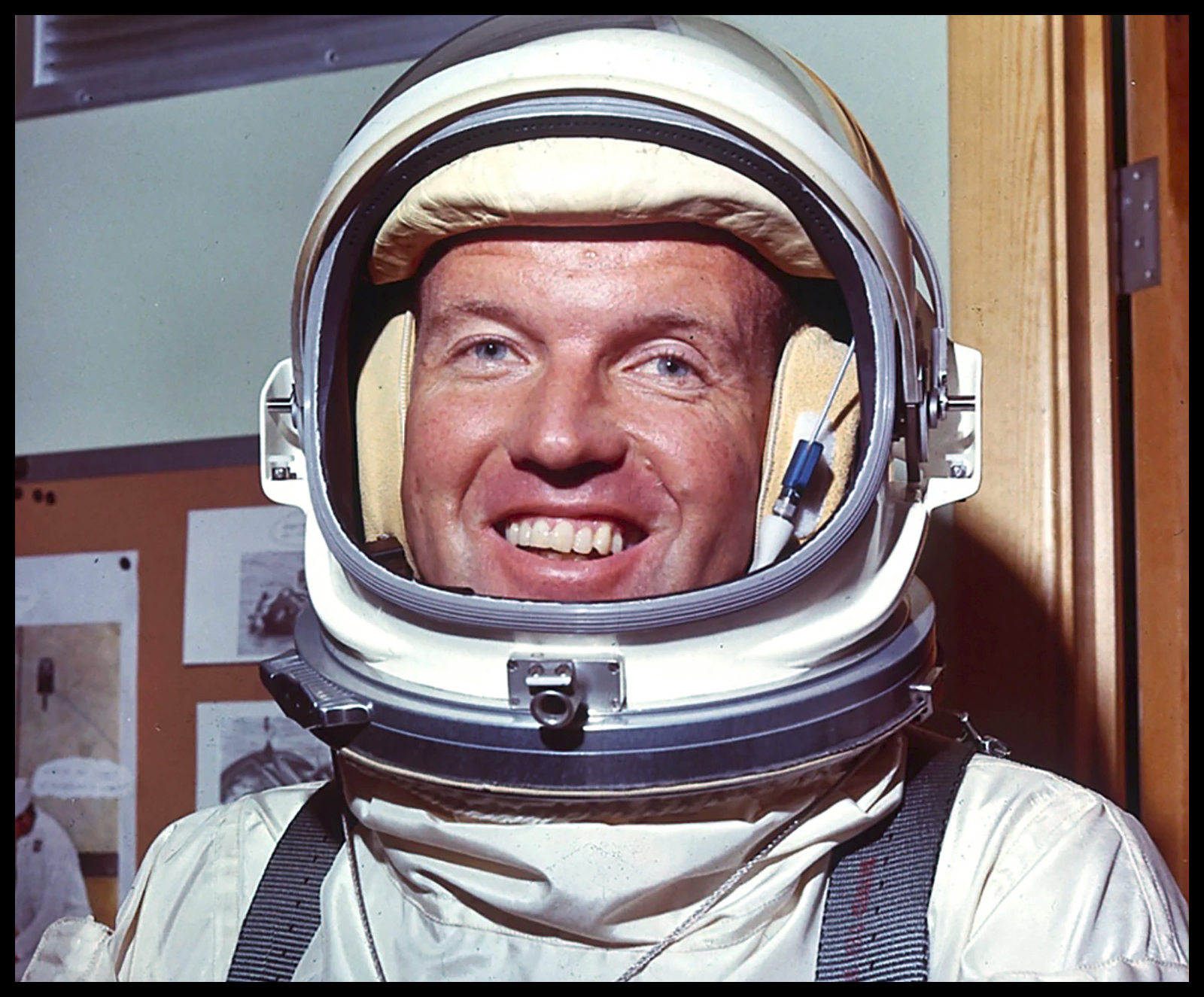

Leroy Gordon Cooper Jr. (March 6, 1927 – October 4, 2004)
✪ Leroy Gordon Cooper Jr. was an American aerospace engineer, test pilot, United States Air Force pilot, businessman, and the youngest of the seven original astronauts in Project Mercury; the first human space program of the United States. Cooper learned to fly as a child, and after service in the United States Marine Corps during World War II, he was commissioned into the United States Air Force in 1949. After serving as a fighter pilot, he qualified as a test pilot in 1956 and was selected as an astronaut in 1959.
In 1963, Cooper piloted the longest and last Mercury spaceflight, Mercury-Atlas 9. During that 34-hour mission, he became the first American to spend an entire day in space, the first to sleep in space, and the last American launched on an entirely solo orbital mission. Despite a series of severe equipment failures, he completed the mission under manual control, guiding his spacecraft, which he named Faith 7, to a successful splashdown just 4 miles ahead of the recovery flotilla.
Cooper became the first person to make a second orbital flight when he flew as command pilot of Gemini 5 in 1965. Along with pilot Pete Conrad, he set a new space endurance record by traveling 3,312,993 miles in 190 hours and 56 minutes; just short of eight days, demonstrating astronauts could survive in space for the length of time required to go from the Earth to the Moon and back.
Cooper enjoyed racing cars and speedboats. He entered the $28,000 Salton City 500 miles boat race, the Southwest Championship Drag Boat races in 1965, and the 1967 Orange Bowl Regatta with firefighter Red Adair. In 1968, he entered the 24 Hours of Daytona, but NASA management ordered him to withdraw due to their concerns about the dangers involved. After serving as backup commander of the Apollo 10 mission, Cooper was superseded by Alan Shepard and retired in 1970 from NASA and the Air Force with the rank of colonel.
Leroy Gordon Cooper Jr. was born on March 6, 1927, in Shawnee, Oklahoma, the only child of Leroy Gordon Cooper Sr. and his wife, Hattie Lee (née Herd). His father enlisted in the United States Navy during World War I. After the war, Cooper Sr. completed high school; Hattie Lee was one of the teachers, although she was only two years older. The senior Cooper joined the Oklahoma National Guard, where he flew a Curtiss JN-4 biplane, graduated from law school, and went on to become a state district judge. After active service in World War II, he transferred to United States Air Force (USAF) when it was formed in 1947, and was stationed at Hickam Air Force Base, Hawaii Territory.
Cooper attended Jefferson Elementary School and Shawnee High School, where he was on the football and track teams. During his senior year in high school, he played halfback on the football team which played in the state football championship. He was also active in the Boy Scouts of America, where he achieved its second highest rank of Life Scout.
Cooper’s parents owned a Command-Aire 3C3 biplane which he learned to fly at a young age. His father sat him on cushions so he could see and rigged the rudder pedals with blocks so he could reach them. He unofficially soloed when he was 12 years old; and earned his pilot license in a Piper J-3 Cub when he was 16. When his father was called back into service, his family moved to Murray, Kentucky. He graduated from Murray High School in June 1945.
After Cooper learned the United States Army and Navy flying schools were not taking any new candidates, he instead enlisted in the United States Marine Corps. He left for Parris Island as soon as he graduated from high school; declining a football scholarship to Oklahoma A&M. However, World War II ended before he could see any overseas service. He was assigned to the Naval Academy Preparatory School (NAPS) and was an alternate appointee to the United States Naval Academy (USNA) but was not appointed. After graduating from NAPS, he served with the Presidential Honor Guard in Washington, D.C. until he was discharged from the Marine Corps in 1946.
Following his discharge from the Marine Corps, Cooper went to Hawaii to live with his parents. There, he began attending the University of Hawaiʻi at Mānoa, and bought his own J-3 Cub. There he also met his first wife, Trudy B. Olson (1927–1994) of Seattle, through the local flying club. She was active in flying and later became the only wife of a Mercury Seven astronaut to have a private pilot license. They were married on August 29, 1947, in Honolulu, when both were 20 years old. They had two daughters.
At college, Cooper was active in the Reserve Officers’ Training Corps (ROTC), which led to his being commissioned as a second lieutenant in the U.S. Army in June 1949. Later, he was able to transfer his commission to the United States Air Force in September of that same year. He received his flight training at Perrin Air Force Base, Texas and Williams Air Force Base, Arizona, in the T-6 Texan.
On completion of his flight training in 1950, Cooper was posted to Neubiberg Air Base in West Germany, where he flew F-84 Thunderjets and F-86 Sabres for four years. He became a flight commander of the 525th Fighter Bomber Squadron. While in Germany, he attended the European Extension of the University of Maryland. He returned to the United States in 1954 and studied for two years at the U.S. Air Force Institute of Technology (AFIT) in Ohio of Air University. He completed and received his Bachelor of Science degree in Aerospace Engineering there on August 28, 1956.
While at AFIT, Cooper met Gus Grissom, a fellow USAF officer, and the two became good friends. in 1956, Cooper and Grissom attended the USAF Experimental Flight Test Pilot School (Class 56D) at Edwards Air Force Base in California. After graduation, Cooper was posted to the Flight Test Engineering Division at Edwards, where he served as a test pilot and project manager testing the F-102A and F-106B. He also flew the T-28, T-37, F-86, F-100 and F-104. By the time he left Edwards, he had logged more than 2,000 hours of flight time, 1,600 hours of which were in jet aircraft.
In January 1959, Cooper received unexpected orders to report to Washington, D.C. There was no indication what it was about, but his commanding officer, Major General Marcus F. Cooper (no relation) recalled an announcement in the newspaper saying that a contract had been awarded to McDonnell Aircraft in St. Louis, Missouri, to build a space capsule. He advised his officers not to volunteer for astronaut training. “I don’t want my best pilots involved in some idiotic space program.”
On February 2, 1959, Cooper attended a briefing of the National Aeronautics and Space Administration on Project Mercury, and the part astronauts would play in it. Cooper went through the selection process with another 109 pilots, and was not surprised when he was accepted as the youngest of the first seven American astronauts
During the selection interviews, Cooper was asked about his domestic relationship, and he lied; claiming he and Trudy had a good, stable marriage. In fact, they had separated four months before, and she was living with their daughters in San Diego while he occupied a bachelor’s quarters at Edwards. Aware that NASA wanted to project an image of its astronauts as loving family men; and that his story would not stand up to scrutiny, he drove down to San Diego to see Trudy at the first opportunity. Lured by the prospect of a great adventure for herself and her daughters, she agreed to go along with the story and pretended they were a happily married couple.
The identities of the Mercury Seven were announced at a press conference at Dolley Madison House in Washington, D.C., on April 9, 1959: Scott Carpenter, Gordon Cooper, John Glenn, Gus Grissom, Wally Schirra, Alan Shepard, and Deke Slayton. Each was assigned a different portion of the project along with other special assignments. Cooper specialized in the Redstone rocket, which would be used for the first sub-orbital spaceflights.
The astronauts drew their salaries as military officers, and an important component of that was flight pay. In Cooper’s case, it amounted to $145 a month (equivalent to $1,601 in 2025). NASA saw no reason to provide the astronauts with their own aircraft, so they flew to meetings around the country on commercial airlines.
After General Motors executive Ed Cole presented Shepard with a brand-new Chevrolet Corvette, Jim Rathmann, a Chevrolet dealer in Melbourne, Florida, convinced Cole to turn this into an ongoing marketing campaign. Henceforth, astronauts were able to lease brand-new Corvettes for only a dollar a year. All of the Mercury Seven except Glenn took Rathmann up the offer. Cooper, Grissom, and Shepard raced their Corvettes around Cape Canaveral, with the police ignoring their exploits. Cooper held licenses with the Sports Car Club of America (SCCA) and the National Association for Stock Car Auto Racing (NASCAR). He also enjoyed racing high performance speedboats.
Cooper served as the capsule communicator (CAPCOM) on NASA’s first sub-orbital spaceflight, made by Alan Shepard in the Mercury-Redstone 3, and for Scott Carpenter’s orbital flight on Mercury-Atlas 7. He was the backup pilot for Wally Schirra in Mercury-Atlas 8. After Mercury-Atlas 8, Cooper was selected for the next mission, Mercury-Atlas 9 (MA-9).
▶️ 3 Minutes 26 Seconds
Cooper was launched into space on May 15, 1963, aboard the Faith 7 spacecraft, for what would turn out to be the last of the Project Mercury missions. Because MA-9 would orbit over nearly every part of Earth from 33 degrees north to 33 degrees south, NASA needed to stage recovery assets all over the globe. A total of 28 ships, 171 aircraft, and 18,000 servicemen were assigned to support the mission. Cooper orbited the Earth 22 times and logged more time in space than all five previous Mercury astronauts combined: 34 hours, 19 minutes and 49 seconds. Cooper achieved a peak altitude of 165.9 miles at apogee. He was the first American astronaut to sleep, not only in orbit, but on the launch pad during a countdown.
There were several mission-threatening technical problems toward the end of Faith 7‘s flight. During the 19th orbit, the capsule had a power failure. Carbon dioxide levels began rising, both in Cooper’s suit and in the cabin, and the cabin temperature climbed to over 130 F. The power failure caused the clock and then the gyroscopes to fail, however the radio, which was connected directly to the battery, remained working, and allowed Cooper to maintain communication with the mission controllers.
Like all Mercury flights, MA-9 was originally designed to be fully controlled from the ground; a controversial engineering decision which reduced the role of an astronaut to that of a passenger, and prompted Chuck Yeager to describe Mercury astronauts as “Spam in a can”. “This flight would put an end to all that nonsense,” Cooper later wrote. “My electronics were shot and a pilot had the stick.”
Falling back on his understanding of star patterns, Cooper took manual control of the tiny capsule and successfully estimated the correct pitch for re-entry into the atmosphere. Precision was needed in the calculation; small errors in timing or orientation could produce large errors in the landing point. Cooper drew lines on the capsule window to help him check his angles & orientation before firing the re-entry rockets. “So I used my wrist watch for time,” he later recalled, “my eyeballs out the window for attitude. Then I fired my retrorockets at the right time and landed right by the carrier.”
Faith 7 successfully splashed down only four miles ahead of the recovery ship, the aircraft carrier USS Kearsarge. Faith 7 was hoisted on board by a helicopter with Cooper still inside. Once on deck, he used the explosive bolts to blow open the hatch.
▶️ 5 Minutes 35 Seconds
On May 22, New York City gave Cooper a ticker-tape parade witnessed by more than four million spectators. The parade concluded with a congratulatory luncheon at the Waldorf-Astoria attended by 1,900 people: where dignitaries such as Vice President Lyndon B. Johnson and former President Herbert Hoover made speeches honoring Cooper.
Project Mercury was followed by Project Gemini, which took its name from the fact it carried two men instead of just one. Slayton designated Cooper as commander of Gemini 5 on an eight-day, 120-orbit mission. Cooper’s assignment was officially announced on February 8, 1965.
The mission was postponed from August 9 to 19 to give Cooper and Conrad more time to train, and was then delayed for another two days due to a storm. Gemini 5 was launched at 09:00 EST on August 21, 1965. The Titan II booster placed them in a 101 by 217 mile orbit.
However, the mission was cut short by the appearance of Hurricane Betsy in the planned recovery area. Cooper fired the retrorockets on the 120th orbit. Splashdown was 81 miles short of the target. A computer error had set the Earth’s rotation at 360 degrees per day, whereas it is actually 360.98. The difference proved to be significant in a spacecraft.
Helicopters plucked them from the sea and took them to the recovery ship, the aircraft carrier USS Lake Champlain. The two astronauts established a new space endurance record by traveling a distance of 3,312,993 miles in 190 hours and 56 minutes; just short of eight days, showing astronauts could survive in space for the length of time necessary to go from the Earth to the Moon and back. Cooper became the first astronaut to make a second orbital flight.
NASA management became increasingly concerned about Cooper’s participation in dangerous motor sports. In November 1964, Cooper entered the $28,000 Salton City 500-mile boat race with racehorse owner Ogden Phipps and racing car driver Chuck Daigh. In 1968, he entered the 24 Hours of Daytona with Charles Buckley, the NASA chief of security at the Kennedy Space Center. The night before the race, NASA management ordered him to withdraw due to the dangers involved. Cooper upset NASA management by quipping to the press that “NASA wants astronauts to be tiddlywinks players.”
Cooper was selected as backup commander for the May 1969 Apollo 10 mission. This placed him in line for the position of commander of Apollo 13, according to the usual crew rotation procedure established by Slayton as Director of Flight Crew Operations. However, when Shepard, the Chief of the Astronaut Office, returned to flight status in May 1969, Slayton replaced Cooper with Shepard as commander of this crew.
Dismayed by his stalled astronaut career, Cooper retired from NASA and the USAF on July 31, 1970, with the rank of colonel, having flown 222 hours in space. Soon after he divorced Trudy and married Suzan Taylor, a schoolteacher, in 1972. They had two daughters & remained married until his death in 2004.
After leaving NASA, Cooper served on several corporate boards and as a technical consultant for more than a dozen companies in fields ranging from high-performance boat design to energy, construction, and aircraft design. Between 1962 and 1967, he was president of Performance Unlimited, Inc., a manufacturer and distributor of racing and marine engines and fiberglass boats.
As part-owner and race project manager of the Profile Race Team from 1968 to 1970, Cooper designed and raced high-performance boats. Between 1968 and 1974, he served as a technical consultant at Republic Corp., General Motors, Ford, and Chrysler Motor Companies, where he was a consultant on design and construction of various automotive components.
Cooper was also President of his own consulting firm, Gordon Cooper & Associates, Inc., which was involved in technical projects ranging from airline and aerospace fields to land and hotel development. From 1973 to 1975, he worked for The Walt Disney Company as the vice president of research and development for Epcot. In 1989, he became the chief executive of Galaxy Group, Inc., a company which designed and improved small airplanes.
Cooper claimed until his death the US Government was hiding & covering up information about UFOs. He pointed out that there were hundreds of reports made by his fellow pilots, many coming from military jet pilots sent to respond to radar or direct visual sightings. In his memoirs, Cooper wrote he had seen unexplained aircraft several times during his career; and hundreds of reports had been made. In 1978, he testified before the UN on the topic. Throughout his later life, Cooper repeatedly expressed in interviews he had seen UFOs, and described his recollections for a 2003 documentary.
On October 4th, 2004, Cooper died at age 77 from heart failure at his home in Ventura, California. A portion of his ashes, along with those of Star Trek actor James Doohan and 206 others, was launched from New Mexico on April 29, 2007, on a sub-orbital memorial flight by a privately owned UP Aerospace SpaceLoft XL sounding rocket. The capsule carrying the ashes fell back toward Earth as planned; but it was lost in a mountainous landscape. The search was obstructed by bad weather, but after a few weeks, the capsule was found, and the ashes it carried were returned to the families. The ashes were then launched on the Explorers orbital mission on August 3, 2008, but were lost when the Falcon 1 rocket failed two minutes into the flight.
On May 22, 2012, another portion of Cooper’s ashes was among those of 308 people included on the SpaceX COTS Demo Flight 2 which was bound for the International Space Station. This flight, using the Falcon 9 launch vehicle and the Dragon capsule, was uncrewed. The second stage and the burial canister remained in the initial orbit that the Dragon C2+ was inserted into, and burned up in the Earth’s atmosphere a month later.
In 1980, Cooper was one of five Oklahoman astronauts inducted into the Oklahoma Aviation and Space Hall of Fame. He was inducted into the International Space Hall of Fame in 1981, and the U.S. Astronaut Hall of Fame on May 11, 1990.
Cooper was a member of the Society of Experimental Test Pilots, the American Institute of Aeronautics and Astronautics, the American Astronautical Society, Scottish Rite and York Rite Masons, Shriners, the Royal Order of Jesters, the Rotary Club, Order of Daedalians, Confederate Air Force, Adventurers’ Club of Los Angeles, and the Boy Scouts of America. He was a Master Mason (member of Carbondale Lodge # 82 in Carbondale, Colorado), and was given the honorary 33rd Degree by the Scottish Rite Masonic body. ✪



















▶️ ◼️◼️◼️◼️◼️◼️◼️◼️◼️◼️ ✪✪✪ DONATE ✪✪✪ ◼️◼️◼️◼️◼️◼️◼️◼️◼️

▶️ DONATE VIA PAYPAL (DEBIT & CREDIT CARD)
ALL PayPal Transactions Are Encrypted For Card Holder Privacy & Security
▶️ DONATE VIA ZELLE (DIRECT BANK CASH TRANSFER)
ZELLE is the perfect online alternative to PayPal. It’s an incredibly simple, secure, easy, fast and FREE way to send or receive money to recipients directly from your online banking account without a middleman. Best of all, there are NO fees.
ZELLE is a service provided by your bank and is already built in to your online banking account. You only need to activate it first before using. If you’ve already activated ZELLE in your online bank or credit union account, you can donate to The New Americanist by using our ZELLE address:
vip@thenewamericanist.com
To activate your ZELLE, follow these easy instructions (a simple two minute process):

▶️ DONATE VIA SNAIL MAIL