



Hi Folks…And Welcome Again To FLAT OUT!

This Month, It’s…
The Ford Torino/Gran Torino: 1968-1976
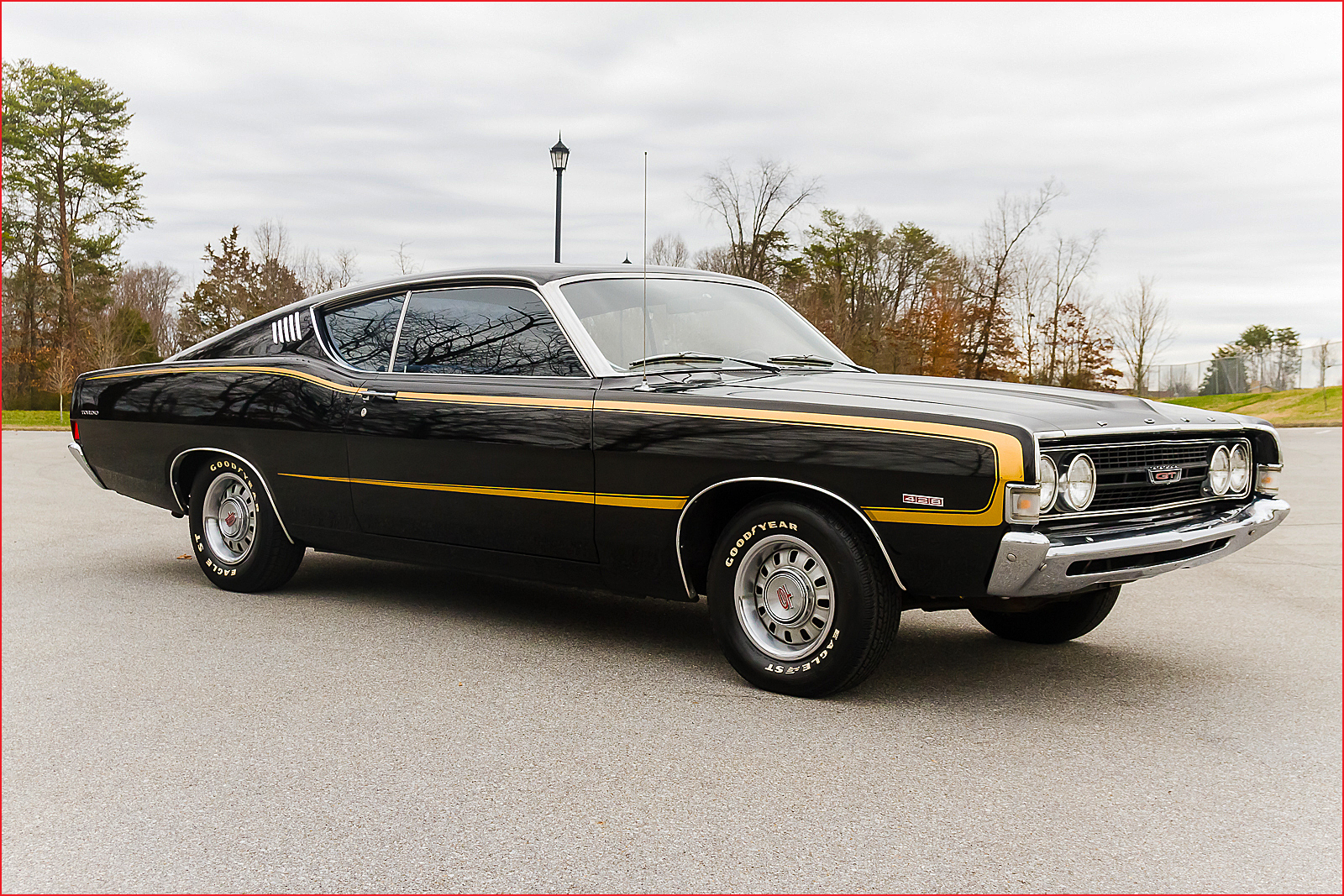
The Torino and Gran Torino were intermediate cars produced by Ford. Named after the Italian city of Turin (Torino in Italian), it was initially an upscale version of the intermediate Ford Fairlane and stablemate to the more luxurious Mercury Montego. In 1968 and 1969, base models wore the Fairlane name while the upper trim levels were badged Torino even though it was still a Fairlane sub-series. By 1970 that arrangement got turned on its head and Fairlane was a sub-series of Torino.The Fairlane nameplate was dropped in 1971, and to the end of the model run five years later the Torino (and later Gran Torino) was the only Ford intermediate model.
The Torino name was also one of the contenders for what eventually became the Mustang.
First Generation 1968 – 1969
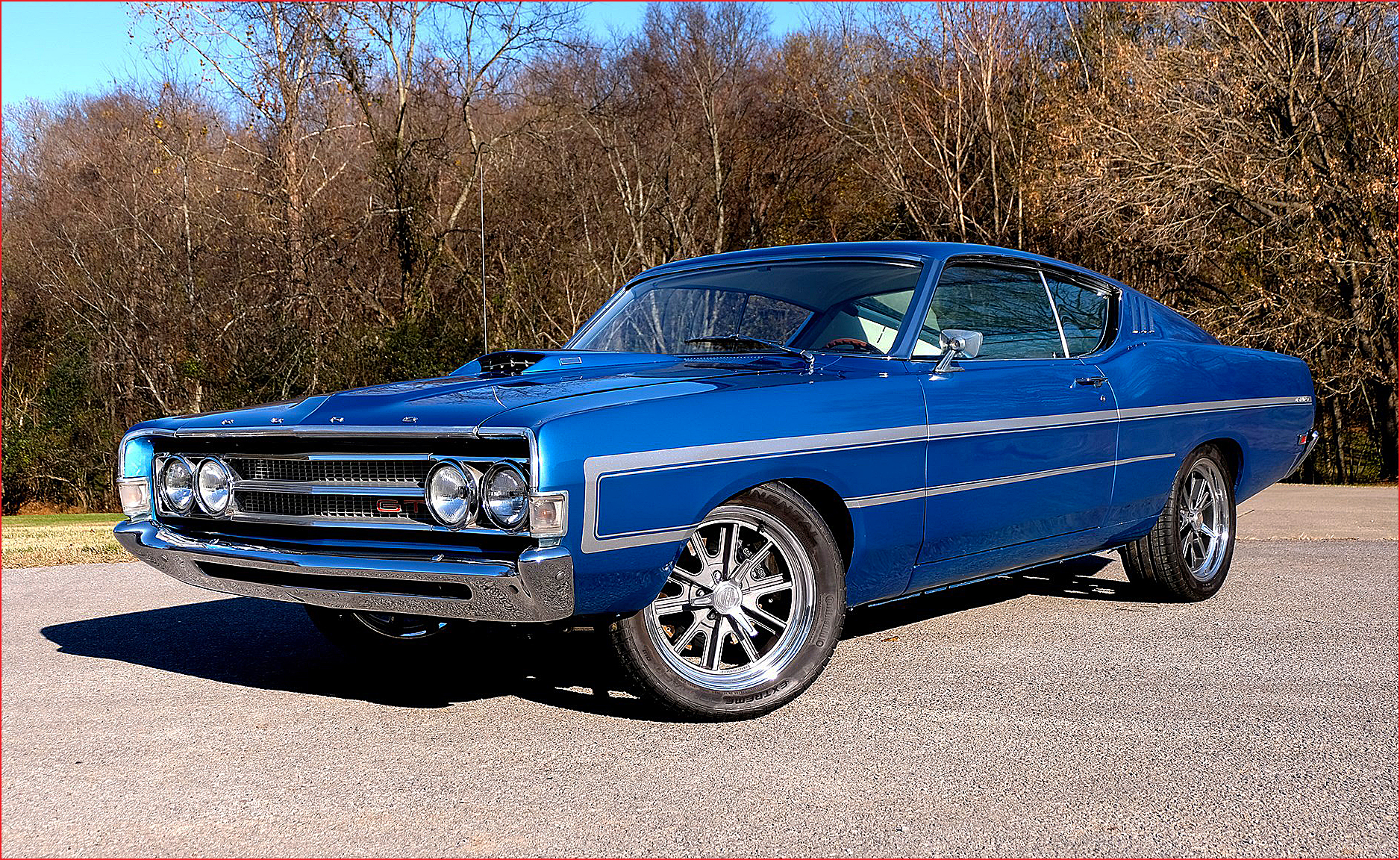
The 2 and 4-door 1968 Fairlane and Torino used the same 116 in. wheelbase as the previous year’s Fairlane. A station wagon version was also available, utilizing a shorter 113 in. wheelbase. Styling was drastically changed from 1967, including increases in size and weight. A 2-door fastback “SportsRoof” version was also available, presumably to entice those who were looking for a larger car than the fastback Mustang. The SportsRoof also had a unique concave taillight panel. This made for excellent aerodynamics (by 1968 standards) that would prove useful on the racetrack the following year.
There were fourteen (yes, fourteen) different models in the Fairlane/Torino lineup. Can you imagine that today? I can’t. The base Fairlane was available in 2-door hardtop, four-door sedan and four-door station wagon configurations. Next up in trim was the Fairlane 500 in 2-door hardtop, 2-door SportsRoof, 2-door convertible, 4-door sedan and 4-door station wagon models. The Torino level could be had in 2-door hardtop, 4-door sedan and the “Squire” station wagon with oh-so-’60s/’70s trimmed fake wood applique on the sides. The Torino GT, the sporty version of the Fairlane 500, got you either a 2-door hardtop, 2-door SportsRoof or 2-door convertible.
The Fairlane/Torino utilized the same base unibody construction as the ’66-’67 Fairlane. Suspension was as you would expect in a late ’60s domestic car, control arms, shocks and coil springs in front and rear leaf springs mounted to a solid axle. A heavy-duty suspension was available with V-8 engines. Manual recirculating-ball steering was standard with optional power assist. Brakes were conventional drums all around with optional front discs and power assist. The interior was new as well, four round pods greeted the driver, although not all held gauges, the left had the fuel gauge and warning lights, the next the speedometer, the third was all warning lights and the fourth was blank unless one paid for the optional tachometer. Torino models had full color-keyed interior carpeting and badges on the “C” pillar. The GT had special badging interior and exterior and was supposed to have bucket seats, but a six-week UAW strike caused the 1968 models to come equipped with bench seating.
The standard engine in all but the Torino GT was a 115 HP, 200 cu. in. inline six-cylinder. The base V-8 was supposed to be a 220 HP 302 cu. in. small-block, this was also supposed to be the standard engine on the Torino GT. That same six-week UAW strike resulted in the 195 HP 289 V-8 being offered as the base V-8 and the base GT engine in 1968 even though Ford‘s sales literature still showed the 302. Other engine options included 2 390 cu. in. models, one with 2 valves per cylinder producing 265 HP and another with 4 valves per cylinder, producing 325 HP. A 390 HP 427 cu. in. V-8 was touted in the literature, but no 1968 models were shipped with this engine. The $306, 335 HP 428 Cobra Jet engine became available mid-year, but these are very rare for 1968, these models were differentiated with red-and-chrome “428” badges on the fenders behind the parking lamps. The actual power of the Cobra Jet was likely between 375 and 400 HP after the break-in period, but Ford de-rated the engine (at least on paper) in an attempt to fool the insurance companies who were beginning to jack up premiums for high-HP big-block engines. A three-speed manual was standard, a four-speed manual and “Cruise-O-Matic” automatic transmissions were optional.
Performance was good, if not spectacular, for the time. A 4-valve 390 equipped Torino GT could make 60 MPH in 7.7 seconds and 1/4 mile in 15.8 seconds at 90 MPH, and handling was on par if not better than most of its sporty domestic contemporaries.
There were a few minor cosmetic changes for 1969, but the real change came in the performance department. The base six-cylinder was bumped to 250 cu. in. and got 40 more HP, the 220 HP 302 finally took its place as the base (standard on GT) V-8, a new 351 cu. in. Windsor engine producing 250 HP in 2-valve form and 290 HP with 4 valves, the 2 and 4-valve 390s with the same HP as ’68 and the 428 Cobra Jet. The latter was the standard engine on a new model, the Torino Cobra, available in 2-door hardtop or 2-door Sports Roof. A functional Ram Air hood scoop was also an option with the Cobra. However, the 428 Cobra Jet was no longer the top-dog engine, being superseded (pun intentional) by the Super Cobra Jet, available with the “Drag-Pack” option specifically made for drag racing. This 4-valves-per-cylinder engine had cast pistons, anodular controlled cast-iron crankshaft with external weights behind the balancer, 427 LeMans-spec cap screw connecting rods, and an engine oil cooler. A 9-inch differential with 3.91:1 gearing, or 4.30:1 gearing with the optional Detroit Locker differential, transferred power to the rear wheels. Despite all the performance upgrades, Ford still rated the Super Cobra Jet at the same ridiculously low 335 HP as the standard Cobra Jet when it probably produced in the neighborhood of 425-450 HP.
The Torino Cobra was Ford‘s move to make the Torino into a true muscle car. In addition to the Cobra Jet engine, it featured competition suspension, a 4-speed manual transmission and larger F70-14 tires. A blacked out grill, hood pins and “Cobra” emblems competed the package. Ford had the Plymouth Road Runner in its sights when building the Torino Cobra. Since the Road Runner was a low-cost muscle car, the Torino Cobra abandoned the GT-level trim and instead featured the lesser trim of the Fairlane 500 to keep costs down and focus on performance.
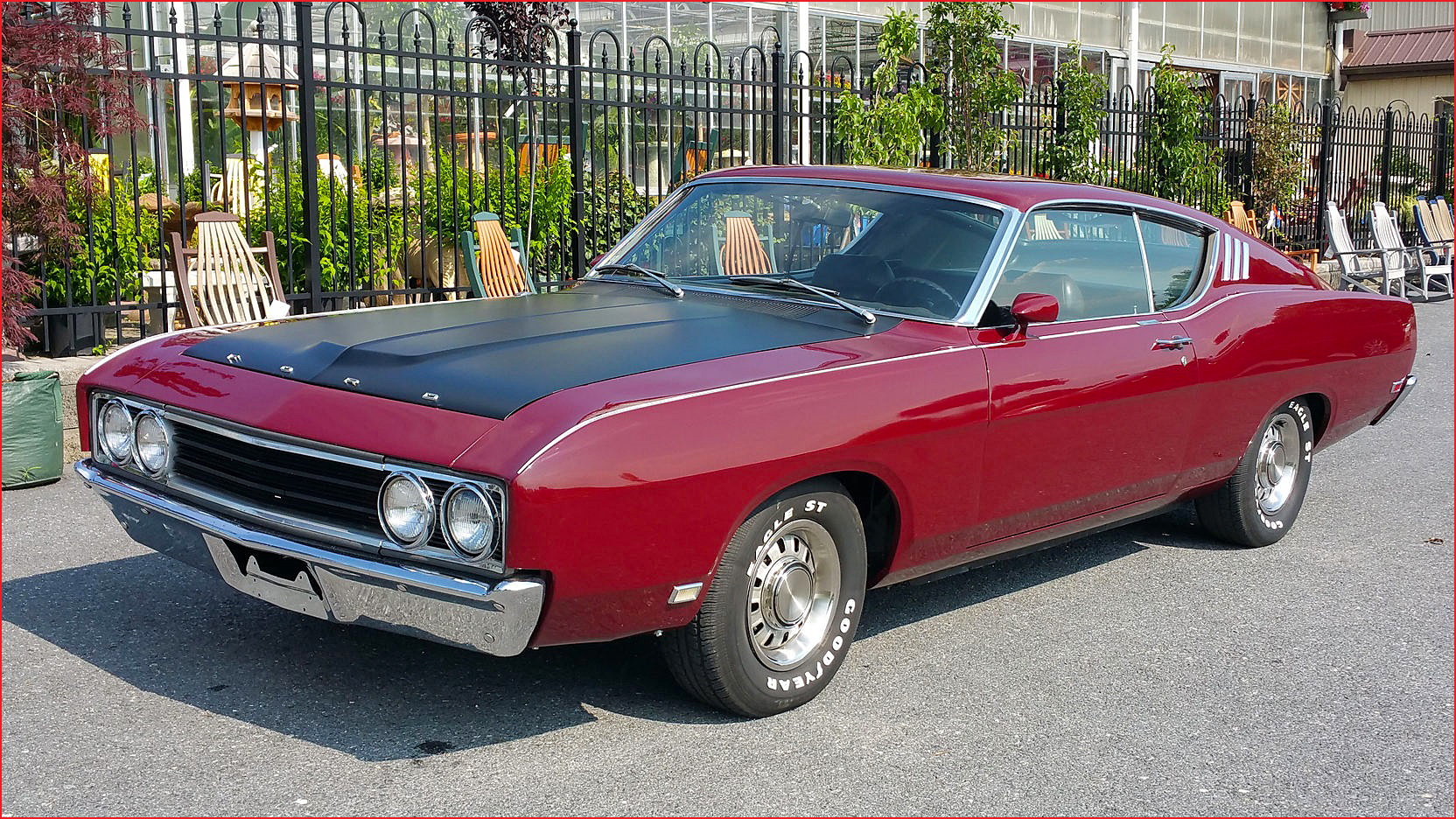
One final model, for a total of an incredible 17 versions, was created in1969…the Torino Talladega. Named after NASCAR’s Talladega Speedway, The Torino Talladega was a more aerodynamic version of the Sports Roof Torino Cobra with a flush-mounted grill instead of the Torino‘s inset grill and a nose that extended out six inches further. A rear bumper that had been cut, narrowed, V-ed in the center and filled in on the ends was more close-fitting and served as a crude front air dam for better aerodynamic performance. The rocker panels were re-shaped and rolled to allow the Talladega to ride an inch closer to the ground, also improving aerodynamics and lowering the center of gravity. Other enhancements were an engine oil cooler (as on the Super Cobra Jet), a power steering cooler, staggered shocks, a 9-inch 3.25:1 rear end and a heavy-duty column-shifted automatic transmission. The only seat offered was a black vinyl and cloth bench seat. The 428 Cobra Jet engine in the Talladega was again rated at only 335 HP by Ford. NASCAR homologation rules called for 500 to be built, but for some reason Ford decided to build another 243 street Talladegas, all 743 with black hoods and black rear tail panels. Three colors were offered: Wimbledon White (286 built), Royal Maroon (258 built) and Presidential Blue (199 built). Because Ford dropped factory support for racing in 1970, Talladegas were built in 1969 only and are the rarest, most collectible Torinos.
Second Generation 1970- 1971
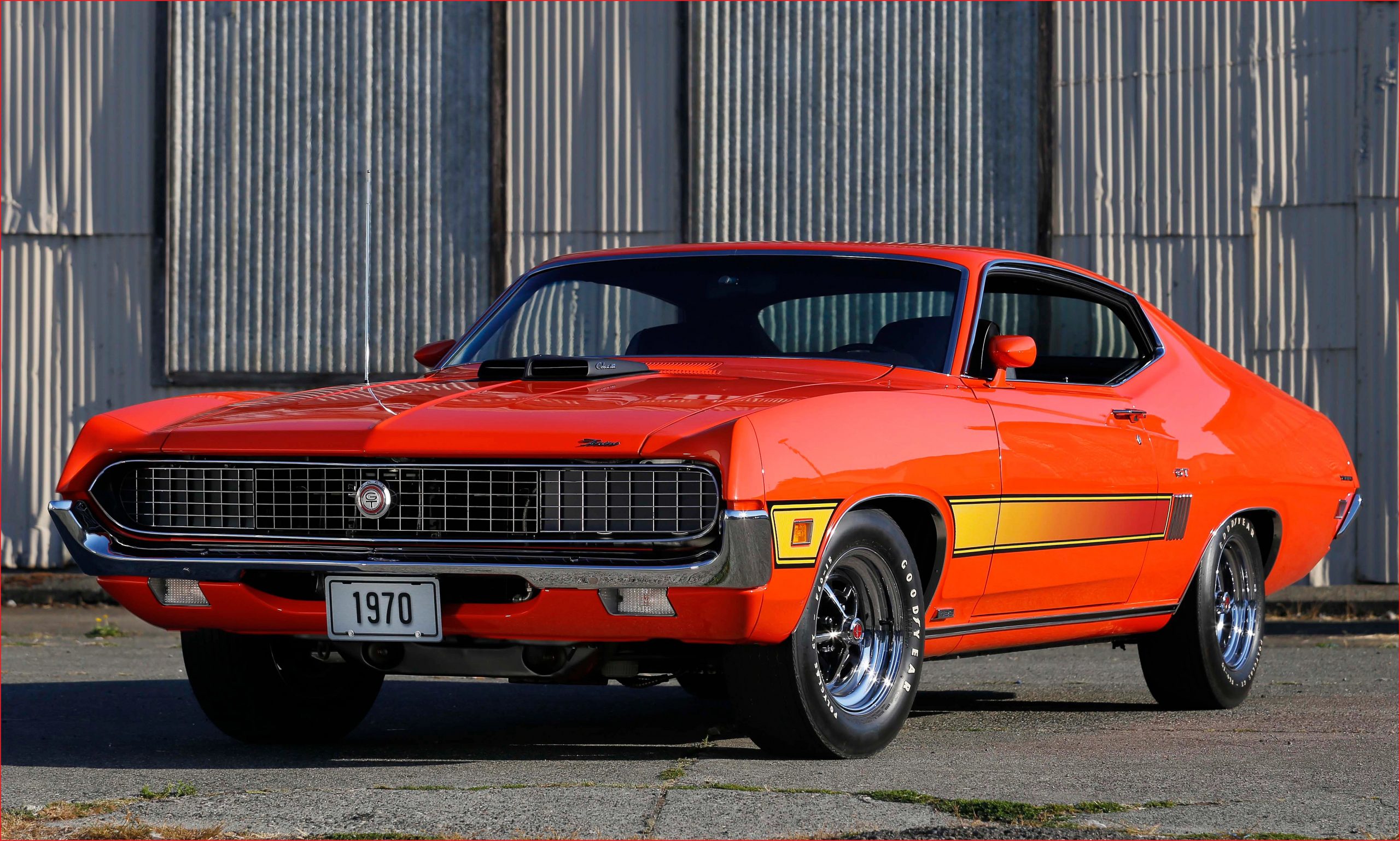
For 1970, Torino moved away from the boxy styling of full-sized Fords and unveiled an all-new body with a “Coke-bottle” shape that had begun to be popular on other manufacturer’s cars of similar size two years earlier. Ford stylist Bill Shenck was inspired by aircraft design that featured a narrow waist and bulging forward and rear fuselages, the “wasp waist” seen on nearly every supersonic aircraft of the day. It was longer, lower and wider than the ’69 model and had a longer front end and a lower roofline. The SportsRoof was of a flatter fastback profile and the front windshield was more raked. The grill covered the entirety of the front fascia and the front end came to a prominent point, unlike the flat front of previous models.
The initial choice of models was again extensive: 13 in all, including 2-door hardtop, 4-door sedan and 4-door wagon Fairlane 500s. A 2 and 4-door hardtop, a new 4-door pillarless hardtop, 4-door sedan and 4-door Squire wagon filled out the mid-level Torino trim, a new, fancier Torino Brougham trim level with 2 and 4-door hardtops, the Torino GT in 2-door Sports Roof and convertible, and finally the Torino Cobra was only available in 2-door Sports Roof form. To add to a buyer’s confusion, the compact Falcon was upgraded to intermediate status and rolled out as an entry-level model in 2 and 4-door hardtop and 4-door wagon form. The Falcon only lasted half a year as it could not meet the new 1970 Federal safety standards. A mid-year Torino Sports Roof model came out as an alternative to the pricier GT, for another total of 17 intermediate Ford models for a time.
The Torino gained inches and pounds as a result of the re-styling, riding on a 117-inch wheelbase (114 for wagon models), and gaining some 100 lbs. A wider wheel track achieved better handling. The interior was changed as well, a new central linear speedometer behind the steering wheel and optional V-8 only “ribbon”-style tach greeted the driver. The only gauge available was for engine temperature, all other functions were monitored by warning lights, as was the trend in the 1970s. High-back bucket seats and a center console were optional on all 2-door models. The 2-door hardtop, SportsRoof and convertible models now featured a standard “DirectAire” ventilation system, eliminating the need for separate front vent windows. This was only an option on other models, so their vent windows remained. To comply with the new Federal safety regulations, the key was moved from the dashboard to the steering column and the column-mounted shifter locked when the key was removed. The new Torino Brougham was a upscale model that brought a more luxurious interior with extra trim, finer upholstery, extra sound dampening material, unique wheel covers and hideaway headlights. Motor Trend wrote: “When you get into a Brougham, it’s the same feeling as an LTD, or even, dare we say it, a Continental. But in a more manageable scale.”. Contrast that with the Torino Cobra that again had the appointments of the lesser Fairlane 500 to keep costs down and focus more on performance.
Suspension was the same as 1969 and heavy-duty and a new competition suspension were available for V-8 equipped Torinos. Motor Trend magazine tested a 1970 Torino Cobra with the competition suspension and remarked that it was “Completely different. The car goes through tight turns in a confidence-inspiring controlled slide. It’s all very smooth and unusual.”. Motor Trend also voted the Torino “Car Of The Year” for 1970.
Only the 250 cu. in. six-cylinder, 302 V-8 (still standard on GT and now Brougham versions)and the 351 Windsor engines were carried over from ’69. A new 351 Cleveland engine with either a 2 or 4-barrel carb rated at 250 HP for the 2-barrel and 300 HP for the 4-barrel and a new 4-valve 429 with a HP rating bump to 360, more in line with the actual performance, were options. The Cobra Jet and Super Cobra Jet were still options, with ratings of 370 and 375 HP respectively instead of the comical 335 HP rating of the 1969 models. If the buyer chose the 2-barrel 351 option they could end up with either the new Cleveland or old Windsor engines, the factory code was the same for both. The “Drag Pack” was offered again with the Detroit Locker 4.30:1 differential or a new “Traction Lock” limited-slip differential with the 3.91:1 gearing. Ram Air now included a “shaker hood” where the scoop was attached to the air cleaner assembly and not the actual hood, and protruded through a cut-out. The Torino GT came standard with a non-functional hood scoop, Ram Air was optional. The 3-speed manual was still the standard gearbox with the 4-speed available on all but the six and 302 models. “Cruise-O-Matic” automatic transmissions were optional on all models.
1971 saw only minor revisions to Torino, but the Fairlane name was now gone and the Falcon disappeared midway through the previous year, only the Torino name remained. Even with the demise of Fairlane and Falcon there were still 14 choices for buyers with the addition of the Torino 500 next up on the trim level from the base Torino with 2-door hardtop, 4-door sedan and hardtop, 4-door wagon and 2-door Sportsroof models. The hideaway headlights of the previous year’s Brougham could now be found on it as well as the Torino 500 and GT. Base Torinos and Cobras got four exposed round headlights like the 1970 models.
Engine choices remained the same as the year before, but all but the 429 suffered from reduced compression ratios and reduced performance as a result. For instance, the Cobra‘s standard engine was now the 4-valve 351 Cleveland but the reduced compression ratio brought the HP down to 285 from 300, but the 429 was still rated at the same 370 HP. However, the Cobra was available with a Hurst shifter on the 4-speed manual gearbox for the first time for 1971.
Third Generation 1972 – 1976
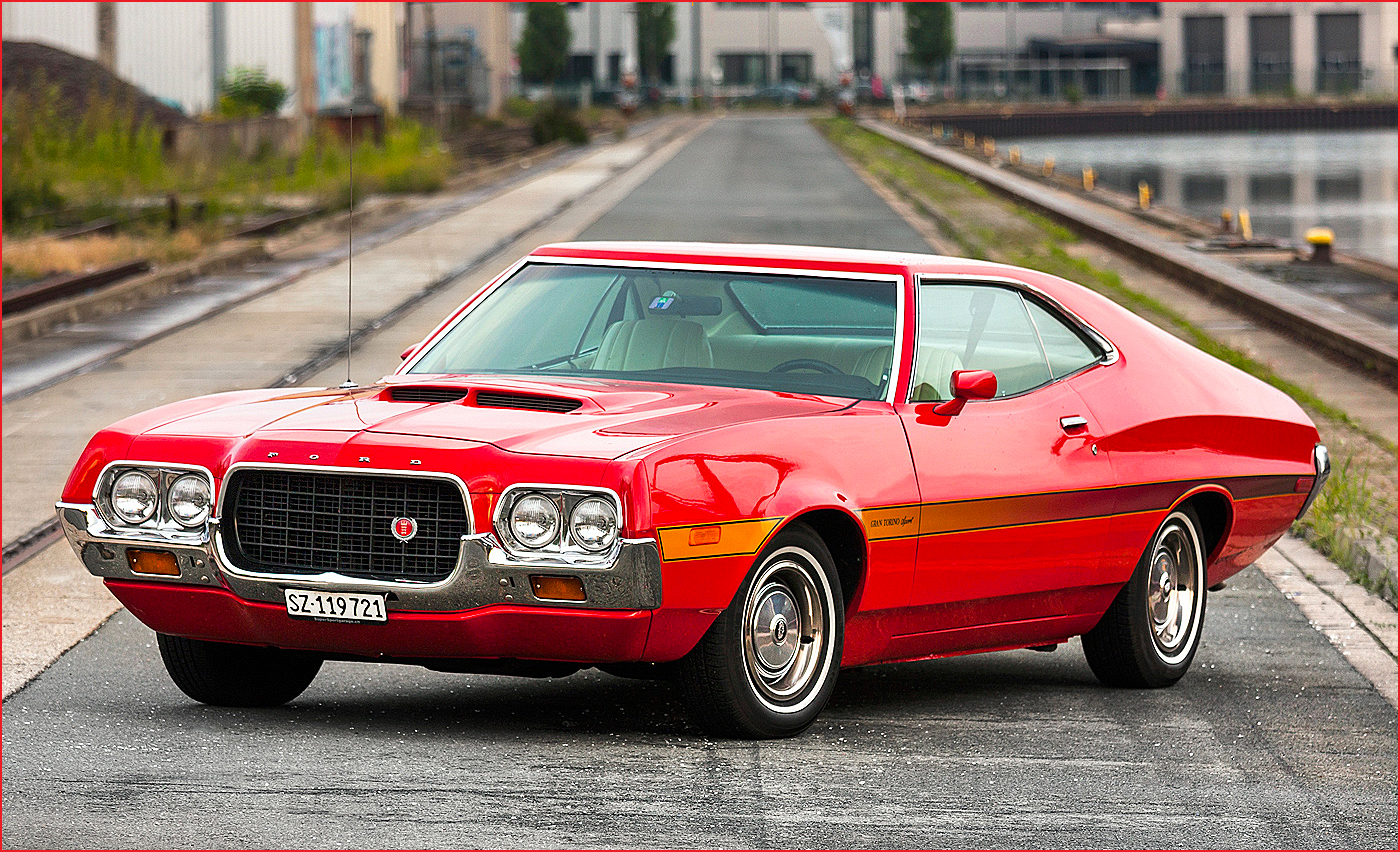
Re-designed again in 1972, Torino kept the same long hood/short rear deck typical of most sporty cars as well as the “Coke-bottle” styling cues. A protruding center section with a large opening for radiator airflow, flanked by four round headlights, was the major departure from the previous generation’s front end. Gran Torinos had chrome bezels surrounding the headlamps on either side of the oval grill, base Torinos had an egg crate grill that surrounded the headlights. The line dropped to three models, Torino, and the new Gran Torino and Gran Torino Sport; the Torino 500, Brougham, GT and Cobra were no more, the line now focusing more on luxury than performance as the muscle car era was coming to a close. Model variations also dropped to 9, a 2-door hardtop, a 4-door “pillared hardtop” replacing the old 4-door hardtops and sedans, and a station wagon for each trim level; the Squire name differentiated the Gran Torino wagon from the others. Brougham was now merely an option package for the Gran Torino and not a model in its own right.
The switch to a body-on-frame construction instead of the unibody of the previous versions gave Torino a quieter and more isolated ride more fitting to the new luxury-centric rather than performance-centric aims of the manufacturer. An energy-absorbing front end was mandated by regulators. Torque boxes, fourteen rubber mounts and five cross members all served to better isolate the driver from the road and the wheel track was extended a further 2 inches. Heavy-duty and competition suspension were the only two offerings, the latter only available on 2-door models. Front disc brakes were standard, it was the only model except its Mercury twin the Montego that could boast such a claim in 1972. Gran Torino Squire wagons offered standard power brakes which were an option on all other models except 429 V-8 equipped cars, where it was not only standard but mandatory. Wheelbases again differed, but this time for both 4-doors and wagons which had a 118 in. wheelbase as opposed to the 114 in. for 2-doors.
A new instrument panel made of ABS plastic eschewed the linear speedometer of the previous generation, replacing it once again with individual pods, five instead of four on the first generation. A speedometer, fuel gauge and temperature gauge were standard, the other pods housed the now-familiar warning lights. The leftmost pod housed the vent for the “DirectAire” vent. V-8 buyers could opt instead for the “Instrumentation Group” that consisted of two large pods in front of the driver housing the speedometer with a trip odometer and tachometer, a third pod this size on the left contained the DirectAire vent.. A smaller stack of pods near the center of the instrument panel were taken up by the fuel gauge, temperature gauge, oil pressure gauge, ammeter and an analog clock. A front bench seat, now with higher back and headrests, was standard and high-back bucket seats were optional on 2-door models.
The base engine was still the 250 cu. in. six except in the Gran Torino Squire wagon and Gran Torino Sport which got the 302 2-valve V-8 with an anemic 140 HP. Optional engines included the 302 2-valve, a 351 2-valve Windsor with 153 HP or Cleveland with 161 HP, a 248 HP 351 4-valve Cobra Jet, a 165 HP 400 2-valve or a 205 HP 429 2-valve, which was not a performance engine but rather a high-torque, low-revving mill. All horsepower was now measured in SAE Net which took account of the drivetrain and exhaust system as well as the engine. Emissions requirements were even stricter in 1972 and all engines had a lower 8.5:1 compression ratio, hindering performance; but the Torino line was no longer about performance, luxury (as compared to previous Torinos) was the primary factor. The only performance engine was the 351 Cobra Jet. Unlike previous 351s, the Cobra Jet featured a special intake manifold,modified camshaft, special valve springs and dampers, a 750 CFM Motorcraft carb , 4-bolt main bearings and a 2 1/2 inch dual exhaust. A 4-speed transmission was only available with this engine package.
Gran Torino Sport was offered with a standard roof or Sports Roof. An integrated hood scoop, color-keyed racing mirrors, body side and wheel-lip moldings, molded plastic door panels, and F70/14 tires were all unique to the model. The “Rallye Equipment Group” was comprised of the 351 Cobra Jet engine (429 non-Cobra Jet optional), Instrumentation Group, Competition Suspension, raised white letter tires and the 4-speed Hurst shifter options, or Cruise-O-Matic if so desired. The 1972 Gran Torino SportsRoof was prominently featured the the 2008 Clint Eastwood film Gran Torino. Eastwood’s “Get off my lawn!” line from that film became as iconic as “Go ahead, make my day.” from Sudden Impact 25 years earlier.
Torino was a sales success for 1972, when Ford outsold the Chevrolet Chevelle in the intermediate category for the first time.
1973 saw new Federal 5 MPH bumper regulations take effect, the bumpers had to take a 5 MPH impact without damaging equipment such as headlamps and the fuel system. The result was a flatter front end without the prominent peaked prow of the previous year. The Gran Torino‘s grill opening was more rectangular, but still with chrome bezels around the headlamps and the parking lamps mounted horizontally within the grill, while Torinos still had the full-width grill but with parking lights on the outer edge. Brougham was once again a sub-model, this time of the Gran Torino where it had been a trim level the year before, available in 2-door hardtop of 4-door sedan form. All other model names remained the same with the same options: Torino, Gran Torino, and Gran Torino Sport, which got its own emblem on the grill and trunk lock cover, but lost the hood scoop and Ram Air.
The Gran Torino Brougham was once again the most luxurious, with nylon cloth fabrics or “leather-like” vinyl. A front armrest, wood grained trim on the instrument panel, a deluxe steering wheel, electric clock, bright pedal pad trim, and a dual-note horn were all standard.
Engine options remained the same with the two 351 engines gaining three ponies apiece, but all others losing a couple of HP. A 269 HP 4-valve 460 cu. in. engine was made available for the Police Interceptor package but was unavailable to civilians.
Torino was again the sales leader in the Intermediate category, even with competition from new GM intermediates. It outsold its rival the Chevelle by 168,000 units.
More revisions were made for 1974. Federal mandates required a 5 MPH bumper on the rear as well as the front, this added approximately 5 inches to the length. The Gran Torino front end was similar to the 1973 model, but with just a hint of a peak in the center and the grill was now divided into 8 rectangular sections. The base Torino‘s front was nearly identical to 1973. The model lineup was nearly the same as 1973, the exceptions being the deletion of the Sports Roof version of the Gran Torino Sport and the addition of the Gran Torino Elite.
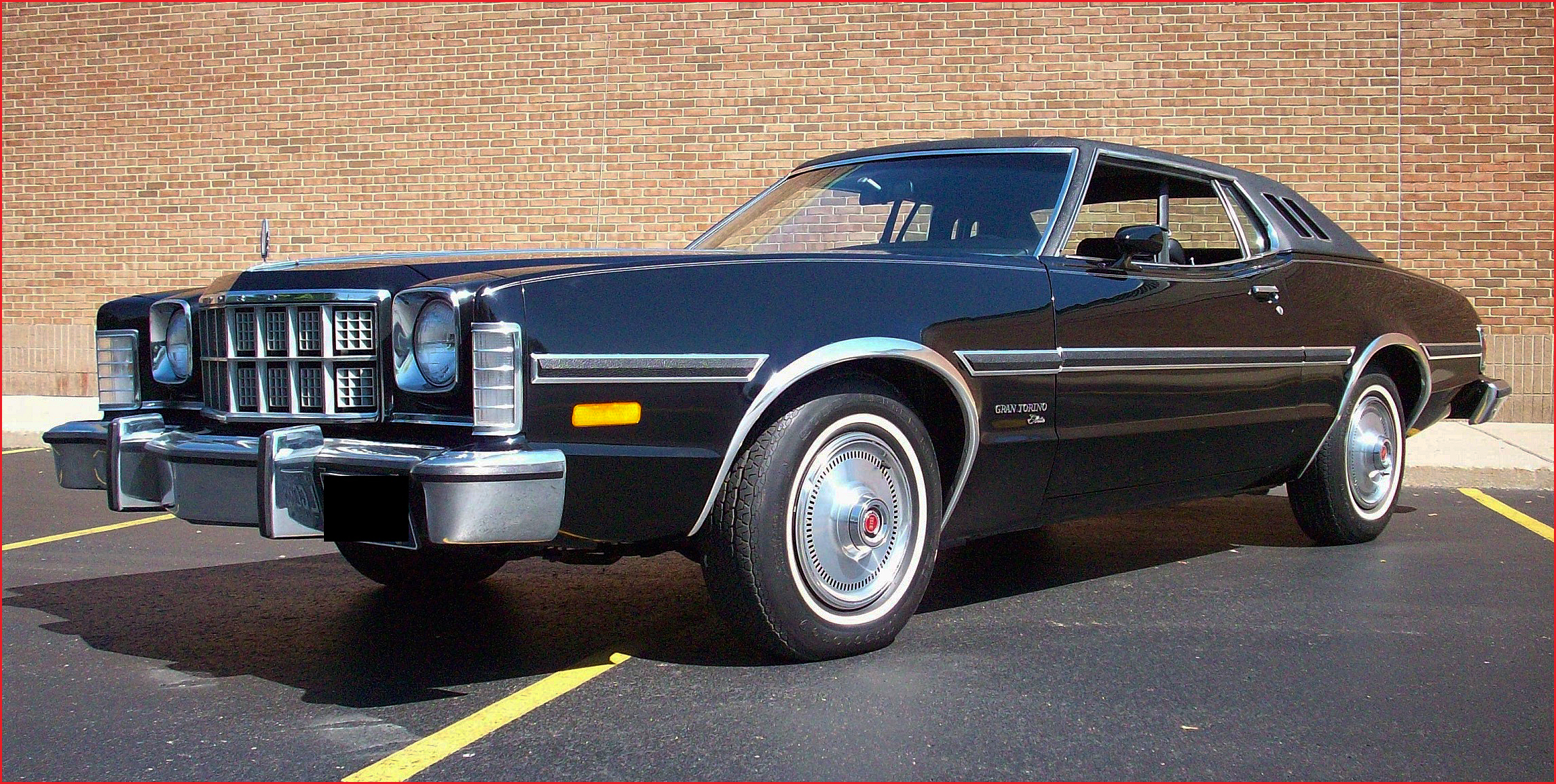
Advertised as “hardtops,” the Elite‘s rear windows were fixed, unlike the earlier hardtops, and the model added a vinyl roof and two small opera windows in the “C” pillar. This low-priced luxury coupe was Ford‘s answer to the Chevrolet Monte Carlo that had debuted back in 1970. It had a large eggcrate grill with two headlights as opposed to four on other Torino models. There were wrap-around taillights and a reflective center panel in the rear, giving the appearance of a full-width taillight assembly. Large vinyl moldings on the side were cues from Ford‘s upscale personal luxury car, the Thunderbird. The 2-valve 351 and automatic transmission were standard, and the interior featured a split-bench front seat, “Westminster” cloth upholstery, woodgrain trim and a full instrumentation package. A leather-wrapped steering wheel was optional. Single large opera windows were offered on the upscale Brougham models, but the Elite was designed to be a cut above Brougham in the luxury department, more akin to the Thunderbird or a Mercury.

The popularity of the 1975-1979 detective TV show Starsky & Hutch, starring David Soul, Paul Michael Glaser and an iconic red 1974 Gran Torino with a wide white custom-painted vector stripe that ran from points in the front just behind the headlights, diagonally up the doors, up the “C” pillar and across the roof, which subsequently became known as the “Starsky & Hutch Stripe”, caused Ford to make the stripe available as an option on 1975 and 1976 models. The collectability of that model in red with the stripe got a boost after the 2004 Starsky & Hutch film starring Ben Stiller and Owen Wilson.
Since Torinos were now larger and heavier than their predecessors the 250 six-cylinder was no longer the base engine, although a small number were apparently sold with that engine, and the 140 HP 302 was placed in that role. The only “performance” engine remained the 351 Cobra Jet at 255 HP, and was only available in 2-door models. I say “performance” only because it had more output than the larger engines, the 2-valve 400 cu. in. at 170 HP and the 4-valve 460 at 220 HP that replaced the 4-valve 429. There was still a Gran Torino Sport, but without the Sports Roof option it was nearly impossible to distinguish from ordinary 2-door Gran Torinos save for emblems on the grill, C-pillar and fuel filler door and a “Sport” script on the C-pillar. The “Sport” script was placed below the “Gran Torino” nameplate on the fender on models equipped with a vinyl roof with opera windows…not very “Sport”-y.
Ford had another good year with the Torino in 1974, although it failed to outsell Chevelle.
Little changed for 1975 except the Elite was dropped from the Torino lineup and became its own separate model, the Ford Elite. The Federal Clean Air Act introduced mandatory catalytic converters for all cars, limiting horsepower even further due to increased exhaust back-pressure, so the 302 was dropped as the standard engine, replaced by the 2-valve 351. Net HP for this engine dropped to a paltry 150. There was no “performance” engine option as the 4-valve 351 Cobra Jet was also dropped. The only engine options remaining were the 2-valve 400 and 4-valve 460 at 158 and 216 Net HP respectively. The 351M replaced the 351 Cleveland later in the year with a 4 HP gain due to the M’s use of the 400 block, connecting rods and intake manifold, which saved on parts costs.
Sales dropped partially because of the Elite becoming its own model, so 1975 was a disappointing year for Torino.
No major styling changes were made for Torino‘s final year, 1976, although the Gran Torino Sport was dropped. This left 9 models, 2 and 4-door Torino, GranTorino and Gran Torino Brougham, plus three station wagon models. Engine choices remained the same, but fuel economy increased due to EGR valves and spark advance revisions. This had the added benefit of increasing HP and torque on 351 and 400 engines, but decreasing it on the 460. The new final drive ratio of 2.75:1 also helped fuel economy. Plummeting sales numbers caused Ford to discontinue the Torino line, although the chassis and underpinnings lived on for another three years under the Ford LTD II and Ranchero and the Mercury Cougar.
Few survive today due to reliability issues and chassis and body corrosion. In Rust Belt states that salted their roads in winter, Torinos were known to have major rust problems after only five years, and to worsen matters the ’69-’73 models suffered paint peeling. Today Torino has the lowest resale value,except GTs, Cobras, Talladegas and red models with the Starsky & Hutch stripe, of any 1970s intermediate.
A friend in high school owned a blue 1976 Gran Torino with the Starsky & Hutch stripe, although his had a vinyl roof so the stripe ran across the trunk lid rather than up the C-pillar and over the roof. His 158 HP 400 engine was no match for even the compression ratio reduced 245 HP of my 1972 Plymouth Duster‘s 340, especially since his Gran Torino outweighed my Duster by nearly 1000 lbs. My junior-year bus driver (before I got my license) who lived down the street from us owned a 1975 Ford Elite. ✪
Got a Great Car Story? Share it! Reminisce About Your Other Favorite Cars, Too!
Seeyas Again Next Time On FLAT OUT!
It’s President Jeff D. Boofer


