


Hi Folks…And Welcome Again To FLAT OUT!
Let’s Get Away From The Exotics This Month. It’s…
The Chevrolet Monte Carlo: 1970-2007
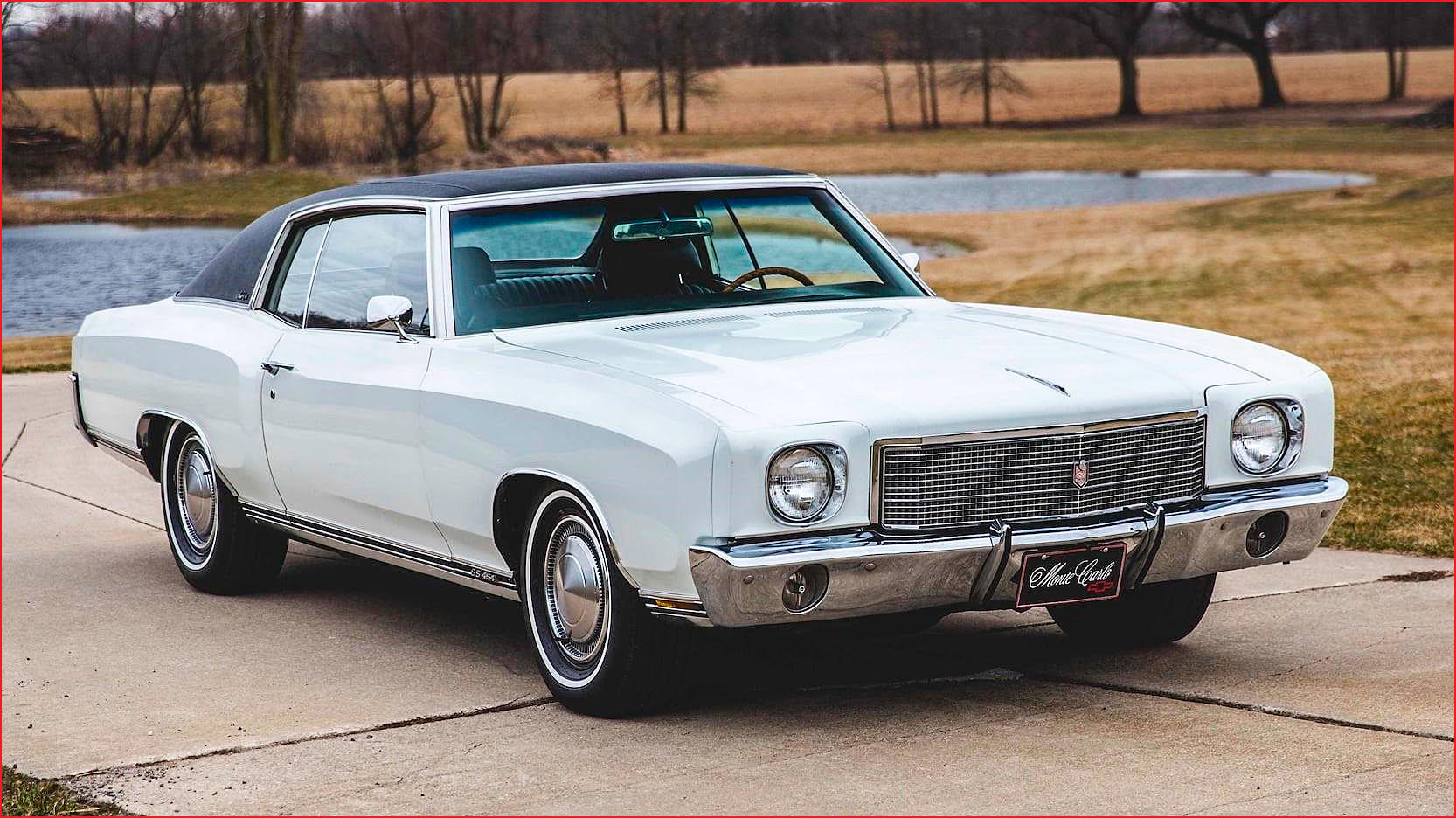
Chevrolet wanted to move into the personal luxury car space occupied by Ford with the 1967 re-styling of the Thunderbird. To that end they created the Monte Carlo, named for the city in Monaco to give it an air of class and sophistication. It was an intermediate car first modeled on the styling of the Cadillac Eldorado, and formally introduced for the new 1970 model year by new Chevrolet president John Z. DeLorean.
First Generation 1970 – 1972
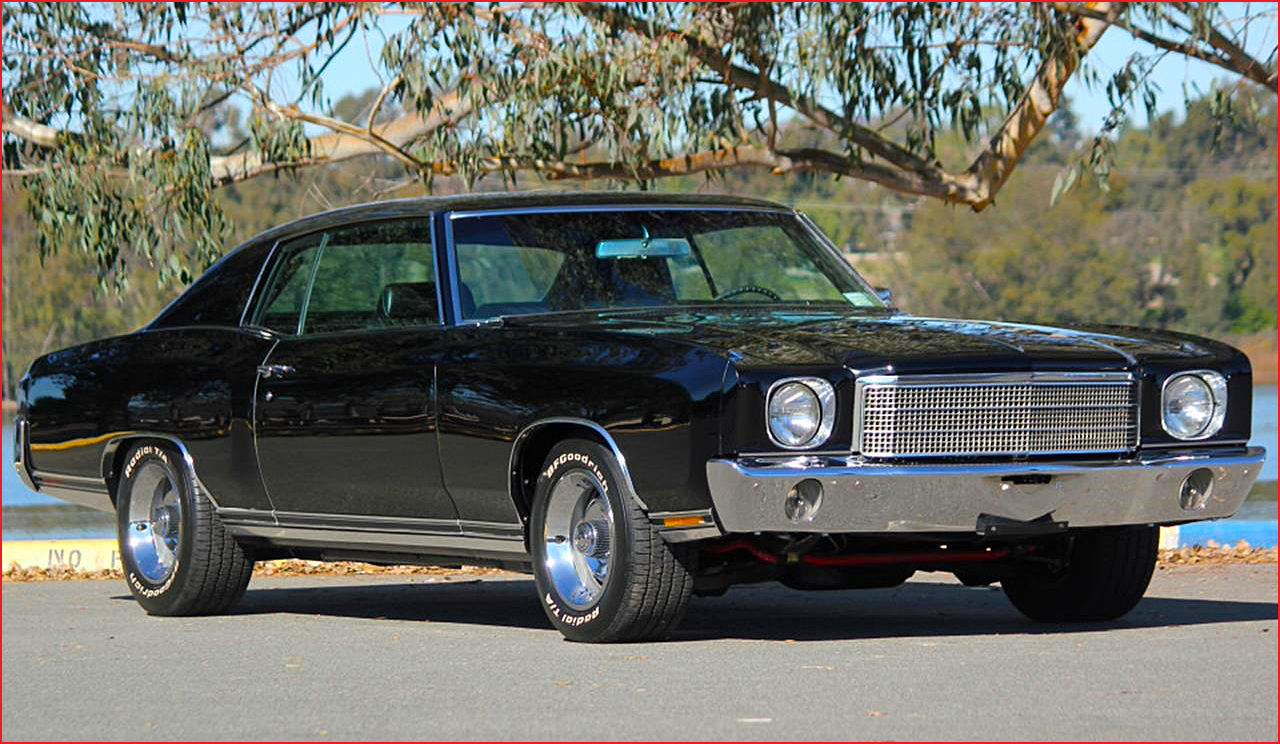
John Z. DeLorean led the development of the Grand Prix during his stint at Pontiac, and the first generation Monte Carlo shared the Grand Prix‘s “A-Special” chassis rather than the standard GM A-body intermediate. It did share body parts and structure with the standard A-body Chevelle. The new exterior “Coke-bottle” styling featured hidden windshield wipers. A chromed rectangular grill with a fine grid pattern of 720 squares was adorned in the center with a Corinthian helmet (referred to as the “knight’s crest”), round headlights and round parking lamps in the bumper. A chrome spear graced the hood, without a stand-up ornament. The fenders had prominent, almost rectangular blisters jokingly referred to by one automotive writer at the time as “Go for Baroque.” The dashboard was identical to the Chevelle except for simulated wood veneer trim, and higher-grade nylon or vinyl upholstery was used. Power steering, power windows, air conditioning, power seats, rally wheels, bucket seats, a center console and full instrumentation were options, and a fully-equipped Monte Carlo could top $5,000, well over the $3,123 base price.
The standard engine was Chevrolet‘s 250 HP “Turbo-Fire” 2-barrel carbureated 350 cubic inch small-block V-8, with a column-mounted 3-speed synchromesh transmission; a 2-speed Powerglide or 3-speed Turbo-Hydromatic automatic transmission were options. Adding a 4-barrel carb to the Turbo-Fire 350 brought the HP up to 300. Stepping up to the Turbo-Fire 400 cubic inch engine gained only 15 HP over the base engine, but the Turbo-Jet 400 with a 4-barrel gained 30 HP over the 4-barrel 350. The Turbo-Fire was a small-block based on the 350, but the Turbo-Jet was an enlarged version of the 396 cubic inch big-block, displacing 402 cubes.
For an extra $420 you could order the SS 454 package, which gave you the Turbo-Jet 454 big-block, good for 360 HP. Heavy-duty suspension, wider tires, automatic load-leveling rear suspension and “SS 454” badging were part of the package, which could only be had with the Turbo-Hydromatic 3-speed. Only 3,823 SS 454s were built in the first year. A labor strike in Chevrolet‘s Flint, Michigan plant early in 1970 limited the availability of Monte Carlos for a time, as as result sales were short of the projected 185,000 at 159,341.
1971 saw cosmetic changes such as the headlight bezels taking on a “squircle” shape as opposed to round and rectangular front parking lamps. The hood spear now featured a stand-up ornament with script “Chevrolet” lettering, and the grill ornament featured “1971” in Roman numerals. The trunk lock ornament now had the Monte Carlo crest. The SS model got “European symbol knobs” and an optional 4-spoke steering wheel. The small-block Turbo-Fire 400 engine was dropped, and lowered compression ratios meant a reduction in HP; 245 for the 350 2-barrel, 270 for the 4-barrel and 300 for the Turbo-Jet 400. The 454 in the SS model actually increased to 365 HP despite the reduction in compression ratios due to using the more aggressive camshaft from the 390 HP Corvette 454. The SS 454 package was dropped after 1971. Chevrolet‘s reasoning was that Monte Carlo was marketed as a luxury car, not a muscle car. However, the 454 engine would remain an option for another four years.
The end of Ford and Chrysler‘s factory NASCAR backing meant that independent teams began to pick up the slack; GM had banned factory racing support back in 1963. The Monte Carlo was the best-suited Chevrolet for racing due to its 116 inch wheelbase, only 1 inch longer than NASCAR‘s minimum, and the long hood that placed the engine further back for better weight distribution. Monte Carlos raced on the NASCAR circuit from 1971 to 1989 and again from 2000-2007.
1972 saw styling changes like an egg-crate grille similar to the Caprice and the parking lamps moved to the grill. A wider spear with no stand-up ornament appeared on the hood. The SS 454 was no longer an option, but a one-year-only Monte Carlo Custom had upgraded suspension and other options from the discontinued SS package, but was available with any engine. Power steering was now standard. The switch to SAE Net HP saw rated numbers plummet; 165 HP for the base, 175 for the 4-barrel 350, 240 HP for the 402 4-barrel and 270 for the 454.
Second Generation 1973- 1977
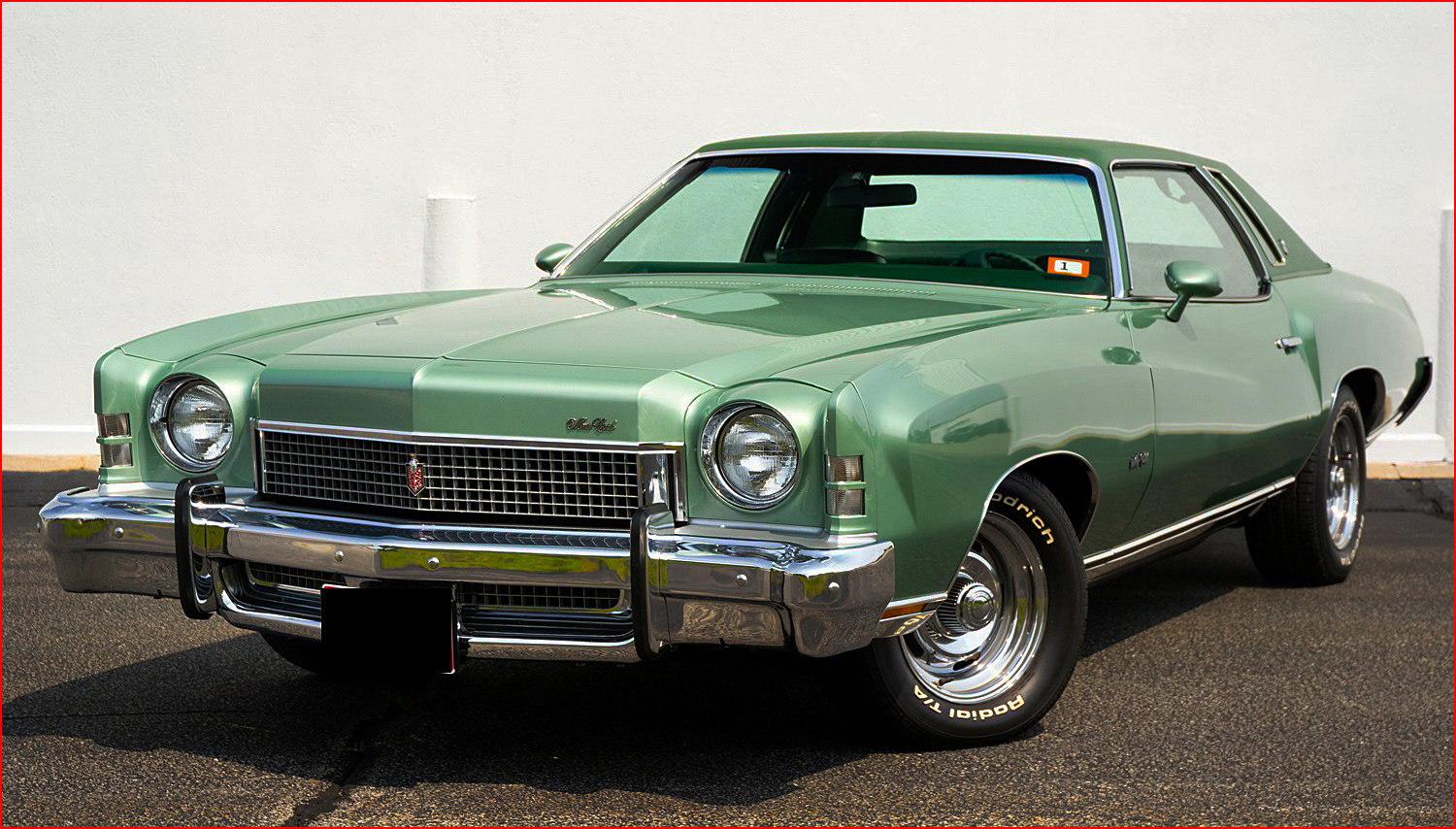
Monte Carlo was re-designed for 1973 along with other GM intermediates. It was now a pillared coupe with frameless glass and opera windows rather than a pillarless hardtop. It retained the egg-crate grill from its predecessor, with smaller segments. The roof was now a double-shell design for improved noise reduction and flush-mounted pull-up door handles appeared. The front bumper was the ugly, Federally-mandated 5MPH variety. Ride and handling were improved thanks to radial tires, Pliacell shock absorbers, high-caster steering and front and rear anti-roll bars from the old SS package. The base manual transmission model retained the old traditional steering and bias-ply tires, but adding an automatic transmission got you all those options and was labeled Monte Carlo S. A new wrap-around cockpit-style instrument panel similar to those introduced in other new GM models greeted the driver. The new Landau edition was an S model with a rear-quarter Landau vinyl roof, special wheels and driver and passenger-side sport mirrors. HP numbers continued their decline as emissions regulations took their toll; 145 for the base 2-barrel 350, 175 for the 4-barrel and 245 for the 454.
Monte Carlo was named Motor Trend‘s 1973 Car Of The Year for its new styling and Euro ride and handling, and the numbers proved that out; almost 250,000 were sold. It and sister Grand Prix‘s success birthed a new set of personal luxury cars from Ford, Mercury, Chrysler, Dodge and AMC the following year.
1974 saw minor changes such as a revised egg-crate grill and a shorter trunk deck. The base model with the 3-speed manual was dropped, leaving only the S and Landau. The base 2-barrel 350’s HP remained the same, but the 4-barrel 350 was only offered in California at 160 HP. The other 49 states got a resurrected 400 cubic inch small-block Turbo-Fire rated at 150HP in 2-barrel form and 180 HP with the 4-barrel. The 454 big-block was still available with 235 HP. The 1973 Arab Oil Embargo cut into sales of other intermediate cars in favor of compacts and sub-compacts, but not Monte Carlo which set a new sales record of over 300,000 units.
For 1975 Monte Carlo got another new grill with the emblem moved to the center section. A new Custom option included a plusher 50/50 bench seat with reclining passenger section and lower door panel carpeting. An all-white interior was offered for the first time. All models got new catalytic converters to conform to California and Federal emissions standards, at the cost of only being able to run lower octane unleaded gas; a new nanny gauge on the dashboard showed if you were using too much.
Four new rectangular stacked headlights appeared on the 1976 model, along with a new crosshatch grill and re-shaped taillights. Also new for the bicentennial was the 305 cubic inch base engine putting out a pitiful 140 HP. The 2-barrel 350 wasn’t much better at 145 HP, nor was the 400 at 30 ponies more. California got a 165 HP 4-barrel 350 as the base engine, a 400 4-barrel was optional. The big-block 454 was gone, and the three-speed Turbo-Hydromatic transmission was standard on base, Custom and Landau models.
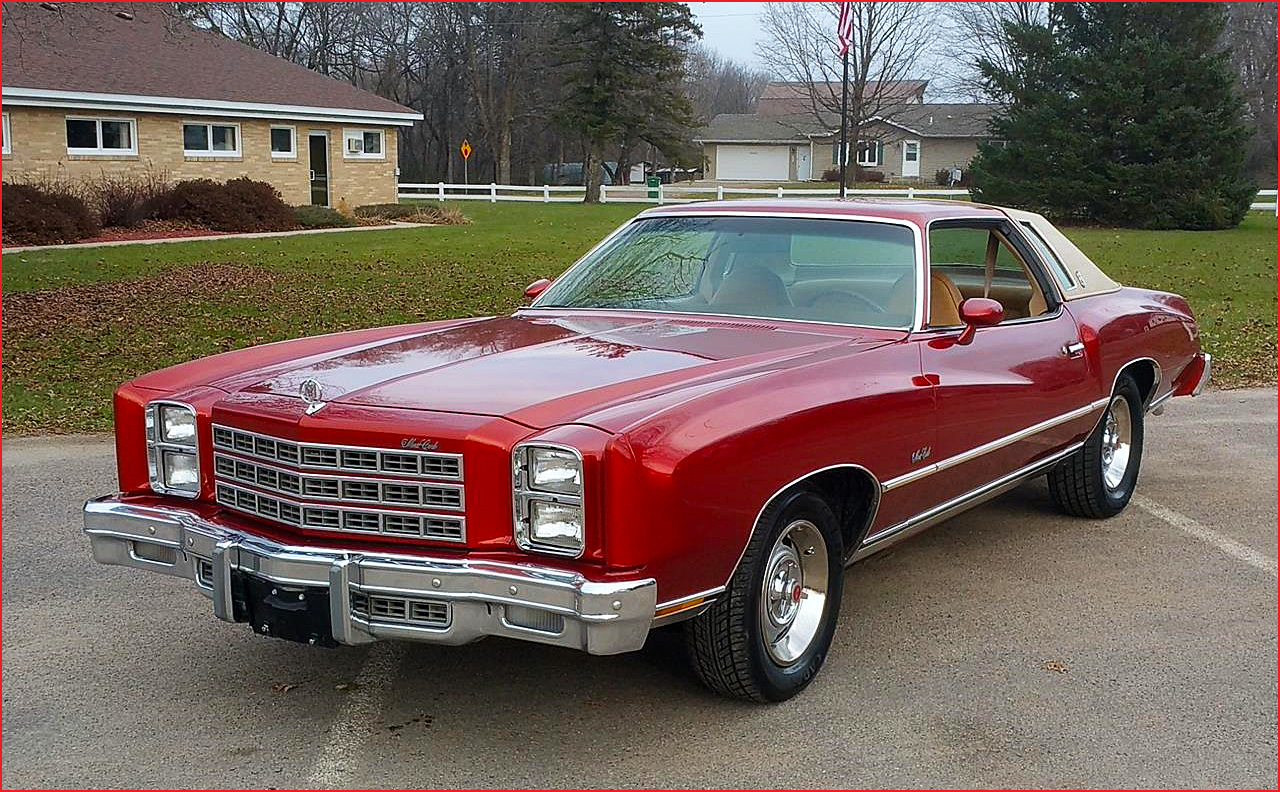
The 1977 model once again had the stand-up hood ornament, this time with the Monte Carlo “knight’s crest” instead of a script Chevrolet as on the ’71, as well as smaller segments on the grill. Taillights were also revised. Base and Custom trims got more upholstery choices; cloth, velour and vinyl were options. Engine choices were limited to two, the dog 140 HP 305 or the 170 HP 350, which was standard in California as the 400 and 4-barrel 350 were dropped. This model marks the only time in history when an intermediate model was larger in every dimension than a full-size; the B-body Caprice/Impala had been downsized for 1977.
Third Generation 1978 – 1980
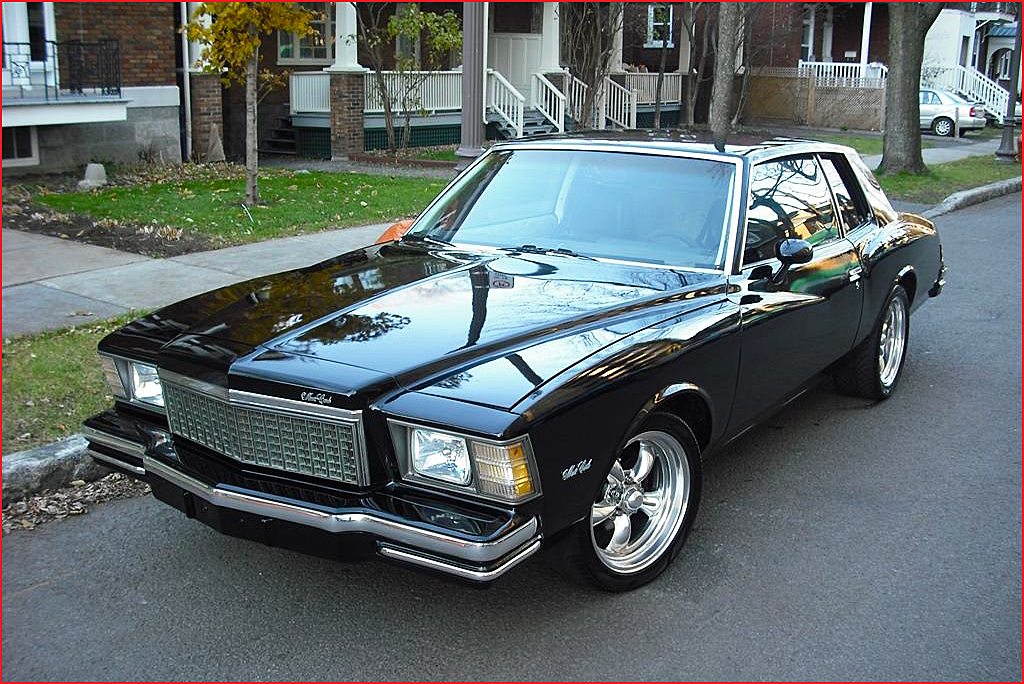
The third generation of Monte Carlo saw the model heavily downsized in response to the Arab Oil Embargo and new Corporate Average Fuel Economy (CAFE) requirements , it was 7-800 lbs lighter and 15 inches shorter than its predecessor but had more interior and trunk space. New one-piece wall-to-wall carpet was now standard and the quad headlights of the ’76-’77 model were replaced by dual rectangular ones. The only V-8 that remained was the lowly 140 HP 305, a 105 HP 231 cubic inch Buick V-6 was standard. The 3-speed manual was back, standard on the base model, and so was the 4-speed manual, the first time since 1971. The Custom trim was gone, and the Turbo-Hydromatic was standard on the V-8 and Landau.
1979 saw a re-styled grill and wrap-around taillamps. A new 94 HP 200 cubic inch Chevrolet V-6 replaced the Buick version as the standard engine in the base model, California base models and the Landau got the Buick mill. The 140 HP 305 was back, but joined by a 4-barrel version good for 160 HP and new 125 HP 297 cubic inch V-8. Transmissions remained the same, but this would be the last year for the manual due to low buyer interest.
The front end was mildly re-styled again for 1980. The quad headlights were back, with turn signals mounted underneath. A new 3-speed automatic transmission was standard, and a new Chevrolet 229 cubic inch V-6 producing 115 HP replaced the two prior V-6s. A new turbocharged version of the 231 V-6 good for 170 HP was optional, as was the 267 and 305 V-8s, now both good for 155 HP.
My off-base roommate in the Navy had a ’78 Monte with the 231 V-6; it was a nice car but a complete dog as far as performance. A 105 HP engine in a 3,000+ lb. car doesn’t move it very fast. It was plush and roomy, though, and he seemed to like it. I occasionally borrowed it when my prospective date balked at the idea of riding on the back of my Norton 850 Commando.
Fourth Generation 1981-1988
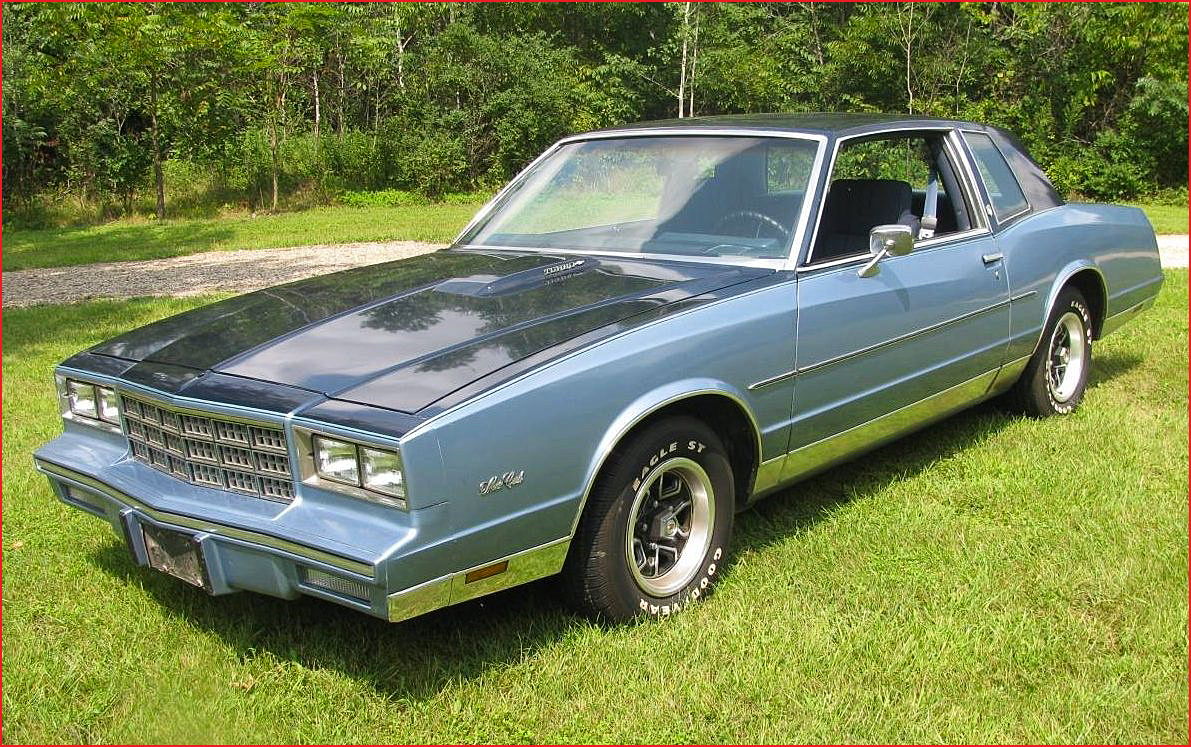
The Monte Carlo‘s body was re-styled along with the other GM mid-size coupes for 1981, with a smoother profile and again sporting quad headlights, side-by-side instead of stacked and new vertical taillights similar to the second generation. Engine choices remained the same, but the model with the turbocharged 231 V-6 got a small hood scoop on the left side flanked by Chevrolet bowties and was christened Monte Carlo Turbo with accompanying Turbo 3.8 badging. Automatic transmission, power steering and power brakes with front discs were standard.
1982 saw few revisions except that the turbocharged 231 cubic inch Buick V-6 was gone, and with it the Monte Carlo Turbo. A new diesel 260 cubic inch V-6 and a diesel Oldsmobile 350 cubic inch V-8 were offered. For the first time, Monte Carlo was offered without a sporty interior option with bucket seats and without a black paint option. With the introduction of a new GM mid-size platform (Buick Century,Chevrolet Celebrity, Oldsmobile Cutlass Ciera and Pontiac 6000), the new platform was given the A-body designation and the previous A-bodies were now called G-body.
Another minor grill update and revised interior trim patterns were changes for 1983, and engine choices remained the same…except for the SS model which returned after a 12-year absence. The Super Sport package featured European-style body color-coding, a new front fascia different from the standard model, a rear spoiler, and the 305 V-8, good for 175 HP thanks to the addition of a 4-barrel carb.
1984 saw few changes in the exterior, but the Strato bucket seats and center console were back as options. The 229 V-6 was up in HP to 125 and the 305 down to 150. This was the last year for the 350 V-8 diesel, and the diesel V-6 was dropped. The SS got a horsepower boost as well to 180, and a 4-speed overdrive Turbo-Hydromatic 200-4R transmission in place of the 3-speed Turbo-Hydromatic. A limited number of the SS were made in Mexico for Mexican sale with a 350 cu. in V-8 with 265 HP in 1984 only. These had the spoiler deleted, black side mirrors and the only interior color choice was blue from a Grand Prix.
A new 130 HP 262 cubic inch (4.3 liter) V-6 with throttle-body fuel injection replaced the 229 for 1985. The 305 V-8 remained at 150 HP while the 4-barrel SS 305 bumped up to 180 HP. You could now get the 4-speed automatic with any engine but the 3-speed auto was not available with the SS package. T-tops were back this year.
Four bodystyles were available for 1986, the base Sport Coupe with the same body panels as the base car since 1981, but with new “aero” side mirrors those like on Camaros and Corvettes. New was the Luxury Sport model with revised front and rear fascias in addition to the “aero” mirrors and new headlights with removable bulbs replaced the previous sealed-beam units. The SS was unchanged with the exception of “aero” mirrors. Also new was the Aerocoupe, featuring a modified SS body with a more deeply sloped rear window and a shorter trunk lid with a flatter spoiler. This was the new NASCAR racer, and 200 examples were sold to the public to meet homologation rules.
The base Sport Coupe was eliminated for 1987, leaving the LS, SS and Aerocoupe essentially unchanged from the previous year.
1988 was the final year for the fourth generation body style, essentially unchanged from the previous year with the exception of no Aerocoupe. There was no need for a “sleeker” Monte Carlo as Chevrolet had decided to go with the more aerodynamic Lumina which was the Monte‘s replacement for its NASCAR racer.
Fifth Generation 1995 – 1999
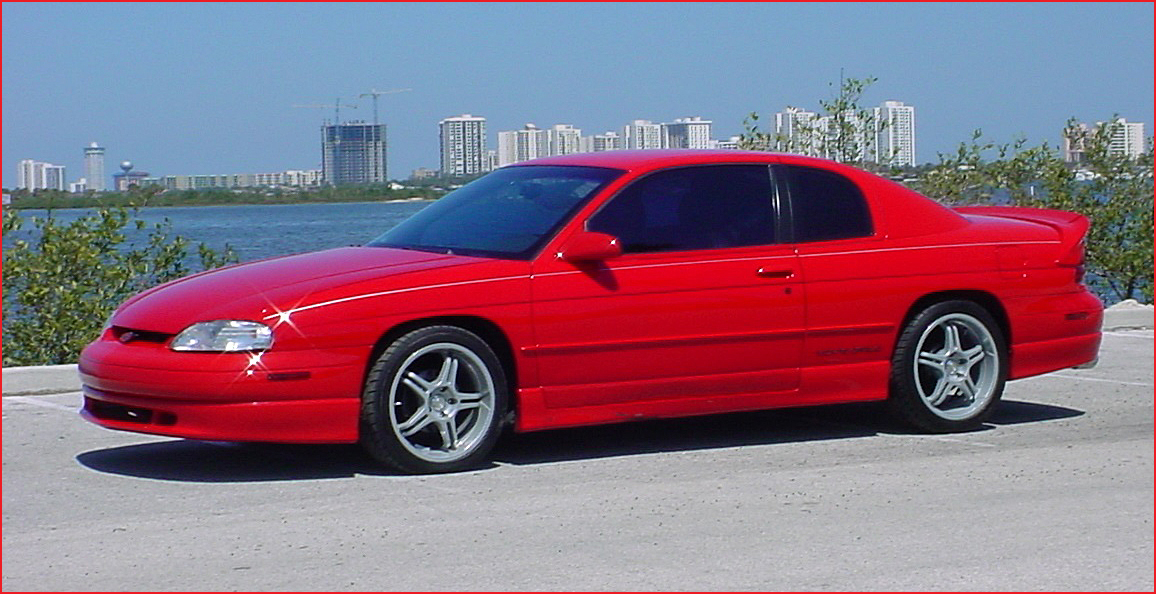
The Lumina model was split in two for 1995, the sedan retaining the Lumina name and the coupe returning as the Monte Carlo. It shared the new W-body platform with other GM models; the Pontiac Grand Prix, Oldsmobile Cutlass Supreme and Intrigue and the Buick Century and Regal. The distinctive fender bulges of previous generations were gone and this was also the first front-wheel-drive Monte Carlo. Two models were for sale, the LS and sportier Z34. Z34 differed in badging and had a front air dam and blacked-out trim. Under the hood lie the real difference, the LS utilized the Lumina‘s 160 HP 3.1 liter V-6 while Z34 got the more powerful 3.4 liter DOHC V-6, good for 215 HP, changed to a 3.8 liter unit producing 200 HP in 1998. Z34 came with 16-inch alloy wheels. 1997 added daytime running lights, and airbag and ABS. Chevrolet made a limited production run of Monte Carlo Brickyard 400 pace cars, none of which were available to the public. Visibility was poor and this model was derided as “Lumina Carlo” due to its Lumina roots and front-wheel drive, however it sold well enough to continue the line with a more original design not based on Lumina for 2000.
Sixth Generation 2000-2007
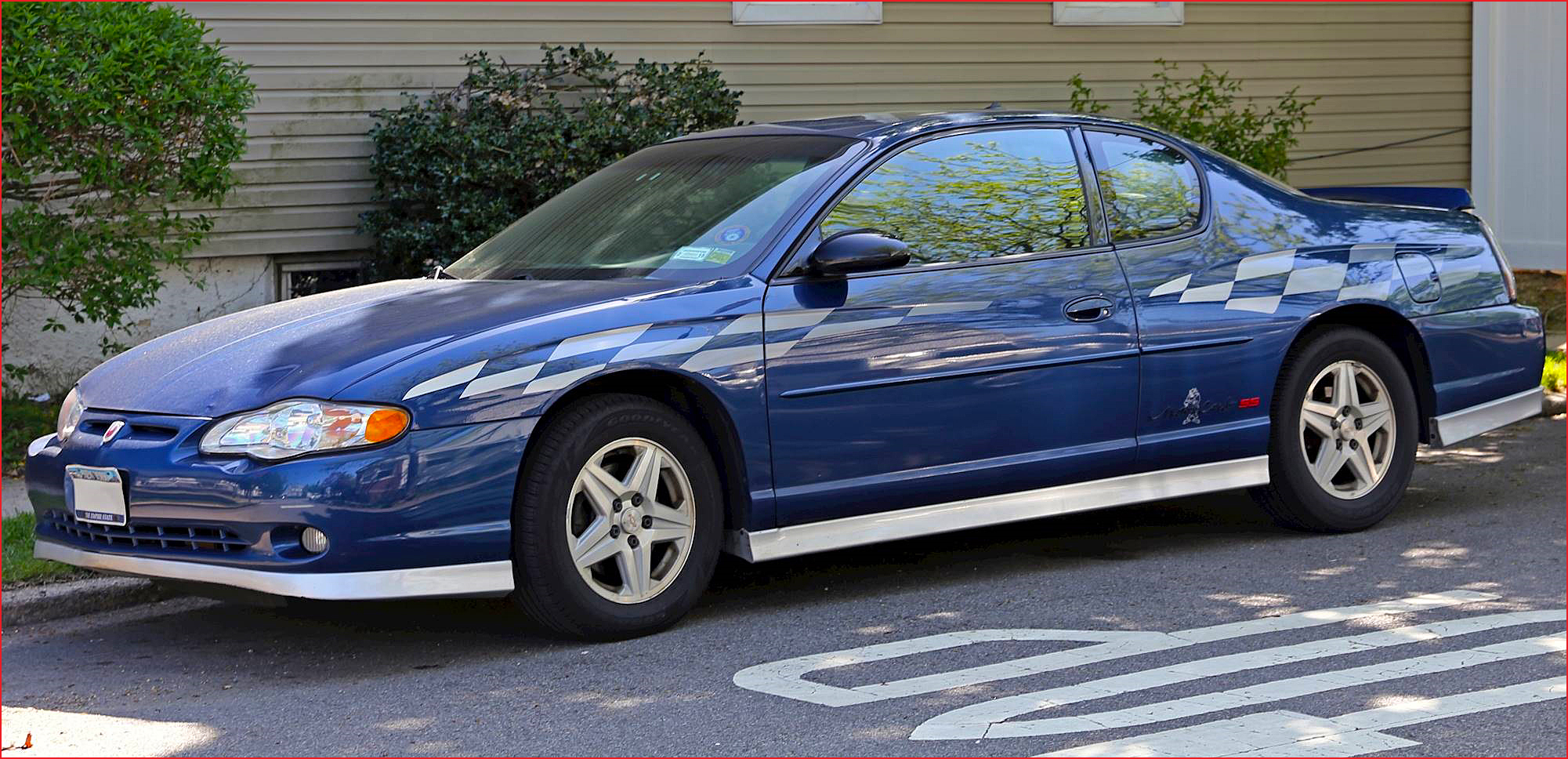
The new Monte Carlo drew on the past for inspiration as well as Chevrolet‘s Motorsport division. Fender flares, vertical taillights and the “knight’s crest” all returned for this final iteration, as well as a full gauge cluster not seen for two years. Lumina was dropped from the Chevrolet lineup and the sedan version was given the resurrected Impala moniker. A slight hump was added to the rear trunk at the request of racing teams, the aerodynamic styling and ducktail rear spoiler were also touches from NASCAR. It was available in LS and SS trim, the LS using the 180 HP 3.4 liter V-6 and SS the 200 HP 3.8 liter, both still front-wheel-drive. 2004-2005 added a supercharger to the SS 3.8, bumping HP to 240. The normally aspirated SS was re-labeled LT for 2005.
Monte Carlo got a facelift in 2006, with a more prominent grill and aero body kit, especially on the SS. A new LTZ model was added for 2006 only, slotted between the LT and SS. The LT and LTZ utilized a new 3.9 liter, 241 HP engine. The LTZ and the 3.9 liter were dropped for the final year 2007, replaced with the 211 HP flex-fuel 3.5 liter from the LS. SS got a new 5.3 liter V-8 good for 303 HP both years.
I’ve always been a bit fond of the early-generation Monte Carlos. I would love to own a 1970 model, but sadly it, along with a dozen other cars I’d like to own, is completely out of my budget. Oh, well.✪
Got a Great Car Story? Share it! Reminisce About Your Other Favorite Cars, Too!
Seeyas Again Next Time On FLAT OUT!


