


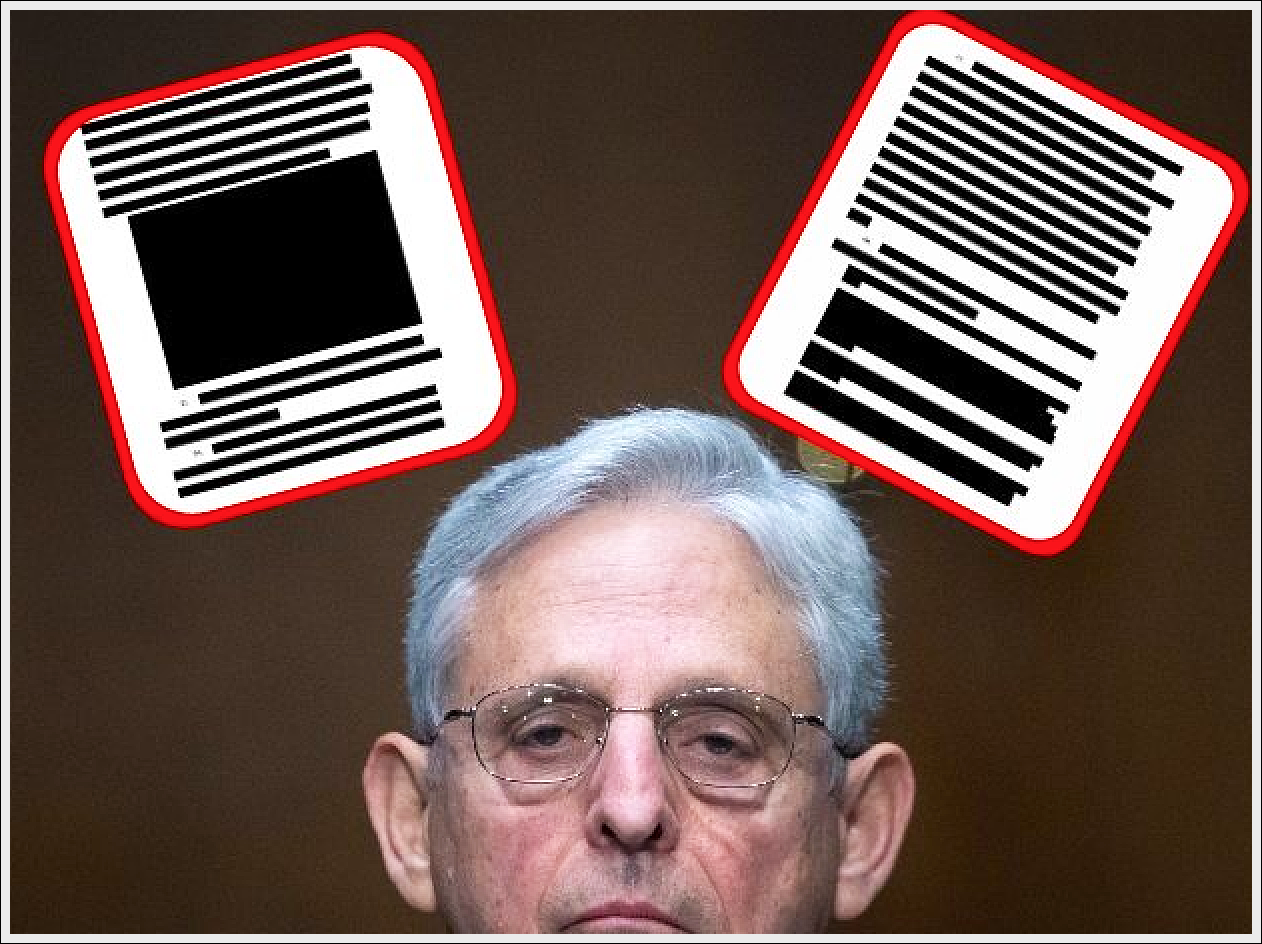

✪ The Department of Justice (DOJ) affidavit seeking the search warrant for the Federal Bureau of Investigation (FBI) raid on former President Donald Trump’s private residence at Mar-a-Lago, Florida, was unsealed by a federal judge Friday afternoon...
You can’t know what’s in it, and you can’t know why you can’t know what’s in it. That’s the message the FBI and Joe Biden’s Department of Justice is sending the American people with their extremely heavily redacted affidavit regarding their raid on President Donald Trump’s home at Mar-a-Lago.
The affidavit, signed by a special agent with the FBI, contends that after reviewing 15 boxes of material that Trump handed over voluntarily to the government, the DOJ determined that classified information had not been stored properly and that there might be more of it at Mar-a-Lago. “The FBI’s investigation has established that documents bearing classification markings, which appear to contain National Defense Information (NDI), were among the materials contained in the FIFTEEN BOXES and were stored at the PREMISES in an unauthorized location,” the affidavit said.
They concluded without giving a hint about what they were actually describing:
“Further, there is probable cause to believe that additional documents that contain classified NDI or that are Presidential records subject to record retention requirements currently remain at the PREMISES. There is also probable cause to believe that evidence of obstruction will be found at the PREMISES.In short, the government has well-founded concerns that steps may be taken to frustrate or otherwise interfere with this investigation if facts in the affidavit were prematurely disclosed,”
One of the government’s concerns was that material in the boxes was poorly organized:
A preliminary review of the FIFTEEN BOXES indicated that they contained “newspapers, magazines, printed news articles, photos, miscellaneous print-outs, notes, presidential correspondence, personal and post- presidential records, and ‘a lot of classified records.’ Of most significant concern was that highly classified records were un-foldered, intermixed with other records, and otherwise un-properly identified.”
The agent did not personally know that there was defense-related information in the documents with alleged classification marking, but said that “based on my training and experience, I know that documents classified at these levels typically contain NDI.”
Separately, the court also released the government’s legal memorandum explaining the reasons for the redactions in the affidavit.
The categories, described further below, are (1) information from a broad range of civilian witnesses who may be subject to “witness intimidation or retaliation,” D.E. 80 at 9; (2) information regarding investigative avenues and techniques that could provide a roadmap for potential ways to obstruct the investigation, id. at 9-10; (3) information whose disclosure is prohibited under Rule 6(e) of the Federal Rules of Criminal Procedure (“Rule 6(e)”), such as grand jury subpoenas, testimony, and related material, id. at 10; (4) information whose disclosure could risk the safety of law enforcement personnel, id. at 9; and (5) information _whose disclosure could harm “legitimate privacy interests” of third parties.
The “five categories of information that must remain under seal in order to protect the safety of multiple civilian witnesses” did not include national security.


▶️ CLICK TO VIEW
▶️ 12 Minutes 10 Seconds ⭐️ Gary Brown
▶️ 28 Minutes 11 Seconds
▶️ 11 Minutes 59 Seconds ⭐️ warpmine of Clovis
