


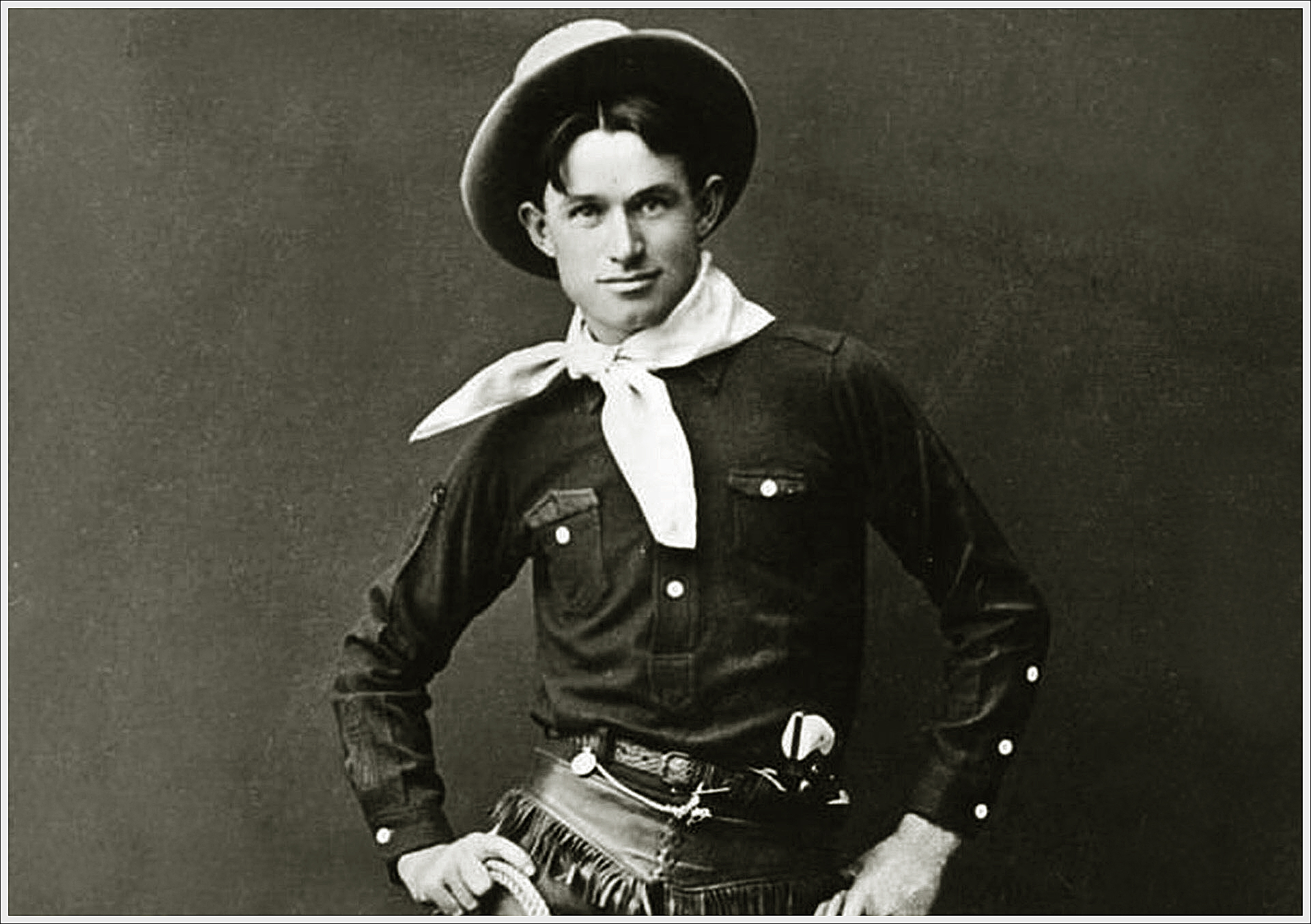

William Penn Adair Rogers (November 4, 1879 – August 15, 1935)
William Penn Adair Rogers was an American vaudeville performer, actor, aviator, satirist and humorous social commentator. He was born a citizen of the Cherokee Nation, in the Indian Territory which is now part of Oklahoma and is known as “Oklahoma’s Favorite Son.” As an entertainer and humorist, he traveled around the world three times, made a total of 71 films (including 50 silent films and 21 “talkies”) and authored more than 4,000 nationally syndicated newspaper columns. By the mid-1930s, Rogers was a hugely popular public figure in the United States for his leading political wit and also the highest paid Hollywood film star of his time.
Rogers was born on his parents’ Dog Iron Ranch in the Cherokee Nation of Indian Territory, near present-day Oologah, Oklahoma, now in Rogers County, named in honor of his father, Clem Vann Rogers. His parents, Clement Vann Rogers (1839–1911) and Mary America Schrimsher (1838–1890), were both of mixed race and Cherokee ancestry. Rogers frequently quipped that his ancestors did not come over on the Mayflower, but instead “met the boat.”
Roger’s mother died when Will was eleven. His father remarried less than two years after her death. Rogers was the youngest of eight children and was named after the Cherokee leader Colonel William Penn Adair. Only three of his siblings, sisters Sallie Clementine, Maude Ethel and May (Mary), survived into adulthood.
Will Rogers attended school in Missouri, at the Willow Hassel School at Neosho, and then the Kemper Military School at Boonville over the 1897-1898 year. He was a good student and an avid reader of The New York Times, but he dropped out of school after the 10th grade. Rogers later said that he was a poor student, saying that he “studied the Fourth Reader for ten years.” He said he was much more interested in cowboys and horses; and he eventually learned to rope and use a lariat.
In 1899, Rogers appeared in the St. Louis Fair as part of the Mulhall Rodeo. Near the end of 1901, when he was 22 years old, he and a friend left home hoping to work as gauchos in Argentina. In May 1902, they arrived in Argentina and spent five months trying to make it as ranch owners in the Pampas. During that time, Rogers and his partner lost all their money. Later he said, “I was ashamed to send home for more.” The two friends separated and Rogers then sailed for South Africa.
Rogers began his show business career as a trick roper in “Texas Jack’s Wild West Circus” in South Africa:
“He [Texas Jack] had a little Wild West aggregation that visited the camps and did a tremendous business. I did some roping and riding, and Jack, who was one of the smartest showmen I ever knew, took a great interest in me. It was he who gave me the idea for my original stage act with my pony. I learned a lot about show business from him. He could do a bum act with a rope that an ordinary man couldn’t get away with, and make the audience think it was great, so I used to study him by the hour, and from him I learned the great secret of show business—knowing when to get off the stage. It’s the fellow who knows when to quit that the audience wants more of.“
Grateful for the guidance but anxious to move on, Rogers quit the circus and went next to Australia. Texas Jack gave him a reference letter for the Wirth Brothers Circus there, and Rogers continued to perform as a rider and trick roper while working on his pony act. He returned to the United States in 1904 and appeared at the Saint Louis World’s Fair.
In 1908, Rogers married Betty Blake (1879–1944) and the couple had four children: Will Rogers Jr., Mary Amelia, James Blake, and Fred Stone. Will Jr. became a World War II hero, played his father in two films and was also elected to Congress. Mary became a Broadway actress, and James “Jim” was a newspaperman and rancher; Fred died of diphtheria at age two. In 1911, Rogers bought a 20-acre ranch near Claremore, Oklahoma, which he intended to use as his retirement home.
Vaudeville
On a trip to New York City, Rogers was at Madison Square Garden on April 27, 1905 when a wild steer broke out of the arena and began to climb into the viewing stands. To the delight of the crowd, Rogers roped the steer. The feat earned him front page publicity from the newspapers, giving him valuable attention and an audience eager to see more. Willie Hammerstein saw his vaudeville act, and signed Rogers to appear with his pony on the Victoria Roof—which was literally on a rooftop venue. For the next decade, Rogers would work for 50 weeks every year at the Roof and at the city’s myriad of vaudeville theaters.
In the fall of 1915, Rogers began to appear in Florenz Ziegfeld’s Midnight Frolic. The variety revue began at midnight on the top-floor night club of Ziegfeld’s New Amsterdam Theatre and drew many influential—and regular—customers. By this time, Rogers had refined his act. His monologues on the news of the day followed a similar routine every night. He would appear on stage in his cowboy outfit, nonchalantly twirling his lasso and say, “Well, what shall I talk about? I ain’t got anything funny to say. All I know is what I read in the papers.” He would then proceed to make jokes about what he had read in that day’s newspapers. The line “All I know is what I read in the papers” is often incorrectly described as Rogers’s most famous punch line, when in fact it was his opening line.
His run at the New Amsterdam ran into 1916, and Rogers’s growing popularity led to an engagement in the more famous Ziegfeld Follies. At this stage, Roger’s act was strictly physical, a silent display of daring riding and clever tricks with his lariat. By 1916, Rogers was a featured star in Ziegfeld’s Follies on Broadway, as he moved into satire by transforming his entertainment persona from the “Ropin’ Fool” to the “Talkin’ Fool.” At one performance with President Woodrow Wilson in the audience, Rogers improvised a “roast” of Wilson’s presidential policies that had Wilson and the entire audience in stitches and showcased his remarkable skill at off-the-cuff, witty commentary on current events. He would build the rest of his career around that skill.
Film
Hollywood discovered Rogers in 1918, as Samuel Goldwyn gave him the title role in Laughing Bill Hyde. A three-year contract with Goldwyn, at triple the Broadway salary moved Rogers west. He bought a ranch in Pacific Palisades and set up his own production company. While Rogers enjoyed film acting, his appearances in silent movies suffered from the obvious limitations and restrictions of silence, as he had originally gained his fame as an on stage commentator.
In 1923, he began a one-year contract with Hal Roach and made 12 pictures. After that, he did not return to the screen again until 1929 to begin work in the ‘talkies.’ Rogers made 48 silent movies, but with the arrival of sound in 1929, he became a top star in that medium. Rogers appeared in a total of 21 feature sound films alongside such other noted performers as Lew Ayres, Billie Burke, Andy Devine, Janet Gaynor, Rochelle Hudson, Boris Karloff, Myrna Loy, Joel McCrea, Hattie McDaniel, Ray Milland, Maureen O’Sullivan, ZaSu Pitts, Dick Powell, Bill “Bojangles” Robinson, Mickey Rooney, and Peggy Wood. His most unusual role may have been in the first talking version of Mark Twain’s novel A Connecticut Yankee in King Arthur’s Court. The clean moral tone of his films resulted in his popularity soaring to new heights with films including Young As You Feel, Judge Priest, and Life Begins at 40.
Newspapers & Magazines
Rogers was an indefatigable worker. He toured the lecture circuit. The New York Times syndicated his weekly newspaper column from 1922 to 1935. In 1926, his short column “Will Rogers Says” reached 40 million newspaper readers every day. He frequently also wrote for the mass-circulation, upscale magazine The Saturday Evening Post. In his columns, Rogers advocated for Americans to embrace the frontier values of neighborliness and democracy on the domestic front, while remaining clear of any foreign entanglements.
Through his nationally syndicated columns between 1922 and 1935, as well as his personal appearances and radio broadcasts, he won the hearts and loving admiration of the American people by poking jibes in witty ways at the issues of the day and prominent people—often politicians. He wrote from a nonpartisan point of view and became the friend of presidents and a confidant of the famous and influential. Loved for his cool mind and warm heart, he was often considered the successor to such greats as Artemus Ward and Mark Twain.
Radio
Rogers also became a popular star in the exciting new medium of radio by broadcasting his newspaper pieces on his own show. From 1929 to 1935, he made radio broadcasts for the Gulf Oil Company. His weekly Sunday evening show, The Gulf Headliners, ranked among the top radio programs in the country at the time. Since Rogers often rambled on to his studio audience from one subject to another, he would often lose track of the program’s half-hour time limit. In his earlier broadcasts, he often had to be cut off in mid-sentence when the show ended. To remedy this, he brought in a wind-up alarm clock and Its on-air buzzing would alert him to start wrapping up his comments. By 1935, his show was announced as “Will Rogers and his Famous Alarm Clock.”
Politics
Although Rogers was a registered Democrat, he is historically known to mostly have been apolitical. Starting with Theodore Roosevelt, he was personal friends with every president. IN 1924, he supported and campaigned for Republican presidential candidate Calvin Coolidge.
Rogers served as a goodwill ambassador to Mexico and even had a brief stint as the mayor of Beverly Hills, a largely ceremonial position that allowed Rogers to joke about do-nothing politicians such as himself. During the depths of the Great Depression, Rogers became angered by Washington’s inability to feed the people so he embarked on a cross country fundraising tour for the Red Cross.
Rogers increasingly expressed the views of the “common man” in America. He downplayed academic credentials, noting, “Everybody is ignorant, only on different subjects.” Moreover, Rogers extolled a hard work ethic as being necessary in order to succeed. Such thoughts and expressions affirmed American theories of individual success. Rogers came to symbolize the self-made man; the common man who believed in America, in progress, and in the American Dream of upward mobility. His humor never offended; even those who were the targets of it.
Aviation & Death
After becoming friends with Charles Lindbergh, Will Rogers became an advocate for the aviation industry after noticing advancements of civil aviation in Europe during a 1926 European trip. Rogers witnessed first hand European advances in commercial air service and compared them to the almost nonexistent facilities in the United States. Rogers’ newspaper columns frequently emphasized the safety record, speed, and convenience of this means of transportation, and he helped to shape public opinion on the subject.
In 1935, Rogers befriended the famed aviator Wiley Post, a fellow Oklahoman who became interested in surveying mail and passenger air routes from the West Coast of the United States to Russia. He asked Post to fly him through Alaska in search of new material for his newspaper column.
After making a test flight in July, Post and Rogers left Lake Washington in Renton in a Lockheed Orion-Explorer in early August and then made several stops in Alaska. While Post piloted the aircraft, Rogers wrote his columns on his typewriter. On August 15, they left Fairbanks for Point Barrow.
About 20 miles southwest of Point Barrow, having difficulty figuring their position due to bad weather, they landed in a lagoon to ask directions. On takeoff, the engine failed at low altitude, and the aircraft plunged into the lagoon, shearing off the right wing, and ended up inverted in the shallow water of the lagoon. Both men died instantly.
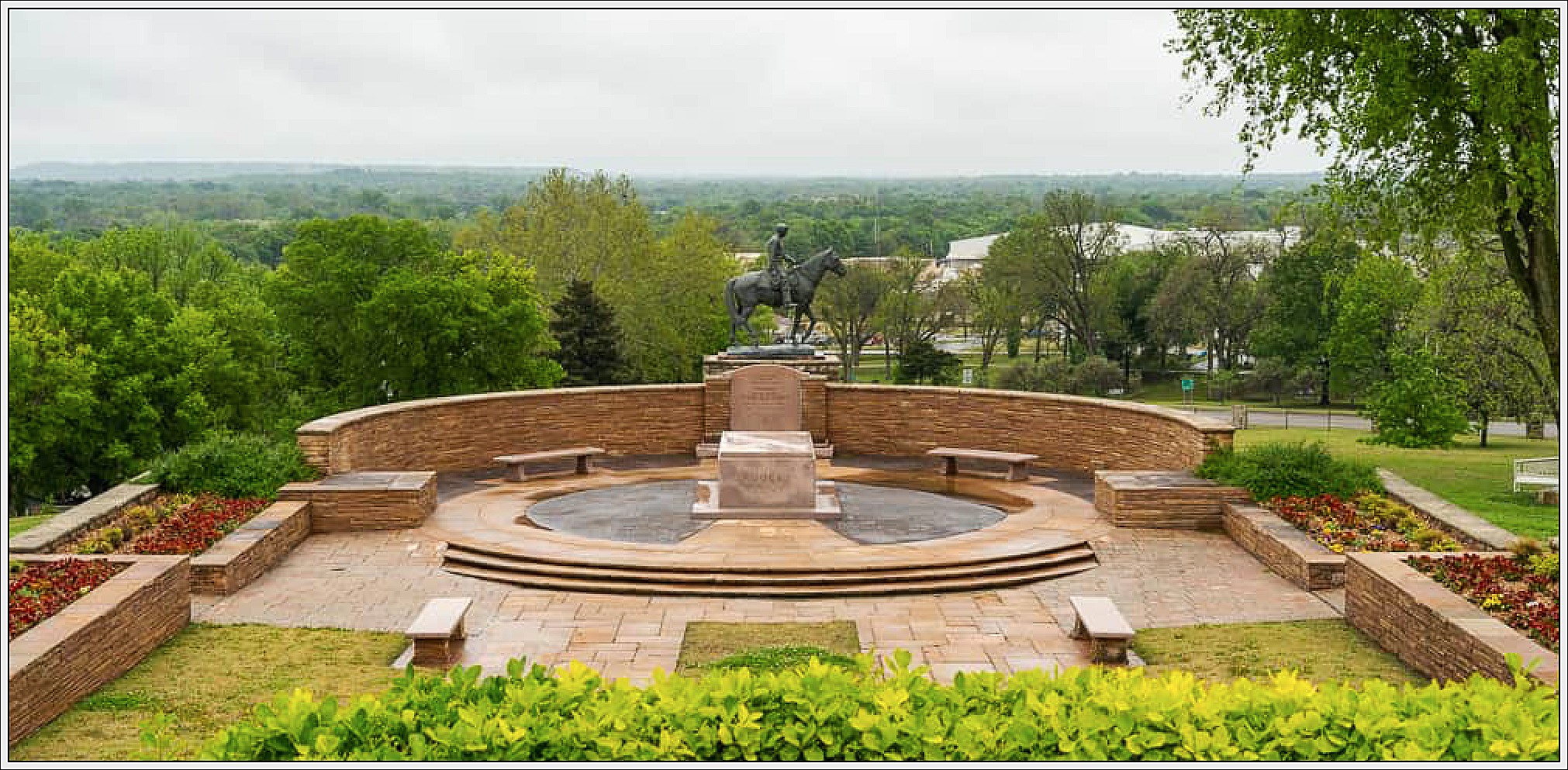
Rogers was buried August 21, 1935, in Forest Lawn Park in Glendale, California; however, that was only a temporary interment. He was later reinterred permanently at the Will Rogers Memorial in Claremore, Oklahoma. ✪


▶️ CLICK HERE TO VIEW
▶️ 17 Minutes 56 Seconds
▶️ 1 Hour 3 Minutes 16 Seconds ⭐️ FredMacFraudenstein
▶️ 11 Minutes 5 Seconds ⭐️ stillrules
▶️ 11 Minutes 51 Seconds
