
⭐️ louisiana_mom


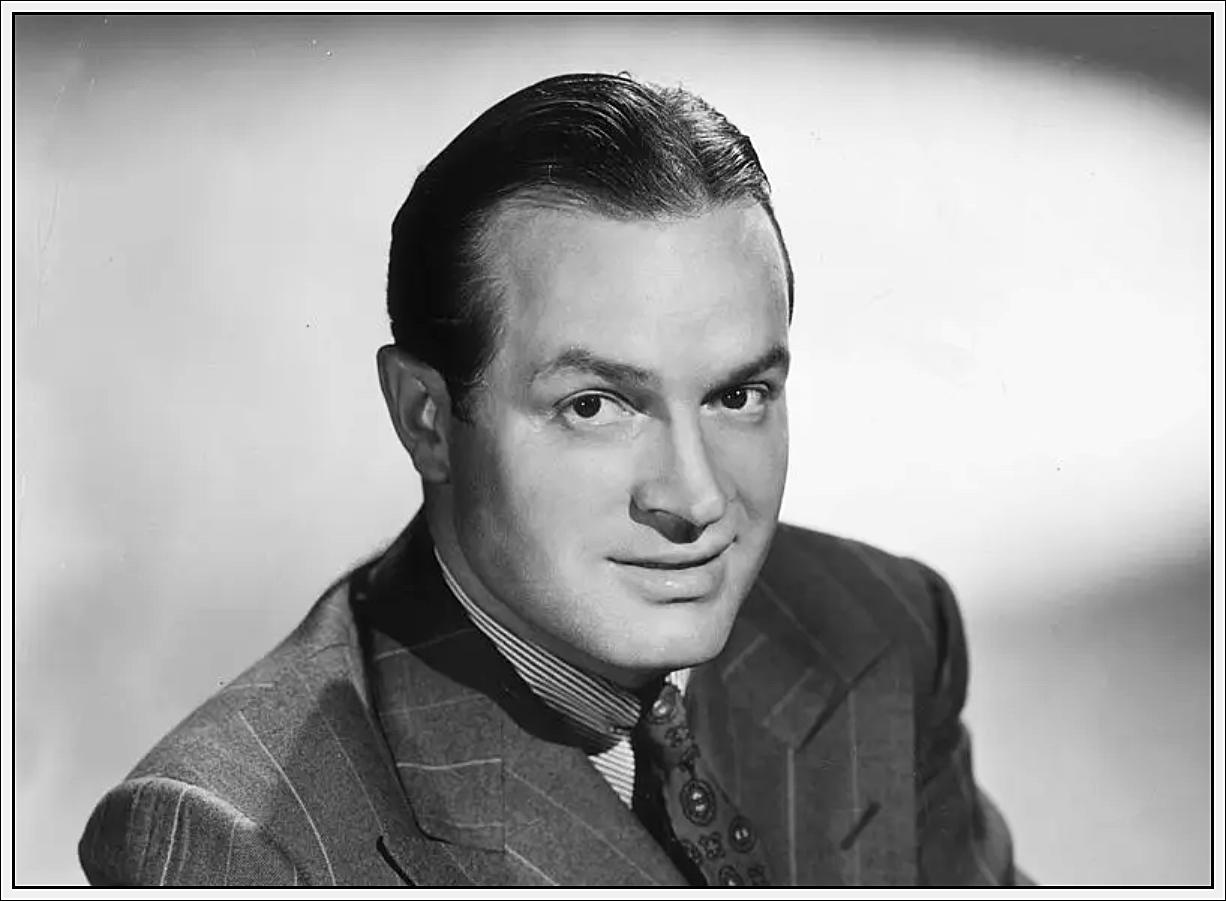

Leslie Townes Hope (May 29, 1903–July 27, 2003)
✪ Leslie Townes “Bob” Hope was an American comedian, actor and entertainer. During a career which spanned almost 80 years, Hope appeared in more than 70 short and feature films; 54 in which he starred. These included a series of extremely popular seven Road to … musical comedy films with Bing Crosby as Hope’s top-billed, co-star partner.
In addition, Hope hosted the Academy Awards show 19 times; more than any other host. Hope also appeared in many stage productions and television roles as well as authoring 14 books. The song “Thanks for the Memory” was his signature tune.
Leslie Townes Hope was born on May 29, 1903, in Eltham, County of London (now part of the Royal Borough of Greenwich) in a terraced house on Craigton Road in Well Hall where there is now a blue plaque honoring his memory. He was the fifth of seven sons of an English father, William Henry Hope, a stonemason and a Welsh mother, Avis (née Townes), a light opera singer from Barry, Vale of Glamorgan who later worked as a cleaner.
in 1908, the family immigrated to the United States, sailing aboard the SS Philadelphia. They passed through Ellis Island, New York on March 30, 1908, before settling in Cleveland, Ohio.
From the age of 12, Hope worked earning pocket money by busking (frequently on the streetcar to Luna Park), singing, dancing and performing comedy. He entered numerous dancing and amateur talent contests as Lester Hope, and won a prize in 1915 for his impersonation of Charlie Chaplin. For a short time, he attended the Boys’ Industrial School in Lancaster, Ohio and as an adult donated sizable sums of money to the institution. As a teenager, Hope had a brief career as a boxer in 1919 and fought billed under the name Packy East. He had three wins and one loss. Later in his life, he participated in several staged charity bouts.
Hope worked as a butcher’s assistant and a lineman through his teens and into his early twenties. He also had a brief stint at the Chandler Motor Car Company. While assisting his brother Jim in clearing trees for a power company in 1921, he was sitting atop a tree that crashed to the ground, crushing his face. The accident required Hope to undergo reconstructive surgery, which contributed to his later distinctive appearance.
After deciding on a show business career, Hope and his girlfriend signed up for dancing lessons. Encouraged after they performed in a three-day engagement at a club, Hope formed a partnership with Lloyd Durbin, a friend from the dancing school. Silent film comedian Fatty Arbuckle saw them perform in 1925 and found them work with a touring troupe called Hurley’s Jolly Follies.
In 1929, Hope informally changed his first name to “Bob.” In one version of the story, he named himself after race car driver Bob Burman. In another, he said he chose the name because he wanted a name with a “friendly ‘Hiya, fellas!’ sound” to it.
After five years on the vaudeville circuit, Hope was “surprised and humbled” when he failed a 1930 screen test for the RKO-Pathé short-subject studio at Culver City, California.
Hope’s first Broadway appearances in 1927’s The Sidewalks of New York and 1928’s Ups-a-Daisy, were only minor walk-on parts. He later returned to Broadway in 1933 to star as Huckleberry Haines in the Jerome Kern / Dorothy Fields musical Roberta.
Additionally, Hope rescued the Eltham Little Theatre in England from closure by providing funds to buy the property. He continued his interest and support, and regularly visited the facility when in London. The theater was renamed in his honor in 1982.
In his early professional days, Hope’s career included appearances on stage in vaudeville shows and Broadway productions. He also began performing on the radio in 1934 mostly with NBC radio, and switched over to television when that medium became popular in the 1950s. Overlapping with this was his movie career, which spanned from 1934 to 1972 and his USO tours, which he conducted from 1941 to 1991.
Hope moved to Hollywood when Paramount Pictures signed him for the 1938 film The Big Broadcast of 1938, also starring W. C. Fields. The song “Thanks for the Memory, “ which later became his trademark, was introduced in the film.
As a film star, Hope was best known for such comedies as My Favorite Brunette and all of the the highly successful “Road” movies in which he starred with Bing Crosby and Dorothy Lamour. At the outset, Paramount executives were amazed at how relaxed and compatible Hope and Crosby were working together as a team. What the executives didn’t know was that Hope and Crosby had already worked together (on the vaudeville stage in 1932); and that working so easily in the “Road” pictures was just an extension of their old stage act.
Hope and Crosby teamed up not only for the “Road” pictures, but for many stage, radio and television appearances and many brief movie appearances together over the decades until Crosby died in 1977. When Paramount threatened to stop production of the “Road” pictures in 1945, they received 75,000 letters of protest.
▶️ 25 Seconds
Hope starred in 54 theatrical features between 1938 and 1972, as well as cameos and short films. However, most of his later movies did not match the level of success of his earlier 1940s efforts.
Though his career as a film star effectively ended in 1972, he did continue making cameo film appearances into the 1980s.
Hope hosted the Academy Awards ceremony 19 times between 1939 and 1977. His supposedly-feigned desire for an Oscar became part of his act. While introducing the 1968 telecast, he quipped, “Welcome to the Academy Awards, or, as it’s known at my house, Passover.” Although he was never nominated for an Oscar, the Academy of Motion Picture Arts and Sciences would honor him with four honorary achievement awards
Hope did many specials for the NBC television network through the decades, beginning in April 1950. He was one of the first performers to use cue cards. The shows often were sponsored by Frigidaire (early 1950s), General Motors (1955–61), Chrysler (1963–73) and Texaco (1975–85). Hope’s Christmas specials were popular favorites and often featured a performance of “Silver Bells” from his 1951 film The Lemon Drop Kid
Hope’s 1970 and 1971 Christmas specials for NBC were filmed in Vietnam in front of military audiences at the height of the war and are on the list of the Top 46 U.S. network prime-time telecasts. Both were seen by more than 60 percent of the U.S. households watching television.
▶️ 54 Minutes 46 Seconds
While aboard the RMS Queen Mary when World War II began in September 1939, Hope volunteered to perform a special show for the passengers, during which he first sang “Thanks for the Memory.”
Hope performed his first USO show on May 6, 1941, at March Field in California and continued to travel and entertain troops for the rest of World War II, later during the Korean War, the Vietnam War, the third phase of the Lebanon Civil War, the latter years of the Iran–Iraq War and the 1990–91 Persian Gulf War. His USO career lasted a half-century during which he headlined 57 times.
Of Hope’s USO shows in World War II, novelist John Steinbeck, who then was working as a war correspondent, wrote in 1943:
When the time for recognition of service to the nation in wartime comes to be considered, Bob Hope should be high on the list. This man drives himself and is driven. It is impossible to see how he can do so much, can cover so much ground, can work so hard, and can be so effective. He works month after month at a pace that would kill most people.
Along with his best friend Bing Crosby, Hope was offered a commission in the United States Navy as lieutenant commander during World War II, but FDR intervened, believing it would be better for troop morale if they kept doing what they were doing by playing for all branches of military service
Hope had a deep respect for the men and women who served in the armed forces and this was reflected in his willingness to go anywhere to entertain them. However, during the highly controversial Vietnam War, Hope had trouble convincing some performers to join him on tour, but he was accompanied on at least one USO tour by Ann-Margret. Anti-war sentiment was high and his pro-troop stance often made him a target of criticism.
The USO tours were funded by the U.S. Department of Defense, Hope’s television sponsors, and by NBC, the network that broadcast the television specials created after each tour from footage shot on location. However, the footage and shows were owned by Hope’s own production company, which made them very lucrative ventures for him.
For his service to his nation through the USO, he was awarded the Sylvanus Thayer Award by the United States Military Academy at West Point in 1968, the first entertainer to receive the award. A 1997 act of Congress signed by President Bill Clinton named Hope an “Honorary Veteran.” He remarked, “I’ve been given many awards in my lifetime, but to be numbered among the men and women I admire most is the greatest honor I have ever received.”
In 1992, Hope made a guest appearance as himself on the animated Fox series The Simpsons in the episode “Lisa the Beauty Queen.” His 90th birthday television celebration in May 1993, Bob Hope: The First 90 Years, won an Emmy Award for Outstanding Variety, Music Or Comedy Special. Toward the end of his career, worsening vision problems rendered him unable to read his cue cards. In October 1996, he announced he was ending his 60-year contract with NBC, joking that he had “decided to become a free agent.” His final television special, Laughing with the Presidents, was broadcast in November 1996, with host Tony Danza helping him present a personal retrospective of presidents of the United States known to Hope, who was a frequent White House visitor over the years.
Following a brief appearance at the 50th Primetime Emmy Awards in 1997, Hope made his last TV appearance in a 1997 commercial about the introduction of Big Kmart, directed by Penny Marshall.
▶️ 31 Seconds
Hope had no faith or confidence in his own skills as a dramatic actor and his performances of that type were not as well received. However, Hope helped establish the modern form of American stand-up comedy. He was widely praised for his comedic timing and his specialization in the use of one-liners and rapid-fire delivery of jokes. He was known for his style of self-deprecating jokes, first building himself up and then tearing himself down. He performed hundreds of times each year.
Hope was also well known as an avid golfer, playing in as many as 150 charity tournaments each year. Introduced to the game in the 1930s while performing in Winnipeg, Canada, he eventually played to a four handicap. His love for the game—and the humor he could find in it made him a very sought-after foursome member. He once remarked when President Dwight D. Eisenhower gave up golf for painting: “Fewer strokes, you know.” He also was quoted as saying, “It’s wonderful how you can start out with three strangers in the morning, play 18 holes and by the time the day is over you have made three solid enemies.”
The Bob Hope Classic Golf Tournament was founded in 1960 & made history in 1995 when Hope teed up for the opening round in a foursome that included Presidents Gerald Ford, George H. W. Bush, and Bill Clinton. The only time three U.S. presidents have played in the same golf foursome.
In 1946, Hope bought a small stake in the Cleveland Indians professional baseball team and held it for most of the rest of his life. He appeared on the June 3, 1963, cover of Sports Illustrated magazine wearing an Indians uniform and sang a special version of “Thanks for the Memory” after the Indians’ last game at Cleveland Stadium on October 3, 1993.
In January 1933, singer Dolores Reade joined Hope’s vaudeville troupe and performed with him at Loew’s Metropolitan Theater. She was described as a “former Ziegfeld beauty and one of society’s favorite nightclub entertainers, having appeared at many private social functions at New York, Palm Beach, and Southampton” Two months later Hope & Reade married, but their marriage was fraught with ambiguities.
As Richard Zoglin wrote in his 2014 biography Hope: Entertainer of the Century:
When he claimed he had married Dolores in Erie he was miles away in New York, on Broadway. More intriguing, there is no record anywhere of his marriage to Dolores, if it happened. And there are no wedding photos, either.
The couple had no children of their own but instead adopted four children: Linda (in 1939), Tony (1940), Kelly (1946), and Eleanora, known as Nora (1946).
Hope had a reputation as a notorious womanizer and continued to be involved with other women throughout his marriage. Zoglin wrote, “Bob Hope had affairs with chorus girls, beauty queens, singers and showbiz wannabes through his 70s; he had a different girl on his arm every night. He was still having affairs into his 80s…”
According to Arthur Marx’s 1993 Hope biography, The Secret Life of Bob Hope, Hope’s subsequent long-term affair with actress Marilyn Maxwell was so open that the Hollywood community routinely referred to her as “Mrs. Bob Hope.”
Rosemarie Frankland was a beauty queen (Miss World 1961) who, according to Zoglin, took part in a 30-year affair with Hope. He said she was “the great love of his life.”
Hope continued an active entertainment career past his 90th birthday, concentrating on his television specials and USO tours. A television special created for his 80th birthday in 1983 at the Kennedy Center in Washington, D.C., featured President Ronald Reagan, actress Lucille Ball, comedian-actor-writer George Burns (a fellow centenarian) and many others. In 1985 Hope was presented with the Life Achievement Award at the Kennedy Center Honors and in 1998 he was appointed an honorary Knight Commander of the Most Excellent Order of the British Empire (KBE) by Queen Elizabeth II. Upon accepting the appointment, Hope quipped, “I’m speechless. 70 years of ad lib material and I’m speechless.”
Hope celebrated his 100th birthday on May 29, 2003. To mark this event, the intersection of Hollywood & Vine in Los Angeles was named “Bob Hope Square” and his centennial was declared “Bob Hope Day” in 35 states. Even at 100, Hope maintained his self-deprecating sense of humor, quipping, “I’m so old, they’ve canceled my blood type.”
Seven years before his death, hope converted to Catholicism and remained in relatively good health until late into his old age, though he became somewhat frail in his last few years. In June 2000 at age 97, he spent nearly a week in a California hospital being treated for gastrointestinal bleeding. In August 2001 at the age of 98, he was hospitalized for two weeks recovering from pneumonia.
During his lifetime, Hope was awarded more than 2,000 honors and awards, including 54 honorary university doctorates. In 1963 President John F.Kennedy awarded him the Congressional Gold Medal for service to his country. In 1969, President Lyndon Johnson bestowed him the Presidential Medal of Freedom for his service to the armed forces through the USO. In 1982 he received the S. Roger Horchow Award for Greatest Public Service by a Private Citizen, an honor given annually by Jefferson Awards. In 1995, he was presented with the National Medal of Arts and the Ronald Reagan Freedom Award in 1997. On June 10, 1980, he became the 64th (and only civilian) recipient of the United States Air Force Order of the Sword which recognizes individuals who have made significant contributions to the enlisted corps.
Bob Hope also has four stars on the Hollywood Walk Of Fame in Los Angeles: Radio Broadcasting, Television, Live Performance and Motion Pictures.

Hope died of pneumonia at his home in Toluca Lake, California on the morning of July 27, 2003, only two months after his 100th birthday. His grandson Zach Hope told a TV interviewer that when asked on his deathbed where he wanted to be buried, Hope is alleged to have told his wife, Dolores, “Surprise me.” His remains were temporarily placed in a mausoleum vault before the construction of the Bob Hope Memorial Garden at San Fernando Mission Cemetery in Los Angeles. He was joined in 2011 by his wife Dolores when she died four months after her 102nd birthday.✪


▶️ CLICK HERE TO VIEW
NOTE: This feature module is currently under construction. More podcast/series channels links will be added in the coming days & weeks. If there’s a podcast or video link you’d like to see posted here, please email your suggestions to vip@thenewamericanist.com


▶️ CLICK HERE TO VIEW
▶️ 8 Minutes 1 Seconds ⭐️ Gary Brown
▶️ 10 Minutes 43 Seconds
▶️ 9 Minutes 33 Seconds
▶️ 5 Minutes 49 Seconds
▶️ 39 Minutes 9 Seconds ⭐️ TheBeatGoesOnandOn
▶️ 2 Minutes 22 Seconds
