


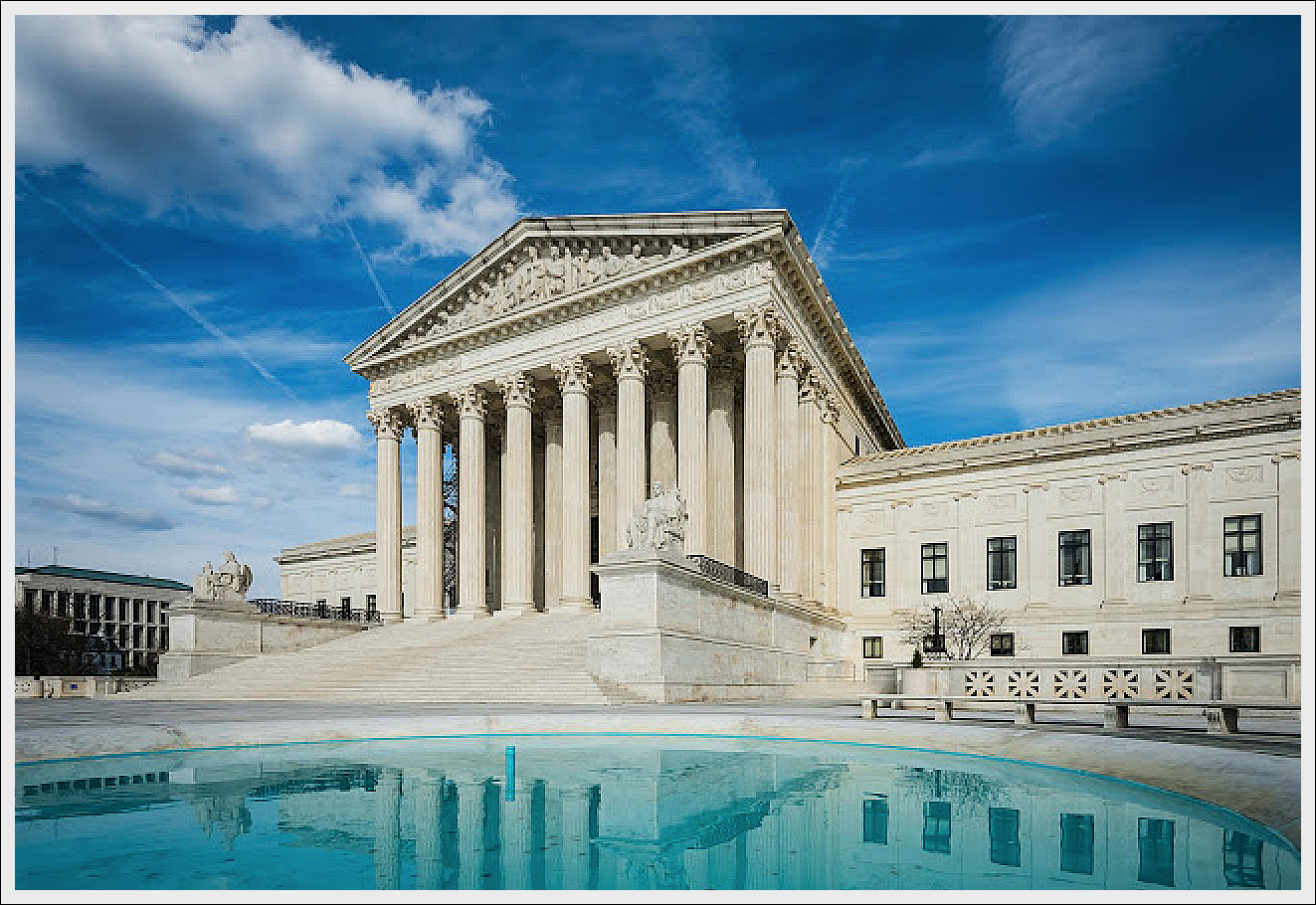

✪ The recent Colorado Supreme Court decision reminds us “Democracy” means whatever the Elites say it means…
▶️ READ THE FULL STORY HERE

Filler
he Colorado Supreme Court on Tuesday ruled that Donald Trump cannot appear on the primary election ballot in the state. In a 4-3 decision, the judges in the majority claimed that Trump had been disqualified by his participation in the January 6 “insurrection.” The judges didn’t indicate in which court of law Trump had been convicted of such a charge. They could not do so, of course, since Trump has not even been charged with the crime of insurrection or anything similar.
Predictably, those who called for Trump to be removed from the ballot claimed that Trump could not be allowed to stand for election since he is a “threat to democracy.” Apparently, the way to “defend democracy” is to have a panel of wealthy judges kick a man off the ballot for a “crime” of which he has not been convicted. In other words, the “pro-democracy” position is to tell the voters for whom they are allowed to vote.
This, of course, is yet another illustration of how “democracy” in America means whatever the elites say it means. When elections may lead to outcomes that are inconvenient to the regime, the regime’s agents simply intervene to nullify the elections or to prevent an election from taking place.
Consider, for example, how the voters of California approved a ban on gay “marriage” in 2008. The majority approved the ban, so government judges simply overturned the result. That’s “democracy.” Similarly, when Californians jumped through all the hoops necessary for a ballot issue breaking up the state into smaller pieces, judges intervened to prevent the election from even happening. That’s more “democracy.” Now, the Colorado Supreme Court has invented a non-existent federal conviction for Trump after being told by advocates that an inclusive ballot is bad for “democracy.” If the decision stands, Colorado voters will be on the receiving end of a diktat from the court preemptively voiding an election. So much “democracy!”
In practice of course, the term “democracy” hasn’t meant anything at all in decades except “the thing the ruling elites like.” Thus, merely asking questions about the honesty and transparency of the election process is “a threat to democracy.” More broadly, anything that questions the regime’s untrammeled control of the narrative is a “threat to democracy.” Voting the “wrong” way is a “threat to democracy.”
The response to the court’s decision was predictable. On the left, political leaders in other Democrat-controlled states immediately called for their own disqualification efforts. Most amusingly, and an excellent illustration of the current state of American politics, a letter by the California Lt. Governor proclaimed: “The constitution is clear: you must be 40 years old and not be an insurrectionist.” The Constitution’s age requirement is, of course, 35.
On the right, the response was varied. While a minority of Republicans desperate for a return to a pre-2016 GOP celebrated the decision, many rank-and-file Republican voters responded with understandable anger, viewing the court’s decision as an outrageous attack on political determination and further indication of the lengths the government will go to undermine their desired political leader. Others viewed the decision as a net positive, a demonstration of the rising probability of Trump’s re-election, and ultimately a form of political theater that would eventually backfire with voters.
This assumption, however, is predicated on the widely held belief that the Colorado decision will quickly make its way to the US Supreme Court, which will strike it down. The timing of Colorado’s decision, which has been threatened by Democrats for months now, will help clarify this process early and remove this threat from next November’s contest.
Supporting this view is one piece of precedence the Supreme Court has to work from: a Civil War-era case where a man, Caesar Griffin, challenged a criminal conviction on the basis that the presiding judge was disqualified from his position due to serving as a legislator in the Virginia Confederate government. At the time, the Court found that the relevant section of the 14th Amendment was not self-enforcing and, therefore, required an act of Congress to disqualify the judge in question.
But what if the Supreme Court does not overturn Colorado’s ruling?
After all, the Colorado verdict engaged with the Griffin Case, arguing that the Court’s decision at the time simply reflected the unique issues regarding the particular circumstance of state secession, which maintained its pre-federal legislative bodies. In the Colorado court’s eyes, Trump’s encouragement of January 6 is a separate matter entirely. They granted their ability to judge Trump guilty of insurrection, regardless of the opinion of any other legal body.
By looking beyond the romantic lens with which far too many conservatives hold regarding their assumptions about how the Constitution should function, the question is, what are the motivations of the current US Supreme Court?
Particularly in the current political environment, beginning with a simple partisan breakdown of the court is natural. This dynamic may better explain the confidence of conservative pundits more than confidence that the Constitution guarantees their desired outcome, given that six of the nine current judges were nominated by Republicans, including three from President Trump himself.
While this six-three split likely will be the favorite result on political gambling websites, the history of the modern court is more nuanced. We have “Republican” judges who frequently rule in ways that have hurt the political calculation of their associated party, from Chief Justice John Roberts’s infamous decision to uphold Obamacare to Justice Brett Kavanaugh’s vote in a voting rights decision that forced the Alabama state legislature to bend to the will of the Democrat Party and create a reliably blue voting district earlier this year. Similarly, Justice Amy Comey Barrett joined in a separate case involving voting maps in North Carolina, as well as a case challenging controversial changes to 2020 election law.
As such, partisanship alone cannot be relied upon to carry the day. Further, commentary by legal scholars at the Cato Institute, such as Ilya Somin celebrating the Colorado Court’s decision, demonstrates that the appetite of “Constitutional lawyers” to justify the logic utilized in the case is not limited simply to progressive activists.
What individuals like Somin and the Colorado majority have in common is an underlying hatred of Donald Trump individually and their belief that he is a uniquely grotesque and dangerous figure to wield the office of the presidency. In the formers’ words, he is a “menace to liberal democracy” whose “rhetoric echoes that of twentieth-century fascists.” If one holds this view, the aim to retroactively rationalize any attempt to prevent his return to power becomes internally justified, even if disqualifying political opponents violates the principles of liberal democracy in a way twentieth-century fascists would have supported.
Could nominally Republican justices hold similar views?
A potential clue could be considering the academic affiliations of the Colorado Court. While Democrats appointed all seven of the state’s Supreme Court, three of the four in the majority justices were from Ivy League products, and DC clerkships shaped their careers. The three dissenters went to the University of Denver. Of the three potential swing votes at the federal level, two are Ivy Leaguers with similar pedigrees: Roberts and Kavanaugh.
While it is overly simplistic to predict the ruling of a judge like Kavanaugh simply because he was a part of that whole Yale thing — after all, the same could be said for Clarence Thomas — his pre-Supreme Court experience was very much spent as part of the political system that views Trump as a particularly vulgar threat. Similarly, the Harvard-trained Roberts was a reliable foil to President Trump during his first term. Various Supreme Court watchers have argued that some of his decisions were made from a position of trying to defend his court’s place in history from accusations of it being a Trump Court.
What better way for these two to win historical fame from their beloved institutions than being those responsible for ending the Trump political threat once and for all? Particularly if the result is a lifeline to a potential Nikki Haley takeover of the Republican banner, a candidate who some reasonably view as “Dick Cheney in 3-inch heels.”
As Murray Rothbard identified in his classic Anatomy of the State, the best way to understand the government’s behavior is from the viewpoint of defending its legitimacy and preservation. If the principle of political self-determination must be sacrificed to preserve the regime, then so be it.
With this understanding in mind, it would be a mistake for conservatives to believe their team will bail out “their guy.” In the end, most of those wearing robes are actually closer in loyalty to their enemies than their friends.
If the Supreme Court saves Trump, it will not be due to their rejecting the belief that Trump is guilty of insurrection, but a calculated decision that the political fallout from the right will spark a danger to the Court’s credibility — and by extension the regime as a whole — then four more years of MAGA.
For those who desire to see the regime threatened, one’s preferred outcome in this case should be shaped by which of those two threats they view as most likely to deliver.
The Colorado Supreme Court, playing the part of Colorado’s very own Politburo has intervened to ensure that “antidemocratic” activities don’t get out of hand. The regime’s loyal supporters will no doubt be thankful that they’re getting this fresh infusion of “democracy” good and hard.✪











▶️ CLICK HERE TO VIEW
NOTE: This feature module is currently under construction. More podcast/series channels links will be added in the coming days & weeks. If there’s a podcast or video link you’d like to see posted here, please email your suggestions to vip@thenewamericanist.com


▶️ CLICK HERE TO VIEW
▶️ 1 Hour 23 Minutes 51 Seconds ⭐️ Zippity Zap
▶️ 10 Minutes 17 Seconds ⭐️ Michael Brower
▶️ 1 Hour 8 Minutes 18 seconds
▶️ 10 Minutes 21 Seconds
▶️ 19 Minutes 43 Seconds ⭐️ Zippity Zap
▶️ 14 Minutes 1 Second
