⭐️ HelloKitty’sGotAHairTrigger


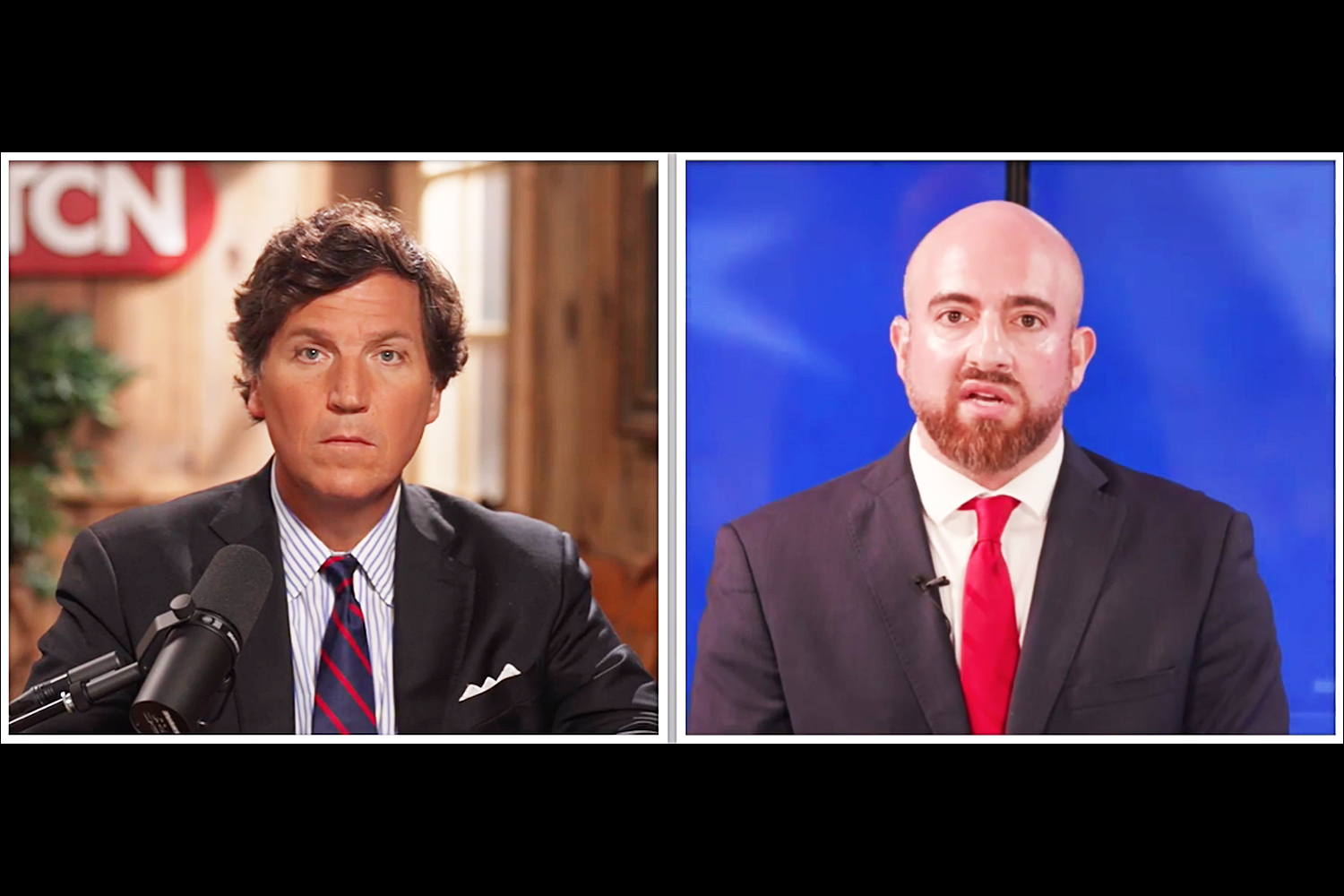

✪ Tucker Carlson’s interview with Mike Benz should be sobering a wake-up call for all Americans that our government is waging war on us.…
▶️ READ THE FULL STORY HERE

f you didn’t see Tucker Carlson’s interview last week with Mike Benz, you need to take an hour and watch the whole thing. In a mind-bending narrative about the emergence of what Benz calls “military rule” through an online censorship industry in the U.S., he lays out in startling detail just how corrupt and tyrannical the U.S. defense and foreign policy establishment has become.
▶️ 1 Hour 4 Minute 45 Seconds
Most importantly, Benz, the executive director of the Foundation For Freedom Online, explains how a constellation of federal agencies and publicly funded institutions, under the pretext of countering “misinformation,” rigged the 2020 election and are right now smothering the First Amendment and rigging the 2024 election through massive state-sponsored censorship online. The 2020 election and the Covid-19 pandemic, says Benz, were the “two most censored events in human history.” And 2024 is shaping up to be the same, thanks to the emergence of a federal censorship-industrial complex.
The problem here is profound, with deep historical roots that go back to the aftermath of World War II and the creation of the CIA along with a host of U.S.-funded international institutions. But for our purposes, it suffices to understand the problem in its two most recent stages: the period from 1991 to 2014, and from 2014 to the present.
At the outset of internet privatization in 1991, free speech online was seen as an instrument of statecraft. At that time, says Benz, internet free speech was championed by the U.S. foreign policy and defense establishments as a way to support dissident groups around the world in their efforts to overthrow authoritarian or disfavored regimes. It allowed the U.S. to conduct what Benz calls “insta-regime change operations,” in service of the State Department’s foreign policy agenda.
The plan worked really well. Among other things, free speech on the internet allowed U.S.-backed groups to assert control over state-run media in foreign countries, making it much easier to overthrow governments. The high-water mark of this way of deploying free speech online, Benz explains, was the Arab Spring in 2011 and 2012, when governments the Obama Administration considered problematic — Egypt, Tunisia, Libya — all began falling in so-called Facebook and Twitter revolutions. During that time, the State Department worked closely with these social media companies to keep them up and running in those countries, to be used as tools for protesters and dissident groups that were trying to circumvent state censorship.
But all of that changed in 2014 after the U.S.-backed coup in Ukraine toppled the government of Viktor Yanukovych and there was an unexpected pro-Russia counter-coup in Crimea and parts of eastern Ukraine. Later that same year, says Benz, when the people of Crimea voted to be annexed into the Russian Federation, “that was the last straw for the concept of free speech on the internet in the eyes of NATO.”
Thereafter, NATO, the CIA, and the State Department, together with the intelligence agencies of our European allies, did an about-face on internet free speech. They began instead to engage in what amounted to hybrid or information warfare to censor what they saw as Russian propaganda online. These efforts quickly spread beyond Ukraine and Eastern Europe to include the censorship of populist groups on the right that were emerging across the EU as a response to the Syrian migrant crisis.
By the time Brexit emerged in the summer of 2016, explains Benz, NATO and the foreign policy establishment felt there was a real crisis afoot; the problem was spreading west from Central and Eastern Europe, and it had to be stopped. If it wasn’t, then Brexit might trigger the collapse of the entire EU, along with NATO and the entire constellation of supranational institutions that relied on NATO. The entire postwar architecture of institutions might come crashing down, all because the hearts and minds of the people were being swayed. So went the thinking, anyway. As far as the national security establishment was concerned, citizens were being swayed by Russian and far-right propaganda, and we can’t have that.
Under these circumstances, free speech was the last thing that could be allowed to flourish online. Censorship became the order of the day. As Carlson put it, these NATO and EU leaders identified their new enemy as democracy within their own countries — their own voters, in other words: “They feared that their people, the citizens of their own countries, would get their way. And they went to war against that.”
And then Trump was elected. From that moment — and indeed, as we know from the Russia-collusion hoax, even before Trump was elected in November 2016 — the U.S. foreign policy and defense establishments, which had done so much to censor and weaponize the internet overseas, turned their attention to American citizens.
Initially, their predicate for domestic surveillance was Crossfire Hurricane, the fatuous notion that Russia had infiltrated the Trump campaign and that Trump was a Russian asset. Once that collapsed, they needed another excuse to spy on and censor Americans who held disfavored opinions or who spread “misinformation,” to put it in the parlance of the censorship-industrial complex. To do that, they had to get around the prohibition against the CIA operating on American soil.
Since they couldn’t very well get away with openly spying on and censoring American citizens, they decided to house the bulk of their censorship operations inside the Department of Homeland Security, specifically in a part of DHS tasked with reducing and eliminating threats to U.S. critical physical and cyber infrastructure. Hence “domestic misinformation” — which is really just a term for opinions and information that the national security state doesn’t like or that run counter to State Department policy — was classified as an attack on “critical cognitive infrastructure,” and could therefore be censored. What it amounted to was an end-run around the First Amendment.
But even DHS couldn’t do this directly, so it outsourced online censorship operations to third parties like the Election Integrity Partnership, or EIP, which consisted of four separate organizations: the Stanford Internet Observatory, the University of Washington’s Center for an Informed Public, Atlantic Council’s Digital Forensic Research Lab, and a firm called Graphika. These private-sector “partners” did the nitty-gritty work of mapping out entire online networks of people who helped spread certain disfavored opinions, or what the censors called “false narratives.” Essentially they were deputized to censor Americans on behalf of the government.
▶️ 1 Minute 9 Seconds
It should come as no surprise that the people behind the EIP censorship network are leftists who hate Donald Trump, despise his supporters, and love censorship. For example, former Facebook executive Alex Stamos is the director of the Stanford Internet Observatory. He has compared “over half of the Republicans in Congress” to ISIS, called for Newsmax and OANN to be kicked off the air, and said, “We have to turn down the capability of these conservative influencers to reach these huge audiences.” His views are typical among the managers of the censorship industry.
These managers and their partners inside the U.S. government went about their task with gusto, including a seven-month pre-censorship campaign ahead of the 2020 election. Any content challenging public faith in mail-in ballots, early voting, and ballot drop boxes was flagged for violating new rules about “delegitimizing elections.” The censors, along with the government, had strong-armed the social media companies into adopting these rules, as documented in great detail last year with the release of the “Twitter Files.”
Indeed, the “Twitter Files” exposed a massive effort by the federal government to deputize Twitter and other social media companies to do what it could not, at least not legally. But in some ways, the “Twitter Files” just revealed the tip of the censorship iceberg.
As detailed in a recent lawsuit filed in December by The Federalist, The Daily Wire, and the state of Texas, the State Department illegally used a counterterrorism center intended to fight foreign “disinformation” to censor Americans.
The State Department, through grants and product development assistance to private entities like the Global Disinformation Index (GDI) and NewsGuard, was “actively intervening in the news-media market to render disfavored press outlets unprofitable by funding the infrastructure, development, and marketing and promotion of censorship technology and private censorship enterprises to covertly suppress speech of a segment of the American press,” according to the lawsuit.
That means the Federal Government was using cutouts like NewsGuard to throttle our reporting and commentary on the 2020 election and its chaotic aftermath. Both the GDI and the State Department’s Global Engagement Center (GEC) developed censorship tools that included “supposed fact-checking technologies, media literacy tools, media intelligence platforms, social network mapping, and machine learning/artificial intelligence technology,” the lawsuit says. The State Department then gave these tools to companies like Facebook and LinkedIn to target disfavored media outlets.
Through these and other methods, during the 2020 election cycle and the Covid pandemic, the government-backed censorship-industrial complex throttled millions of online posts, suppressing traffic to news sites and undermined revenue streams for a host of outlets and influencers with disfavored or dissident views.
▶️ 1 Minute 30 Seconds
But this isn’t a thing of the past. All of the censorship infrastructure described above is still intact, still functioning, and is firing on all cylinders right now ahead of the 2024 election. If anything, the censorship-industrial complex is more robust than it was four years ago. Just last week, Meta’s President of Global Affairs Nick Clegg boasted on CNBC that he currently has some 40,000 employees, which is nearly 60 percent of Meta’s entire workforce, tasked with censoring speech on Facebook, Instagram and WhatsApp. Clegg also claimed Meta has spent about $20 billion, including $5 billion in the last year, on its censorship efforts — or what he euphemistically called “election integrity.”
What does that mean in practice? We don’t have to guess. Remember that Facebook infamously censored the Hunter Biden laptop story in October 2020 at the behest of the FBI. With 40,000 employees now charged with censoring “hate speech” and ensuring “election integrity,” we can be fairly certain that if another Hunter Biden laptop story comes along this election cycle, it too will be quashed by the censors.
Why exactly is our government doing this? It’s not merely a partisan preference for ensuring Democrats stay in power, but something deeper and more insidious. To circle back to Carlson’s interview with Benz,
it’s because the national security state has come to regard “democracy” not as the will of the people expressed through elections, but as the constellation of government agencies, government-backed institutions, corporations, media outlets, and nonprofit groups. Protecting democracy, in this view, means protecting these institutions from the people they were putatively meant to serve.
As Benz says at one point in the interview:
“The relationship between the managers of the American empire and the citizens of the American homeland has broken down, and that has played itself out in the story of the censorship industry.”
All of this seems rather complex and dense, at least in the details of how it works. But at root it’s very simple: Those who have power don’t want to be held accountable by the unwashed masses, by “populism,” and certainly not by the results of free and fair elections. They will not tolerate anyone, not even a duly elected president, going against the “interagency consensus” — that famous phrase of Alexander Vindman’s from the first Trump impeachment. They don’t think the people have that right and they intend to use every tool they have to protect their power and privilege.
The stark truth is that if we don’t defeat and dismantle this censorship-industrial complex, it means the end of our republic and the rise of tyrannical military rule in the United States.
If you think that’s an overstatement, go watch the entire Benz interview and consider it in the context of what we have all seen play out in America over the past half-decade or so. There is no language alarmist enough to convey the gravity of what’s happening here. This is a hybrid war being fought mostly online but with real-world consequences that are every day becoming more obvious. We have to win the war to save our country, but we can’t even fight if we don’t know what’s happening, or how, or why.
About 15 minutes into the interview, I was again reminded of something I once heard the late, great Angelo Codevilla say in a lecture. He said our response to 9/11 was fundamentally flawed because it took a “law enforcement” approach to terrorism that required the creation of a vast state security and surveillance apparatus to detect and stop terrorist attacks. Once the terrorist threat subsided, Codevilla explained, this surveillance apparatus would be turned on the American people and destroy the republic it was supposedly designed to protect.
That lecture was in 2013. Codevilla was right. It’s all happened exactly as he said it would. What happens next is up to us. ✪