


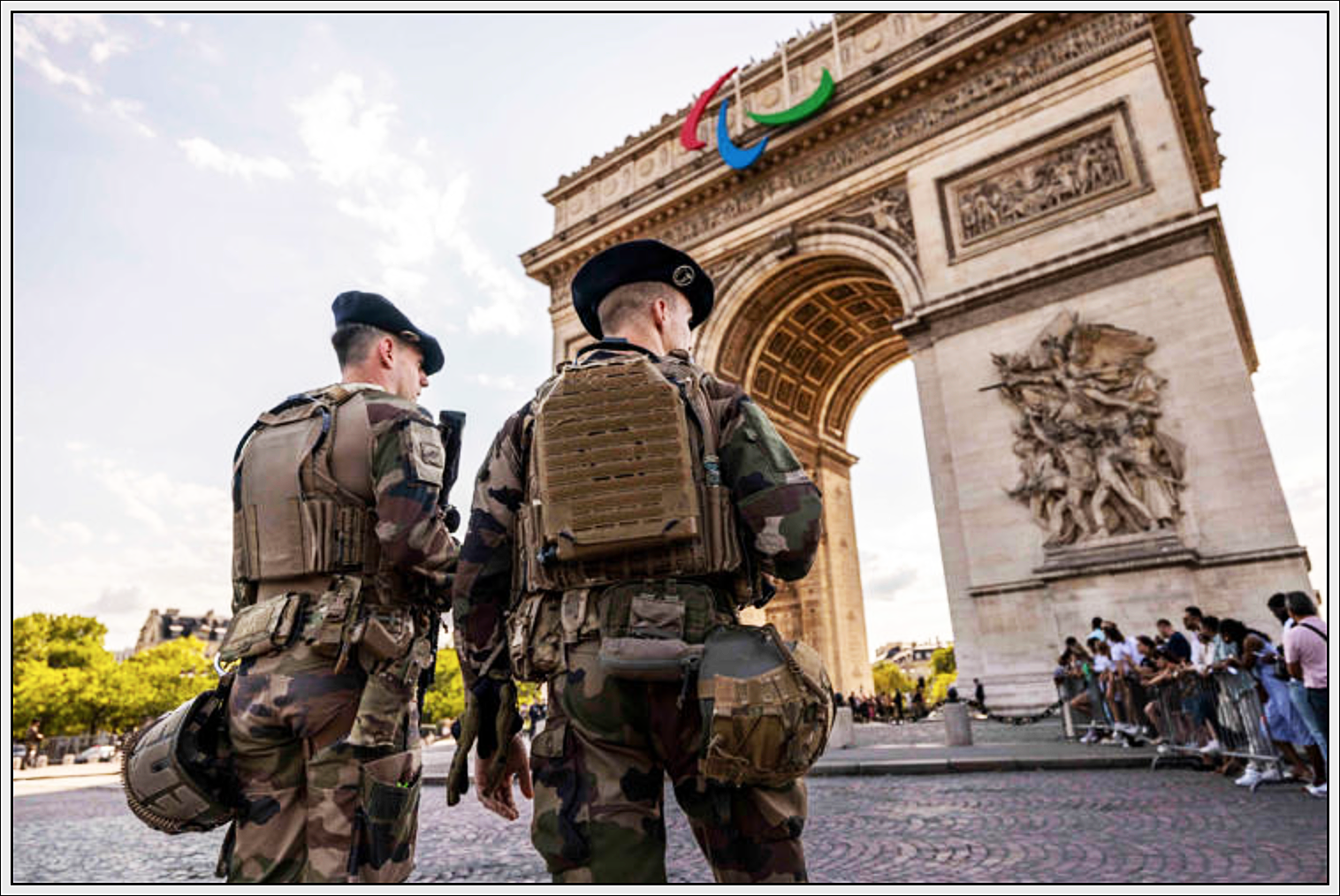

✪ Squadrons of soldiers have been drafted from all over France. An AI surveillance system that would make China’s president Xi Jinping jealous has been installed and both banks of the River Seine are fenced & barricaded. This is now Paris only days before the 2024 Olympic Games, which are scheduled to begin this Friday, July 26…
▶️ CLICK HERE TO READ

lll
o anyone who does not live in a large European city like London, Paris – often referred to as the ‘City of Love’ – might resemble a dystopian enclave preparing for the Hunger Games.
Final preparations are under way as the French capital prepares to host the 2024 Summer Olympic and Paralympic Games. Streets and bridges are closed, large areas are inaccessible, and security is tight as the city gears up for an unprecedented Opening Ceremony on Friday involving a 6-kilometre (4-mile) floating procession down the River Seine.
Yasmina, a general manager at the Hotel Des Ducs D’Anjou, just a few minutes from the Louvre Museum, saya the city ‘feels like a jail’ right now.
She told Metro.co.uk: “On every street there are at least four or five police officers. ‘It feels unsafe. To me, the presence of so many police means there is a threat of a terrorist attack.“
French Gendarmes carry out security checks at barricades set up near the Louvre.
Temporary seating has been erected on Paris’s iconic bridges, many of which have been closed to traffic, for spectators wishing to view the Opening Ceremony procession down the River Seine.
An artist’s impression of the Paris Olympics’ unprecedented Opening Ceremony, which French authorities fear could be the target of drone attacks. A ban on drones flying in Paris airspace is being strictly enforced, with authorities saying an average of six drones are being intercepted each day.
The bridge at Place de la Concorde is closed and the metro stops serving the area have been temporarily shut down.
Arriving at Gare Du Nord, there are no flags or posters to signal that the Olympics are now only 72 hours away.
It is only when you get closer to the Seine that the police presence becomes more noticeable, particularly around attractions and monuments like the Eiffel Tower.
It was a year ago that the head of the 2024 Olympic Games organizing committee, Tony Estanguet, declared that Paris will be ‘the safest city in the world’ when the event starts. Today, this prediction looks more convincing than ever before.
A ‘no-go’ grey zone – something like an iron curtain – has been erected in the heart of the city, making it inaccessible to both residents and tourists without a valid QR code.
Also known as a ‘Games Pass,’ it allows entry to the perimeter – but the system to get one is complicated and has led to a lot of confusion. Visitors have also been advised to apply more than a week before arriving.
Barriers were first put in place on July 18, a full week before the Games opening ceremony. This has been a surprise – and has resulted in a lot of frustration.
Mevhibe and Kilian, a couple from Germany who were on their first trip to Paris, were not aware that the Olympics were taking place. They did not know that they were expected to get a code to access some of the city’s main attractions and river banks.
‘All of the roadblocks are very annoying and we did not know that we have to get a pass in advance,’ Mevhibe said.
“We cannot access the Seine and we have to make big circles to get to anything. We wanted to walk from Musée d’Orsay to Notre Dame, but it is not possible. We had tickets, but still we could not go.“
Lines of police officers guard the barricades lining the Seine, scanning code after a code for anyone who wants to enter. At every crossing, there are people pleading to be let through, most without much success.
One police officer, who wished to remain anonymous & was stationed outside the Notre Dame, on Île de la Cité said that in the last 50 minutes, they had scanned more than 200 passes, but had only allowed entry for two.
In many cases, people are asked to produce additional documentation like a pre-booked ticket to a museum, a reservation to a restaurant or an appointment to a hospital.
‘Hundreds of people turn up every day without a code,’ they said. The issue is that they do not know they need a code. Tourists and residents.
‘Normally, even if they have a ticket to see an attraction inside the zone, they are not allowed if they do not have a code. But I feel bad, so I let them through.’
▶️ 1 Minute 53 Seconds
The militarized approach to Olympic security is not without reason. A series of extremist attacks have rocked Paris and other parts of the country in the past decade.
France is a nation scarred by a series of coordinated terrorist attacks carried out by three groups of gunmen in November 2015 in Paris and the suburb of Saint-Denis.
At least 130 people were killed and more than 350 were injured, with the worst bloodshed carried out at the Bataclan concert hall, where American rock band Eagles of Death Metal was playing to a sold-out crowd.
International tensions are also running high amid wars in Ukraine and Gaza, with bloodshed now threatening to spill over across the Israel-Lebanon border.
A month after an attack on a concert hall outside Moscow that left at least 145 dead, Islamic State – namely its Afghanistan-based affiliate Islamic State – Khorasan Province (IS-KP) – called for further violence in Russia and elsewhere in Europe.
Alongside London and Madrid, the group urged its followers ‘to recreate the glory’ of the November 2015 massacre in Paris during the Olympics.
Historically, the Games have also been the site of several terror attacks and plots.
In 1972, the Munich Summer Games were overshadowed by an attack by the Palestinian group Black September, which left 11 Israeli Olympic athletes and one West German police officer dead. ✪
lll

















▶️ CLICK HERE TO VIEW


▶️ CLICK HERE TO VIEW
▶️ 1 Hour 38 Minutes 17 Seconds
▶️ 1 Hour 46 Minutes
▶️ 37 Minutes 25 Seconds
▶️ 42 Minutes 51 Seconds
▶️ 11 Minutes 45 Seconds
▶️ 8 Minutes 17 Seconds
▶️ 23 Minutes 15 Seconds
▶️ 7 Minutes 10 Seconds
▶️ 18 Minutes 25 Seconds ⭐️ Gary Brown
▶️ 39 Seconds
