




Sir Alexander Fleming: August 6, 1881–March11, 1955
✪ Sir Alexander Fleming was a Scottish physician and microbiologist, best known for discovering the world’s first broadly effective antibiotic substance, which he named penicillin. His discovery in 1928 of what was later named benzylpenicillin (or penicillin G) from the mold Penicillium rubens has been described as the “single greatest victory ever achieved over disease.” For this discovery, he shared the Nobel Prize in Physiology or Medicine in 1945 with Howard Florey and Ernst Boris Chain. He also discovered the enzyme lysozyme.
Fleming was knighted for his scientific achievements in 1944. In 1999, he was named in Time magazine’s list of the 100 Most Important People of the 20th Century. In 2002, he was chosen in the BBC’s television poll for determining the 100 Greatest Britons, and in 2009, he was also voted third “greatest Scot” in an opinion poll conducted by STV, behind only Robert Burns and William Wallace.
Born on 6 August 1881 at Lochfield farm near Darvel, in Ayrshire, Scotland, Alexander Fleming was the third of four children of farmer Hugh Fleming and Grace Stirling Morton, the daughter of a neighbouring farmer. Hugh Fleming had four surviving children from his first marriage. He was 59 at the time of his second marriage to Grace, and died when Alexander was only seven.
Fleming attended Loudoun Moor School and Darvel School, and earned a two-year scholarship to Kilmarnock Academy before moving to London, where he attended the Royal Polytechnic Institution. After working in a shipping office for four years, the twenty-year-old Alexander Fleming inherited some money from an uncle, John Fleming. His elder brother, Tom, was already a physician and suggested to him that he should follow the same career path. So in 1903, the younger Alexander enrolled at St Mary’s Hospital Medical School in Paddington (now part of Imperial College London); he qualified with an MBBS degree from the school with distinction in 1906.
Fleming, was also a private in the London Scottish Regiment of the Volunteer Force from 1900 to 1914 and had been a member of the rifle club at the medical school. The captain of the club, wishing to retain Fleming in the team, suggested that he join the research department at St Mary’s, where he became assistant bacteriologist to Sir Almroth Wright, a pioneer in vaccine therapy and immunology. In 1908, he gained a BSc degree with gold medal in bacteriology, and became a lecturer at St Mary’s until 1914.
Commissioned lieutenant in 1914 and promoted captain in 1917, Fleming served throughout World War I in the Royal Army Medical Corps. He and many of his colleagues worked in battlefield hospitals at the Western Front in France.
On 24 December 1915, Fleming married a trained nurse, Sarah Marion McElroy of Killala, County Mayo, Ireland. Their only child, Robert Fleming (1924–2015), became a general medical practitioner. After his first wife’s death in 1949, Fleming married Amalia Koutsouri-Vourekas, a Greek colleague at St. Mary’s on 9 April 1953; she died in 1986.
During World War I, Fleming joined the war effort with Leonard Colebrook and Sir Almroth Wright. Together, they practically moved the entire Inoculation Department of St Mary’s to the British Military Hospital at Boulogne-sur-Mer. Serving as a temporary lieutenant in the Royal Army Medical Corps, he witnessed the battlefield deaths of many soldiers resulting from infected wounds & sepsis.
He observed Antiseptics, which were used at the time to treat infected wounds, often worsened the injuries. In an article published in the medical journal The Lancet in 1917, he described an ingenious experiment, which he was able to conduct as a result of his own glassblowing skills, in which he explained why antiseptics were killing more soldiers than infection itself during the war.
In 1918 he returned to St Mary’s Hospital, where he was elected Professor of Bacteriology of the University of London in 1928. In 1951 he was elected the Rector of the University of Edinburgh for a term of three years.
At St Mary’s Hospital, Fleming continued his investigations into bacteria culture and antibacterial substances. As his research scholar at the time V. D. Allison recalled, Fleming was not a tidy researcher and usually expected unusual bacterial growths in his culture plates. Fleming had teased Allison of his “excessive tidiness in the laboratory,” and Allison rightly attributed such untidiness as the success of Fleming’s experiments, and said, “If he had been as tidy as he thought I was, he would not have made his two great discoveries.”
In late 1921, while he was maintaining agar plates for bacteria, he found that one of the plates was contaminated with bacteria from the air. When he added nasal mucus, he found that the mucus inhibited the bacterial growth. Surrounding the mucus area was a clear transparent circle (1 cm from the mucus), indicating the killing zone of bacteria, followed by a glassy and translucent ring beyond which was an opaque area indicating normal bacterial growth.
His further tests with sputum, cartilage, blood, semen, ovarian cyst fluid, pus and egg white showed that the bactericidal agent was present in all of these. He reported his discovery before the Medical Research Club in December and before the Royal Society the next year but failed to stir any interest, as Allison recollected:
I was present at this [Medical Research Club] meeting as Fleming’s guest. His paper describing his discovery was received with no questions asked and no discussion, which was most unusual and an indication that it was considered to be of no importance. The following year he read a paper on the subject before the Royal Society, Burlington House, Piccadilly and he and I gave a demonstration of our work. Again with one exception little comment or attention was paid to it.[
Reporting in the 1 May 1922 issue of the Proceedings of the Royal Society B: Biological Sciences under the title “On a remarkable bacteriolytic element found in tissues and secretions,” Fleming wrote:
In this communication I wish to draw attention to a substance present in the tissues and secretions of the body, which is capable of rapidly dissolving certain bacteria. As this substance has properties akin to those of ferments I have called it a “Lysozyme”, and shall refer to it by this name throughout the communication. The lysozyme was first noticed during some investigations made on a patient suffering from acute coryza.
This was the first recorded discovery of lysozyme. Although he was able to obtain larger amounts of lysozyme from egg whites, the enzyme was only effective against small counts of harmless bacteria, and therefore had little therapeutic potential.
In his Nobel lecture on 11 December 1945, he briefly mentioned lysozyme, saying, “Penicillin was not the first antibiotic I happened to discover.” It was only towards the end of the 20th century that the true importance of Fleming’s discovery in immunology was realixed as lysozyme became the first antimicrobial protein discovered which constitutes part of our innate human immunity.
One sometimes finds what one is not looking for. When I woke up just after dawn on September 28, 1928, I certainly didn’t plan to revolutionize all medicine by discovering the world’s first antibiotic, or bacteria killer. But I suppose that was exactly what I did.— Alexander Fleming
By 1927, Fleming had been investigating the properties of staphylococci. He was already well known from his earlier work, and had developed a reputation as a brilliant researcher.
On 3 September 1928, Fleming returned to his laboratory having spent a holiday with his family at Suffolk. Before leaving for his holiday, he inoculated staphylococci on culture plates and left them on a bench in a corner of his laboratory. On his return, Fleming noticed that one culture was contaminated with a fungus, and that the colonies of staphylococci immediately surrounding the fungus had been destroyed, whereas other staphylococci colonies farther away were normal, famously remarking “That’s funny.” Fleming showed the contaminated culture to his former assistant Merlin Pryce, who reminded him, “That’s how you discovered lysozyme.” He identified the mould as being from the genus Penicillium.
Fleming grew the mould in a pure culture and found that the culture broth contained an antibacterial substance. He investigated its anti-bacterial effect on many organisms, and noticed that it affected bacteria such as staphylococci and many other Gram-positive pathogens that cause scarlet fever, pneumonia, meningitis and diphtheria, but not typhoid fever or paratyphoid fever, which are caused by Gram-negative bacteria, for which he was seeking a cure at the time. It also affected Neisseria gonorrhoeae, which causes gonorrhoea.
After some months of calling it “mould juice” or “the inhibitor,” he gave the name penicillin on 7 March 1929 for the antibacterial substance present in the mould.
Fleming presented his discovery on 13 February 1929 before the Medical Research Club. His talk on “A medium for the isolation of Pfeiffer’s bacillus” did not receive any particular attention or comment. Henry Dale, the then Director of National Institute for Medical Research and chair of the meeting, much later reminisced that he did not even sense any striking point of importance in Fleming’s speech. Fleming published his discovery in 1929 in the British Journal of Experimental Pathology, but very little attention was paid to the article.
As late as in 1936, there was no appreciation for penicillin. When Fleming talked of its medical importance at the Second International Congress of Microbiology held in London, no one believed him.
At the Medical Research Club meeting, Fleming suggested the possible value of penicillin for the treatment of infection in man. Again there was a total lack of interest and no discussion. Fleming was keenly disappointed, but worse was to follow. He read a paper on his work on penicillin at a meeting of the International Congress of Microbiology, attended by the foremost bacteriologists from all over the world. There was no support for his views on its possible future value for the prevention and treatment of human infections and discussion was minimal. Fleming bore these disappointments stoically, but they did not alter his views or deter him from continuing his investigation of penicillin.
In 1941, the British Medical Journal reported that “Penicillin does not appear to have been considered as possibly useful from any other point of view.”
Fleming was modest about his part in the development of penicillin, describing his fame as the “Fleming Myth.” However, his discovery of penicillin and its subsequent development as a prescription drug marked the start of modern antibiotics.
There is a popular assertion both in popular and scientific literature that Fleming largely abandoned his penicillin work in the early 1930s.
In his review of André Maurois’s The Life of Sir Alexander Fleming, Discoverer of Penicillin, William L. Kissick went so far as to say that “Fleming had abandoned penicillin in 1932… Although the recipient of many honors and the author of much scientific work, Sir Alexander Fleming does not appear to be an ideal subject for a biography.” This is false, as Fleming continued to pursue penicillin research. As late as in 1939, Fleming’s notebook shows attempts to make better penicillin production using different media. In 1941, he published a method for assessment of penicillin effectiveness.
By mid-1942, an Oxford team of researchers produced the pure penicillin compound as yellow powder. In August 1942, Harry Lambert (an associate of Fleming’s brother Robert) was admitted to St Mary’s Hospital due to a life-threatening infection of the nervous system (streptococcal meningitis). Fleming treated him with sulphonamides, but Lambert’s condition deteriorated. He tested the antibiotic susceptibility and found that his penicillin could kill the bacteria.
Fleming immediately administered into Lambert’s spinal canal. Lambert showed signs of improvement the very next day and completely recovered within a week. In 1943, Fleming published the clinical case in The Lancet.
Upon this medical breakthrough, Allison informed the British Ministry of Health of the importance of penicillin and the need for mass production. The Penicillin Committee was created on 5 April 1943. The main goals were to produce penicillin rapidly in large quantities with collaboration of American companies, and to supply the drug exclusively for Allied armed forces. By D-Day in 1944, enough penicillin had been produced to treat all the wounded of the Allied troops.
Fleming also discovered very early that bacteria developed antibiotic resistance whenever too little penicillin was administered or when it was used for too short a time period.
Fleming cautioned about the use of penicillin in his many speeches around the world. On 26 June 1945, he made the following cautionary statements: “the microbes are educated to resist penicillin and a host of penicillin-fast organisms is bred out … In such cases the thoughtless person playing with penicillin is morally responsible for the death of the man who finally succumbs to infection with the penicillin-resistant organism. I hope this evil can be averted.” He cautioned not to use penicillin unless there was a properly diagnosed reason for it to be used, and that if it were used, never to use too little; or for too short a period, since these are the circumstances under which bacterial resistance to antibiotics develops.
Elaborating the possibility of penicillin resistance in clinical conditions in his Nobel Lecture, Fleming said:
The time may come when penicillin can be bought by anyone in the shops. Then there is the danger that the ignorant man may easily underdose himself and by exposing his microbes to non-lethal quantities of the drug make them resistant.
It was around that time that the first clinical case of penicillin resistance was reported.
Fleming came from a Presbyterian background, while his first wife Sarah was Roman Catholic. It is said that Fleming was not particularly religious. Their son Robert was later received into the Anglican Church, while still reportedly inheriting his two parents’ fairly irreligious disposition.
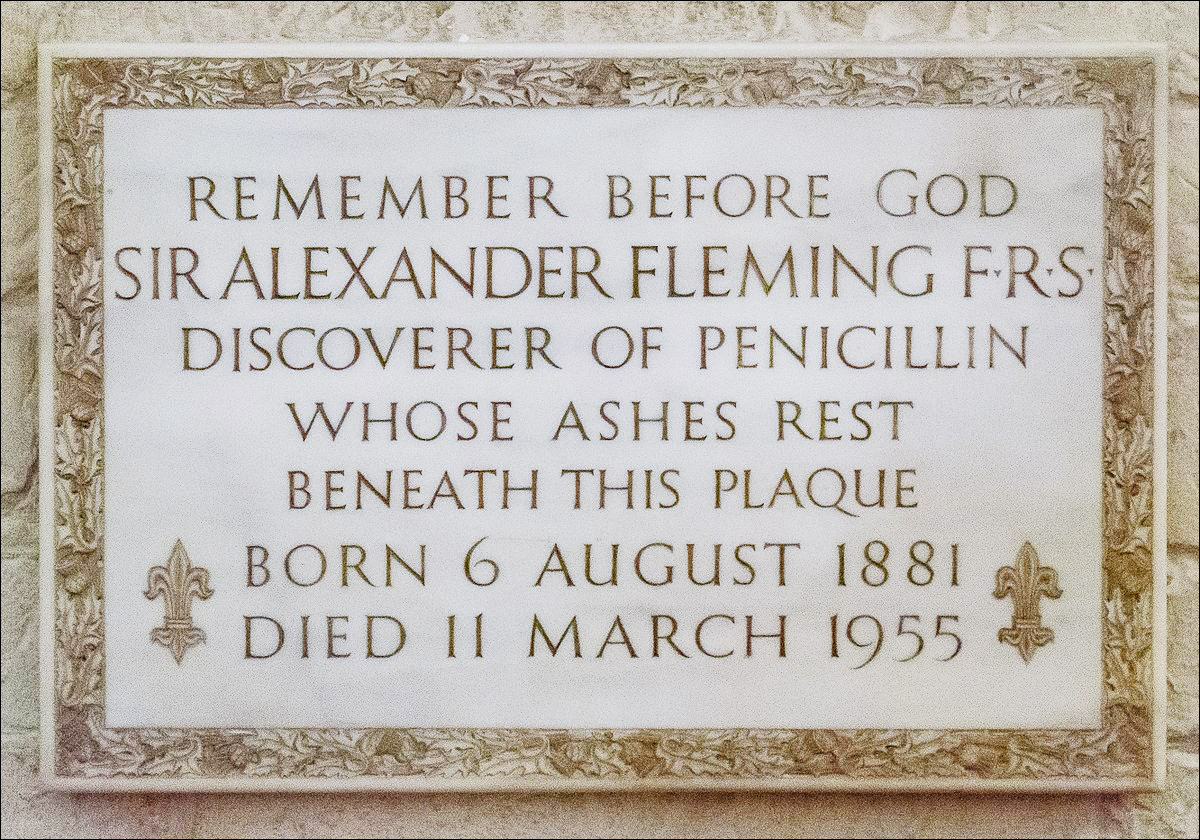
Fleming died at his home in London on 11 March 1955 of a heart attack. His ashes are interred in St Paul’s Cathedral.
Fleming’s discovery of penicillin changed the world of modern medicine by introducing the age of useful antibiotics; penicillin has saved, and continues to save millions of lives around the world.✪



















▶️ CLICK HERE TO VIEW


▶️ CLICK HERE TO VIEW
▶️ 58 Minutes 17 Seconds
▶️ 1 Hour 24 Minutes 54 Seconds
▶️ 22 Minutes 52 Seconds
▶️ 7 Minutes
▶️ 42 Minutes 51 Seconds
▶️ 6 Minutes 23 Seconds
▶️ 9 Minutes 47 Seconds
▶️ 1 Hour 43 Minutes 18 Seconds
▶️ 13 Minutes 32 Seconds
▶️ 5 Minutes 18 Seconds
▶️ 39 Seconds
