



William Francis Sutton Jr. (June 30, 1901–November 2, 1980)
✪ William Francis “Willie” Sutton Jr. was an American bank robber during the Depression & World War II Eras known as “The Gentleman Robber.” During his forty-year robbery career he stole an estimated $2 million ($44,934,300 equivalent in 2024) He would eventually spend more than half of his adult life in prison and escape three times. For his fondness at executing robberies in clever disguises, he was also known as “The Actor” and “Slick Willie.” Sutton is also credited as the namesake of the so-called Sutton’s Law.
Sutton was born on June 30, 1901 in Brooklyn, New York, the fourth of five children. He attended school through eighth grade, then left home to secure a job. Sutton’s early employment included jobs as a clerk, a driller and gardener. His longest continuous employment on record lasted 18 months.
Sutton was born into an Irish-American family to William Francis Sutton Sr., a blacksmith, and Mary Ellen Bowles. The Sutton family lived on the corner of Gold and Nassau Streets in the neighborhood of Irishtown, Brooklyn, now called Vinegar Hill. Sutton was the fourth of five children, and did not attend school past the 8th grade.
He found his calling at an early age starting at ten with pilferage. Soon, he attempted his first burglary after breaking into the business of his girlfriend’s father, taking money so the pair could elope. Sutton married Louise Leudemann in 1929. She divorced him while he was in jail. Their daughter Jeanie was born the next year.
Sutton was asked by reporter Mitch Ohnstad why he robbed banks. According to Ohnstad, he replied, “Because that’s where the money is.” The quote evolved into Sutton’s Law, which is often invoked to medical students as a metaphor for emphasizing the most likely diagnosis, rather than wasting time and money investigating every conceivable alternative possibility.
Sutton became a criminal at an early age, though throughout his entire professional criminal career, he did not kill or harm anyone. He was described by Mafioso Donald Frankos as “a little bright-eyed guy, just 5’7” and always talking, chain-smoking … cigarettes with Bull Durham tobacco.
Frankos stated also that Sutton was extremely well educated and informed in matters of legal advice. He could “dispense mounds of legal advice” to any convict willing to listen. Inmates considered Sutton a “wise old head” in the prison population. When incarcerated at “The Tombs” (Manhattan House of Detention) he did not have to worry about assault because Mafia friends protected him. In conversation with Donald Frankos he would sadly reminisce about the 1920s and 1930s when he was most active in robbing banks and would always tell fellow convicts that in his opinion, during the days of Al Capone and Lucky Luciano, the criminals were the bloodiest. Sutton was known to be witty, intelligent, amusing and non-violent. Frankos declared that Sutton made legendary bank thieves Jesse James and John Dillinger seem like uncultured amateurs.
Willie Sutton acquired two nicknames, “The Actor” and “Slick Willie,” for his ingenuity in executing robberies in various disguises. Fond of expensive clothes, Sutton was described as being an immaculate dresser. He was extremely popular with the Public during the Depression; being viewed as a kind of American Robin Hood folk hero.
Sutton usually carried a pistol or an automatic Thompson submachine gun. “You can’t rob a bank on charm and personality,” he once observed. In an interview in the Reader’s Digest published shortly before his death, Sutton was asked if the guns that he used in his robberies were loaded. He responded that he never carried loaded guns because somebody might get hurt. He stole from the rich and kept it and allegedly never robbed a bank whenever a woman screamed or a baby cried.
▶️ 8 Minutes 47 Seconds
Although he was a criminal, Sutton had the reputation of being a gentleman; in fact, people present at his robberies stated he was quite cordial and polite. One victim said witnessing one of Sutton’s robberies was like being at the movies, except the usher had a gun. When asked why he robbed banks, Sutton simply replied, “Because that’s where the money is.”
However, in his autobiography, Sutton denied originating the pithy rejoinder:
The irony of using a bank robber’s maxim as an instrument for teaching medicine is compounded, I will now confess, by the fact that I never said it. The credit belongs to some enterprising reporter who apparently felt a need to fill out his copy. I can’t even remember where I first read it. It just seemed to appear one day, and then it was everywhere. If anybody had asked me, I’d have probably said it. That’s what almost anybody would say … it couldn’t be more obvious.
He also said:
Why did I rob banks? Because I enjoyed it. I loved it. I was more alive when I was inside a bank, robbing it, than at any other time in my life. I enjoyed everything about it so much that one or two weeks later I’d be out looking for the next job. But to me the money was the chips, that’s all.
On February 15, 1933, Sutton and a companion attempted to rob the Corn Exchange Bank and Trust Company in Philadelphia, Pennsylvania. Sutton, disguised as a mailman, entered the bank early in the morning. The curiosity of a passerby caused the robbery attempt to be abandoned. However, on January 15, 1934 Sutton entered the same bank with two companions through a skylight. When the watchman arrived, they forced him to admit the employees as usual. Each employee was then handcuffed and locked inside a small room.
Sutton once also executed a Broadway jewelry store robbery in broad daylight, impersonating a postal telegraph messenger. Sutton’s other disguises included a policeman, messenger and maintenance man. He usually arrived at the banks or stores slightly before they opened for the day.
Besides being known as an innovative robber, Sutton recommitted in June 1931 on charges assault and robbery. Sentenced to 30 years, he escaped on December 11, 1932, by scaling the prison wall on two 9-foot sections of ladder that were joined together.
Sutton was apprehended again on February 5, 1934 and was sentenced to serve 25 to 50 years in Eastern State Penitentiary, Philadelphia, Pennsylvania, for the robbery of the Corn Exchange Bank. On April 3, 1945, Sutton was one of 12 convicts who escaped the institution through a tunnel. Sutton was recaptured the same day by Philadelphia police officers; this was his fifth escape attempt at this prison.
Sentenced to life imprisonment as a fourth time offender, Sutton was transferred to the Philadelphia County Prison in Homesburg, Pennsylvania. On February 10, 1947, Sutton and other prisoners dressed as prison guards. On their way to escaping, the men carried two ladders across the prison yard to the wall after dark. When the prison’s searchlights hit him, Sutton yelled, “It’s okay, it’s only us” and no one stopped them. Their escape over the wall was successful.
On March 20, 1950, Willie “The Actor” Sutton was added to the FBI’s list of Ten Most Wanted Fugitives. Because of his love for expensive clothes, Sutton’s photograph was given to tailors as well as police departments. A 24-year-old tailor’s son recognized Sutton on the New York subway on February 18, 1952 and followed him to a local gas station where Sutton purchased a battery for his car. The man reported the incident to the police who later arrested Sutton.
Sutton did not resist his arrest by New York City police, but denied any robberies or other crimes since his 1947 escape from Philadelphia County Prison. At the time of his arrest, Sutton owed one life sentence plus 105 years. He was further sentenced to an additional 30 years to life in New York State Prison following a jury trial in Queens County Court.
Judge Peter T. Farrell presided over a 1952 trial in which Sutton was convicted of the 1950 robbery of $63,942 (equal to $809,755 in 2023) from a bank of the Manufacturers Trust Company in Sunnyside, Queens. For that robbery, he received a sentence of 30 to 120 years in Attica State Prison.
Seventeen years later, the New York State penal authorities decided that Sutton did not have to serve two life sentences and 105 years. Sutton was then ill; he had emphysema and was preparing for a major operation on arteries in his legs.
On Christmas Eve 1969, 68-year-old Sutton was released from Attica State Prison. Farrell ruled that Sutton’s good behavior, along with his deteriorating health, justified commuting his sentence to time served. At the hearing Sutton responded, “Thank you, your Honor. God bless you,” and wept as he was led out of the court building.
Upon his release from prison, Sutton delivered lectures on prison reform and consulted with banks on theft and robbery deterrent techniques. Ironically, Sutton did a television commercial to promote the New Britain, Connecticut, Bank and Trust Company’s new photo credit card program. His lines were, “They call it the ‘face card.’ Now when I say I’m Willie Sutton, people believe me.”
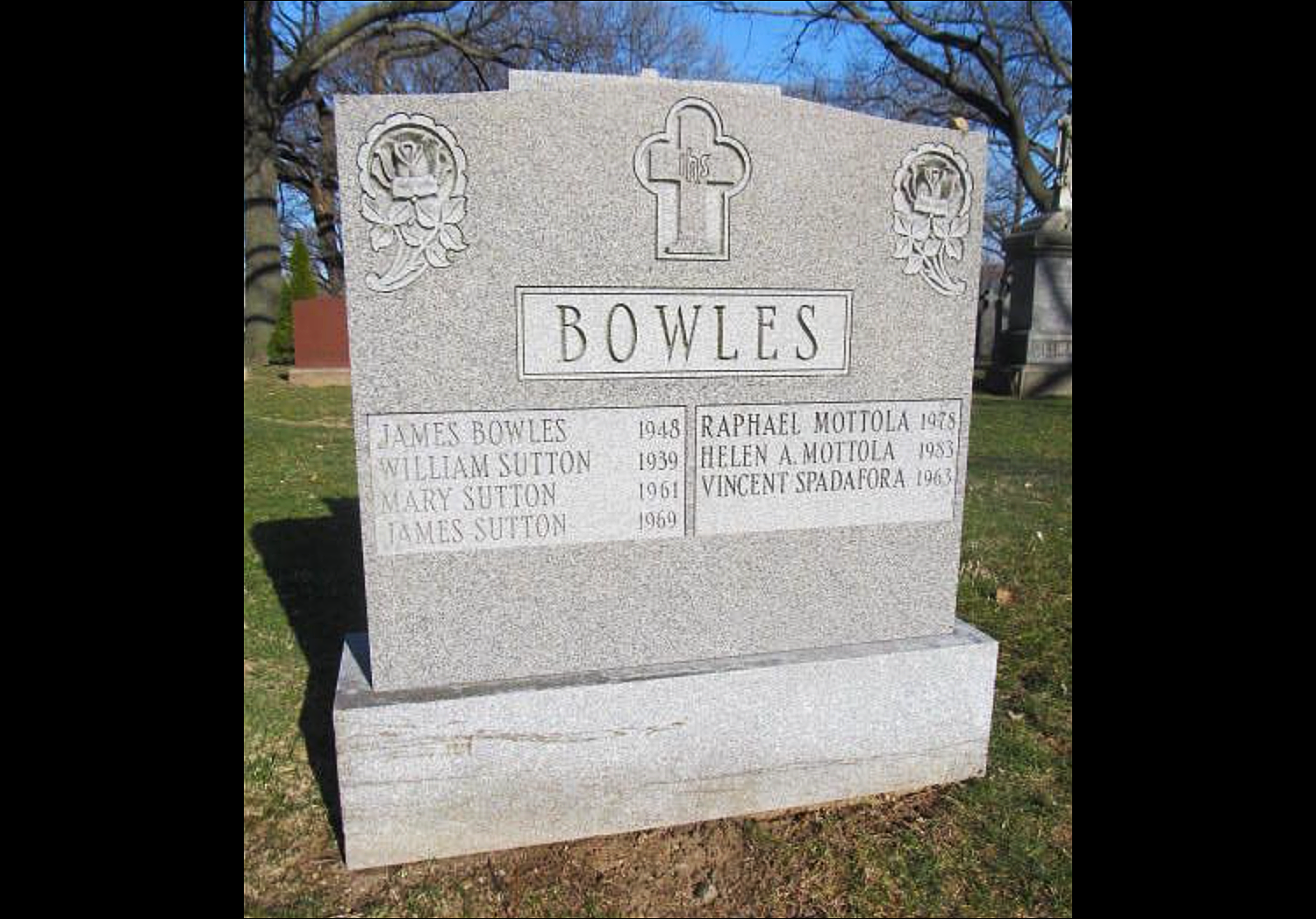
Sutton died in 1980 at the age of 79 after spending his last years with his sister in Spring Hill, Florida. He frequented the Spring Hill Restaurant where he kept to himself. After Sutton’s death, his family arranged a quiet burial in Brooklyn in the family plot. ✪






















▶️ CLICK HERE TO VIEW


▶️ CLICK HERE TO VIEW
▶️ 1 Hour 38 Minutes 38 Seconds
▶️ 1 Hour 17 Minutes 49 Seconds
▶️ 51 Minutes 56 Seconds
▶️ 5 Minutes 43 Seconds
▶️ 9 Minutes 31 Seconds
▶️ 1 Hour 36 Minutes 23 Seconds ⭐️ wtd
▶️ 9 Minutes 04 Seconds
▶️ 10 Minutes 5 Seconds
▶️ 21 Minutes47 Seconds
▶️ 9 Minutes 45 Seconds
▶️ 34 Minutes 411 Seconds
▶️ 16 Minutes 11 Seconds
▶️ 30 Minutes 57 Seconds
▶️ 4 Minutes 38 Seconds ⭐️ wtd
