


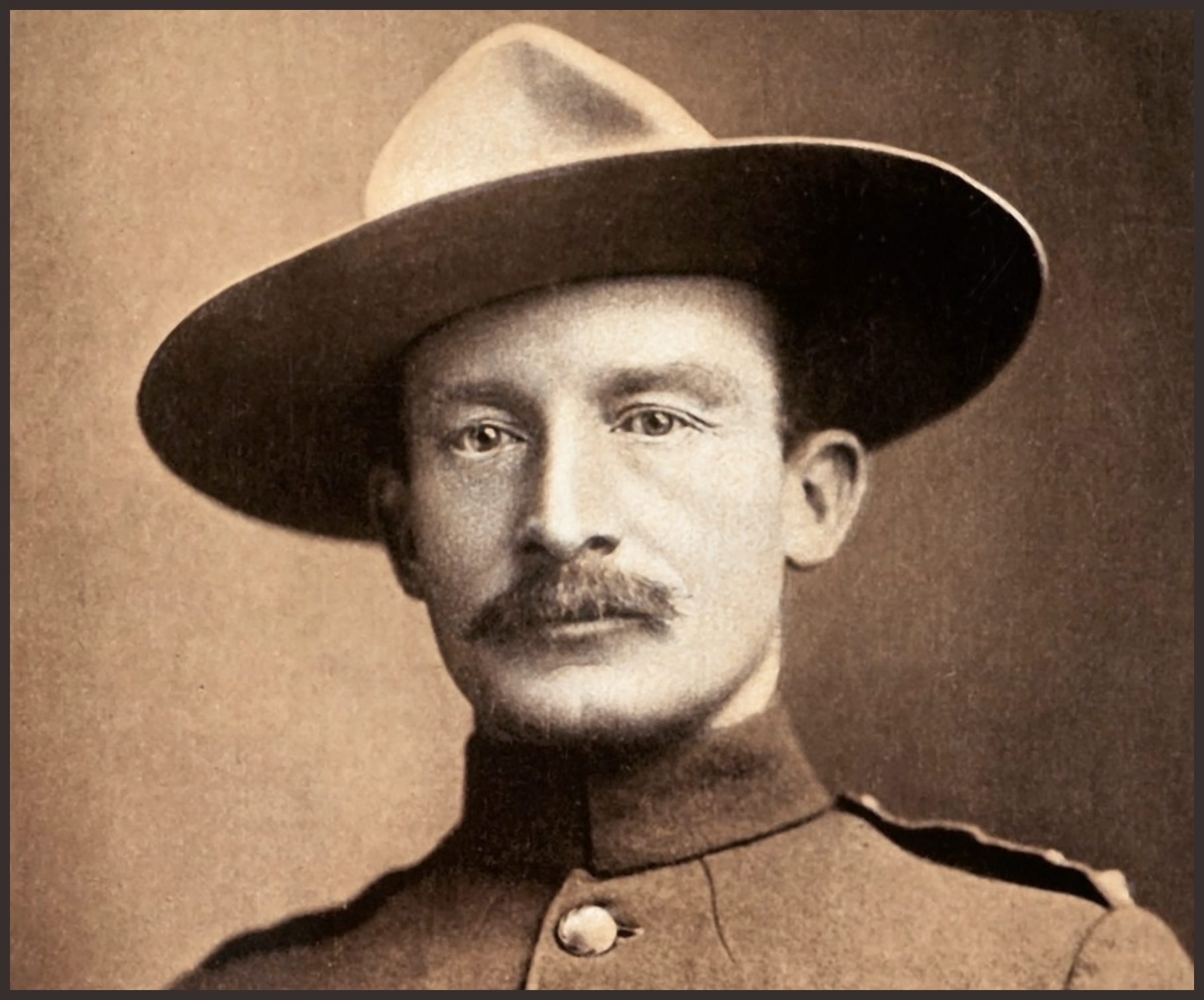

Robert Stephenson Smyth Baden-Powell (February 22, 1857–January 8, 1941)
✪ Lieutenant-General Robert Stephenson Smyth Baden-Powell, 1st Baron Baden-Powell was a British Army officer, writer, artist,founder and first Chief Scout of the world-wide Scout Movement. With his sister Agnes, he also founded the world-wide Girl Guide/Girl Scout Movement.
Powell wrote the seminal work Scouting for Boys; which with his previous 1899 book Aids to Scouting for N.-C.Os and Men, (originally intended for the military) captured the imagination of the boys of Britain and led to the creation of the Scout Movement.
Educated at Charterhouse School, Baden-Powell served in the British Army from 1876 until 1910 in India and Africa. In 1899, during the Second Boer War in South Africa, Baden-Powell successfully defended the town in the Siege of Mafeking. Several of his books, written for military reconnaissance and scout training in his African years, were also read by many boys.
In August 1907, he held a demonstration camp event, the Brownsea Island Scout Camp, which is now considered the beginning of Scouting. Based on his earlier books, particularly Aids to Scouting, he also wrote Scouting for Boys, which was published in 1908 by Sir Arthur Pearson, for boy readership. In 1910 Baden-Powell retired from the army and formed The Scout Association.
Baden-Powell was born Robert Stephenson Smyth Powell at 6 Stanhope Street (now 11 Stanhope Terrace), Paddington, London, on 22 February 1857. He was called Stephe (pronounced “Stevie”) by his family. He was named after his godfather, Robert Stephenson, the railway and civil engineer.
Baden-Powell was a son of Baden Powell, a Savilian Professor of Geometry at the University of Oxford and a Church of England priest and his third wife, Henrietta Grace Smyth, the eldest daughter of Admiral William Henry Smyth. The family of Baden-Powell’s father originated in Suffolk. His mother’s earliest known Smyth ancestor was a Royalist American colonist. Baden-Powell’s maternal grandfather was Thomas Warrington; the British Consul in Naples around 1800.
Baden-Powell had four older half-siblings from the second of his father’s two previous marriages and was the fifth surviving child of his father’s third marriage.
Baden-Powell’s father died when he was only three. Subsequently, Baden-Powell was raised by his mother, a strong woman who was determined that her children would succeed. In 1933 he said of her “The whole secret of my getting on, lay with my mother.”
He attended Rose Hill School, Tunbridge Wells and was given a scholarship to Charterhouse, a prestigious public school named after the ancient Carthusian monastery buildings it occupied in the City of London.
During his childhood, Baden Powell played with dolls and studied piano and violin. He was also an ambidextrous artist and enjoyed acting. Family holidays were usually spent on yachting or canoeing expeditions with his brothers. Baden-Powell’s first introduction to Scouting skills was through stalking and cooking game while hiding & avoiding teachers in the nearby woods, which were strictly out-of-bounds.
In 1876, Baden-Powell joined the 13th Hussars in India with the rank of lieutenant. In 1880 he was charged with the task of drawing maps of the Battle of Maiwand. He enhanced and honed his military scouting skills amidst the Zulu in the early 1880s in the Natal Province of South Africa, where his regiment was posted.
Baden-Powell’s skills impressed his superiors and in 1890 he was brevetted Major as military secretary and senior aide-de-camp to the Commander-in-Chief and Governor of Malta, his uncle General Sir Henry Augustus Smyth. He was posted to Malta for three years and worked as an intelligence officer for the Mediterranean for the Director of Military Intelligence. He frequently travelled disguised as a butterfly collector, incorporating plans of military installations into his drawings of butterfly wings. In 1884 he published Reconnaissance and Scouting.
Baden-Powell returned to Rhodesia, Africa in 1896, and served in the Second Matabele War, in the expedition to relieve British South Africa Company personnel under siege in Bulawayo. This was a formative experience for him because many of his later Boy Scout ideas originally took hold in his mind here. It was during this campaign that he first met and befriended the American scout Frederick Russell Burnham, who introduced Baden-Powell to stories of the American Old West and woodcraft (i.e., Scoutcraft), It was here that he was also introduced to the Montana Peaked version of a western cowboy hat, of which Stetson was a prolific manufacturer.
After Rhodesia, Baden-Powell served in the Fourth Ashanti War on the Gold Coast. In 1897, at the age of 40, he was brevetted colonel (the youngest colonel in the British Army) and given command of the 5th Dragoon Guards in India. A few years later he wrote a small manual, entitled Aids to Scouting: a summary of lectures he had given on the subject of military scouting, much of it a written explanation of the lessons he had learned from Burnham, to help train recruits.
Briefly back in the United Kingdom in October 1901, Baden-Powell was invited to visit King Edward VII at Balmoral, the monarch’s Scottish retreat. Baden-Powell was given the role of organizing the South African Constabulary, a colonial police force, but during this time, he was sent to Britain on sick leave, so he was only in command for seven months
In 1903, Baden-Powell returned to England again to take up the post of Inspector-General of Cavalry. While holding this position, he was instrumental in reforming reconnaissance training in British cavalry, giving the force an important advantage in scouting ability over continental rivals. Baden-Powell was a career cavalryman, but understood that cavalry was no match against the machine gun.
On his return from Africa in 1903, Baden-Powell found that his military training manual, Aids to Scouting, had become a best-seller, and was being used by teachers and youth organizations.
With encouragement from his friend, William Alexander Smith, Baden-Powell decided to re-write Aids to Scouting to suit a youth readership. In August 1907, he held a camp on Brownsea Island to test out his ideas. About twenty boys attended: eight from local Boys’ Brigade companies and about twelve public school boys, mostly sons of his friends.
In October 1907, Baden-Powell was appointed to the command of the Northumbrian Division of the newly formed Territorial Army. On 19 February 1909, Baden-Powell sailed in the SS Aragon via Portugal and Spain to South America, for what seems to have been just a holiday, a trip not related to either the Army or to Scouting. When in March 1909 he visited Santiago de Chile for three days, “He was given a warmer reception than had ever been afforded a foreigner in South America.” He sailed back in the RMS Danube on 1 May 1909.
Baden-Powell’s first book on the Scout Movement, Scouting for Boys was published in six installments in 1908 and has since sold approximately 150 million copies. It is the fourth best-selling book of the 20th Century.
Boys and girls spontaneously formed Scout troops and the Scouting Movement started by itsel; first as a national, and soon an international phenomenon. A rally of Scouts was held at Crystal Palace in London in 1909, at which Baden-Powell met some of the first Girl Scouts of whom 6,000 had already been officially registered as Scouts. The Girl Guides were subsequently formed in 1910 under the auspices of Baden-Powell’s sister, Agnes Baden-Powell.
In 1910, aged 53, Baden-Powell retired from the Army.
In January 1912, Baden-Powell was en route to New York on a Scouting World Tour, on the ocean liner SS Arcadian, when he met Olave St Clair Soames. She was 23, while he was 55; they shared the same birthday, 22 February. They became engaged in September of the same year, causing a media sensation due to Baden-Powell’s fame. To avoid press intrusion, they married in private on 30 October 1912, at St. Peter’s Church, Parkstone.
Baden-Powell also had a positive impact on improvements in youth education. Under his dedicated command, the World Scouting Movement grew. By 1922 there were more than a million Scouts in 32 countries; by 1939 the number of Scouts worldwide was over 3.3 million.
In 1929, during the 3rd World Scout Jamboree, he received as a present a new 20-horsepower Rolls-Royce car. The car, nicknamed Jam Roll, was sold after his death by Olave Baden-Powell in 1945.
In June 1934, Nazi Germany banned Scouting, considering it to be a competitor to the Hitler Youth; seeing it as “a haven for young men opposed to the new State.” Based on the Nazi regime’s view of Scouting as a dangerous espionage organization, Baden-Powell’s name was included in “The Black Book,” a 1940 secret list of people to be detained following the planned conquest of the United Kingdom. Baden-Powell never knew about the list or his inclusion in it, because the list was only made public in 1945, shortly after the defeat of the Nazis, and Baden-Powell died in 1941.
At the 5th World Scout Jamboree in 1937, Baden-Powell gave his farewell to Scouting and retired from public Scouting life. 22 February, the joint birthday of Robert and Olave Baden-Powell, continues to be marked every year as Founder’s Day by Scouts and World Thinking Day by Guides to remember and celebrate the work of the Chief Scout and Chief Guide of the World.
In 1937, Baden-Powell was appointed to the Order of Merit, one of the most exclusive awards in the British Honors System. He has also been awarded 28 decorations by various foreign states.
Baden-Powell was regarded as an excellent storyteller. During his whole life he told “ripping yarns” to audiences. After having published Scouting for Boys, Baden-Powell continued writing more handbooks and educative materials for all Scouts, as well as directives for Scout Leaders. In his later years, he also wrote about the Scout movement and his ideas for its future. He spent most of the last two years of his life in Africa, and many of his later books had African themes.
Baden-Powell painted or sketched almost every day of his life, and with equal competence with either hand. Most of his works have a humorous or informative character. His books are scattered with his pen-and-ink sketches, frequently whimsical. He did a largely unknown number of pen-and-ink sketches; he always travelled with a sketchpad that he used frequently for pencil sketches and “cartoons” for later watercolor paintings.
In his final letter to the Scouts, Baden-Powell wrote:
I have had a most happy life and I want each one of you to have a happy life too. I believe that God put us in this jolly world to be happy and enjoy life. Happiness does not come from being rich, nor merely being successful in your career, nor by self-indulgence. One step towards happiness is to make yourself healthy and strong while you are a boy, so that you can be useful and so you can enjoy life when you are a man. Nature study will show you how full of beautiful and wonderful things God has made the world for you to enjoy. Be contented with what you have got and make the best of it. Look on the bright side of things instead of the gloomy one. But the real way to get happiness is by giving out happiness to other people. Try and leave this world a little better than you found it and when your turn comes to die, you can die happy in feeling that at any rate you have not wasted your time but have done your best. “Be prepared” in this way, to live happy and to die happy – stick to your Scout Promise always – even after you have ceased to be a boy – and God help you to do it.
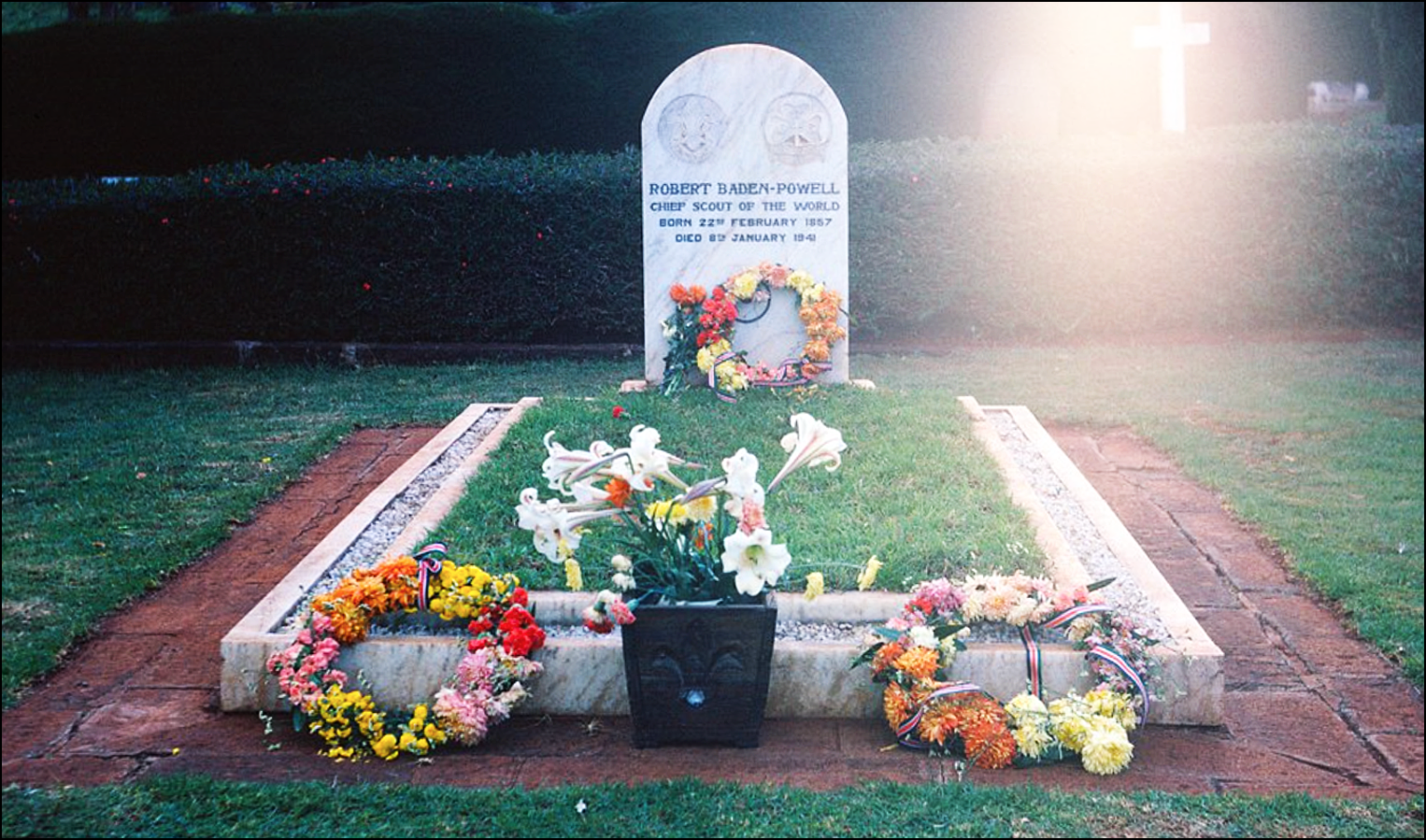
Baden-Powell died on 8 January 1941: his grave is in St Peter’s Cemetery in Nyeri, Kenya. His gravestone bears a circle with a dot in the centre “ʘ”, which is the Scout trail sign for “Going home,” or “I have gone home.” His wife Olave moved back to England in 1942. After she died in 1977, her ashes were taken to Kenya by her grandson Robert and interred beside her husband. In 2001, the Government of Kenya officially designated Baden-Powell’s grave as a national monument. ✪





















▶️ CLICK HERE TO VIEW


▶️ CLICK HERE TO VIEW
▶️ Cued to begin @ 00:05:29
▶️ 1 Hour 20 Minutes 46 Seconds
▶️ 1 Hour 4 Minutes 9 Seconds
▶️ 1 Hour 14 Minutes 37 Seconds
▶️ 26 Minutes 45 Seconds
▶️ 1 Hour 36 Minutes 23 Seconds
▶️ 9 Minutes 27 Seconds
▶️ 4 Minute 37 Seconds
▶️ Premiere
▶️ 2 Minutes 1 Second
