
✪ The public spectacle in the Media last Fall of an extremely frail & senile Jimmy Carter was one of the worst cases of public elder abuse we’ve ever seen...
▶️ CLICK HERE TO READ

kkk
t was ghoulish of his family to wheel him out in such an undignified condition in service of a political stunt on behalf of the Democratic Party, even if Carter wanted to bask in the glow of knowing that soon he would no longer be regarded as America’s worst modern president after Joe Biden’s ignominious end.
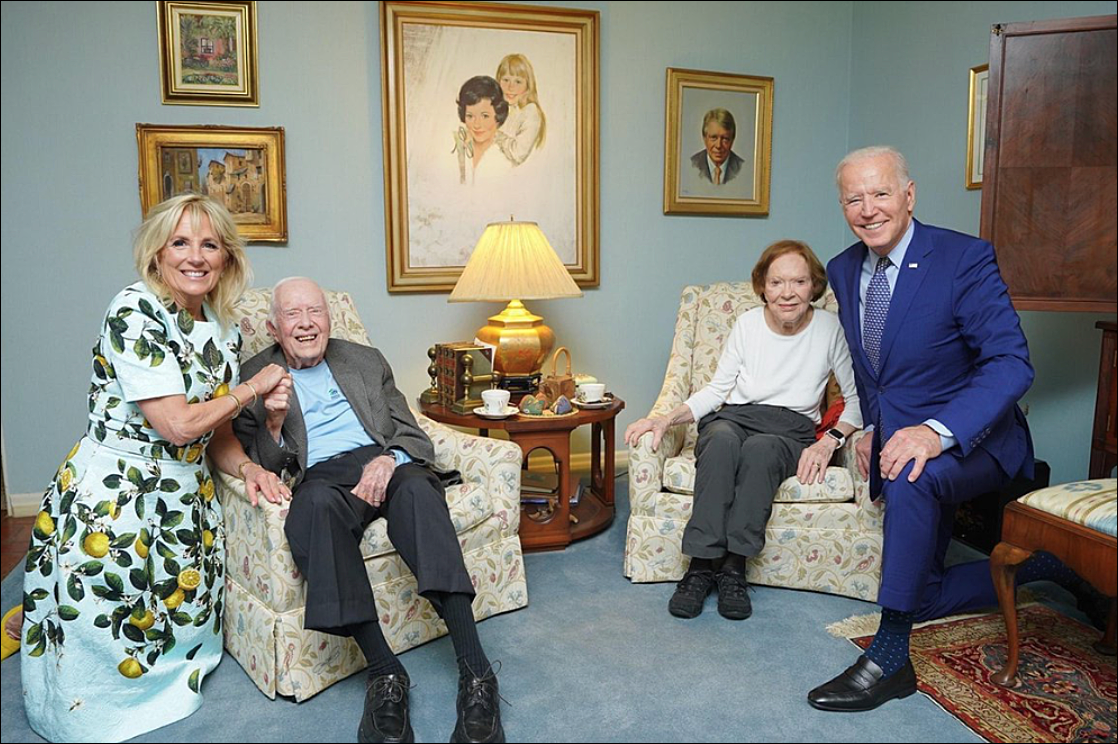
Then of course, there was this strange photo op instance of more Democrat propaganda a couple of years ago:
I generally disdain speaking ill of the recently departed, and there are some aspects of real genius to the Carter story, especially his insight into how an obscure figure could rise fast and win the presidency out of the ashes of Watergate in 1976. And we can expect a flood of retrospects in the days ahead about how Carter was an unappreciated president, and above all that he was America’s greatest ex-president.
In fact this story line has been taking shape for at least 25 years now. As disastrous as his presidency was, many Americans still came to have a warm spot in their heart for Carter, sympathizing with his intentions, admiring him for his good works such as Habitat for Humanity, fighting to eradicate horrible diseases in the Third World; and hopeful about his globetrotting efforts on behalf of peace. People magazine, which Carter criticized during his presidency for its focus on self-absorbed celebrity, wrote about him 20 years ago: “Almost everyone agrees that Jimmy Carter was not our best President, but as former Presidents go, he’s tops,” while Time magazine wrote that Carter is the “consensus best ex-President.”
Carter’s former chief of staff Jack Watson remarked effusively that Carter is “the only man in American history who used the United States presidency as a stepping-stone to greatness.” Howard Baker said in the 1980s that “history will be kind to Jimmy Carter.”
I’ll leave to another time evaluating both his presidency and ex-presidency, and for the moment reflect merely on how Carter’s character and capacities were both underestimated and overestimated from the very beginning and continuing to this day.
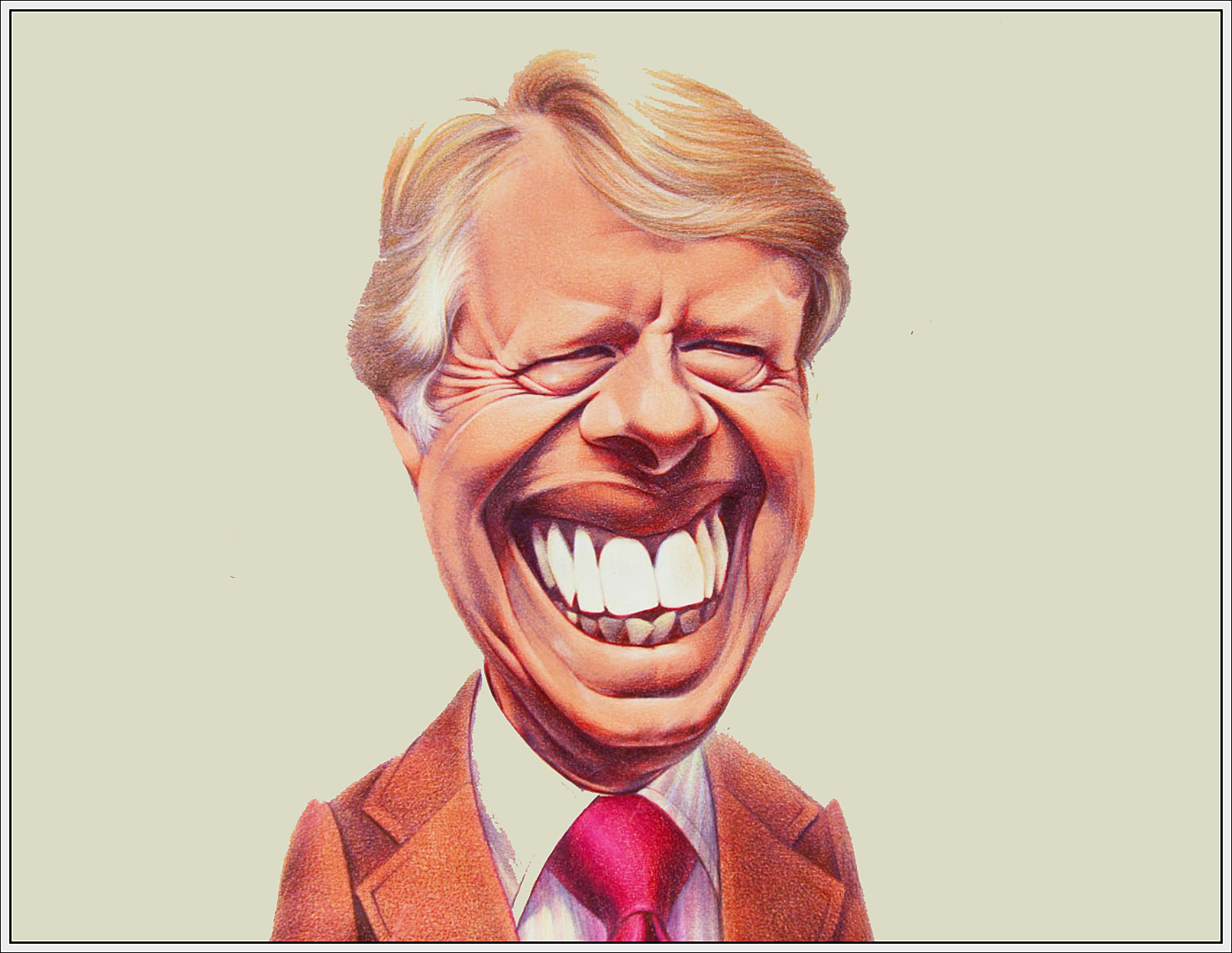
Jimmy Carter is often considered a relic of the 1970s, a forlorn decade whose iconography, from rounded typefaces to disco music (but thankfully not the leisure suits), are coming back into vogue. Perhaps the most memorable 1970s icon was the smiley-face, so it is not surprising that the smiley-face decade produced a smiley-face candidate: Carter’s most prominent attribute was a grin toothier than a Cheshire cat. Like the Cheshire cat in Lewis Carroll, what lay behind the grin was mysterious. His chief campaign strategist and later White House chief of staff Hamilton Jordan referred candidly to what he called Carter’s “weirdness factor,” 50 years before Democrats tried to employ the same term against J.D. Vance.
In the early stages of Carter’s extraordinary campaign for the presidency in 1976, a common public response to his candidacy was, “Jimmy who?” In some respects, we are still asking that question today, 50 years after he emerged suddenly on the national stage. He had a Jekyll and Hyde quality unlike almost any other American politician. He is certainly a better person than Bill Clinton; at least Carter only lusted after women in his heart.
Carter presents layer upon layer of difficulty to untangle. Carter’s one-time speechwriter Patrick Anderson observed that in Carter’s hometown of Plains, Georgia, neighbors said of him that after an hour you love him, after a week you hate him, and after ten years you start to understand him. (Anderson added that anyone who didn’t have a personality conflict with Carter, didn’t have a personality.)
Anderson also described him as a combination of Machiavelli and Mr. Rogers. The Washington Post’s Sally Quinn observed: “The conventional image of a sexy man is one who is hard on the outside and soft on the inside. Carter is just the opposite.” Fellow Southern Baptist Bill Moyers said “In a ruthless business, Mr. Carter is a ruthless operator, even if he wears his broad smile and displays his southern charm.” Part of the mystique of Carter was his careful and successful positioning as someone “above politics.” He gave off an air that he is too good for us, or certainly better than the rest of his peers in politics. Carter exemplified the paradox of taking pride in denouncing the sin of pride. He also displays a talent for combining self-pity and self-righteousness, sometimes in the same sentence.
He was a maddeningly contradictory figure. He first achieved statewide office in Georgia with a cynical race-baiting campaign, and then immediately proclaimed that the time had come for the South to repudiate its racist ways.
An avatar of morality and truthfulness, Carter bent the truth and had a singularly nasty side to his character that ultimately helped cost him the presidency in 1980. David Brinkley observed of Carter: “Despite his intelligence, he had a vindictive streak, a mean streak, that surfaced frequently and antagonized people.” Eleanor Randolph of the Chicago Tribune wrote: “Carter likes to carve up an opponent, make his friends laugh at him and then call it a joke. . . [He] stretched the truth to the point where it becomes dishonest to call it exaggeration.” New York Times reporter James Wooten called Carter “a hyperbole addict.” And Gary Fink, author of a generally favorable study of Carter’s governorship, notes that “Carter usually claimed the moral and ethical high ground” but “practiced a style of politics based on exaggeration, disingenuousness, and at times outright deception.” Carter seldom if ever repented of his nastiness or asks forgiveness. Instead, when called out for an egregious personal attack, Carter displayed the advanced skills of evasion that made him such an effective presidential candidate, at least until the public caught on in 1980.
The man with the legendary smile could be unfriendly and cold. “There were no private smiles,” said one disgruntled campaign aide in 1976. His personal White House secretary, Susan Clough, recalled that Carter rarely said hello to her as he walked by her desk. Not a “Happy Thanksgiving,” or a “Merry Christmas.” Nothing, she says. Arthur Schlesinger Jr. judged Carter to be a “narcissistic loner.” “Carter was never a regular guy,” Patrick Anderson observed; “the sum of his parts never quite added up to that. . . Carter talked his way into the presidency, yet in some profound way he never learned the language of men.”
His campaign autobiography, Why Not the Best?, proclaimed that he was “optimistic about America’s third century,” but he became a tribune of “limits to growth” pessimism, diminished expectations for the future, and a national “malaise.” Margaret Thatcher, among others, noted the trouble with this, writing that Carter “had no large vision of America’s future so that, in the face of adversity, he was reduced to preaching the austere limits to growth that was unpalatable, even alien, to the American imagination.”
He campaigned on the slogan of giving us “a government as good as the people,” and then, at the climactic moment of his presidency, complained that the people were no good. As a champion of human rights and critic of autocratic dictators while president (at least so long as they were pro-American), ex-President Carter compiled a record of meeting with and subsequently praising some of the world’s most loathsome dictators, often strengthening their political stature. Yet he was always quick to criticize anyone else who treated with dictators. He remains the only person elected to the presidency who filed a UFO-sighting report with the Air Force. “I don’t laugh at people anymore when they say they have seen a UFO because I’ve seen one myself,” Carter said at a 1975 press conference. He is the only president to ever to come close to provoking the resignation of his vice president because of a loss of confidence.
Self-righteousness was another obvious hallmark of Carter. Biographer Betty Glad noted that as governor:
“Carter seemed to experience opposition as a personal affront and as a consequence responded to it with attacks on the integrity of those who blocked his projects. He showed a tendency (which will become even clearer as other facets of his career are explored) to equate his political goals with the just and the right and to view his opponents as representative of some selfish or immoral interest.”
This aspect of Carter’s character cannot be unraveled without looking deeply into the self-proclaimed sources of his political thought, and especially his political religion. There was an alarming superficiality to his political religion that journalists and biographers noticed but did not analyze with sufficient seriousness.
Biographer Kenneth Morris wrote that “when he became governor and then president, Carter continued to show himself bereft of a solid intellectual foundation for his political views.” Betty Glad reached a similar conclusion: “He lacks, it seems, a well-thought-out conceptual framework to guide his concrete political choices. . . Carter’s political views rest on a simplistic moralism.” Some of Carter’s critics thought he was a religious charlatan. Reg Murphy, editor of the Atlanta Constitution during Carter’s years as governor, called Carter “one of the three or four phoniest men I ever met.”
RIP. ✪




















▶️ JANUARY 2025 SUPPORT CHALLENGE

✪ ANNUAL TNA OPERATING EXPENSES
$1200 WordPress Hosting: 50GB package
$ 700 Comprehensive Site Security & Support
$ 400 Corporate License Annual Renewal
$ 150 Annual Disqus Licensing
$ 50 Name & URL Registration Annual Renewal
$2500 TOTAL FOR 2025
✪ NEW TNA ANNUAL PATRON STATUS
If you’d like to help support the site by making a donation of $500 or more during the month of January, we’ll honor you as a TNA Annual Patron with your own personal listing appearing in the bottom page footer every day for the rest of 2025.

As an Annual Patron you can list either your real life or online username, business name including web address (sorry no phone numbers) or a tribute to a living or deceased love one. If you have questions, please contact me via email.
✪ NEW MONTHLY CHALLENGE AMOUNT FOR FEB – DEC 2025
I am requesting a new monthly challenge goal amount in 2025 of $2500 beginning in February. Creating and maintaining TNA each day is a full time job position which requires between 60-80 hours per week researching, rewriting, editing, graphics, formatting and publishing. Final challenge totals for 2024 consistently averaged between $2100-2300 each month. This new monthly amount will allow me to continue to make quality the top priority.
✪ NEW NON PAYPAL DONATION OPTION
If you don’t care for PayPal’s woke business culture & attitude; or their fees, you can now use ZELLE to easily make online purchases or donations. ZELLE is already installed inside your online banking. There’s no need to register, create an account or enter any debit or credit card information. ZELLE provides safe, secure and immediate electronic transfers directly between your bank and your recipients. It’s also completely FREE and already built into your bank or credit union’s online banking account page. If you haven’t used ZELLE before, you only need to activate it. A simple, two minute process which can be found at this link:

THANK YOU FOR YOUR CONTINUING SUPPORT
YOUR DONATIONS KEEP US GOING STRONG!
▶️ DONATE VIA PAYPAL (DEBIT OR CREDIT CARD)
ALL PayPal Transactions Are Encrypted For Card Holder Privacy & Security
▶️ DONATE VIA ZELLE (DIRECT DIGITAL CASH TRANSFER)
ZELLE is a simple, secure, easy, fast and FREE way to send money directly to recipients directly from your online banking page or app without a middleman.
If you’ve already activated ZELLE in your bank or credit union account, you may make a donation by using The New Americanist ZELLE Address:
vip@thenewamericanist.com
If you haven’t yet activated ZELLE in your bank or credit union account, easy to follow instructions (a simple two minute process) may be found here:
▶️ DONATE VIA SNAIL MAIL


COUNTDOWN TO INAUGURATION DAY 2025




▶️ CLICK HERE TO VIEW
▶️ 1 Hour 1 Minute 43 Seconds
▶️ 16 Minutes 32 Seconds
▶️ 1 Hour 4 Minutes 8 Seconds
▶️ 59 Minutes 2 Seconds
▶️ 19 Minutes 29 Seconds
▶️ 1 Hour 12 Minutes
▶️ 10 Minutes 55 Seconds
▶️ 12 Minutes
▶️ 8 Minutes 7 Seconds
▶️ 1 Hour 18 Minutes 17 Seconds
▶️ 9 Minutes 25 Seconds
▶️ 1 Minute 38 Seconds
▶️ 56 Seconds
▶️ 55 Seconds