


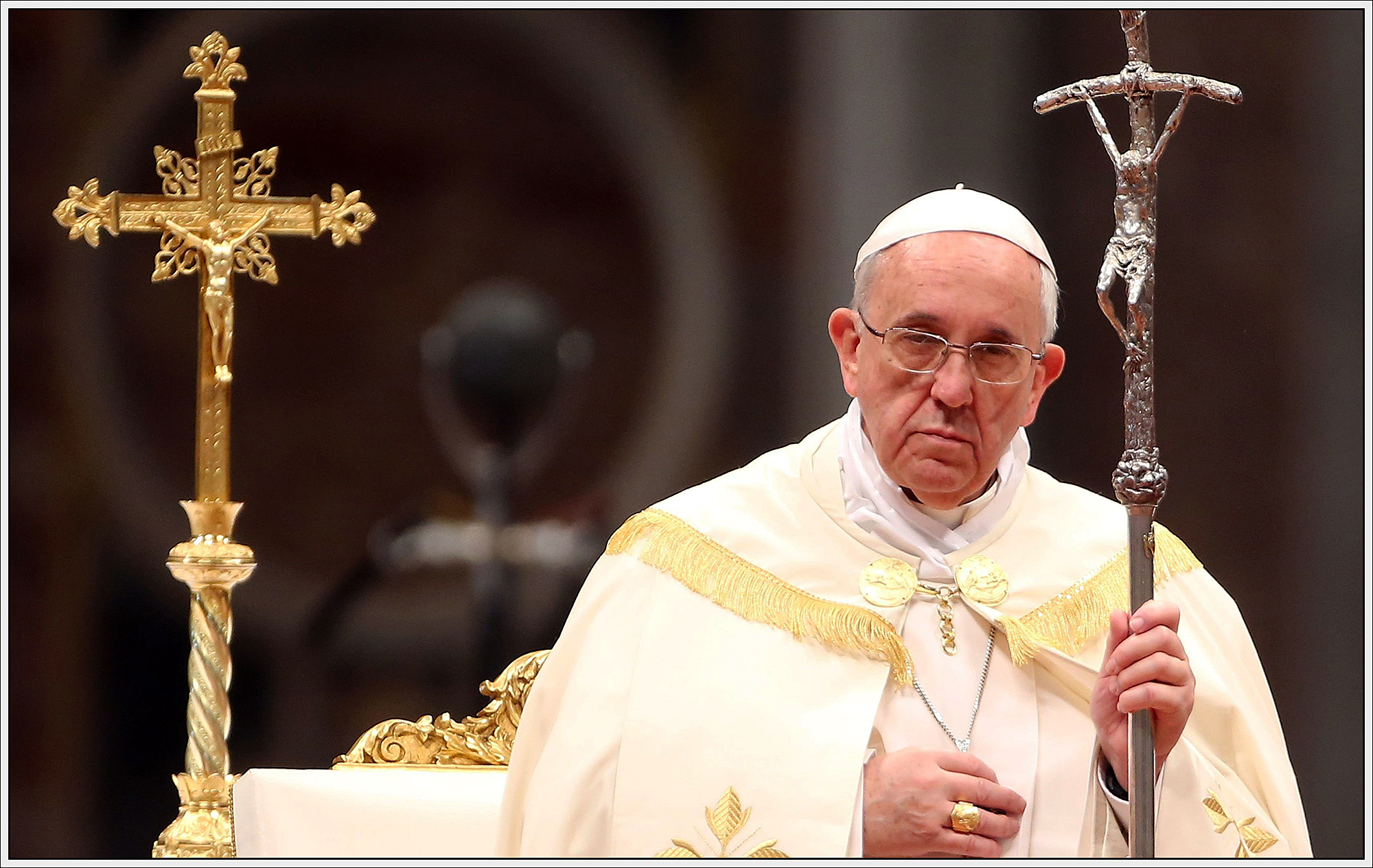

✪ Francis didn’t change Catholic teaching, but instead pushed an ideology of moral relativism which worked to weaken the Roman Catholic Church and Christianity itself...
▶️ FEATURED ARTICLE: CLICK HERE TO READ

nnn
hen he ascended the throne of Saint Peter as the first Jesuit pope and first pontiff to hail from outside Europe in over a thousand years, Francis caused quite a stir. He eschewed the pomp and circumstance of his predecessor, Pope Benedict XVI, donning simpler clerical attire, refusing to take up residence in the papal palace, and referring to himself simply as “the bishop of Rome.”
Here, it seemed, was a populist pope, a man of the people who not only promised to clean up the corruption in the Holy See but went out of his way to embrace the poor, the disfigured, the downtrodden — and made sure to be seen doing so.
To many Catholics, he was an unknown. As Archbishop of Buenos Aires Jorge Bergoglio, Francis was politically on the left, with strong anti-American and anti-conservative tendencies that would manifest themselves in the years to come. But he also had a reputation in Argentina for personal austerity and humility, doctrinal conservatism, and working closely with the poor. It was possible, in those very early days, to imagine that he could be a pontiff to bring together the warring factions of the church and forge a path into the 21st Century for a united Catholic Church.
But it wasn’t to be. Early on in Francis’ pontificate there were signs of the chaos, confusion, and division that would come to define his papacy. What even many devout Catholics didn’t know in 2013 was that Francis’s past was checkered with scandals, including attempts to shield sex abusers from justice in Argentina, and that, as longtime Vatican observer Damian Thompson has written, Francis would govern Rome as an autocrat whose “rule is shaped more by his rages and simmering resentments than by any theological agenda.”
The twelve-year reign of Jorge Mario Bergoglio, Pope Francis, as the head of the Roman Catholic Church began shortly after the strange and still-unexplained resignation of Pope Benedict XVI, and seven weeks into the second term of Barack Obama as President of the United States. It was fitting that Obama was president during the first four years of Francis’ papacy. Just as Obama did as President of the United States, Pope Francis worked to weaken, instead of strengthen, the institution he was leading, and to provide aid and comfort to its enemies, while confusing and maddening its ardent supporters.
Francis was a doctrinaire leftist on many political issues. He seemed to think that it was incumbent upon the people of Europe and North America to relinquish their national character and culture voluntarily, and become minorities in their own countries. In 2016, he declared that someone who built a border wall was “not a Christian.” In Feb. 2025, he sent a letter to the U.S. bishops, excoriating Trump for securing America’s southern border. He repeatedly insisted that welcoming any and all migrants was a Christian duty, and rejected “any measure that tacitly or explicitly identifies the illegal status of some migrants with criminality.”
Like many other leftists, the Pope was also a dutiful shill for the warriors of jihad. He worked hard to build bridges with the international Islamic community, downplaying jihad terrorism, while ignoring the rampant Muslim persecution of Christians in the Middle East and Africa, and even obliquely justifying the 2015 murders of cartoonists of the French satirical magazine Charlie Hebdo who had lampooned the Islamic prophet Muhammad.
Francis said that “it is true that you must not react violently, but” — ah, yes, there is always a “but” at such moments — “although we are good friends, if [an aide] says a curse word against my mother, he can expect a punch, it’s normal. You can’t make a toy out of the religions of others. These people provoke and then (something can happen). In freedom of expression, there are limits.” This was, in essence, a submission to Islam’s blasphemy laws which would, if followed, mean the end of free societies.
Francis even cast aside the Roman Catholic Church’s traditional definition of itself as the Church that Christ founded. The Catholic Herald reported in Sept. 2024 that he had declared that “all religions are a path to God.” He explained:
“They are like different languages in order to arrive at God, but God is God for all. Since God is God for all, then we are all children of God. If you start to fight, ‘my religion is more important than yours, mine is true and yours isn’t’, where will that lead us? There’s only one God, and each of us has a language to arrive at God. Some are [Sikh], Muslim, Hindu, Christian, and they are different paths [to God].”
In this, Francis seemed to be contradicting Jesus’ statement: “I am the way, and the truth, and the life; no one comes to the Father but by me” (John 14:6). He also seemed to be contradicting the teaching of the Roman Catholic Church’s Second Vatican Council, which emphasized that it was “the burden of the Church’s preaching to proclaim the cross of Christ as the sign of God’s all-embracing love and as the fountain from which every grace flows.” (Nostra Aetate 2, 4) The Catholic Herald noted, apparently by way of explanation, that in making these remarks, the pope had set aside his prepared remarks and was speaking extemporaneously.
Pope Francis was the first pope, at least in modern times, to put the answer to the old question, “Is the Pope Catholic?,” in doubt. Argentine President Javier Milei didn’t think Francis was much of a Catholic, deriding him as a “Communist” and even saying that he was “the representative of the evil one on earth.” Francis sowed so much confusion about Catholic doctrine that in 2022, Cardinals Walter Brandmüller and Raymond Leo Burke, along with the support of three other Cardinals, Juan Sandoval Íñiguez, Robert Sarah, and Joseph Zen Ze-kiun, asked him a series of public questions about exactly where he stood.
The Pope replied the following year, clarifying his position on issues and trying to dispel the impression that he had departed from the actual teaching of the Roman Catholic Church. Vatican News identified these issues as “the interpretation of Divine Revelation, the blessing of same-sex unions, synodality as a constitutive dimension of the Church, the priestly ordination of women, and repentance as a necessary condition for sacramental absolution.”
It didn’t take long for liberal reformers in the Catholic hierarchy — especially those in western Europe who had done so much to elect him — to see that in Francis they had a Pope that would be willing, for reasons of his own, to push the boundaries of Catholic doctrine on contentious moral issues like homosexuality, marriage and divorce, and the ordination of women. Modernist, liberal reformers thought the revolutionary changes that had been impossible under Pope John Paul II and Benedict XVI might finally be within reach under Francis.
However, those changes never quite materialized, but Francis allowed the boundaries to be pushed just far enough to sow confusion over issues that should be; and according to traditional Catholic teaching, actually are very clear-cut. Indeed, the true legacy of Francis is not opening the church to gay marriage, divorce and re-marriage, the ordination of women or any other major doctrinal reform, but opening up questions about these things that will now have to be answered definitively by a future pontificate.
Under Francis, great changes in the Catholic Church always seemed to be on the way but never arrived in full. Time and again, what Francis gave with one hand he withdrew with the other. The result was not some big reform or change in doctrine leading to schism, but deepening chaos and division in a church already on the brink of open war.
Take for example the papal ruling Fiducia Supplicans, which appeared to sanction the blessing of same-sex couples by Catholic priests. The document appeared without warning just before Christmas in 2023 and caused immediate scandal for seeming to defy Catholic teaching on marriage. It also caused confusion by declaring that same-sex couples or those in “irregular” relationships could receive “non-liturgical” blessings, a category that appears nowhere in canon law. That it was promulgated through the Dicastery for the Doctrine of the Faith, which had only two years prior condemned the notion of same-sex couples, only added to the confusion and outrage.
What followed was chaos. Amid questions from frustrated bishops all over the world, the Vatican issued a hasty clarification that the blessings in question should be no more than 15 seconds long and were not to be construed as an endorsement of the relationship. Shortly thereafter, the bishops of Africa more or less rejected Fiducia outright, issuing a statement that they “did not consider it appropriate for Africa to bless homosexual unions or same-sex couples,” and that there would be “no blessings for same-sex couples in the African Churches.” Meanwhile, bishops in Ukraine and Poland simply declared that Fiducia didn’t apply to them, even as LGBT activist priests like Fr. James Martin were celebrating it in the United States.
Where was Francis in all this? Mostly silent, although he did clumsily say that it was fine for the African bishops to reject blessings for same-sex couples because they’re Africans, and eventually seemed to disavow Fiducia amid the scandal it caused. The issue was left unresolved — yet another “mess” Francis made, albeit by accident more than by design.
Whatever the significance of Fiducia, it hasn’t led to any revolutionary change in Catholic teaching or practice vis-à-vis gay Catholic couples. Indeed, for all his liberal leanings Francis was never as fond of the church’s gay lobby as his conservative critics supposed. Less than six months after the uproar over Fiducia, Francis himself twice made headlines after it was reported that he used the term “faggotry” in private conservations with priests and bishops while arguing there’s a gay culture in the Vatican and that seminaries must be wary of admitting men with homosexual inclinations.
The entire Fiducia affair was emblematic of the Pope’s disjointed, reactionary way of pushing the envelope on what should be settled Catholic teaching. To take another salient example, his 2016 Apostolic exhortation Amoris Laetitia, which came after two synods on the family in 2014 and 2015, appeared to offer an opening for divorced-and-remarried Catholics to receive communion — something which should not be possible according to Catholic doctrine on the indissolubility of marriage.
But Amoris urged priests to look at each individual case of divorce and remarriage separately and engage in a “process of discernment” about whether such a couple can receive communion. Essentially, it urged priests to adopt a pastoral approach to what should be a cut-and-dried matter of applying canon law. Defenders of Amoris, especially the liberal German prelates that had been pushing this issue for years, insisted that, despite appearances, it upheld the indissolubility of marriage, when in fact the entire purpose of the exhortation was to give priests and bishops a way around it.
As with Fiducia, the impetus behind Amoris came from liberalizing prelates of the shrinking churches of western Europe, whose utterly implausible argument was that the prohibition on communion for divorced-and-remarried Catholics is a significant driver of declining Mass attendance in Europe. Only by loosening the rules; as if the Catholic hierarchy is free simply to change doctrine whenever it likes, could the church “stay relevant” and speak to the modern world, they argued. (Never mind that in countries like England and France, the recent record numbers of new converts to Catholicism are overwhelmingly conservative in their theology and cultural disposition.)
Francis’ willingness to indulge, up to a point, such reforming impulses from the most decrepit, wayward, dying parts of the Catholic Church, led by the most faithless, modernizing prelates, is the key to understanding what his actual legacy is.
His legacy isn’t clear, bold changes to Catholic teaching on issues so beloved by the cultural and political left. Rather, it’s the way Francis pushed the church toward a more Anglican model of communion, one in which theology and doctrine are negotiable and dependent on context. It amounts to a wholesale reimagining of Catholic moral teaching, in which each believer is “on a faith journey,” and the job of the Church and its leaders is to “journey with” each believer as they navigate life as best they can.
That’s one reason why the documents and declarations from the Francis pontificate are so larded up with academic and therapeutic jargon that it can be difficult to parse out what’s really being asserted. The liberalizing bishops and cardinals behind all of this know that what they’re proposing is a break with the church’s past understanding of sin, repentance, and communion. Since they cannot propose a break outright, they couch it in vague terms and convoluted formulations that leave the faithful wondering whether there has in fact been a change or not.
Meanwhile Pope Francis would periodically lash out with astonishing vehemence at Catholics in America who attend the Traditional Latin Mass. Yet he had little or nothing to say about protestantizing German bishops who are effectively in schism with Rome. Elsewhere in the developing world, bishops simply rejected missives from Rome that they knew to be incompatible with Catholic doctrine, as the Africans did with Fiducia.
All of this conjures a vision of the future in which a Catholic diocese in one part of the world might teach and practice one thing, and dioceses elsewhere might teach and practice something different — all under the increasingly meaningless banner of “Catholicism.”
The implications of this shift are enormous. It means nothing less than a denial of the Catholic faith and the universal, united Catholic Church. On a question like communion for divorced-and-remarried Catholics, the central issue is the matter of sin and what to do about it. No amount of “pastoral accompaniment” can paper over the plain fact that the Catholic Church cannot recognize divorce, and that civilly divorced Catholics are barred — for their own good — from communion. The modern world might object to this, might call it unfair, but the Catholic faith is not contingent on modern sensibilities, no matter what a pope might say. That’s how it had always been — until Francis.
Pope Francis opened up questions that previously were closed, and in so doing created divisions and confusion that will require, at some future point, definitive clarification and decision. Perhaps these questions will have to be settled by an ecumenical council tasked with cleaning up the mess Francis made. However for now, as the cardinals of the Catholic Church gather in Rome for a conclave to select Francis’ successor, a cloud of uncertainty, even of dread, hangs over the Holy See. That’s the true legacy of Pope Francis.✪















▶️ DONATE VIA PAYPAL (DEBIT & CREDIT CARD)
ALL PayPal Transactions Are Encrypted For Card Holder Privacy & Security
▶️ DONATE VIA ZELLE (DIRECT BANK CASH TRANSFER)
ZELLE is the perfect online alternative to PayPal. It’s an incredibly simple, secure, easy, fast and FREE way to send or receive money to recipients directly from your online banking account without a middleman. Best of all, there’s NO fees.
ZELLE is a service provided by your bank and is already built in to your online banking account. You only need to activate it first before using. If you’ve already activated ZELLE in your online bank or credit union account, you can donate to The New Americanist by using our ZELLE address:
vip@thenewamericanist.com
To activate your ZELLE, follow these easy instructions (a simple two minute process):

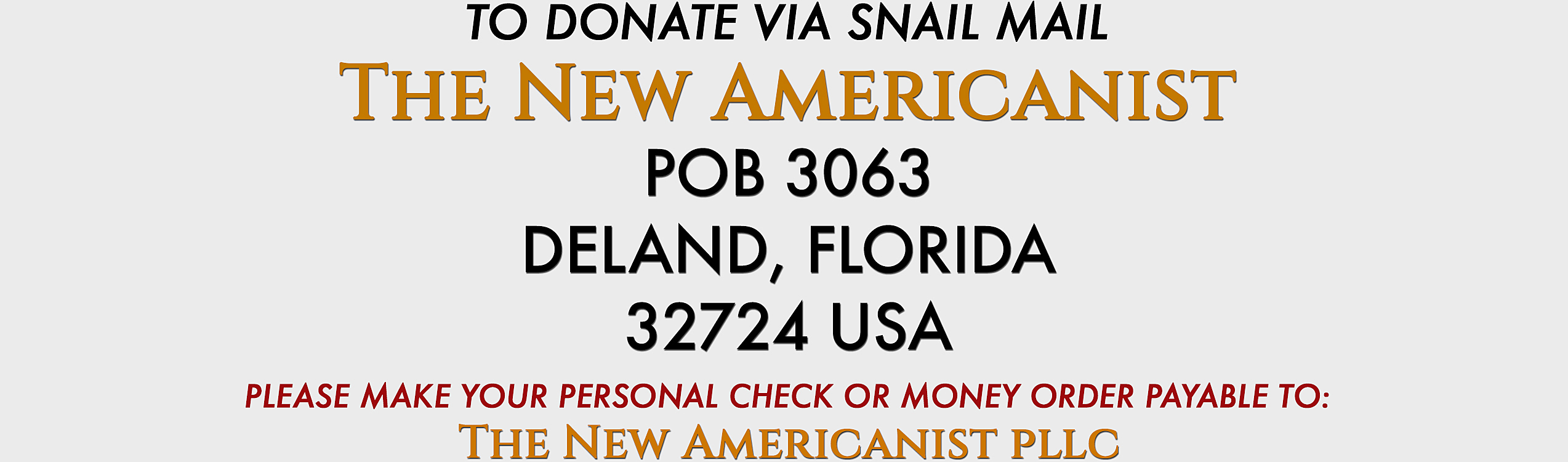
▶️ DONATE VIA SNAIL MAIL





▶️ CLICK HERE TO VIEW
▶️ 9 Minutes 34 Seconds
▶️ 14 Minutes 34 Seconds
▶️ 18 Minutes 02 Seconds
▶️ 32 Minutes 34 Seconds
▶️ 5 Minutes 44 Seconds
▶️ 15 Minutes
▶️ 41 Minutes 15 Seconds ⭐️ Navajo Nation
▶️ 13 Minutes 18 Seconds
▶️ 20 Minutes 05 Seconds
▶️ 6 Minutes 12 Seconds
▶️ 6 Minutes 42 Seconds
▶️ 12 Minutes 20 Seconds
▶️ 11 Minutes 20 Seconds
▶️ 13 Minutes 32 Seconds
▶️ 7 Minutes 48 Seconds
▶️ Premiere
▶️ 16 Minutes 49 Seconds
▶️ 36 Minutes 26 Seconds ⭐️ The New Logical Show
A NEW video podcast produced by TNA’s very own bet125. Make certain you SUBSCRIBE & LIKE.
Let’s all support new Conservative Media. 😎
