
⭐️ HelloKitty’sGotAHairTrigger




✪✪✪ One of the most dangerous illusions Americans are living under today is the belief that safety is ambient, existing automatically, everywhere, and at all times, by virtue of laws, norms, or declarations. For decades, we have been trained to assume that public spaces are fundamentally benign and that vigilance itself is somehow antisocial or unnecessary...
▶️ CLICK HERE FOR FEATURE STORY

iii
hat assumption is no longer valid. A steady stream of viral videos now documents what many quietly sense: sudden assaults in stores, flash-mob robberies, random attacks on public transport, group intimidation in ordinary places. These are not war zones or failed states. They are malls, trains, sidewalks, and parking lots. The common element is not criminal genius, but civilian unpreparedness.
America has drifted into what security professionals call Condition White: relaxed, distracted, and unaware. In an era when threats are opportunistic and often collective, that posture is no longer merely naïve. Instead, it is dangerous.
✪ Situational Awareness Is Not Paranoia
The argument here is not for panic or permanent fear. There is a critical distinction between situational awareness and hypervigilance, and confusing the two has left many Americans untrained and exposed.
Situational awareness is a calm, teachable skill. It is the ability to notice what is normal in an environment and recognize when something deviates from that baseline. It is relaxed alertness: heads up, eyes open, mind engaged. It is the same mental posture we use when driving: aware of surroundings, ready to respond, but not consumed by fear. Head on a swivel.
Hypervigilance, by contrast, is a trauma state. It assumes danger everywhere, exhausts the nervous system, and is unsustainable for ordinary life. No one is advocating for that.
What America needs is a cultural reset toward Condition Yellow: alert, observant, and prepared to act early before a situation escalates.
✪ The Cost Of Declared Safety
Part of the problem is cultural. For years, institutions have promised safety through rhetoric: “safe spaces, community standards, zero tolerance, equity-based prevention.” These declarations were comforting, but they were not operational. They substituted language for reality.
Safety cannot be declared into existence. It is produced through design, enforcement, norms, and individual awareness. When institutions fail to deliver it, the burden shifts back to the individual, whether acknowledged or not. Pretending otherwise will leave people exposed.
The woman who sits down amid a suspicious group on public transport, the shopper absorbed in a phone while a group loiters nearby, the pedestrian wearing noise-canceling headphones at night. Note, though, that these are not moral failures. They are, instead, the result of miseducation. People were taught that awareness itself was unnecessary, even rude. Recent reality has corrected that lesson.
✪ Awareness As Agency
Situational awareness is not about confrontation. In fact, it prevents most confrontations. Simple practices can dramatically reduce risk:
- Noticing exits when entering a space
- Observing who is present and how they are behaving
- Avoiding deep distraction in unfamiliar or crowded environments
- Positioning oneself near walls or exits rather than isolated areas
- Trusting instincts and moving early when something feels “off”
These are small, humane acts of self-respect. They are not aggressive. They are not political. They are practical.
One particularly underappreciated tool is the humble whistle. Small, inexpensive, and non-lethal, a loud whistle can attract immediate attention, disrupt attackers, and signal distress without escalating force. It is a simple equalizer—especially for women, the elderly, and those who do not wish to carry weapons. Three sharp blasts are a universally recognized distress signal. This is not paranoia; it is preparation.
✪ Hypervigilance Is A Symptom: Awareness Is The Answer
Critics will argue that encouraging vigilance creates fear. In fact, the opposite is true. Fear flourishes in uncertainty. Awareness reduces it.
People who know how to read environments, spot anomalies, and act early are calmer, not more anxious. They do not freeze when something unexpected happens. They do not rely on last-second reactions. They quietly adjust.
Hypervigilance emerges when people feel powerless. Situational awareness restores agency.
✪ A Civic Adjustment Instead Of Cultural Breakdown
This is not an argument that America is collapsing into chaos, nor a call to retreat from public life. It is a recognition that conditions have changed, and default assumptions must change with them.
Every generation has had to relearn realism when circumstances demanded it. Ours is no different. The era of passive trust has ended. This is not because Americans have failed morally. Instead, it’s because the environment no longer rewards obliviousness. Relearning situational awareness is not a loss of civility. It is an update to reality.
✪ The Quiet Conclusion
We do not need to live in fear. But we can no longer afford to live unaware. Situational awareness is not about expecting the worst. It is about being ready for the unexpected, calmly, quietly, and early.
In a world where threats are real but uneven, vigilance is not hysteria. It is simply the return of adult responsibility. And that return, however uncomfortable, is ultimately an act of care, both for oneself and for others. ✪
















▶️ DONATE VIA PAYPAL (DEBIT & CREDIT CARD)
ALL PayPal Transactions Are Encrypted For Card Holder Privacy & Security
▶️ DONATE VIA ZELLE (DIRECT BANK CASH TRANSFER)
ZELLE is the perfect online alternative to PayPal. It’s an incredibly simple, secure, easy, fast and FREE way to send or receive money to recipients directly from your online banking account without a middleman. Best of all, there’s NO fees.
ZELLE is a service provided by your bank and is already built in to your online banking account. You only need to activate it first before using. If you’ve already activated ZELLE in your online bank or credit union account, you can donate to The New Americanist by using our ZELLE address:
To activate your ZELLE, follow these easy instructions (a simple two minute process):
vip@thenewamericanist.com

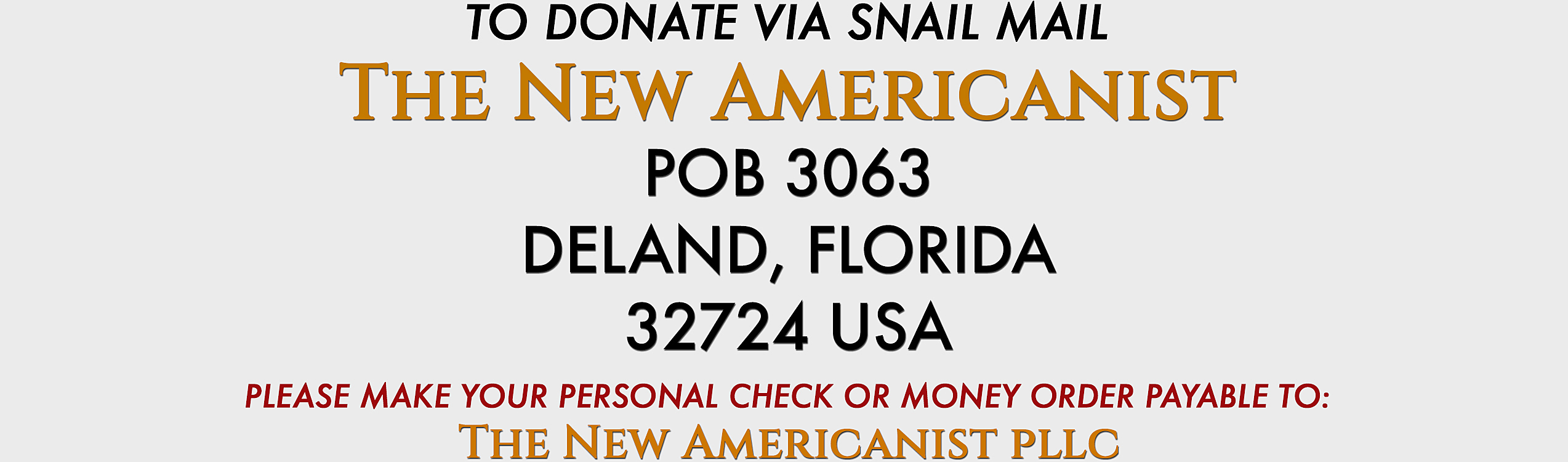
▶️ DONATE VIA SNAIL MAIL






▶️ CLICK HERE TO VIEW
▶️ 18 Minutes19 Seconds
▶️ 1 Hour 33 Minutes 48 Seconds
▶️ 25 Minutes 40 Seconds
▶️ 9 Minutes 55 Seconds
▶️ 21 Minutes 33 Seconds
▶️ 20 Minutes 52 Seconds
▶️ 24 Minutes 21 Seconds
▶️ 34 Minutes 30 Seconds
▶️ 18 Minutes 56 Seconds
▶️ 10 Minutes
▶️ 1 Hour 6 Minutes 6 Seconds
▶️ 8 Minutes 2 Seconds
▶️ 12 Minutes 42 Seconds
▶️ 16 Minutes 32 Seconds
▶️ 21 Minutes 54 Seconds
▶️ 12 Minutes 52 Seconds
▶️ 9 Minutes 46 Seconds
▶️ 19 Minutes
▶️ 20 Minutes 45 Seconds
▶️ 19 Minutes 44 Seconds
▶️ 51 Minutes 58 Seconds
▶️ 14 Minutes 39 Seconds
▶️ 14 Minutes 10 Seconds
▶️ 15 Minutes 3 Seconds
▶️ 29 Minutes 41 Seconds
▶️ 11 Minutes 11 Seconds
▶️ 5 Minutes 13 Seconds
▶️ 3 Minutes 46 Seconds
▶️ 7 Minutes 27 Seconds
