
✪ Green mandates aren’t saving the planet. They’re building a tech-driven surveillance state where appliances cost more, work worse, and condition Americans to accept control as virtue...
▶️ CLICK HERE TO READ TODAY’S FEATURE STORY

gggg
magine life in a California suburb in 2035. It’s a Monday morning, and your household trash cans have been wheeled to the curb for pickup. Hold on, not so fast!
Ahead of the garbage truck there’s now a mostly autonomous vehicle which still carries a human overseer “managing” a swarm of garbage-sniffing drones. As they hover over still yet unemptied garbage cans, mechanical tentacles descend, opening the lid. A separate tentacle, packed with sensors, pokes into the garbage. If “organic” materials are detected in the trash bin, an enforcement division is alerted, and a citation is issued. A corresponding penalty fee or fine is automatically deducted from that household’s central digital currency account.
Instead of airborne drones, perhaps the garbage truck itself is equipped with sensors and appendages on the mechanical arm which lifts the waste containers to dump them into the truck. One way or another, high technology is going to demand citizens are environmentally responsible for getting those kitchen scraps in the right container; or pay an extra infraction when they don’t.
This is a very possible real future in which environmentalist zealots and their opportunistic corporate allies combine missions to dominate public policy; and it is merely an extension of what’s already happening. Whenever we talk about employing technology to modify human behavior, the future is already here.
If you’re wondering why Silicon Valley titans continue doing business in California, it’s not just because of the good weather and great scenery. It’s because California is the home of the most powerful & extreme environmentalist political machine on Earth. A machine which has convinced an overwhelming percentage of the state’s voters any and everything goes when the objective is “saving the Earth.”
However, there’s a common thread built in to every over-engineered, over-technological appliance that’s slowly becoming the only option for consumers in California; and increasingly, everywhere else in America.
Technology. Chips. Software. Internet connectivity. The selling points are features they claim you can’t live without, along with an overwrought moral imperative to save energy and water. Yet, the authentic underlying motivation is really about more profit and control. Do we really need all these “features?”
It’s already starting to become ridiculous. The latest refrigerator manufactured by Samsung doesn’t just chill & preserve your perishables. It’s now a “Family Hub.” The outside of this marvelous machine includes a high-resolution touchscreen, internet connectivity, speakers, microphones, cameras, proximity sensors, and it will automatically integrate with all of your other technological, smart home “ecosystems.” Inside, there are AI cameras monitoring your food.
In case you’re wondering, why yes, your Samsung Family Hub refrigerator will talk with you and your family, so you can command it to play music or videos, answer phone calls, create shopping lists, surf the Web and control other smart home devices. So convenient, right? Isn’t the Future wonderful?
Most of this intrusion of technological overkill has already been around for several years. Samsung introduced the first talking refrigerator back in 2018. Loading the capacities of AI into appliances already saturated with integrated circuits is intended only to accelerate the consumer trend toward households filled with devices performing tasks nobody imagined they’d ever need. Meanwhile, these marvels of technology have become less and less able to perform the basic tasks for which they were originally designed.
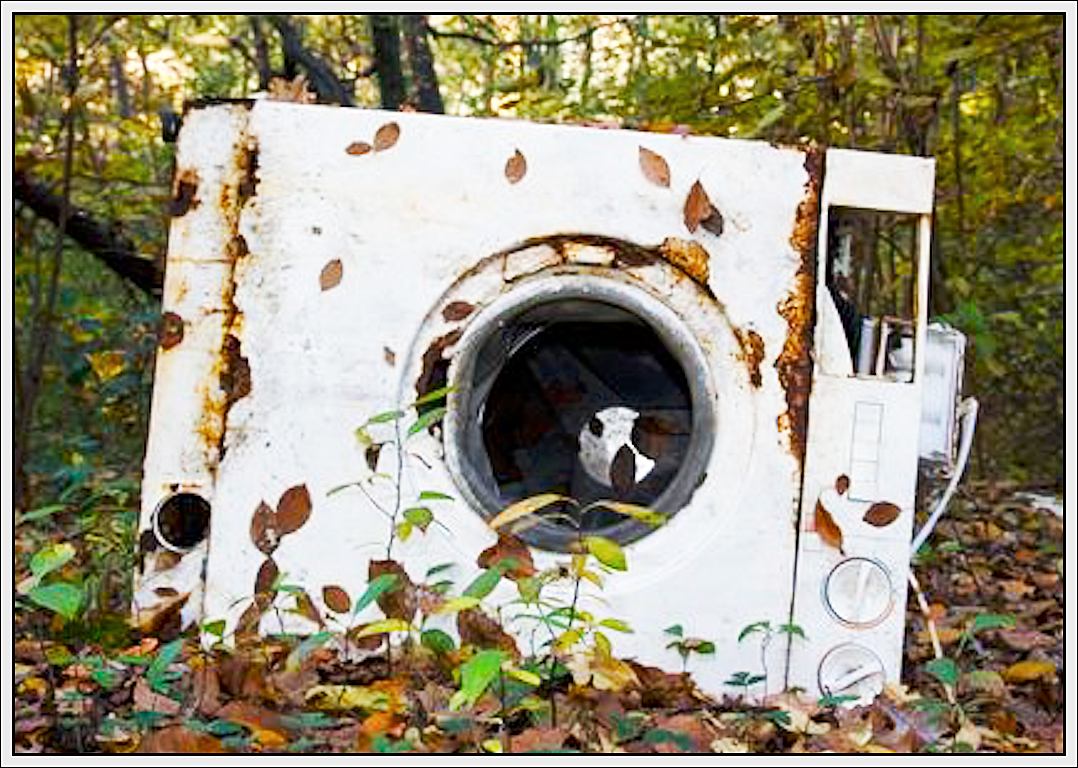
The modern washing machine is a perfect example of how chips and climate change alarmism have completely ruined what was once a durable product in a trusted industry. In the name of conserving electricity and water, the environmentalist industrial complex just couldn’t settle for saving just a little electricity and water. Instead, they have mandated a product which uses almost no water. And to “conserve” electricity, they’ve turned the control panel on your washing machine into something resembling the bridge of a starship, with so many options you have to study a detailed manual just to figure out how to turn it on to wash your clothes.
Of course, these wonderful new washing machines are front-loading instead of top-loading, because of course that saves a few extra gallons more of water; but your clothes will flop around inside a drum that’s on a horizontal axis. That means clothing can get damaged, or not as clean as you would hope or expect; and you may have to get down onto your knees on the floor in order to load and unload them. Most over-engineered washing machines are top-loading, and then once the lid is shut, the drum rotates 90 degrees to move the water on a horizontal axis. This, of course, only adds to the price and introduces yet another set of components which are designed to wear out instead of last.
Since when has it ever been in the interests of consumers to buy and use washing machines which are confusing to operate, difficult to load and unload, do a poor job washing clothes, damage fabrics, take an hour or more to complete cycles which should be only a 20 minutes? What’s the point of building technology into machinery which breaks down every few months & can’t possibly be repaired at home by owners? Before today’s coalition of environmentalists and technology companies got out of control, washing machines as well as almost every other type of home appliances were built to last. Not just for three years, or even 10 years, but 30 years or more. And they did.
Meddling government, environmental standards & mandates have only made appliances in America more expensive, less durable, and less effective. A study exposing how federal appliance efficiency standards have attacked the consumer by limiting product choices and raising operating & maintenance costs was published last month by Ben Lieberman of the Competitive Enterprise Institute. One of Lieberman’s main points is every time the U.S. Congress is controlled by the environmentalist industrial complex lobby, more appliance regulations are added; whereas during years when genuine reform might have occurred, all that ever happens is a pause in the relentless march towards technological over regulation & complexity. Federal appliance standards over the past decades can be compared to a ratchet. They advance and tighten, stop briefly; and then advance & tighten again, without ever being rolled back or reformed.
In his study, “Free the Appliances,” Lieberman’s makes several astute observations regarding washing machines:
“Washing machine standards have led to cleaning performance and reliability problems that were never anticipated by the agency and have not been acknowledged since. They have also led to the accumulation of foul-smelling mold in many machines, necessitating a new market in products designed to eliminate the smell. The need to occasionally wash the washing machine by running it empty with these special cleaners is not only an inconvenience, but also undercuts the agency’s claimed energy and water savings. The same is true of the increased need to run loads more than once due to diminished cleaning performance.”
A similar litany of negative consequences, both unintentional and deliberate, can be documented for literally everything in the American home which consumes energy or water. That includes furnaces and air conditioners, water heaters, dishwashers, faucets, shower heads, lighting, ovens, stoves, microwaves, washers, dryers, and refrigerators.
When we consider the green, environmentalist assault on American households, the most obvious observation is how their policies have only succeeded in raising, not lowering, the cost of energy and water, because the very same principles always at work. The goal is to enforce government mandates which limit opportunities for real competition and innovation in the appliance market. Subsidize “renewable” energy while working to regulate and litigate cheap, conventional energy into oblivion. Prevent effective water supply management and investment in new water supply infrastructure while enforcing expensive water rationing. In all cases, all of the resulting cost increases are passed on to households.
The environmentalist assault on household appliances only create consumer products which are more expensive, break down more frequently or become obsolete much sooner. What does it matter if a refrigerator is “smart” and can talk if it does a poor job of preserving your perishable foods? All these designated, so-called ultra-smart appliances are only part of a bigger, ultimate campaign to introduce and expand total technological surveillance and micromanagement over every aspects of our personal lifestyles, over everything we do.
This is perhaps the most alarming aspect of the merging of technology and the environmentalist movement. The extreme environmentalists who lobby to influence government policies which regulate appliance design believe the middle-class lifestyle is environmentally unsustainable. And the technology companies only want to sell more of their technology. Unchecked, the natural synergy generated between these two market influences is moving us toward a kind of tech-enabled green totalitarianism which infects and affects literally everything we do.
Consider another completely plausible scenario: it’s 2035 and your refrigerator informs you your broccoli must be immediately consumed because it is going to spoil in 24 hours; and until you eat it, your digital currency account will be locked from all further purchases. In addition, if you make a habit of allowing food to spoil, your refrigerator will know and your “green” social score could be adversely affected. The cameras and built in AI supervisor in your refrigerator’s “family hub” will be watching diligently to ensure you eat your broccoli instead of putting it down the garbage disposal, or worse into the incorrect waste container. Either way, your refrigerator will still know.
Crazy? Impossible? Pick your permutation, however, applications of this general concept and design are just around the corner. The mission of environmentalism is simple: any waste or inefficiencies whatsoever resulting in additional carbon emissions must be reduced and eliminated. Any absurdities which must be introduced in order to achieve the reduced carbon footprint are considered worth the tradeoff in efficiency and reliability, especially if they end up generating more profits for government and industry in the long run.
The robots are already here; and if the current environmentalist industrial complex is not broken, AI robots will enforce and restrict limits on the lifestyles of biological humans while more of the World’s resources are redirected towards their policing technology. We will be come dystopian prisoners within our very own households.
However, there is a glorious & liberating alternative for us to consider instead. And that is to choose more realistic environmentalist goals which defy and discard extremist climate narratives which has thus far corrupted the commercial priorities of the appliance manufacturing industry. If technology can be likened to a river, then changing priorities will change the flow. Robots and AI can certainly be utilized to make our lives easier instead of more complicated, complex and expensive. Instead of Terminator, perhaps we should be thinking Jetsons. ✪





















▶️ ◼️◼️◼️◼️◼️◼️◼️◼️◼️ ✪✪✪ DONATE ✪✪✪ ◼️◼️◼️◼️◼️◼️◼️◼️◼️◼️

▶️ DONATE VIA PAYPAL (DEBIT & CREDIT CARD)
ALL PayPal Transactions Are Encrypted For Card Holder Privacy & Security
▶️ DONATE VIA ZELLE (DIRECT BANK CASH TRANSFER)
ZELLE is the perfect online alternative to PayPal. It’s an incredibly simple, secure, easy, fast and FREE way to send or receive money to recipients directly from your online banking account without a middleman. Best of all, there are NO fees.
ZELLE is a service provided by your bank and is already built in to your online banking account. You only need to activate it first before using. If you’ve already activated ZELLE in your online bank or credit union account, you can donate to The New Americanist by using our ZELLE address:
vip@thenewamericanist.com
To activate your ZELLE, follow these easy instructions (a simple two minute process):

▶️ DONATE VIA SNAIL MAIL