


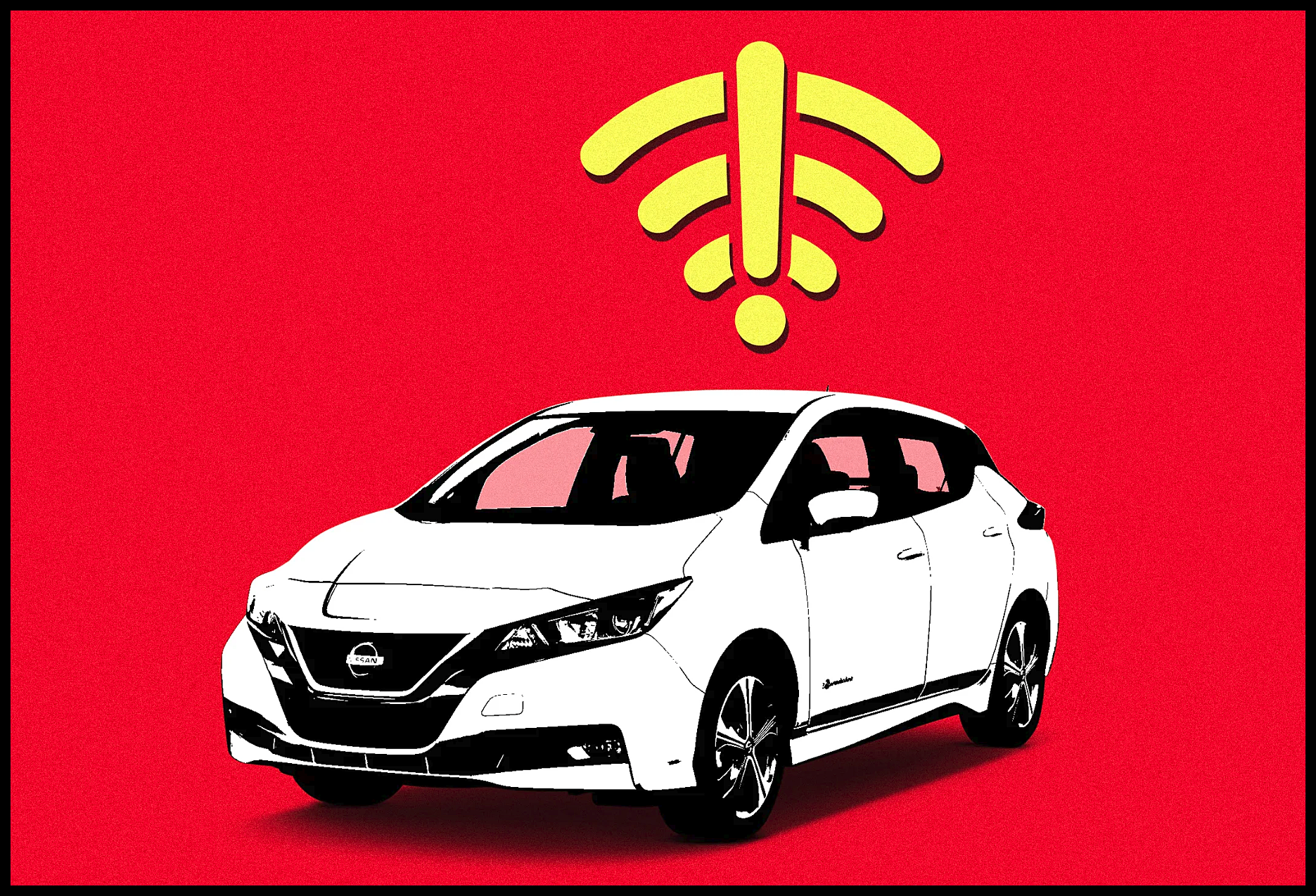

✪ There once was a time not very long ago, when the automobile represented one of the clearest expressions of individual choice in a free society. Limited only by fuel, roads and imagination, a person could choose where to go, when to go, and how to get there. The car was not merely a machine. It was mobility itself as an extension of personal autonomy and freedom...
▶️ CLICK HERE TO READ TODAY’S FEATURE STORY

lll
adly, that is no longer the case. Increasingly, this same instrument, once a tool to facilitate individual independence, has been repurposed into a system of monitoring and control. Though advertised as safety measures for the consumer, these measures were clearly designed to empower the state.
Modern vehicles are no longer just mechanical devices; they are computers on wheels. Embedded sensors track speed, braking patterns, seatbelt usage, location, and even driver attention. Event Data Recorders — commonly referred to as “black boxes” — have been standard in most new vehicles for years. Originally justified as instruments to reconstruct accidents, these devices record data in the moments before a crash. Few object to understanding the causes of collisions. However it is worth noting that once data exists, its use rarely remains confined to its original purpose.
Insurance companies now seek access to driving data to adjust premiums. Law enforcement agencies have used vehicle data in criminal investigations. Courts have admitted such data as evidence. Each of these developments can be justified in isolation. However, together, they represent a quiet but unmistakable shift: the automobile is no longer simply your property — it is a source of information about you.
More recently, legislative developments have accelerated this trend. The Federal infrastructure legislation passed in 2021 includes a mandate for advanced impaired driving prevention technology to be installed in all new vehicles within the coming years. While often described in benign terms; systems which passively detect intoxication or driver impairment, the practical reality is that these systems must continuously monitor driver behavior in order to function. Monitoring creates data. And data, once created, rarely remains unused. It takes on a life of its own.
Proposals and discussions around remote vehicle disablement; popularly referred to as “kill switches” have raised further concerns. While proponents argue that such features could prevent high-speed chases or stop stolen vehicles, the existence of remote-control capabilities introduces a fundamentally different relationship between the individual and the machine. A car that can be disabled remotely is clearly not under the control of its owner.
History suggests that powers granted for limited purposes seldom remain limited. Civil asset forfeiture, initially justified as a tool against organized crime, expanded into widespread seizures affecting ordinary citizens. Surveillance authorities granted for national security purposes have been used in far broader contexts. It would be historically naïve to assume that vehicle control technologies would be immune to similar expansion.
Nor is this merely a question of government. The line between public authority and private corporations has become increasingly blurred. Automakers collect vast amounts of data from connected vehicles. Technology companies process and store this information. In some cases, this data is shared — with consent often buried in lengthy user agreements that few read and fewer understand.
Thus, the modern driver finds himself in a position that would have been difficult to imagine only a generation ago: operating a machine that reports on him, evaluates him, and is even capable of overriding him.
None of this arose from a sudden conspiracy or a single sweeping law. Rather, it is the cumulative result of many incremental steps, each justified on its own terms. Safety regulations. Anti-theft measures. Environmental standards. Insurance optimization. While each step may appear reasonable, the end result is something quite different from the starting point.
There is also an asymmetry in how costs and benefits are distributed. The benefits of these technologies; reduced accidents, improved enforcement, lower insurance costs, are often immediate and visible. The costs; loss of privacy, erosion of autonomy, potential for misuse, are more diffuse and often realized only over time. This makes it easier for policymakers to emphasize the former while discounting the latter.
As usual, those who bear the costs are seldom those who make the decisions. Legislators do not personally experience the implications of data collection in the same way ordinary citizens do. Bureaucracies, once established, have institutional incentives to expand their scope. Corporations, responding to regulatory frameworks and profit motives, have little reason to resist data collection that can be monetized.
What is largely absent from the discussion is any serious consideration of limiting principles. If a car can monitor impairment, why not distraction? If it can monitor distraction, why not emotional state? If it can record data for accidents, why not for routine enforcement? If it can be disabled to prevent a crime, why not enforce compliance with regulations?
These are not hypothetical questions. They are the logical extensions of capabilities already being developed and, in some cases, already deployed.
The broader issue is not technology itself. Technology is neutral. The question is how it is used and under what constraints. A free society depends not only on the existence of capabilities but also on the limits placed upon their use.
Automobiles once expanded the range of individual freedom. They allowed people to leave places they did not wish to be, to seek opportunities elsewhere, and to act independently of centralized systems. To the extent that they become instruments of surveillance and control, that function is diminished.
The long-term implications of such technologies should be considered before they become embedded and irreversible. These features should be options, not mandates.
The automobile did not cease to be a tool of freedom overnight. Like so many erosions of liberty, they occur incrementally, under the banner of progress. ✪
















▶️ ◼️◼️◼️◼️◼️◼️◼️◼️◼️ ✪✪✪ DONATE ✪✪✪ ◼️◼️◼️◼️◼️◼️◼️◼️◼️◼️

▶️ DONATE VIA PAYPAL (DEBIT & CREDIT CARD)
ALL PayPal Transactions Are Encrypted For Card Holder Privacy & Security
▶️ DONATE VIA ZELLE (DIRECT BANK CASH TRANSFER)
ZELLE is the perfect online alternative to PayPal. It’s an incredibly simple, secure, easy, fast and FREE way to send or receive money to recipients directly from your online banking account without a middleman. Best of all, there are NO fees.
ZELLE is a service provided by your bank and is already built in to your online banking account. You only need to activate it first before using. If you’ve already activated ZELLE in your online bank or credit union account, you can donate to The New Americanist by using our ZELLE address:
vip@thenewamericanist.com
To activate your ZELLE, follow these easy instructions (a simple two minute process):

▶️ DONATE VIA SNAIL MAIL







▶️ CLICK HERE TO VIEW
▶️ 35 Minutes 30 Seconds
▶️ 27 Minutes 16 Seconds
▶️ 17 Minutes 50 Seconds
▶️ 40 Minutes 25 Seconds
▶️ 1 Hour 6 Seconds
▶️ 18 Minutes 3 Seconds
▶️ 15 Minutes 7 Seconds
▶️ 33 Minutes 27 Seconds
▶️ 14 Minutes 3 Seconds
▶️ 11 Minutes 1 Second
▶️ 9 Minutes 41 Seconds
▶️ 44 Minutes 3 Seconds
▶️ 5 Minutes 33 Seconds
▶️ 31 Minutes 7 Seconds
▶️ 17 Minutes 52 Seconds
▶️ 22 Minutes 6 Seconds
▶️ 20 Minutes 22 Seconds
⭐️ 1 Hour 13 Minutes 19 Seconds
▶️ 11 Minutes 29 Seconds
▶️ 47 Minutes 38 Seconds
▶️ 12 Minutes 7 Seconds
▶️ 13 Minutes 23 Seconds
▶️ 30 Minutes 26 Seconds
▶️ 11 Minutes 34 Seconds
▶️ 16 Minutes 10 Seconds
▶️ 14 Minutes 3 Seconds
▶️ 8 Minutes 11 Seconds
▶️ 11 Minutes 18 Seconds
▶️ 2 Minutes 1 Second
▶️ 8 Minutes 17 Seconds ⭐️ Huckfunn
▶️ RSBN LIVESTREAM LINK: First Lady Melania @ Fostering The Future Summit
▶️ RSBN LIVESTREAM LINK: White House Press Briefing
▶️ RSBN LIVESTREAM LINK: Trump @ NRCC Dinner
⭐️ TokaiseBlessedPatriot
