




✪ Mass Indian immigration is reshaping America into a parallel society, and a nation that ignores assimilation, sovereignty, and loyalty risks surrendering its future to foreign interests...
▶️ CLICK HERE TO READ TODAY’S FEATURE STORY

yyy
he American Right as a whole, but especially the online masses of the American Right, has recently erupted into a discussion of Indian immigration to the United States; and for very good reason. The total Indian descended population of America is now closing in on and may well exceed six million people. We estimate roughly 5.8–6.2 million Indians now live in the United States, and roughly 3.2 million of them, or about 55 percent, were born abroad. Extrapolating from Pew Data, we estimate an additional 1.8 million Indians in the US are second-generation immigrants.
In other words, around 80 percent of the Indians in the United States are immigrants and their children. Americans are starting to notice.
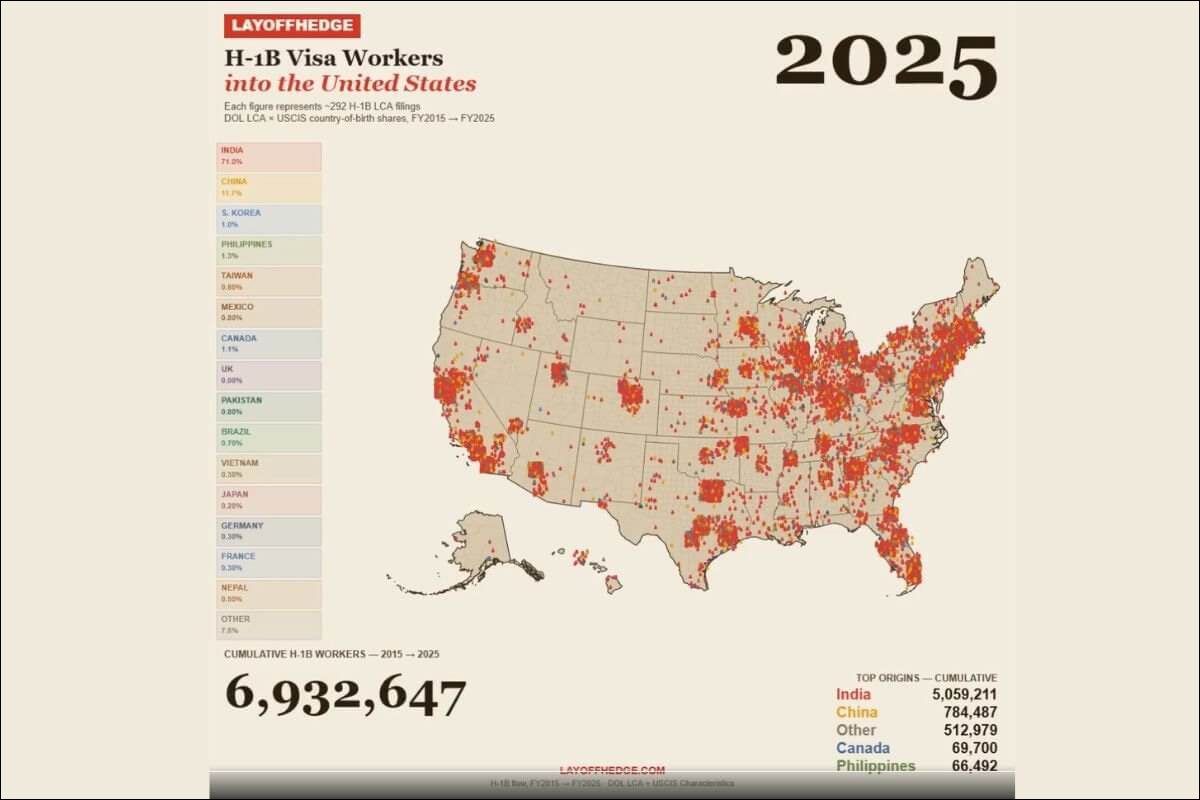
The pro-replacement immigration crowd and Indian ethnic advocates in the US are quick to argue that this is a good thing because Indians are an economic boon because of their high household incomes, which are about $150,000 a year. This is great for Indian families; but it has been disastrous for young Americans forced out of the tech workforce by these Indians. This is the crux of the issue. It is not about the GDP figure or by what percentage the economy grows. It is also not about whether or not Indians are good, decent, honest people or if they are scammers, liars, and have a third-world cultural outlook. There is evidence in abundance to support both of these views, but they are not what is being presented in this piece.
Our focus here is on the fact America is not India; and therefore, there is no reason for the United States and the American people to play host to a large and growing Indian diaspora that seeks political influence and economic control. Another foreign demographic which poses serious cultural and national security risks to the American people.
Our first significant problem is the Indian diaspora in the United States is viewed as a political tool by India to be used to influence the American Government. There are numerous articles on Indian political engagement in American party politics, on how the Indian-origin tech CEOs of once-American companies are pouring hundreds of billions into the Indian economy, and on a raft of research by the Carnegie Endowment about how Indians in the US lean leftward, are concerned about Indian domestic politics, and, of course, about their overall disapproval for the Trump Administration’s tightening of immigration policies.
Indians in the United States are not “just as American” as an Anglo-Protestant whose family arrived in 1840 or an American Catholic with roots going back to 1910. Rather, Indian Americans are yet another, distinct part of the massive post-1965 immigrant-descended population which asserts its own priorities and is politically at odds with the core American nation.
But do they assimilate? Social and political integration remains limited, despite decades of high-skilled immigration and economic success. Carnegie Endowment surveys of Indian Americans consistently show that roughly 80 percent of respondents have a spouse or partner of Indian origin, with even US-born Indian Americans at about 71 percent endogamy. Indians practice far higher rates of in group marriages than other major Asian groups. This pattern holds across generations and reflects deep cultural, religious, and caste-based preferences which prioritize preserving Indian identity over full assimilation into broader American social norms. Many Indian Americans cluster in ethnic enclaves—think dense “Little India” communities in New Jersey, California, and Texas—where social life, marriage markets, temples, and businesses revolve around Indian networks rather than the wider American mainstream.
Remittances back to India run into the tens of billions annually, and tech leaders of Indian origin frequently channel capital, talent, and know-how back to the homeland, underscoring that economic success in America often serves transnational rather than purely American ends.
Politically, this Indian diaspora acts as a distinct interest group with its own priorities. The Carnegie Endowment data reveals Indian Americans lean heavily Democrat and express strong disapproval of immigration restrictions, H-1B reforms, and America First economic policies. Large majorities opposed the Trump-era tightening of visas and deportations; viewing them through the lens of their own community’s interests rather than the national interest.
Indian American political action committees and donors have poured resources into US elections while simultaneously engaging Indian domestic politics; often prioritizing Modi-era issues or countering perceived anti-Indian activism in the West. This creates the appearance of dual loyalty: elected Indian-origin officials and wealthy donors advocate for policies that sustain high levels of Indian immigration and tech outsourcing while native-born Americans face wage suppression and displacement in STEM fields. Indians are not “assimilating” into the historic American nation. They are building parallel power structures to compete politically and economically with the American people.
Finally, data on crime, spying, and corporate espionage further illustrate the risks of treating a large, unassimilated Indian population as indistinguishable from the American people. Violent crime rates among Indian Americans are low, which is consistent with broader Asian immigrant patterns driven by high education and selection effects. However, white-collar and immigration-related offenses tell a different story. The Department of Justice has brought repeated cases against Indian nationals and Indian-owned firms for systemic H-1B visa fraud. Infosys, one of India’s largest IT giants, paid a record $34 million civil penalty to settle allegations of widespread misuse of B-1 visitor visas to perform skilled work that should have gone to Americans or properly authorized H-1B workers. Similar patterns appear across the “body shop” model which dominates Indian IT staffing in the US: fake job postings, benching workers, and circumventing labor protections to flood the market with lower-cost foreign labor.
National security concerns are even more direct & concerning. US authorities have charged Indian Government employees and intelligence-linked operatives in plots targeting dissidents on American soil. In one high-profile case, the DOJ indicted Vikash Yadav, an Indian government employee allegedly tied to RAW (India’s external intelligence agency), in a murder-for-hire conspiracy against a US citizen Sikh activist in New York City. These incidents echo broader patterns of foreign influence operations where Indian intelligence monitors and pressures critics of the Indian diaspora inside the United States.
On the corporate front, while India is not the dominant player in economic espionage compared to China, DOJ prosecutions have documented cases of Indian nationals stealing trade secrets in tech, medical devices, and pharmaceuticals, often downloading proprietary data before returning home or feeding it to Indian competitors. Each instance represents not random criminality but a foreseeable byproduct of mass immigration from a country whose cultural, political, and economic incentives do not align with full loyalty to American sovereignty.
The bottom line is simple: Indians are not Americans. They are a high-achieving, endogamous, and politically organized foreign diaspora whose presence in large numbers imposes real risks to American wages, cultural cohesion, political independence, and national security. High household incomes do not magically transform outsiders into insiders, nor do they erase the fundamental truth that America is not India. Continuing to import millions more while ignoring assimilation failures, fraud rings, and espionage risks is not “enrichment”—it is replacement by another name. The American people have every right to demand that their government put their interests first, rather than subsidizing the growth of a parallel society that views the United States primarily as an economic opportunity and political lever for Indian ends. GDP be damned. ✪


















▶️ ◼️◼️◼️◼️◼️◼️◼️◼️◼️ ✪✪✪ DONATE ✪✪✪ ◼️◼️◼️◼️◼️◼️◼️◼️◼️◼️
▶️ DONATE VIA PAYPAL (DEBIT & CREDIT CARD)
ALL PayPal Transactions Are Encrypted For Card Holder Privacy & Security
▶️ DONATE VIA ZELLE (DIRECT BANK CASH TRANSFER)
ZELLE is the perfect online alternative to PayPal. It’s an incredibly simple, secure, easy, fast and FREE way to send or receive money to recipients directly from your online banking account without a middleman. Best of all, there are NO fees.
ZELLE is a service provided by your bank and is already built in to your online banking account. You only need to activate it first before using. If you’ve already activated ZELLE in your online bank or credit union account, you can donate to The New Americanist by using our ZELLE address:
vip@thenewamericanist.com
To activate your ZELLE, follow these easy instructions (a simple two minute process):

▶️ DONATE VIA SNAIL MAIL






▶️ RSBN LIVESTREAM LINK: Maternal Healthcare Event
▶️ RSBN LIVESTREAM LINK: Trump Hosts 2026 Football Champs
⭐️ TokaiseBlessedPatriot
