
✪ President Biden unveiled his election-year budget pitch Monday, calling for $5.5 trillion in tax increases by raising rates on the wealthy and corporations — while spending $7.3 trillion on defense, federal benefit programs, affordable housing and student debt cancellation, among other proposals...
▶️ READ THE FULL STORY HERE

Fill
he fiscal year 2025 budget — which is highly unlikely to be approved by Congress — matches last year’s topline tax increase level and spends $300 billion more while purportedly cutting the federal deficit by $3 trillion over the next 10 years, the White House said on Monday.
Fiscal hawks and Republicans alike were quick to call out the administration for the “reckless spending.”
▶️ 1 Minute 49 Seconds
The Committee for a Responsible Federal Budget (CRFB) noted the Office of Management and Budget (OMB) estimates project the national debt would surge to $45.1 trillion — or 105.6% of Gross Domestic Product (GDP) — by 2034 under the plan, up from $27.4 trillion.
Brian Riedl, a senior fellow at the Manhattan Institute focusing on the budget and taxes, said on Monday that the president’s proposals would saddle the US with “the highest sustained income tax burden in American history as a share of the economy.”
“The president isn’t simply raising taxes to close the deficit, he’s raising it to expand government,” Riedl said after having called Biden’s budget last year “the highest peacetime burden in American history.”
In a Friday interview before the budget dropped, Riedl added that the proposals amount to “even bigger tax hikes down the road when it’s time to rein in the deficit.”
“The price tag of President Biden’s proposed budget is yet another glaring reminder of this Administration’s insatiable appetite for reckless spending and the Democrats’ disregard for fiscal responsibility,” House Speaker Mike Johnson (R-La.) and other GOP leaders said in a statement.
“While hardworking Americans struggle with crushing inflation and mounting national debt, the President would increase their pain to spend trillions of additional taxpayer dollars to advance his left-wing agenda.”
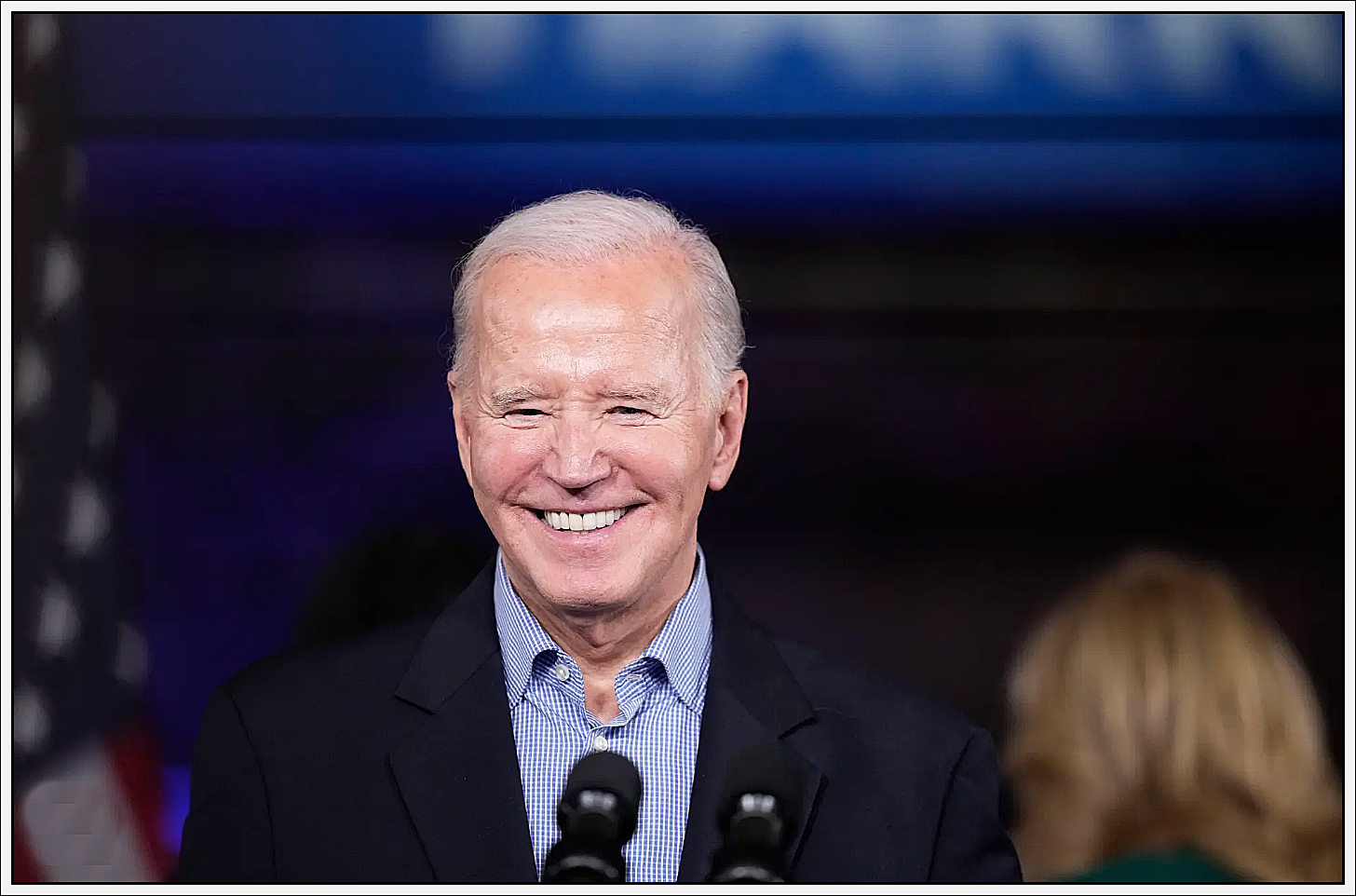
Biden, 81, floated some of his budget proposals during last Thursday night’s State of the Union address, including raising the income tax rate for corporations to 28% and bringing the minimum corporate tax rate from 15% up to 21%.
He also called for more than $400 monthly in mortgage rate tax credits and a 25% tax on billionaires — defined as those with a net worth of $100 million or greater.
“You know, there are 1,000 billionaires in America. You know what the average federal tax is for these billionaires? They are making great sacrifices: 8.2%,” Biden said mockingly, adding that his tax hike would “raise $500 billion over the next 10 years.”
“Under my plan, nobody earning less than $400,000 a year will pay an additional penny in federal taxes,” he added. “Nobody. Not one penny. And they haven’t yet.”
The White House budget claims revenue from the new taxes would help prevent the insolvency of Medicare while paying for a $2,000 cap on prescription drugs and a $35 cap on insulin.
The Biden Administration has repeatedly attacked congressional Republicans for supporting the 2017 Tax Cuts and Jobs Act under President Donald Trump, which it faulted for including “giveaways” to “wealthy and corporate tax cheats.”
However, most of those tax cuts will sunset by 2025 — leaving a “glaring black hole in the budget” and complicating Biden’s pledge to not raise taxes on Americans earning under $400,000 annually according to CRFB President Maya MacGuineas.
Making the tax cuts set by the Trump-era legislation permanent could cost the feds as much as $3 trillion — effectively negating any deficit reduction.
“The president is trying to have it both ways on the 2017 tax cuts,” said Riedl, who also said that Biden’s claims that the 2017 law largely benefited the rich have been “widely debunked” and argued the 8.2% tax rate was “essentially made up by White House economists.”
“They do not count the corporate and estate taxes paid by the wealthy, but they also expand their income to include all sorts of things like unrealized capital gains that will be taxed in a future year,” Riedl said.
“America has the most progressive tax code in the entire [Organization for Economic Co-operation and Development] and billionaires do not pay an 8% tax rate.”
Social Security will also be insolvent within a decade on its current pace, added MacGuineas, forcing cuts of 23% for all beneficiaries due to an immediate payout from the program’s trust funds.
Biden has also accused his predecessor of adding nearly $2 trillion to the deficit, a number Riedl noted included bipartisan COVID relief legislation.
“President Biden in his first 20 months signed legislation adding $4 trillion dollars in 10-year costs,” he said. “The deficit doubled last year from $1 [trillion] to $2 trillion … its highest non-war, non-recession level in American history.”
OMB Director Shalanda Young, in a Monday phone call with reporters, touted the Biden Administration’s claim of having created 15 million new jobs and record of holding the unemployment rate to under 4% over the last two years as proof of the president’s successful economic agenda.
Inflation has also slowed from a 40-year high of 9.1% in June 2022 back down to near pre-pandemic levels, though the spike was fueled by trillions of dollars in federal spending.
Nearly half of the $3 trillion deficit reduction would come from corporate tax revenues during that period, the White House budget plan shows, while taxes on wealthy individuals would add roughly $500 billion.
The White House budget sets defense spending at $895 billion, an increase of 4.3% since fiscal year 2023, and lowers non-defense discretionary spending at $733 billion, a decrease of 3.4% from two years ago.
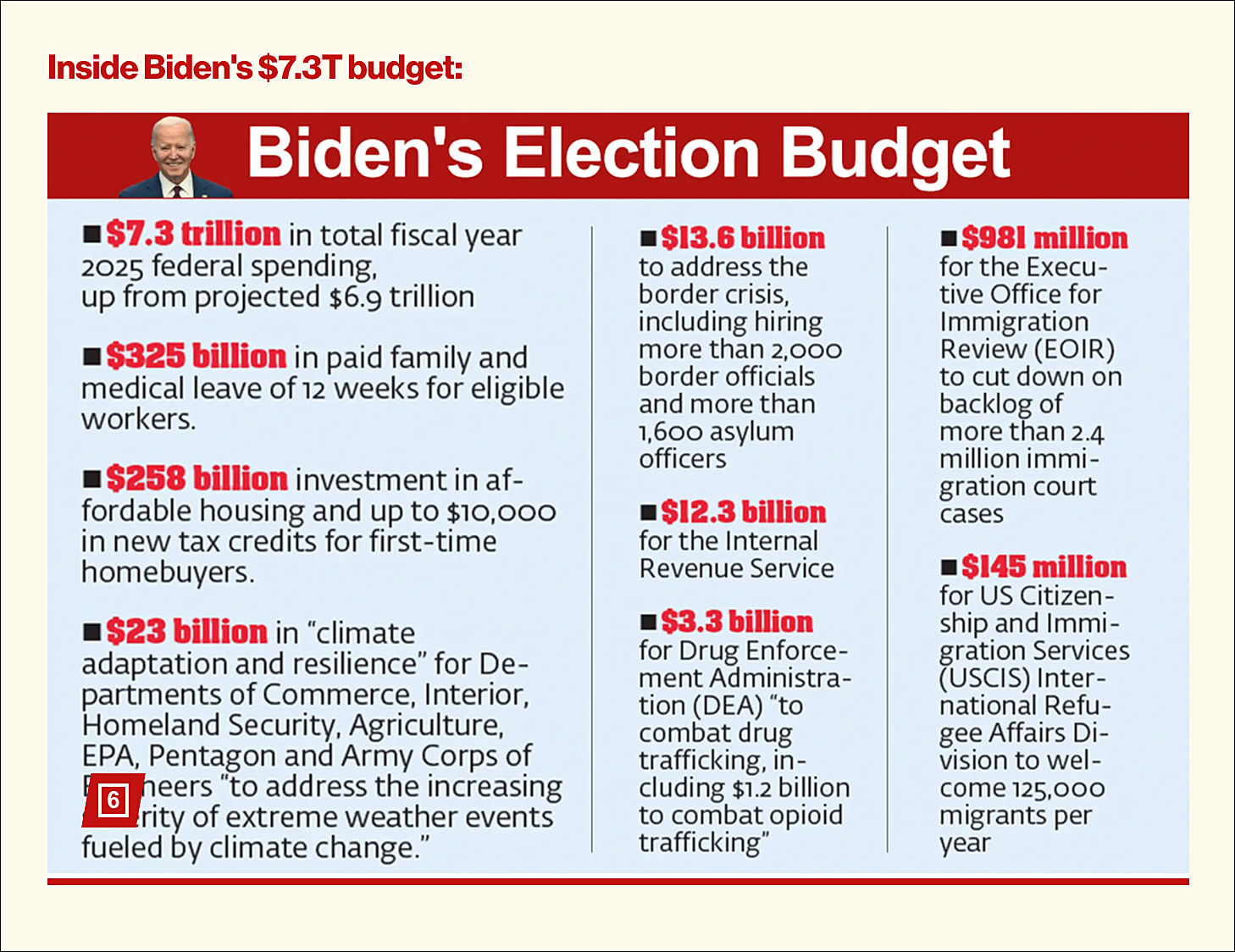
The president’s budget also touts an unprecedented $258 billion investment in affordable housing and up to $10,000 in new tax credits for first-time homebuyers.
“The tax credit just responds to rising housing prices by subsidizing demand even more, which will just further raise housing prices and negate much of these savings for families,” Riedl said of the provision.
Another line item touts the restoration of the full child tax credit of up to $3,600 as enacted in Biden’s American Rescue Plan, as well as other tax cuts for middle- and low-income Americans amounting to $765 billion over the next decade.
At least $23 billion would also go toward “climate adaptation and resilience” across several federal agencies “to address the increasing severity of extreme weather events fueled by climate change” — leading Sen. Eric Schmitt (R-Mo.) to refer to the plan as “a mishmash of liberal wish list items.”
The president also asked Congress for a comparatively paltry $13.6 billion to fund US border security by hiring thousands of officials and asylum officers, while requesting $3.3 billion for the Drug Enforcement Administration (DEA) — $1.2 billion of which would crack down on “opioid trafficking” such as fentanyl.
The Executive Office for Immigration Review would also get $981 million to help reduce a backlog of more than 2.4 million immigration court cases for asylum seekers and other migrants.
Just $145 million would be sent to the US Citizenship and Immigration Services International Refugee Affairs Division to help settle 125,000 migrants per year in the US.
Republicans have repeatedly sought to cut funding for the IRS, but Biden’s budget would provide $12.3 billion more to the agency.
The budget would add $8.5 billion for federal food benefit programs, most of which would go to the Special Supplemental Nutrition Program for Women, Infants and Children (WIC), as well as $325 billion in paid family and medical leave of 12 weeks for eligible workers.
After having already canceled $137 billion in student loan debt for 3.7 million borrowers, the budget further proposes $12 billion for reducing the costs of college, expanding federal Pell Grants, offering tuition-free community college, eliminating origination fees on student loans and tucking other student debt cancellation measures into a $3.7 billion state and local safety proposal.
Tens of billions more would also be invested in veterans’ benefit programs and plans to hire and retain educators and support students in schools nationwide four years after the start of the COVID-19 pandemic.
Another $2.7 billion would be set aside for the Office of Federal Student Aid to support student borrowers.
Before Biden’s address to Congress last week, House Budget Committee chairman Jodey Arrington (R-Texas) released a budget resolution to reduce deficits by $14.2 trillion and add a budget surplus of $45 billion over the next decade.
However, the proposal would likely result in cuts to mandatory spending programs such as Medicare, Medicaid and Social Security, with committee members backing a decrease of $8.7 trillion during that period.
Trump, 77, has often opposed any reductions to the programs, but in a CNBC interview on Monday suggested he was open to “cutting” some entitlements.
▶️ 4 Minutes 3 Seconds
“There is a lot you can do in terms of entitlements, in terms of cutting and in terms of also — the theft and the bad management of entitlements,” he said. “Tremendous bad management of entitlements.” ✪