


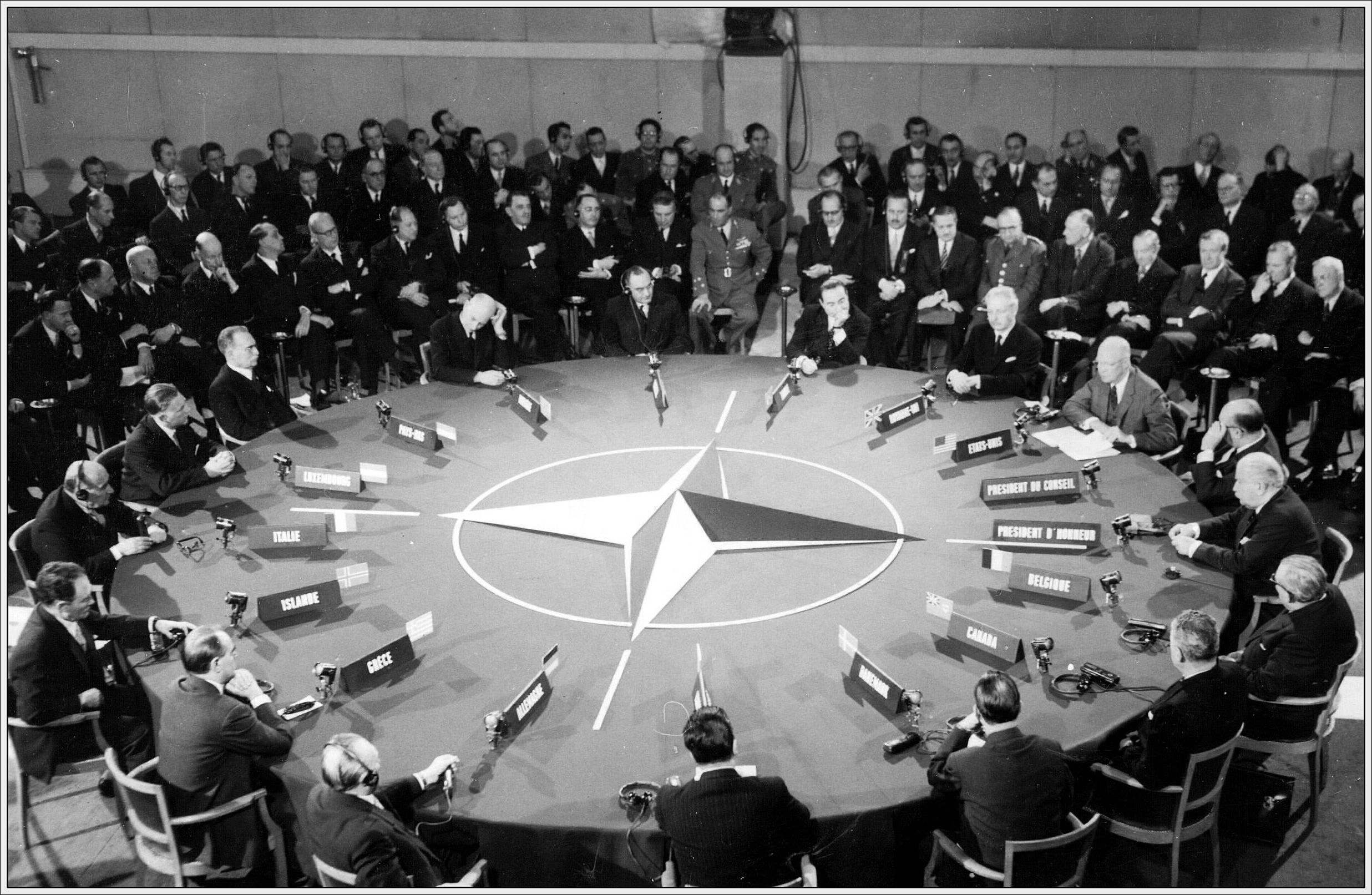

✪ Seventy-five years ago, on April 4, 1949, the foreign ministers of 12 European and North American countries convened in Washington and signed the North Atlantic Treaty establishing NATO…
▶️ READ THE FULL STORY HERE

ith war raging in Eastern Europe and calls from a number of NATO allies to escalate that war, unpopular yet critical questions need to be addressed with regard to the alliance’s history, its continuation and its future expansion, as well as its ramifications for U.S. national security. Indeed, several articles of faith with regard to NATO’s successes and indispensability turn out to be, upon even cursory examination, highly questionable—if not entirely mistaken.
While criticism of the alliance is effectively verboten in today’s Washington, at the time of its founding, some eminent American foreign policy thinkers such as Walter Lippmann warned that “a great power like the United States gains no advantages and it loses prestige by offering, indeed, peddling, its alliances to all and sundry. An alliance should be hard diplomatic currency, valuable and hard to get.”
An argument could be made that by the end of its first decade, NATO was already obsolete. The great Hungarian-American historian John Lukacs has argued that, by the mid-1950s, the Soviets (post-Stalin, post-Beria) were beating a retreat from the center of Europe. In 1954–55, they agreed to, in Lukacs’s words, a “reciprocal withdrawal” in Austria, paving that way for that country’s Cold War neutrality. Within a year the Soviets relinquished their naval base in Finland (which henceforth was to also pursue neutral status—that is, until last year) and mended ties with Tito’s Yugoslavia. By Lukacs’s accounting, 1956 “was the turning point of the cold war. Perhaps even the end of it, if by ‘cold war’ means the direct prospect of an actual war between American and Russian armed forces in Europe.”
In the absence of the competing alliance systems, the Cold War might have come to a denouement decades earlier. Certainly Turkey’s incorporation into the alliance in 1952 and the subsequent decision to place nuclear-armed Jupiter missiles there did little to further peace and stability between East and West. Indeed, it did help set the stage for the nuclear missile crisis of October 1962.
Nevertheless, the decision to carry on and indeed expand the alliance was made within a mere 24 months of the dissolution of the Soviet Union. For Clinton, the impetus to expand came from domestic politics rather than the requirements of US national security.
As Ambassador Jack Matlock has recently noted:
The real reason that Clinton went for it [NATO expansion] was domestic politics. I testified in Congress against NATO expansion, saying that it would be a great “mistake”; when I came out of that testimony, a couple of people who were observing said, “Jack, why are you fighting against this?”And I said, “Because I think it’s a bad idea.” They said, “Look, Clinton wants to get reelected. He needs Pennsylvania, Michigan, Illinois….”
As many at the time knew, the project was fraught with risk. But in the Washington, DC of thirty years ago, one could have an actual debate on the merits of one or another foreign policies without being labeled a foreign “dupe” or a Russian “apologist.” In those years, scores of members of the Washington establishment, not least Senators Daniel Patrick Moynihan and John Warner, made their objections to the expansionist project known.
One group of objectors was led by the granddaughter of President Dwight Eisenhower. In 1997, the estimable Susan Eisenhower published an open letter in an effort to persuade Clinton to reconsider his chosen course. Calling NATO expansion a “policy error of historic proportions,” the letter’s 50 signatories, including longtime hawks Paul Nitze and Richard Pipes, the prominent Democrat Senators Bill Bradley and Sam Nunn, and intellectuals like David Calleo and Owen Harries, warned:
In Russia, NATO expansion, which continues to be opposed across the entire political spectrum, will strengthen the nondemocratic opposition, undercut those who favor reform and cooperation with the West, bring the Russians to question the entire post-Cold War settlement.
At around the same time, an article by the World Policy Institute’s Sherle Schwenninger noted,
NATO expansion threatens to create tensions and conflicts in the heart of Central and Eastern Europe that would otherwise not exist…The Clinton Administration justifies NATO enlargement in part as an effort to avoid a new security vacuum in Central Europe, but even as it removes some countries from East-West competition it only increases the potential intensity of the rivalry over others, like the Baltic states and Ukraine.
Today, NATO’s defenders will no doubt ask: Surely after the Russian invasion of Ukraine, NATO is needed more than ever to keep Europe safe from the Russian bear? Not really.
First, as the distinguished political scientist John Mearsheimer and others have tirelessly pointed out, there is scant evidence that Putin wants all of Ukraine, much less more real estate in Eastern Europe. Do we really suppose Russia wants to take on the burden of supporting three-quarters of a million Polish pensioners? Or waste more blood and treasure in what most certainly would be fierce guerrilla resistance in Galicia? The fact is that Russia lacks both the means and the will to establish political, economic, and territorial hegemony on the continent.
Arguments to the contrary are, to be polite about it, based on a misunderstanding of Russian national security aims. The French political philosopher Emmanuel Todd (less polite) believes that the idea that Russia has Europe in its sights is the stuff of “fantasy and propaganda.”
As Todd writes in The Defeat of the West:
“The truth is that Russia with a shrinking population and a territory of 17 million square kilometers, far from wanting to conquer new territories, wonders above all how she will continue to occupy those she already possesses.”
Let’s call NATO what it is: an unnecessary alliance which poses a danger to the true national security interest of the United States. NATO encourages free-riding on the part of our partners; it encourages recklessness on the part of strategically insignificant though wildly bellicose client states; it encourages incredibly self-defeating behavior on the part of those nations that want to join it; it encourages and helps enable the U.S. to meddle in the Middle Eastern and North Africa where we have virtually no business being.
The show has been on the road for far too long. Surely, 75 years of NATO is enough—and eight decades after the end of the Second World War, it is a long past time for Europe to stand on its own. ✪

















▶️ CLICK HERE TO VIEW
NOTE: Please contact the administrator @ vip@thenewamericanist.com to report any broken or nonfunctioning links,


▶️ CLICK HERE TO VIEW
▶️ 17 Minutes 50 Seconds ⭐️ Gary Brown
▶️ 15 Minutes 9 Seconds
▶️ 11 Minutes 38 Seconds
