
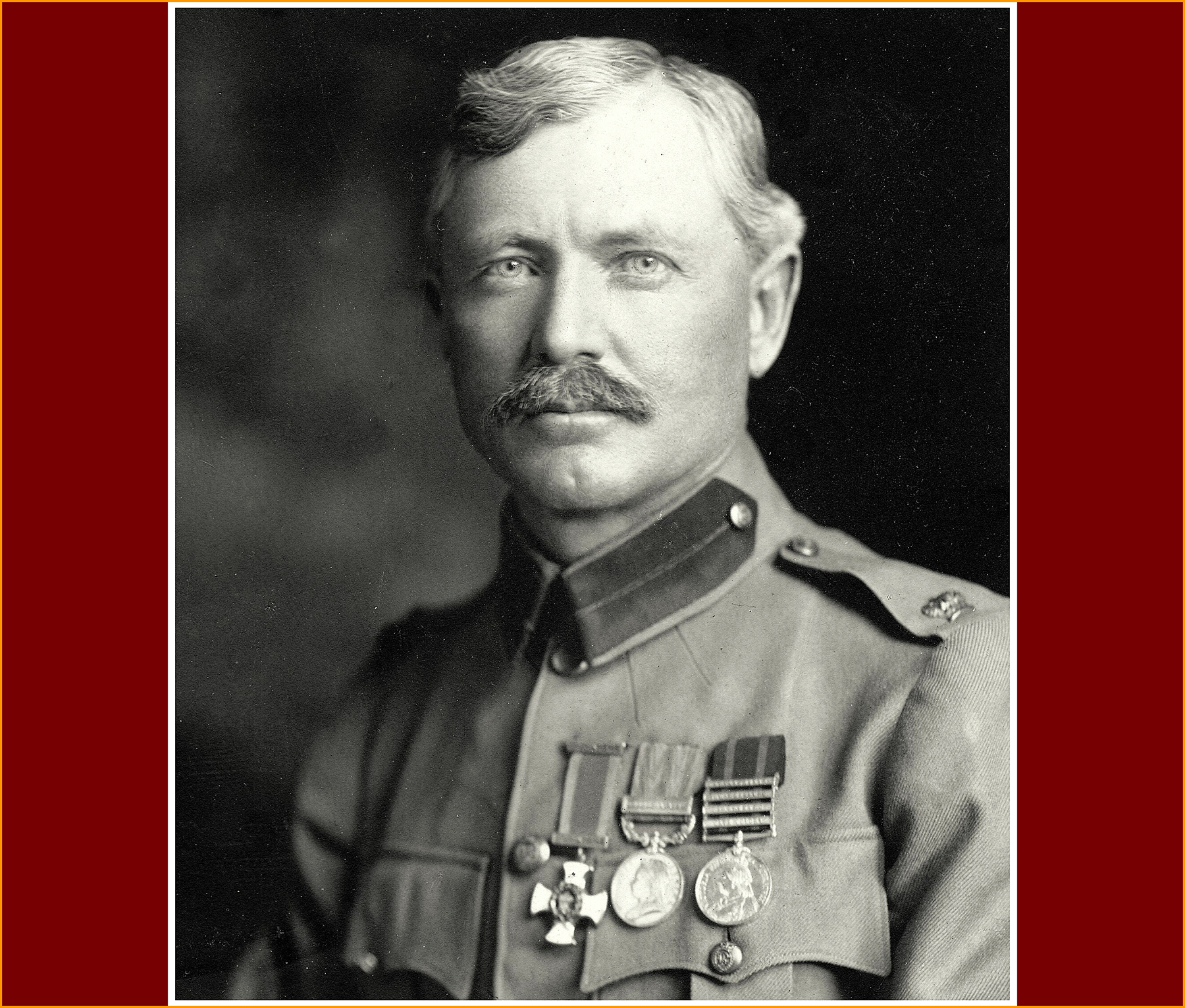

Frederick Russell Burnham (May 11, 1861–September 1, 1947)
✪ Major Frederick Russell Burnham was an American scout and world-traveling adventurer. He is known for his service to the British South Africa Company and to the British Army in colonial Africa, and for teaching woodcraft to Robert Baden-Powell in Rhodesia. Burnham helped inspire the founding of the international Scouting Movement.
Burnham was born on a Dakota Sioux Indian reservation in Minnesota, in the small village of Tivoli near the city of Mankato; there he learned the ways of American Indians as a boy. By the age of 14, he was supporting himself in California, while also learning scouting from some of the last of the cowboys and frontiersmen of the American Southwest.
Burnham had little formal education, never finishing high school. After moving to the Arizona Territory in the early 1880s, he was drawn into the Pleasant Valley War, a feud between families of ranchers and sheepherders. He escaped and later worked as a civilian tracker for the United States Army in the Apache Wars. Feeling the need for new adventures, Burnham took his family to southern Africa in 1893, seeing Cecil Rhodes’s Cape to Cairo Railway project as the next undeveloped frontier.
Burnham distinguished himself in several battles in Rhodesia and South Africa and became Chief of Scouts. Despite his U.S. citizenship, his military title was British and his rank of major was formally given to him by King Edward VII.
Burnham was born on May 11, 1861, on a Dakota Sioux Indian reservation in Minnesota, to a missionary family living near the small pioneer town of Tivoli (now gone), about 20 miles from Mankato. His father, the Reverend Edwin Otway Burnham, was a Presbyterian minister educated and ordained in New York; he was born in Ghent, Kentucky. Burnham’s mother Rebecca Russell Burnham spent most of her childhood in Iowa, having emigrated with her family from Westminster, England at the age of three.
The young Burnham attended schools in Iowa. There he met Blanche Blick, whom he later married. The Burnham family moved from Minnesota to Los Angeles, California in 1870, in search of easier living conditions soon after his father Edwin was seriously injured in an accident while rebuilding the family homestead. Two years later, Edwin died, leaving the family destitute. Burnham’s mother and three-year-old younger brother Howard returned to Iowa to live with her parents. However, the 12-year-old Burnham remained in California alone to repay his family’s debts and ultimately make his own way
For the next few years, Burnham worked as a mounted messenger for the Western Union Telegraph Company in California and Arizona Territory. On one occasion his horse was stolen from him by Tiburcio Vásquez, a famous California bandit. At 14, he began his life as a scout and Indian tracker in the Apache Wars, during which he took part in the United States Army expedition to find and capture or kill the Apache chief Geronimo.
During the Apache uprisings, the young Burnham also learned much from Al Sieber, the Chief of Scouts. Burnham learned much about scouting from these Indian trackers, who were advanced in age and fading from the frontier, including the vital lesson that “it is imperative that a scout should know the history, tradition, religion, social customs, and superstitions of whatever country or people he is called on to work in or among.” But the scout who was to have perhaps the greatest influence on Burnham during his formative years was a man named Holmes.
Holmes had served under Kit Carson and John C. Fremont, but he was old and physically impaired when he met Burnham. He had lost all of his family in the Indian wars and before he died he wanted to impart his knowledge of the frontier to the young Burnham. The two men traveled throughout the American Southwest and northern Mexico, and Holmes taught him many scouting skills, such as how to track a trail, how to double and cover one’s own trail, how to properly ascend and descend precipices, and how to tell the time at night.
In Globe, Arizona, Burnham unwittingly joined the losing side of the Pleasant Valley War before mass killing started, and only narrowly escaped death. Once the killing started, he felt he had to join a faction as a hired gun, although it put him on the wrong side of the law. In between raids and forays, he practiced incessantly with his pistol; he learned to shoot using either hand and from the back of a galloping horse. Burnham had many enemies.
Burnham eventually went back to California to attend high school, but he never graduated. He returned to Arizona and was appointed Deputy Sheriff of Pinal County, but he soon went back to herding cattle and prospecting. After he went to Prescott, Iowa to visit his childhood sweetheart Blanche, the two were married on February 6, 1884. He was 23 years old. Burnham’s wife of 55 years, Blanche (February 25, 1862 – December 22, 1939) from Nevada, Iowa, accompanied him in very primitive conditions through many travels in both the Southwest United States and southern Africa. Together they had three children, all of whom spent their early youth in Africa. In the early years, she watched over the children and the pack animals, and she always kept a rifle nearby. In the dark of night, she used her rifle many times against lions and hyena. He and Blanche settled down soon after in Pasadena, California, to tend to an orange grove but soon Burnham returned to prospecting and scouting. Active as a Freemason, he rose to become a Thirty-Second Degree Mason of the Scottish Rite.
In 1895, Burnham oversaw and led the Northern Territories British South Africa Exploration Company expedition that first established for the British South Africa Company that major copper deposits existed north of the Zambezi in North-Eastern Rhodesia. After this expedition he was elected a fellow of the Royal Geographical Society. Later, the British South Africa Company built the mining towns of the Copperbelt and a railroad to transport the ore through Portuguese Mozambique.
Burnham decided it was time to leave Africa and move on to other adventures. The family returned to California. Soon after, Fred traveled to Alaska and the Yukon to prospect in the Klondike Gold Rush, taking with him his eldest son Roderick, who was then 12 years old. On hearing of the Spanish–American War, Burnham rushed home to volunteer his services, but the war ended before he could get to the fighting.
Burnham was already a celebrated scout when he first befriended Baden-Powell. From his youth on the open plains, Burnham’s earliest playmates were Sioux Indian boys and their ambitions pointed to excelling in the lore and arts of the trail and together they dreamed of some day becoming great scouts. When Burnham was a teenager he supported himself by hunting game and making long rides for Western Union through the California deserts, his early mentors were wise old scouts of the American West, and by 19 he was a seasoned scout chasing and being chased by Apache
In his first scouting handbook, Aids to Scouting (1899), Baden-Powell published many of the lessons he learned from Burnham and this book was later used by boys’ groups as a guide to outdoor fun. At the urging of several youth leaders, Baden-Powell decided to adapt his scouting handbook specifically to training boys. While Baden-Powell went on to refine the concept of Scouting, publish Scouting for Boys (1908), and become the founder of the international Scouting movement, Burnham has been called the movement’s father.
Burnham’s descendants followed in his footsteps and are also active in Scouting and in the military. His son Roderick enlisted in the U.S. Army and he fought in France in World War I. His grandson, Frederick Russell Burnham II, was a leader in the BSA and a Vietnam War veteran. His great-grandson, Russell Adam Burnham, is an Eagle Scout and was the United States Army’s Soldier of the Year in 2003.
Burnham led the Wa Syndicate’s 1901 expedition through the Gold Coast and the Upper Volta, looking for minerals and ways to improve river navigation. Between 1902 and 1904 he was employed by the East Africa Syndicate, for which he led a vast mineral prospecting expedition in the East Africa Protectorate .
In 1909, William Howard Taft and Porfirio Díaz planned a summit in El Paso, Texas, and Ciudad Juárez, Mexico, an historic first meeting between a U.S. President and a Mexican president and also the first time an American president would cross the border into Mexico. But tensions rose on both sides of the border, including threats of assassination, so the Texas Rangers, 4,000 U.S. and Mexican troops, U.S. Secret Service agents, FBI agents and U.S. marshals were all called in to provide security. Burnham was put in charge of a private security detail of 250 men.
After the Taft-Díaz summit, Burnham led a team of 500 men in guarding mining properties owned by Hammond, J. P. Morgan, and the Guggenheims in the Mexican state of Sonora. Just as the irrigation and mining projects were nearing completion in 1912, a long series of Mexican revolutions began. The final blow to these efforts came in 1917 when Mexico passed laws prohibiting the sale of land to foreigners. Burnham carried his property until 1930 and then sold it to the Mexican government.
During this period, Burnham was one of the 18 officers selected by former U.S. president Theodore Roosevelt to raise a volunteer infantry division for service in France in 1917 shortly after the United States entered the war.
Although Burnham had lived all over the world, he never had a great deal of wealth to show for his efforts. It was not until he returned to California, the place of his youth, that he found great affluence. In November 1923, he struck oil in Dominguez Hills, near Carson, California. In a field that covered just two square miles, over 150 wells from Union Oil were soon producing 37,000 barrels a day, with 10,000 barrels a day going to the Burnham Exploration Company.
In the first 10 years of operation, the Burnham Exploration Company paid out $10.2 million in dividends. The spot where Burnham found oil was land where “as a small boy he used to graze cattle, and shoot game which he sold to the neighboring mining districts to support his widowed mother and infant brother.”
In his later years, Burnham filled various public offices and also served as a member of the Boone and Crockett Club of New York; and as a founding member of the American Committee for International Wildlife Protection (now a committee of the World Conservation Union). He was one of the original members of the first California State Parks Commission (serving from 1927 to 1934), a founding member of the Save the Redwoods League, president of the Southwest Museum of Los Angeles from 1938 until 1940, and he served as both the Honorary President of the Arizona Boy Scouts and as a regional executive for the BSA throughout the 1940s until his death in 1947.
In late 1958, Ernest Hemingway acquired the rights to produce a film version of Burnham’s memoirs, Scouting on Two Continents. CBS immediately contracted Hemingway to produce the film for television, with Gary Cooper expressing considerable interest in playing the part of Burnham. Hemingway was already behind schedule with other commitments, however, and no work had been done on the movie when he committed suicide in July 1961.
Another epic film, On My Honor, was conceived and begun by Cecil B. DeMille. It was to document the founding of the Scouting movement but was left unfinished after DeMille died in January 1959.
At 5 ft 4 inches, Burnham was short, but he was also muscular and bronzed, with a finely formed square jaw. He had a boyish appearance which he used to his advantage on numerous occasions. His most noticeable feature was his steady, grey-blue eyes. Contemporary reports had it that Burnham’s gaze appeared to never leave those of the person he was looking at, and yet somehow could simultaneously monitor all the details of the physical surroundings.
Burnham would not smoke and seldom drank alcohol, fearing these habits would injure the acuteness of his sense of smell. He found ways to train himself in mental patience, took power naps instead of indulging in periods of long sleep, and drank very little liquid. He trained himself to accept these abstinences in order to endure the most appalling fatigues, hunger, thirst, and wounds, so that when scouting or traveling where there was no water, he might still be able to exist.
On more than one occasion he survived in environments where others would have died, or were in fact dying, of exhaustion. He was quiet-mannered and courteous, according to contemporaries. Their reports describe a man who was neither shy nor self-conscious, who was extremely modest, and who seldom spoke of his many adventures.
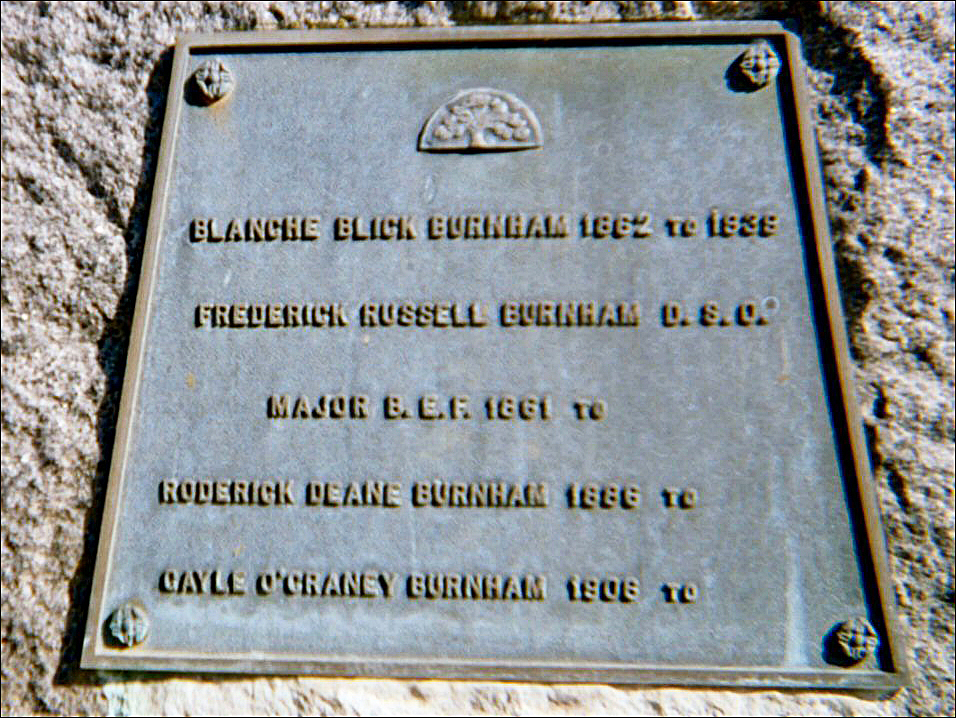
Burnham died of heart failure at the age of 86, on September 1, 1947, at his home in Santa Barbara, California. He was buried at a private ceremony at Three Rivers, California, near his old cattle ranch, La Cuesta. His memorial stone was designed by his only surviving child, Roderick. ✪
















▶️ DONATE VIA PAYPAL (DEBIT & CREDIT CARD)
ALL PayPal Transactions Are Encrypted For Card Holder Privacy & Security
▶️ DONATE VIA ZELLE (DIRECT BANK CASH TRANSFER)
ZELLE is the perfect online alternative to PayPal. It’s an incredibly simple, secure, easy, fast and FREE way to send or receive money to recipients directly from your online banking account without a middleman. Best of all, there’s NO fees.
ZELLE is a service provided by your bank and is already built in to your online banking account. You only need to activate it first before using. If you’ve already activated ZELLE in your online bank or credit union account, you can donate to The New Americanist by using our ZELLE address:
vip@thenewamericanist.com
To activate your ZELLE, follow these easy instructions (a simple two minute process):

▶️ DONATE VIA SNAIL MAIL