


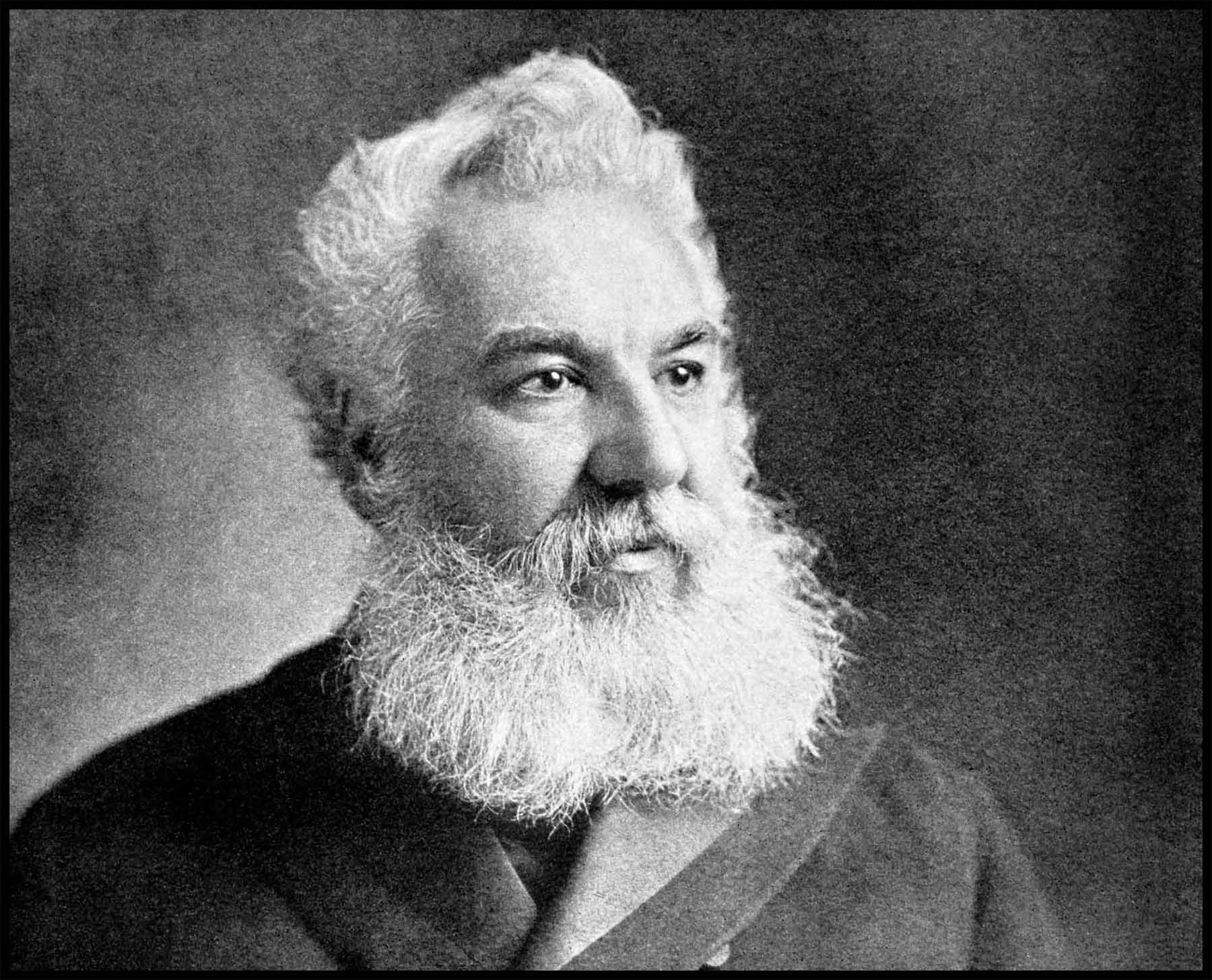

Alexander Bell: March 3, 1847 – August 2, 1922
✪ Alexander Graham Bell (born Alexander Bell) was a Scottish-born Canadian-American inventor, scientist, and engineer who is credited with patenting the first practical telephone. He also co-founded the American Telephone and Telegraph Company (AT&T) in 1885.
Many other inventions marked Bell’s later life, including ground-breaking work in optical telecommunications, hydrofoils, and aeronautics. Bell also had a strong influence on the National Geographic Society and its magazine while serving as its second president from 1898 to 1903.
Beyond his work in engineering, Bell had a deep interest in the emerging science of heredity. His work in this area has been called “the soundest, and most useful study of human heredity proposed in nineteenth-century America … Bell’s most notable contribution to basic science, as distinct from invention.”
Bell was born in Edinburgh, Scotland, on March 3, 1847, to Alexander Melville Bell, a phonetician, and Eliza Grace Bell (née Symonds). The family home was on South Charlotte Street in Edinburgh, where a stone inscription marks it as Bell’s birthplace. Bell had two brothers: Melville James Bell (1845–1870) and Edward Charles Bell (1848–1867), who both died of tuberculosis.
Bell was born as just “Alexander Bell.” However, at age 10, he made a plea to his father to have a middle name like his two brothers. For his 11th birthday, his father acquiesced and allowed him to adopt the name “Graham,” chosen out of respect for Alexander Graham, a Canadian patient being treated by his father who was also a family friend. To close relatives and friends he remained “Aleck.” Bell and his siblings attended a Presbyterian Church in their youth.
As a child, Bell displayed a curiosity about his world; he gathered botanical specimens and ran experiments at an early age. His best friend was Ben Herdman, a neighbor whose family operated a flour mill. At the age of 12, Bell built a homemade device which combined rotating paddles with sets of nail brushes, creating a simple dehusking machine which was put into operation at the mill and used steadily for a number of years. In return, Ben’s father John Herdman gave both boys the run of a small workshop in which to “invent.”
From his early years, Bell showed a sensitive nature and a talent for art, poetry, and music which his mother encouraged. With no formal training, he mastered the piano and became the family’s pianist. Though normally quiet and introspective, bell reveled in mimicry and “voice tricks” akin to ventriloquism to entertain family guests.
Bell was also deeply affected by the onset of his mother’s gradual deafness (she began to lose her hearing when he was only 12), and learned a manual finger language so he could sit at her side and tap out silently the conversations in the family parlor. He also developed a technique of speaking in clear, modulated tones directly into his mother’s forehead; whereby she could hear him with reasonable clarity. Bell’s preoccupation with his mother’s deafness would eventually led him to study acoustics.
Bell’s family was long associated with the teaching of elocution: his grandfather, Alexander Bell, in London, his uncle in Dublin, and his father, in Edinburgh, were all elocutionists. His father published a variety of works on the subject, several of which are still well known, especially The Standard Elocutionist (1860), which appeared in Edinburgh in 1868. The Standard Elocutionist appeared in 168 British editions and sold over 250,000 copies in the United States alone. It explains methods on how to instruct deaf-mutes (as they were then known) to articulate words and read other people’s lip movements to decipher meaning.
As a young child, Bell, like his brothers, was schooled at home by his father. At an early age, he was enrolled at the Royal High School in Edinburgh. However, his school record was undistinguished; marked by absenteeism and mediocre grades. His main interest remained in the sciences, especially biology, while he treated other school subjects with indifference, to his father’s dismay.
After high school, Bell attended the University of Edinburgh, joining his brother Melville, who enrolled there the previous year. In 1868, Bell completed his matriculation exams and was accepted for admission to University College London, though he did not complete his studies, as his family emigrated to Canada in 1870 following the deaths of his brothers Edward and Melville from tuberculosis.
Bell’s father encouraged his interest in speech; and, in 1863, took his sons to see a demonstration of unique automaton developed by Sir Charles Wheatstone based on the works of german inventor Von Kempelen. The rudimentary “mechanical man” simulated a human voice. Bell was fascinated by the machine, and after he obtained a copy of von Kempelen’s book, published in German, and had laboriously translated it, he and Melville built their own automaton head.
At age 19, Bell wrote a report on his work and sent it to philologist Alexander Ellis, a colleague of his father. Ellis immediately wrote back indicating that the experiments were similar to existing work being conducted in Germany. Bell fortuitously then made a deduction that would underpin all his future work on transmitting sound, reporting: “Without knowing much about the subject, it seemed to me that if vowel sounds could be produced by electrical means, so could consonants, so could articulate speech.”
In 1865, when the Bell family moved to London, Bell returned to Weston House as an assistant master; and in his spare hours, continued his experiments on sound using a minimum of laboratory equipment. Bell concentrated on experimenting with electricity to convey sound and later installed a telegraph wire from his room in Somerset College to that of a friend. Throughout late 1867, his health would falter mainly through exhaustion.
Helping his father in Visible Speech demonstrations and lectures brought Bell to Susanna E. Hull’s private school for the deaf in South Kensington, London. His first two pupils were deaf-mute girls who made remarkable progress under his tutelage.
In 1870, 23-year-old Bell travelled with his parents and his brother’s widow, Caroline Margaret Ottaway to Paris, Ontario to stay with Thomas Henderson, a Baptist minister and close family friend. The Bells soon purchased a farm of 10.5 acres at Tutelo Heights (now called Tutela Heights), near Brantford, Ontario. The property consisted of an orchard, large farmhouse, stable, pigsty, hen-house, and a carriage house, which bordered the Grand River.
At the homestead, Bell set up a workshop in the converted carriage house near what he called his “dreaming place,” a large hollow nestled in trees at the back of the property above the river. Despite his frail condition upon arriving in Canada, Bell found the climate and environs to his liking and rapidly improved.
Bell continued his experiments with his “harmonic telegraph.” The basic concept behind his device was that messages could be sent through a single wire if each was transmitted at a different pitch, but more work on both the transmitter and receiver was needed.
Unsure of his future, Bell contemplated returning to London to complete his studies, but decided instead to return to Boston to pursue teaching. While working as a private tutor, one of his pupils was Helen Keller, who came to him as a young child unable to see, hear, or speak. She later said that Bell dedicated his life to the penetration of that “inhuman silence which separates and estranges.” In 1893, Keller performed the sod-breaking ceremony for the construction of Bell’s new Volta Bureau, dedicated to “the increase and diffusion of knowledge relating to the deaf.”
Throughout his life, Bell sought to assimilate the deaf and hard of hearing into the hearing world. He encouraged speech therapy and lip-reading over sign language.
In 1872, Bell became professor of Vocal Physiology and Elocution at the Boston University School of Oratory. During this period, he alternated between Boston and Brantford, spending summers in his Canadian home. At Boston University, Bell was “swept up” by the excitement engendered by the many scientists and inventors living in the city.
With days and evenings occupied by his teaching and private classes, Bell began to stay awake late into the night, running experiment after experiment in rented facilities at his boarding house. His health soon deteriorated as he had severe headaches. Returning to Boston in autumn 1873, Bell made a far-reaching decision to concentrate on his experiments in sound.
By 1874, Bell’s initial work on the harmonic telegraph had entered a formative stage, with progress made both at his new Boston “laboratory” (a rented facility) and at his family home in Canada a big success. While working that summer in Brantford, Bell experimented with a “phonautograph,” a pen-like machine that could draw shapes of sound waves on smoked glass by tracing their vibrations. Bell thought it might be possible to generate undulating electrical currents that would correspond to sound waves.
In 1874, telegraph message traffic was rapidly expanding and, in the words of Western Union President William Orton, had become “the nervous system of commerce.” Orton contracted with inventors Thomas Edison and Elisha Gray to find a way to send multiple telegraph messages on each telegraph line to avoid the great cost of constructing new lines. When Bell mentioned to Gardiner Hubbard and Thomas Sanders that he was working on a method of sending multiple tones on a telegraph wire using a multi-reed device, the two began to financially support Bell’s experiments
In March 1875, Bell and Pollok visited the scientist Joseph Henry, then the director of the Smithsonian Institution, to ask his advice on the electrical multi-reed apparatus that Bell hoped would transmit the human voice by telegraph. Henry said Bell had “the germ of a great invention.” When Bell said that he lacked the necessary knowledge, Henry replied, “Get it!”
A chance meeting in 1874 between Bell and Thomas A. Watson, an experienced electrical designer and mechanic at the electrical machine shop of Charles Williams, would soon completely change Bell’s life.
On March 7, 1876, the U.S. Patent Office issued Bell patent 174,465. It covered “the method of, and apparatus for, transmitting vocal or other sounds telegraphically … by causing electrical undulations, similar in form to the vibrations of the air accompanying the said vocal or other sound”
Meanwhile, Elisha Gray was also experimenting with acoustic telegraphy and thought of a way to transmit speech using a water transmitter. On March 10, Bell succeeded in getting his telephone to work, using a liquid transmitter similar to Gray’s design. Vibration of the diaphragm caused a needle to vibrate in the water, varying the electrical resistance in the circuit. When Bell spoke the sentence “Mr. Watson—Come here—I want to see you” into the liquid transmitter, Watson, listening at the receiving end in an adjoining room, heard the words clearly.
After March 1876, Bell focused on improving the electromagnetic telephone and never used Gray’s liquid transmitter in public demonstrations or commercial use.
Continuing his experiments in Brantford, Bell brought home a working model of his telephone. On August 3, 1876, from the telegraph office in Brantford, Bell sent a telegram to the village of Mount Pleasant four miles away, indicating that he was ready. He made a telephone call via telegraph wires and faint voices were heard replying.
The following night, he amazed guests as well as his family with a call between the Bell Homestead and the office of the Dominion Telegraph Company in Brantford along an improvised wire strung up along telegraph lines and fences, and laid through a tunnel. This time, guests at the household distinctly heard people in Brantford reading and singing. The third test, on August 10, 1876, was made via the telegraph line between Brantford and Paris, Ontario, eight miles away. This test is said by many sources to be the “world’s first long-distance call.”
Bell then began a series of public demonstrations and lectures to introduce the new invention to the scientific community as well as the general public. A short time later, his demonstration of an early telephone prototype at the 1876 Centennial Exposition in Philadelphia brought the telephone to international attention.
On January 14, 1878, at Osborne House, on the Isle of Wight, Bell demonstrated the device to Queen Victoria by placing calls to Cowes, Southampton, and London. These were the first publicly witnessed long-distance telephone calls in the UK.
The Bell Telephone Company was created in 1877, and by 1886, more than 150,000 people in the U.S. owned telephones. Bell Company engineers made numerous other improvements to the telephone, which emerged as one of the most successful products in history. In 1879, the company acquired Edison’s patents for the carbon microphone from Western Union. This made the telephone more practical for longer distances; and it was no longer necessary to shout to be heard at the receiving telephone.
In January 1915, Bell made the first ceremonial transcontinental telephone call. Calling from the AT&T head office at 15 Dey Street in New York City, Bell was heard by Thomas Watson at 333 Grant Avenue in San Francisco. The New York Times reported:
On October 9, 1876, Alexander Graham Bell and Thomas A. Watson talked by telephone to each other over a two-mile wire stretched between Cambridge and Boston. It was the first wire conversation ever held. Yesterday afternoon [on January 25, 1915], the same two men talked by telephone to each other over a 3,400-mile wire between New York and San Francisco. Dr. Bell, the veteran inventor of the telephone, was in New York, and Mr. Watson, his former associate, was on the other side of the continent.
Over 18 years, the Bell Telephone Company faced 587 court challenges to its patents, including five that went to the U.S. Supreme Court, but none was successful in establishing priority over Bell’s original patent, and the Bell Telephone Company never lost a case which proceeded to a final trial stage.
On July 11, 1877, a few days after the Bell Telephone Company was established, Bell married Mabel Hubbard (1857–1923) at the Hubbard estate in Cambridge, Massachusetts. His wedding present to his bride was to turn over 1,487 of his 1,497 shares in the newly formed Bell Telephone Company. Shortly thereafter, the newly-weds embarked on a year-long honeymoon in Europe. During that excursion, Bell took a handmade model of his telephone with him, making it a “working holiday” They had four children.
In 1880, Bell received the Volta Prize with a purse of 50,000 French francs (approximately US$340,000 in today’s currency) for the invention of the telephone from the French government. Among the luminaries who judged were Victor Hugo and Alexandre Dumas
Bell was a British subject throughout his early life in Scotland and later in Canada until 1882 when he became a naturalized citizen of the United States. In 1915, he characterized his status as: “I am not one of those hyphenated Americans who claim allegiance to two countries.” Despite this declaration, Bell has been proudly claimed as a “native son” by all three countries he resided in: the United States, Canada, and the United Kingdom.
Until the end of his life, Bell and his family would alternate between the two homes, but Beinn Bhreagh in Victoria County, Nova Scotia would, over the next 30 years, become more than a summer home as Bell became so absorbed in his experiments that his annual stays lengthened.
Although Alexander Graham Bell is most often associated with the invention of the telephone, his interests were extremely varied. According to one of his biographers, Charlotte Gray, Bell’s work ranged “unfettered across the scientific landscape” and he often went to bed voraciously reading the Encyclopædia Britannica, scouring it for new areas of interest.
Bell worked extensively in medical research and invented techniques for teaching speech to the deaf. During his Volta Laboratory period, Bell and his associates considered impressing a magnetic field on a record as a means of reproducing sound. Although the trio briefly experimented with the concept, they could not develop a workable prototype. They abandoned the idea, never realizing they had glimpsed a basic principle which would one day find its application in the tape recorder, the hard disc and floppy disc drive, and other magnetic media.
Bell is also credited with developing one of the early versions of a metal detector through the use of an induction balance, after the shooting of U.S. President James A. Garfield in 1881.
In 1891, Bell had begun experiments to develop motor-powered heavier-than-air aircraft. The AEA was first formed as Bell shared the vision to fly with his wife, who advised him to seek “young” help as Bell was then at the age of 60.
Bell was also a supporter of aerospace engineering research through the Aerial Experiment Association (AEA), officially formed at Baddeck, Nova Scotia, in October 1907 at the suggestion of his wife Mabel and with her financial support after the sale of some of her real estate.
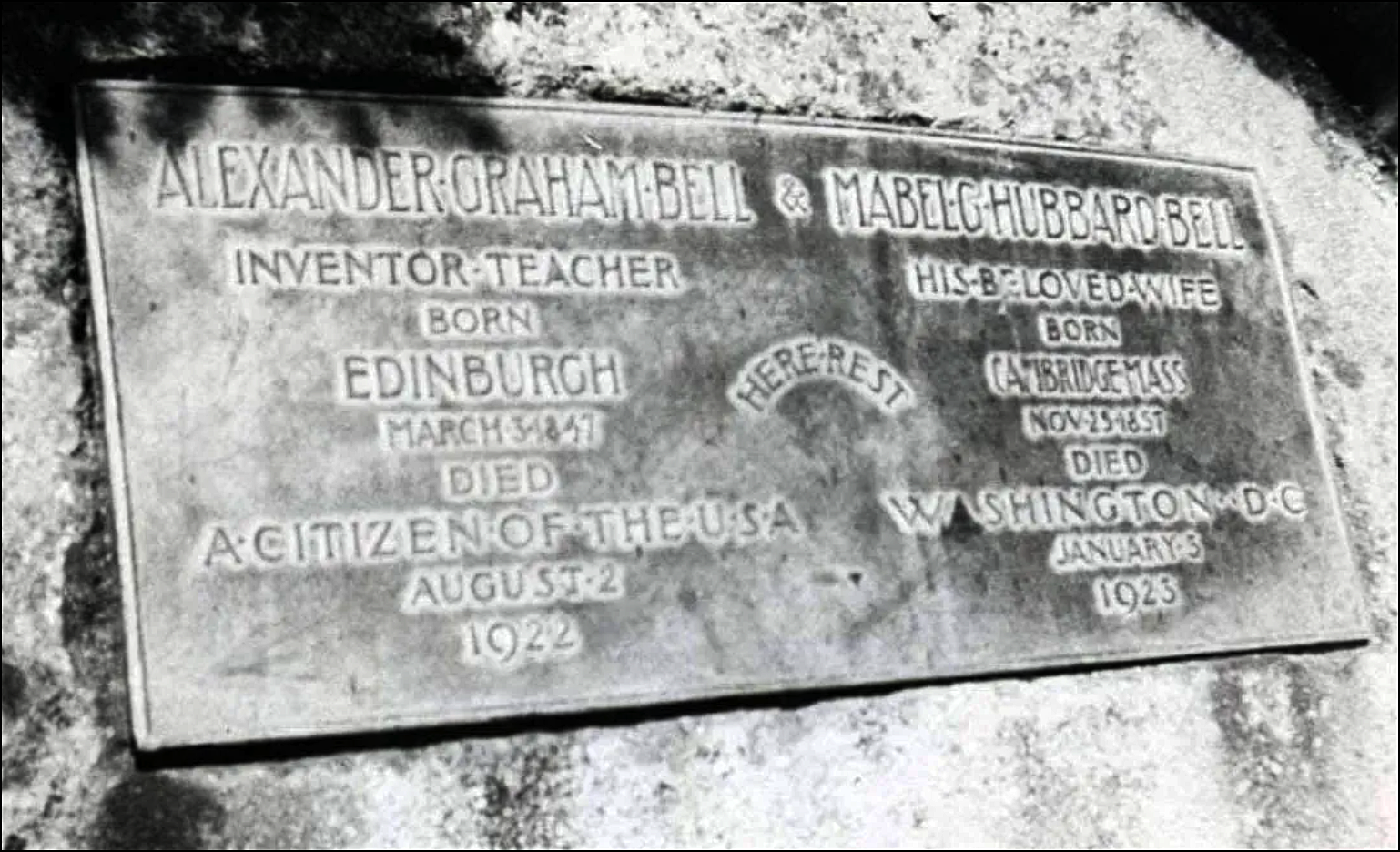
Bell died of complications arising from diabetes on August 2, 1922, at his private estate in Cape Breton, Nova Scotia, at the age of 75. Bell ‘s health was also been affected by pernicious anemia. His last view of the land he had inhabited was by moonlight on his mountain estate at 2:00 a.m. While tending to him after his long illness, Mabel, his wife, whispered, “Don’t leave me.” By way of reply, Bell signed “no…”, lost consciousness, and died shortly after.
Upon the conclusion of Bell’s funeral, for one minute at 6:25 p.m. Eastern Time, “every phone on the continent of North America was silenced in honor of the man who had given to mankind the means for direct communication at a distance.” Alexander Graham Bell was buried atop Beinn Bhreagh mountain, on his estate where he had resided increasingly for the last 35 years of his life, overlooking Bras d’Or Lake. He was survived by his wife Mabel, his two daughters, Elsie May and Marian, and nine of his grandchildren.✪



















▶️ ◼️◼️◼️◼️◼️◼️◼️◼️◼️ ✪✪✪ DONATE ✪✪✪ ◼️◼️◼️◼️◼️◼️◼️◼️◼️◼️

▶️ DONATE VIA PAYPAL (DEBIT & CREDIT CARD)
ALL PayPal Transactions Are Encrypted For Card Holder Privacy & Security
▶️ DONATE VIA ZELLE (DIRECT BANK CASH TRANSFER)
ZELLE is the perfect online alternative to PayPal. It’s an incredibly simple, secure, easy, fast and FREE way to send or receive money to recipients directly from your online banking account without a middleman. Best of all, there are NO fees.
ZELLE is a service provided by your bank and is already built in to your online banking account. You only need to activate it first before using. If you’ve already activated ZELLE in your online bank or credit union account, you can donate to The New Americanist by using our ZELLE address:
vip@thenewamericanist.com
To activate your ZELLE, follow these easy instructions (a simple two minute process):

▶️ DONATE VIA SNAIL MAIL










▶️ CLICK HERE TO VIEW
▶️ 1 Hour 26 Minutes 22 Seconds
▶️ 1 Hour 24 Minutes 32 Seconds
▶️ 37 Minutes 23 Seconds
▶️ 37 Minutes 41 Seconds
▶️ 59 Minutes 59 Seconds
▶️ 1 Hour 28 Minutes 38 Seconds
▶️ 12 Minutes 32 Seconds
▶️ 50 Minutes 8 Seconds
▶️ 17 Minutes 35 Seconds
▶️ 5 Minutes 6 Seconds
▶️ 19 Minutes 20 Seconds
▶️ 15 Minutes 58 Seconds
▶️ 10 Minutes 28 Seconds
▶️ 14 Minutes 47 Seconds
▶️ 12 Minutes 25 Seconds
▶️ 45 Minutes 50 Seconds
▶️ 11 Minutes 44 Seconds
▶️ 14 Minutes 54 Seconds
▶️ 11 Minutes 17 Seconds
▶️ 7 Minutes 51 Seconds ⭐️ Zippity Zap
▶️ 5 Minutes
▶️ 15 Minutes 40 Seconds
▶️ 17 Minutes 29 Seconds
▶️ 6 Minutes 40 Seconds
▶️ 7 Minutes 38 Seconds
▶️ 8 Minutes 35 Seconds
▶️ 21 Minutes 38 Seconds
