
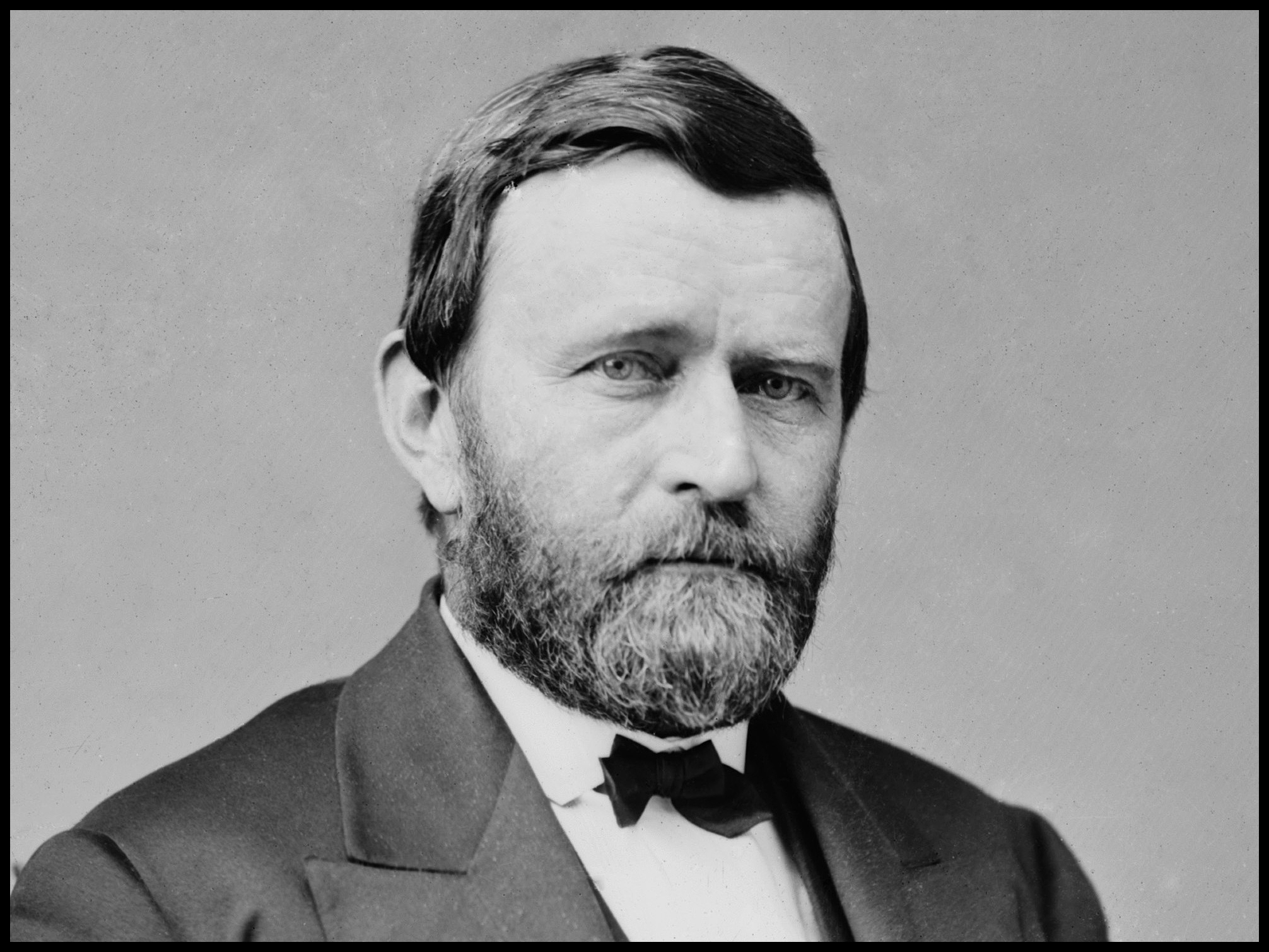

Hiram Ulysses Grant: April 27, 1822–July 23, 1885
✪ Ulysses S. Grant (born Hiram Ulysses Grant) was the 18th president of the United States, serving from 1869 to 1877. In 1865, as commanding general, Grant led the Union Army to victory in the American Civil War.
Grant was hailed across the North as the general who “saved the Union;” and overall, his military reputation has held up well over time. Achieving great national fame for his victories at Vicksburg and the surrender at Appomattox, Grant was the most successful general, Union or Confederate, of the American Civil War. However, he was criticized in the South for using excessive force, and his drinking was often exaggerated by the press and stereotyped by rivals and critics.
Grant was born in Ohio and graduated from the United States Military Academy (West Point) in 1843. He served with distinction in the Mexican–American War, but resigned from the army in 1854 and returned to civilian life impoverished. In 1861, shortly after the Civil War began, Grant joined the Union Army and rose to prominence after securing victories in the western theater. In 1863, he led the Vicksburg campaign which gave Union forces control of the Mississippi River and dealt a major strategic blow to the Confederacy. President Abraham Lincoln promoted Grant to lieutenant general and command of all Union armies after his victory at Chattanooga. For thirteen months, Grant fought Robert E. Lee during the high-casualty Overland Campaign which ended with the capture of Lee’s army at Appomattox, where he formally surrendered to Grant.
As president, Grant stabilized the post-war national economy, supported congressional Reconstruction and the Fifteenth Amendment. He prosecuted the Ku Klux Klan. Under Grant, the Union was completely restored. An effective civil rights executive, Grant signed a bill to create the United States Department of Justice and worked with Radical Republicans to protect African Americans during Reconstruction. In 1871, he created the first Civil Service Commission, advancing the civil service more than any prior president. Grant was re-elected in the 1872 presidential election, but was inundated by executive scandals during his second term.
Grant’s father Jesse Root Grant was a Whig Party supporter and a fervent abolitionist. Jesse and Hannah Simpson were married on June 24, 1821, and their first child, Hiram Ulysses Grant, was born on April 27, 1822. The name Ulysses was drawn from ballots placed in a hat. To honor his father-in-law, Jesse named the boy “Hiram Ulysses,” though he always referred to him as “Ulysses.”
In 1823, the family moved to Georgetown, Ohio, where five siblings were born: Simpson, Clara, Orvil, Jennie, and Mary. At the age of five, Ulysses started at a subscription school and later attended two private schools. In the winter of 1836–1837, Grant was a student at Maysville Seminary, and in the autumn of 1838, he attended John Rankin’s academy.
In his youth, Grant developed an unusual ability to ride and manage horses; his father gave him work driving supply wagons and transporting people. Unlike his siblings, Grant was not forced to attend church by his Methodist parents. For the rest of his life, he prayed privately and never officially joined any denomination.
Grant was largely apolitical before the war but wrote, “If I had ever had any political sympathies they would have been with the Whigs. I was raised in that school.”
At Jesse Grant’s request, Representative Thomas L. Hamer nominated Ulysses to the United States Military Academy at West Point, New York, in the spring of 1839. Grant was accepted on July 1. Unfamiliar with Grant, Hamer altered his name, so Grant was enlisted under the name “U. S. Grant.” Since the initials “U.S.” also stood for “Uncle Sam,” he became known among army colleagues as “Sam.”
Initially, Grant was indifferent to military life, but within a year he reexamined his desire to leave the academy and later wrote that “on the whole I like this place very much.” Soon, he earned a reputation as the “most proficient” horseman. Seeking relief from military routine, he studied under Romantic artist Robert Walter Weir, producing nine surviving artworks. He spent more time reading books from the library than his academic texts. Grant later wrote of the military life, “there is much to dislike, but more to like.”
Grant graduated on June 30, 1843, ranked 21st out of 39 in his class and was promoted the next day to brevet second lieutenant. He planned to resign his commission after his four-year term. He would later write that among the happiest days of his life were the day he left the presidency and the day he left the academy. Grant was happy with his commander but looked forward to the end of his military service and a possible teaching career.
In 1844, Grant accompanied Frederick Dent to Missouri and met his family, including Dent’s sister Julia. The two soon became engaged and on August 22, 1848, they were married at Julia’s home in St. Louis. Grant’s abolitionist father disapproved of the Dents’ owning slaves, and neither of Grant’s parents attended the wedding. After the wedding, Grant obtained a two-month extension to his leave and returned to St. Louis, where he decided that, with a wife to support, he would remain in the army. The couple had four children.
Grant’s first assignments took him and Julia to Detroit on November 17, 1848, but he was soon transferred to Madison Barracks, a desolate outpost in upstate New York, in bad need of supplies and repair. After four months, Grant was sent back to his quartermaster job in Detroit.
Grant tried several business ventures but failed, and in one instance his business partner absconded with $800 of Grant’s investment, equivalent to $23,000 in 2023. After he witnessed white agents cheating local Indians of their supplies, and their devastation by smallpox and measles transferred to them by white settlers, he developed empathy for their plight.
Promoted to captain on August 5, 1853, Grant was assigned to command Company F, 4th Infantry, at the newly constructed Fort Humboldt in California. Grant arrived at Fort Humboldt on January 5, 1854.
Separated from his family, Grant began to drink Colonel Buchanan reprimanded Grant for one drinking episode and told Grant to “resign or reform.” Grant told Buchanan he would “resign if I don’t reform.” Keeping his pledge to Buchanan, Grant resigned, effective July 31, 1854.
Grant never did face a court-martial; the War Department said: “Nothing stands against his good name.” Grant said years later, “the vice of intemperance (drunkenness) had not a little to do with my decision to resign.” With no means of support, Grant returned to St. Louis and reunited with his family.
In 1854, at age 32, Grant entered civilian life, without any money-making vocation to support his growing family. It was the beginning of seven years of financial struggles and instability.
In 1856, the Grants moved to land on Julia’s father’s farm, and built a home called “Hardscrabble” on Grant’s Farm; Julia described it as an “unattractive cabin.” Grant’s family had little money, clothes, and furniture, but always had enough food. During the Panic of 1857, which devastated Grant as it did many farmers, Grant pawned his gold watch to buy Christmas gifts. In 1858, Grant rented out Hardscrabble and moved his family to Julia’s father’s 850-acre plantation. That Fall, after having malaria, Grant gave up farming.
In 1858, Grant acquired a slave from his father-in-law, a thirty-five-year-old man named William Jones. Although Grant was not an abolitionist at the time, he disliked slavery and could not bring himself to force an enslaved man to work. In March 1859, Grant freed Jones by a manumission deed, potentially worth at least $1,000 (equivalent to $35,000 in 2024).
Grant moved to St. Louis, taking on a partnership with Julia’s cousin Harry Boggs working in the real estate business as a bill collector, again without success and at Julia’s prompting ended the partnership. In August, Grant applied for a position as county engineer. He had thirty-five notable recommendations, but Grant was passed over by the Free Soil and Republican county commissioners because he was believed to share his father-in-law’s Democrat sentiments.
On April 12, 1861, the American Civil War began when Confederate troops attacked Fort Sumter in Charleston, South Carolina. The news came as a shock and Grant shared his neighbors’ concern about the war. On April 15, Lincoln called for 75,000 volunteers. The next day, Grant attended a mass meeting to assess the crisis and encourage recruitment.
In an April 21 letter to his father, Grant wrote out his views on the upcoming conflict: “We have a government and laws and a flag, and they must all be sustained. There are but two parties now, Traitors and Patriots.”
On November 5, Grant, along with Brigadier General John A. McClernand, landed 2,500 men at Hunter’s Point, and on November 7 engaged the Confederates at the Battle of Belmont.
Grant had wanted to destroy Confederate strongholds at Belmont, Missouri, and Columbus, Kentucky, but was not given enough troops and was only able to disrupt their positions. On the morning of April 6, 1862, Grant’s troops were taken by surprise when the Confederates, led by Generals Albert Sidney Johnston and P. G. T. Beauregard, struck first “like an Alpine avalanche” near Shiloh church, attacking five divisions of Grant’s army and forcing a confused retreat toward the Tennessee River.
Bolstered by 18,000 troops from the divisions of Major Generals Buell and Lew Wallace, Grant counterattacked at dawn the next day and regained the field, forcing the disorganized and demoralized rebels to retreat.
Shiloh was the costliest battle in American history to that point and the staggering 23,746 casualties stunned the nation. Briefly hailed a hero for routing the Confederates, Grant was soon mired in controversy. The Northern press castigated Grant for shockingly high casualties, and accused him of drunkenness during the battle, contrary to the accounts of those with him at the time. Lincoln dismissed Grant’s critics, saying “I can’t spare this man; he fights.”
Grant’s war responsibilities included combating illegal Northern cotton trade and civilian obstruction.
On October 16, 1863, Lincoln promoted Grant to major general in the regular army and assigned him command of the newly formed Division of the Mississippi, which comprised the Armies of the Ohio, the Tennessee, and the Cumberland.
On March 2, 1864, Lincoln promoted Grant to lieutenant general, giving him command of all Union Armies. Grant’s new rank had previously been held only by George Washington. Grant arrived in Washington on March 8 and was formally commissioned by Lincoln the next day at a Cabinet meeting. Grant developed a good working relationship with Lincoln, who allowed Grant to devise his own strategy. Grant now commanded 533,000 battle-ready troops spread out over an eighteen-mile front.
On April 2, Grant ordered a general assault on Lee’s forces; Lee abandoned Petersburg and Richmond, which Grant captured. On April 9, Grant and Lee met at Appomattox Court House. Although Grant felt depressed at the fall of “a foe who had fought so long and valiantly,” he believed the Southern cause was “one of the worst for which a people ever fought.” Grant wrote out the terms of surrender: “each officer and man will be allowed to return to his home, not to be disturbed by U.S. authority so long as they observe their paroles and the laws in force where they may reside.” Lee immediately accepted Grant’s terms and signed the surrender document, without any diplomatic recognition of the Confederacy. Lee asked that his former Confederate troops keep their horses, which Grant generously allowed. Grant ordered his troops to stop all celebration, saying the “war is over; the rebels are our countrymen again.“
On April 14, 1865, Grant attended a cabinet meeting in Washington. Lincoln invited him and his wife Julia to Ford’s Theatre but they declined, because they planned to travel to their home in Burlington. In a conspiracy that also targeted top cabinet members in one last effort to topple the Union, Lincoln was shot by John Wilkes Booth at the theater that evening and died the next morning.
At the war’s end, Grant remained commander of the army, with duties that included dealing with Emperor Maximilian and French troops in Mexico, enforcement of Reconstruction in the former Confederate states, and supervision of Indian wars on the Western Plains. On July 25, 1866, Congress promoted Grant to the newly created rank of General of the Army of the United States.
Grant believed the people of the South were not ready for self-rule and required federal government protection. Concerned that the war led to diminished respect for civil authorities, he continued using the Army to maintain order.
At the 1868 Republican National Convention, the delegates unanimously nominated Grant for president on the first ballot. Although Grant had preferred to remain in the army, he accepted the Republican nomination, believing that he was the only one who could unify the nation.
Grant won the popular vote and an Electoral College landslide of 214 votes. Grant was aided by 500,000 votes cast by black people, winning him 52.7 percent of the popular vote. He lost Louisiana and Georgia, primarily due to Ku Klux Klan violence against African-American voters. At the age of 46, Grant was the youngest president yet elected.
On March 4, 1869, Grant was sworn in as President by Chief Justice Salmon P. Chase. In his inaugural address, Grant urged the ratification of the Fifteenth Amendment; many African Americans attended his inauguration. He urged that bonds issued during the Civil War should be paid in gold, called for “proper treatment” of Native Americans and encouraged their “civilization and ultimate citizenship.”
In 1875, Grant proposed a constitutional amendment that limited religious indoctrination in public schools. Schools would be for all children “irrespective of sex, color, birthplace, or religions.”
In October 1871, under the Morrill Act, using federal marshals, Grant prosecuted hundreds of Utah Territory Mormon polygamists. Grant called polygamy a “crime against decency and morality.”
Beginning in March 1873, under the Comstock Act, Grant prosecuted pornographers, in addition to abortionists. To administer the prosecutions, Grant put in charge a vigorous anti-vice activist and reformer, Anthony Comstock. Comstock headed a federal commission and was empowered to destroy obscene material and hand out arrest warrants to offenders.
In 1870, to enforce Reconstruction, Congress and Grant created the Justice Department which allowed the Attorney General and the new Solicitor General to prosecute the Klan. Congress and Grant passed three Enforcement Acts, designed to protect black people and Reconstruction governments. Using the Enforcement Acts, Grant crushed the Klan.
Soon after taking office, Grant took conservative steps to return the economy to pre-war monetary standards. During the War, Congress had authorized the Treasury to issue banknotes that, unlike the rest of the currency, were not backed by gold or silver. These “greenbacks” were necessary to pay the war debts, but caused inflation and forced gold-backed money out of circulation.
On March 18, 1869, Grant signed the Public Credit Act of 1869, which guaranteed bondholders would be repaid in “coin or its equivalent.” The act committed the government to the full return of the gold standard within ten years. This followed a policy of “hard currency, economy and gradual reduction of the national debt.” Grant’s own ideas about the economy were simple, and he relied on the advice of businessmen.
Grant had limited foreign policy experience,ad an expansionist impulse to protect American interests abroad and was a strong advocate of the Monroe Doctrine.
In 1869, Grant initiated his plan to annex the Dominican Republic, then called Santo Domingo. Grant believed acquisition would increase the United States’ natural resources, and strengthen U.S. naval protection to enforce the Monroe Doctrine, safeguard against British obstruction of U.S. shipping and protect a future oceanic canal, stop slavery in Cuba and Brazil, while black people in the United States would have a safe haven from “the crime of Klu Kluxism/”
Grant’s plan, however, was obstructed by Senator Charles Sumner. On December 31, Grant met with Sumner at Sumner’s home to gain his support for annexation. Grant left confident that Sumner approved, but what Sumner actually said was disputed by various witnesses. Without appealing to the American public, Grant submitted the treaties on January 10, 1870, to the Senate Foreign Relations Committee, chaired by Sumner, for ratification, but Sumner shelved the bills.
Grant easily won reelection easily thanks to federal prosecution of the Klan, a strong economy, debt reduction, and lowered tariffs and taxes. He received 56% of the vote and another Electoral College landslide (286 to 66). Most African Americans in the South voted for Grant, while Democrat opposition remained mostly peaceful.
Grant was sworn in by Salmon P. Chase on March 4, 1873. In his second inaugural address, he focused on what he considered the chief issues: freedom and fairness for all Americans and the benefits of citizenship for freed slaves. Grant concluded his address: “My efforts in the future will be directed towards the restoration of good feelings between the different sections of our common community.”
Grant signed the Coinage Act of 1873, effectively ending the legal basis for bimetallism. The Coinage Act discontinued the standard silver dollar and established the gold dollar as the monetary standard; because the gold supply did not increase as quickly as the population, the result was deflation.
The post-Civil War economy brought on massive industrial wealth and government expansion. Speculation, lifestyle extravagance, and corruption in federal offices were rampant. All of Grant’s executive departments were investigated by Congress. Grant by nature was honest, trusting, gullible, and loyal to his friends. His responses to malfeasance were mixed: at times appointing cabinet reformers, others defending culprits.
The abandonment of Reconstruction played a central role during the 1876 election. Mounting investigations into corruption by the House, controlled by the Democrats, discredited Grant’s presidency. Grant did not run for a third term, while the Republicans chose Governor Rutherford B. Hayes of Ohio, a reformer, at their convention. Voting irregularities in three Southern states caused the election to remain undecided for several months.
After leaving the White House, Grant said he “was never so happy in my life” Using $25,000 (equivalent to $738,000 in 2024) from liquidating an investment in a Nevada-based mining company, the Grants set out on a world tour for approximately two and a half years. On May 16, Grant and his wife left for England aboard the SS Indiana. During the tour, the Grants made stops in Europe, Africa, India, the Middle East and the Far East, meeting with notable dignitaries such as Queen Victoria, Tsar Alexander II, Pope Leo XIII, Otto von Bismarck, Li Hongzhang, and Emperor Meiji.
Grant attended a service for Civil War veterans in Ocean Grove, New Jersey, on August 4, 1884, receiving a standing ovation from the ten thousand attendees; it would be his last public appearance. In the summer of 1884, Grant complained of a sore throat but put off seeing a doctor until late October, when he learned it was cancer, possibly caused by his frequent cigar smoking. Grant chose not to reveal the seriousness of his condition to his wife.
On July 18, 1885, Grant finished his memoir, which includes the events of his life to the end of the Civil War. The Personal Memoirs of U. S. Grant was a critical and commercial success. Julia Grant eventually received about $450,000 in royalties (equivalent to $15,700,000 in 2024). The memoir has been highly regarded by the public, military historians, and literary critics. Grant portrayed himself as an honorable Western hero, whose strength lies in his honesty. He candidly depicted his battles against both the Confederates and internal army foes.

Grant died in the Mount McGregor cottage on July 23, 1885. Sheridan, then Commanding General of the Army, ordered a day-long tribute to Grant on all military posts, and President Grover Cleveland ordered a thirty-day nationwide period of mourning. After private services, the honor guard placed Grant’s body on a funeral train, which traveled to West Point and New York City. A quarter of a million people viewed it in the two days before the funeral. Tens of thousands of men, many of them veterans from the Grand Army of the Republic (GAR), marched with Grant’s casket drawn by two dozen black stallions to Riverside Park in Morningside Heights, Manhattan.
Following the casket in the seven-mile-long procession were President Cleveland, two former living presidents Hayes and Arthur, all of the president’s cabinet, and justices of the Supreme Court.
Attendance at the New York funeral topped 1.5 million. Ceremonies were held in other major cities around the country, while Grant was eulogized in the press. Grant’s body was laid to rest in Riverside Park, first in a temporary tomb, and then on April 17, 1897, in the General Grant National Memorial, known as “Grant’s Tomb,” the largest mausoleum in North America. ✪
















▶️ DONATE VIA PAYPAL (DEBIT & CREDIT CARD)
ALL PayPal Transactions Are Encrypted For Card Holder Privacy & Security
▶️ DONATE VIA ZELLE (DIRECT BANK CASH TRANSFER)
ZELLE is the perfect online alternative to PayPal. It’s an incredibly simple, secure, easy, fast and FREE way to send or receive money to recipients directly from your online banking account without a middleman. Best of all, there’s NO fees.
ZELLE is a service provided by your bank and is already built in to your online banking account. You only need to activate it first before using. If you’ve already activated ZELLE in your online bank or credit union account, you can donate to The New Americanist by using our ZELLE address:
vip@thenewamericanist.com
To activate your ZELLE, follow these easy instructions (a simple two minute process):

▶️ DONATE VIA SNAIL MAIL