
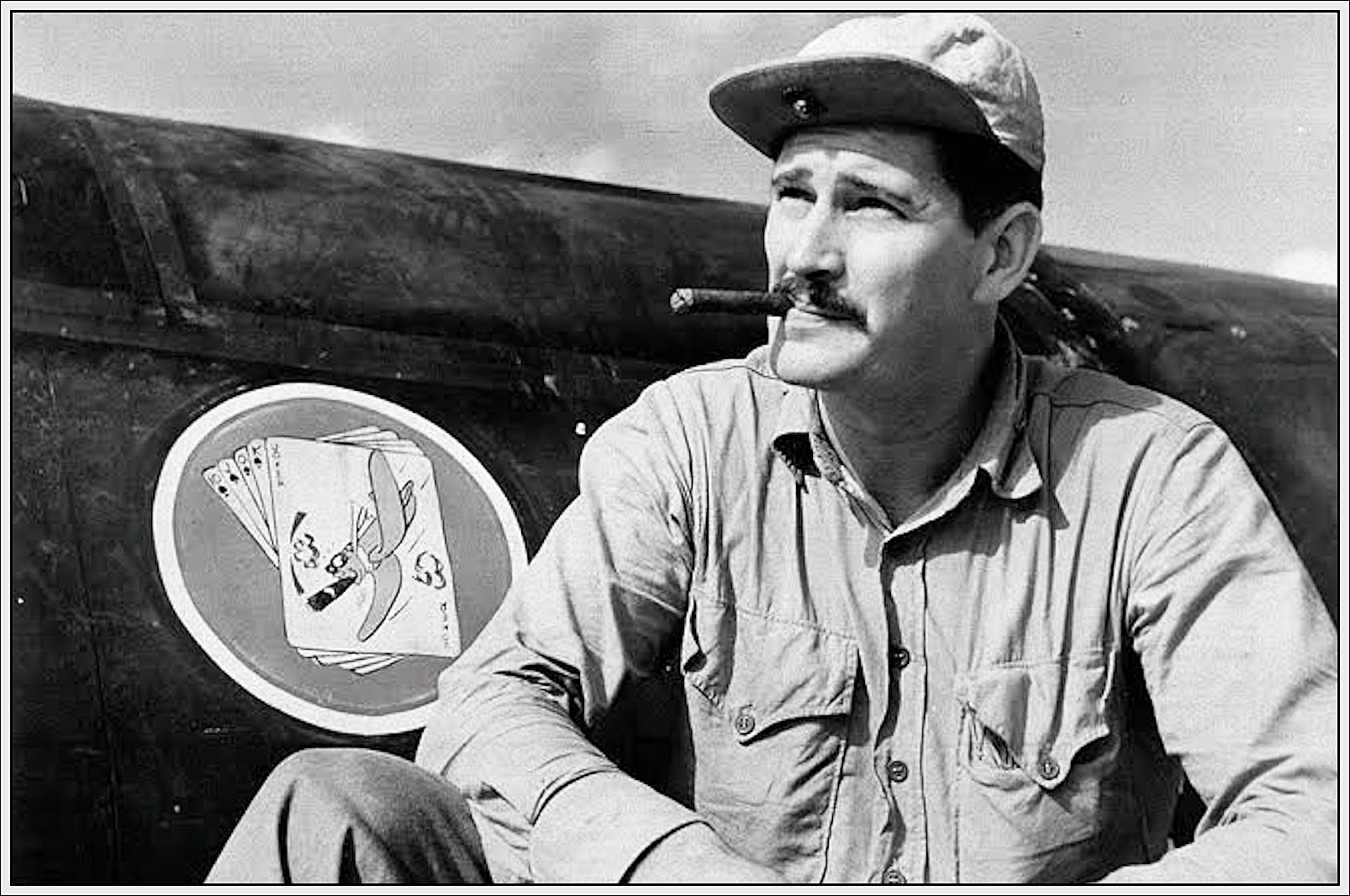

Joseph Jacob Foss (April 17, 1915-January 1, 2003)
✪ Joseph Jacob Foss was a United States Marine Corps Major and a leading Marine fighter ace in World War II. He received the Medal of Honor in recognition of his role in air combat during the Guadalcanal campaign. In postwar years, he was an Air National Guard Brigadier General, served as the 20th Governor of South Dakota (1955–1959), president of the National Rifle Association of America (NRA). He also was a television broadcaster and the first commissioner of the American Football League.
Foss was born in an unelectrified farmhouse near Sioux Falls, South Dakota, the oldest son of Mary Esther (née Lacey) and Frank Ole Foss. He was of Norwegian and Scottish descent. At age 12, he visited an airfield in Renner to see Charles Lindbergh on tour with his aircraft, the Spirit of St. Louis. Four years later, he and his father paid $1.50 apiece to take their first aircraft ride in a Ford Trimotor at Black Hills Airport with a famed South Dakota aviator, Clyde Ice.
In March 1933, while coming back from the fields during a storm, his father was killed when he drove over a downed electrical cable and was electrocuted as he stepped out of his automobile. Young Foss, not yet 18 years old, pitched in with his mother and brother Cliff to continue running the family farm. Farming was made difficult by dust storms, which over the next two years took its toll on crops and livestock.
After watching a Marine Corps aerial team perform aerobatics in open-cockpit biplanes, Foss was determined to become a Marine aviator. Foss worked at a service station to pay for books and college tuition, and to begin flight lessons from Roy Lanning, at the Sioux Skyway Airfield in 1938, after scraping up $65 to pay for the instruction. His younger brother took over the management of the farm and allowed Foss to go back to school and graduate from Washington High School in Sioux Falls. He graduated from the University of South Dakota in 1939 with a degree in business administration.
While at USD, Foss and other like-minded students convinced authorities to set up a CAA flying course at the university; he built up 100 flight hours by graduation. Foss paid for his college education by bussing tables. He joined the Sigma chapter of the Sigma Alpha Epsilon fraternity and excelled at sports in USD, fighting on the college boxing team, participating as a member of the track team and as a second-string guard on the football team.
Foss served as a Private in the 147th Field Artillery Regiment, Sioux Falls, South Dakota National Guard from 1939 to 1940. By 1940, armed with a pilot certificate and a college degree, Foss hitchhiked to Minneapolis to enlist in the Marine Corps Reserves, in order to join the Naval Aviation Cadet program to become a Naval Aviator.
Foss was accepted by the Marine Corps for flight school and commissioning. After graduation from flight school at NAS Pensacola, Florida he was designated a Naval Aviator and was commissioned as a Second Lieutenant, in the Marine Corps. At 27 years of age, he was considered too old to be a fighter pilot, and was instead sent to the Navy School of Photography. Upon completion of his initial assignment, he was transferred to Marine Photographic Squadron 1 (VMO-1) stationed at Naval Air Station North Island in San Diego, California.
Dissatisfied with his role in photographic reconnaissance, Foss made repeated requests to be transferred to a fighter qualification program. He checked out in Grumman F4F Wildcats while still assigned to VMO-1, logging over 150 flight hours in June and July, 1942, and was eventually transferred to Marine Fighting Squadron 121 VMF-121 as the executive officer. While stateside, Foss married his high school sweetheart, June Shakstad in 1942.
In October 1942, VMF-121 pilots and aircraft were sent to Guadalcanal as part of Operation Watchtower. On October 9, Foss and his group were catapult launched off the USS Copahee escort carrier and flew 350 miles north to reach Guadalcanal. The air group, code named “Cactus,” based at Henderson Field became known as the Cactus Air Force, and their presence played a pivotal role in the Battle of Guadalcanal.
Foss soon gained a reputation for aggressive close-in fighter tactics and uncanny gunnery skills. Foss shot down a Japanese Zero on his first combat mission on October 13, but his own F4F Wildcat was shot up as well, and with a dead engine and three more Zeros on his tail, he landed at full speed, with no flaps and minimal control on Henderson Field, barely missing a grove of palm trees. On 7 November his Wildcat was again hit, and he survived a ditching in the sea off the island of Malaita.
In December 1942, Foss contracted malaria. He was sent to Sydney, Australia for rehabilitation, where he met Australian ace Clive “Killer” Caldwell and delivered some lectures on operational flying to RAF pilots, newly assigned to the theater. On January 1, 1943, Foss returned to Guadalcanal, to continue combat operations with fellow fighter pilots in what was known as Foss’s Flying Circus until February 9, 1943.
In three months of sustained combat, Foss’s Flying Circus had shot down 72 Japanese aircraft; 26 of which the Marines credit to Foss. Upon matching the record of 26 kills held by America’s top World War I ace, Eddie Rickenbacker, Foss was accorded the honor of becoming America’s first “ace-of-aces” in World War II.
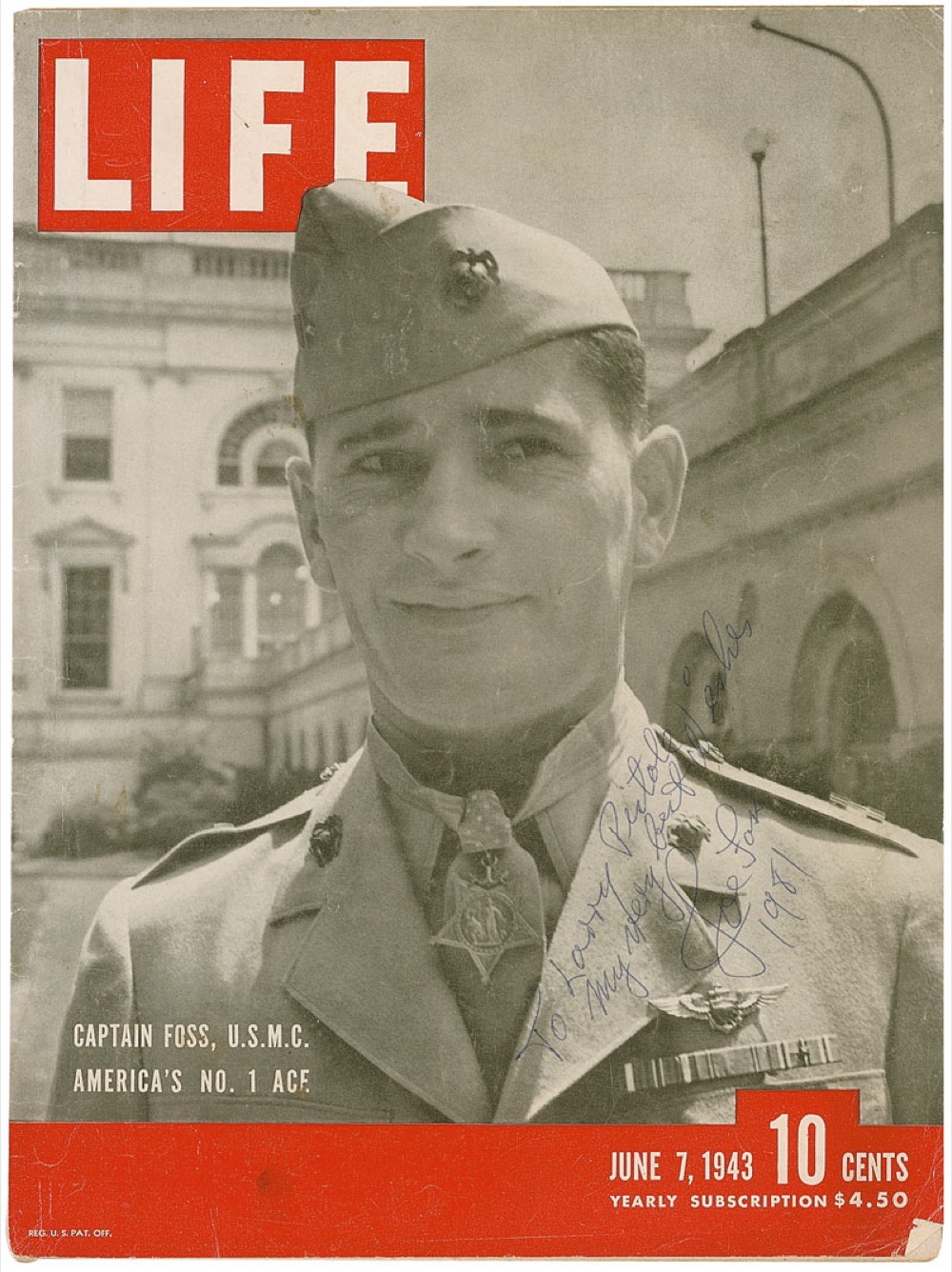
Foss returned to the United States in March 1943. On May 18, 1943, Foss received the Medal of Honor from President Franklin Delano Roosevelt. The White House ceremony was featured in Life magazine, with the reluctant Captain Foss appearing on the magazine’s cover.
In February 1944, Foss returned to the Pacific theater to lead VMF-115, flying the F4U Corsair. It was during this second tour that Foss met and became friends with fellow Marine fighter ace Marion Carl. He also had an opportunity to meet and fly with his boyhood idol, Charles Lindbergh, who was on assignment touring the South Pacific as an aviation consultant. After eight months of operational flying but no opportunities to increase his wartime score, Foss finished his combat service as one of America’s top scoring pilots.
In February 1945, Foss became operations and training officer at the Marine Corps Air Station Santa Barbara, California.
In August 1945, Foss was released to inactive duty and opened Joe Foss Flying Service, charter flying service and flight instruction school in Sioux Falls, that eventually grew into a 35-aircraft operation. With a friend, Duane “Duke” Corning, he also later owned a Packard car dealership in the town.
In 1946, Foss was appointed a Lieutenant Colonel in the South Dakota Air National Guard and instructed to form the South Dakota Air National Guard, becoming the Commanding Officer for the Guard’s 175th Fighter-Interceptor Squadron.
During the Korean War, Foss, then a Colonel, was called to active duty with the United States Air Force, relinquishing command of the 175th Squadron, and served as a Director of Operations and Training for the Central Air Defense Command; he eventually reached the rank of Brigadier General.
▶️ 11 MINUTES 37 SECONDS
Campaigning from the cockpit of a light aircraft, Foss served two elected terms as a Republican representative in the South Dakota legislature and, beginning in 1955, at age 39, as the state’s youngest governor. Foss had previously appeared on the long-running game show What’s My Line on May 1, 1955.
After serving as governor, Foss spent a short time working for Raven Industries before becoming the first Commissioner of the newly created American Football League in 1959. He oversaw the emergence of the league as the genesis of modern professional football. During the next seven years, Foss helped expand the league and made lucrative television deals, including the initial five-year, $10.6 million contract with ABC in 1960 to broadcast AFL games. Foss stepped aside as commissioner in April 1966, two months before the historic agreement that led to the merger of AFL and NFL and the creation of the Super Bowl.
Drawing on a lifelong love of hunting and the outdoors, Foss hosted ABC television’s The American Sportsman from 1964 to 1967, which took him around the world for hunting and fishing excursions. He then hosted and produced his own syndicated outdoors TV series, The Outdoorsman: Joe Foss, from 1967 to 1974. In 1972, he also began a six-year stint as Director of Public Affairs for KLM Royal Dutch Airlines.
Starting in 1988, Foss was elected to two consecutive one-year terms as president of the National Rifle Association of America. He was portrayed on the cover of the 29 January 1990 issue of Time Magazine wearing his trademark Stetson hat and holding a revolver.
Foss, who had a daughter with cerebral palsy, served as President of the National Society of Crippled Children and Adults. Foss’s other charities included the Easter Seals campaign, Campus Crusade for Christ, and an Arizona program for disadvantaged youths.
In 2001, Foss and his second wife, “Didi,” founded the Joe Foss Institute, a 501(c)(3) nonprofit organization. The institute works with veterans and educators around the United States to educate the nation’s youth on history and civics, and to inspire them to become informed and engaged citizens. Through classroom presentations, curriculum and scholarships, the Joe Foss Institute has served more than 1.35 million children, as of June 2014, nationwide. Currently, the institute offers three primary programs; Veterans Inspiring Patriotism (VIP), You are America Civics Series and scholarship contests which run year-round. Foss did many of these school visits himself, speaking to children of all ages about service, responsibility, patriotism, integrity and commitment.
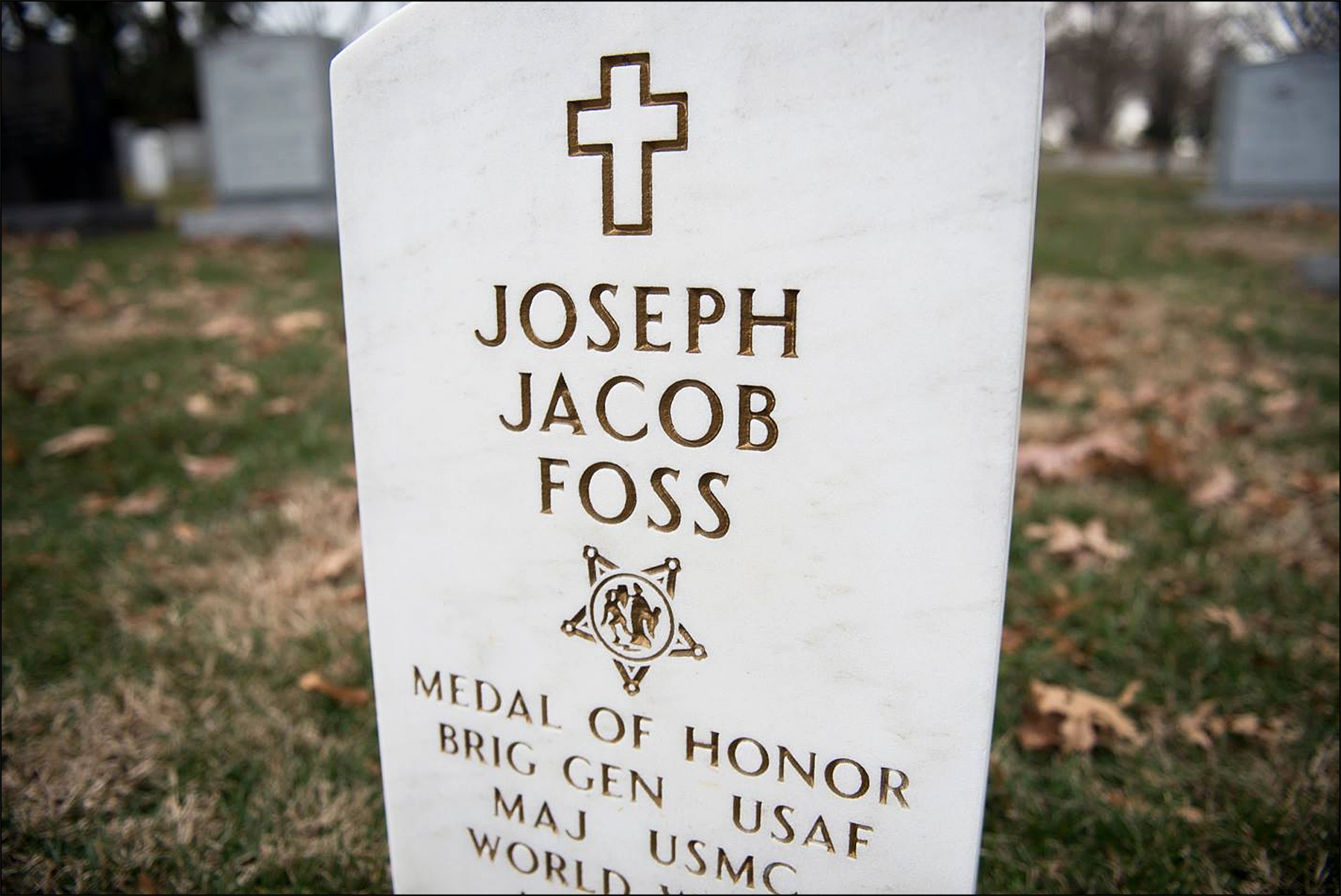
Foss suffered a stroke in October 2002 when he bled from a cerebral aneurysm. He died three months later on New Year’s Day, 2003, never having regained consciousness, in Scottsdale, Arizona, where he and his wife had made their home in later years.
Joe Foss, Medal of Honor recipient, is buried in Section 7A of Arlington National Cemetery.
A number of institutions and locations have been named in honor of Foss, including Marine Corps Air Station Miramar Joe Foss Field, the Joe Foss Field Air National Guard Station in Sioux Falls, South Dakota, the Joe Foss Field at the Sioux Falls Regional Airport, Joe Foss High School also in Sioux Falls, and the State Building in Pierre, South Dakota. A larger-than-life bronze statue of Foss stands in the lobby of the Sioux Falls Regional Airport.
In 1984, Foss was inducted into the National Aviation Hall of Fame in Dayton, Ohio. Foss was inducted into the Naval Aviation Hall of Honor at the National Naval Aviation Museum in Pensacola, Florida, in 1994.✪

















▶️ DONATE VIA PAYPAL (DEBIT & CREDIT CARD)
ALL PayPal Transactions Are Encrypted For Card Holder Privacy & Security
▶️ DONATE VIA ZELLE (DIRECT BANK CASH TRANSFER)
ZELLE is the perfect online alternative to PayPal. It’s an incredibly simple, secure, easy, fast and FREE way to send or receive money to recipients directly from your online banking account without a middleman. Best of all, there’s NO fees.
ZELLE is a service provided by your bank and is already built in to your online banking account. You only need to activate it first before using. If you’ve already activated ZELLE in your online bank or credit union account, you can donate to The New Americanist by using our ZELLE address:
vip@thenewamericanist.com
To activate your ZELLE, follow these easy instructions (a simple two minute process):

▶️ DONATE VIA SNAIL MAIL