


John Hancock: January 23,1737 – October 8,1793
✪ John Hancock was an American Founding Father, merchant, statesman, and prominent Patriot of the American Revolution. He was the longest-serving president of the Continental Congress; having served as the second president of the Second Continental Congress and the seventh president of the Congress of the Confederation. He was also the first and third governor of the Commonwealth of Massachusetts. His large and stylish signature on the United States Declaration of Independence led to John Hancock or Hancock becoming a colloquialism for a person’s signature. He also signed the Articles of Confederation; and used his influence to ensure that Massachusetts ratified the United States Constitution in 1788.
Before the American Revolution, Hancock was one of the wealthiest men in the Thirteen Colonies, having inherited a profitable mercantile business from his uncle. He began his political career in Boston as a protégé of Samuel Adams, an influential local politician, though the two men later became estranged. Hancock used his wealth to support the colonial cause as tensions increased between colonists and Great Britain in the 1760s. He became very popular in Massachusetts, especially after British officials seized his sloop Liberty in 1768 and charged him with smuggling. Those charges were eventually dropped.
Hancock was born on January 23, 1737 in Braintree, Massachusetts, in a part of town that eventually became the separate city of Quincy. He was the son of Colonel John Hancock Jr. of Braintree and Mary Hawke Thaxter who was from nearby Hingham. As a child, Hancock became a casual acquaintance of young John Adams, whom the Reverend Hancock had baptized in 1735. The Hancock family lived a comfortable life.
After Hancock’s father died in 1744, he was sent to live with his uncle and aunt, Thomas Hancock and Lydia (Henchman) Hancock. Thomas Hancock was the proprietor of a firm known as the House of Hancock, which imported manufactured goods from Britain and exported rum, whale oil, and fish. Thomas Hancock’s highly successful business made him one of Boston’s richest and best-known residents.
After graduating from the Boston Latin School in 1750, Hancock enrolled in Harvard College and received a bachelor’s degree in 1754. Upon graduation, he began work with his uncle just as the French and Indian War was beginning. Hancock worked hard, but he also enjoyed playing the role of a wealthy aristocrat and developed a fondness for expensive clothes.
From 1760 to 1761, Hancock lived in England while building relationships for his uncle’s business with customers and suppliers. Upon returning to Boston, Hancock gradually assumed control over the House of Hancock as his uncle’s health failed; becoming a full partner in January 1763. He became a member of the Masonic Lodge of St. Andrew in October 1762, which connected him with many of Boston’s most influential citizens. When Thomas Hancock died in August 1764, John inherited the business, Hancock Manor. There is no historical evidence John Hancock ever bought or sold slaves.
After its victory in the Seven Years’ War, the British Empire was deeply in debt. Looking for new sources of revenue, the British Parliament sought, for the first time, to directly tax the colonies, beginning with the Sugar Act of 1764. The Sugar Act of 1764 provoked outrage in Boston, where it was widely viewed as a violation of colonial rights.
The earlier Molasses Act of 1733, a tax on shipments from the West Indies produced hardly any revenue because it was widely bypassed by smuggling, which was seen as a victimless crime. Not only was there little social stigma attached to smuggling in the colonies, but in port cities where trade was the primary generator of wealth, smuggling enjoyed considerable community support, and it was even possible to obtain insurance against being caught. Colonial merchants developed an impressive repertoire of evasive maneuvers to conceal the origin, nationality, routes, and content of their illicit cargoes. This included the frequent use of fraudulent paperwork to make the cargo appear legal and authorized. And much to the frustration of the British authorities, when seizures did happen local merchants were often able to use sympathetic provincial courts to reclaim confiscated goods and have their cases dismissed.
Hancock was not yet a political activist; however, he criticized the tax for economic, rather than constitutional, reasons. Hancock emerged as a leading political figure in Boston just as tensions with Great Britain were increasing. Hancock joined the resistance to the Stamp Act of 1765 by participating in a boycott of British goods, which made him even more popular in Boston. After Bostonians learned of the impending repeal of the Stamp Act, Hancock was elected to the Massachusetts House of Representatives in May 1766.
After the repeal of the Stamp Act, the British Parliament took a different approach to raising revenue by passing the 1767 Townshend Acts, which established new duties on various imports and strengthened the customs agency by creating the American Customs Board. Colonial merchants, even those not involved in smuggling, found the new regulations oppressive. Other colonists protested that new duties were another attempt by Parliament to tax the colonies without their consent. Hancock joined other Bostonians in calling for a boycott of British imports until the Townshend duties were eventually repealed.
On April 9, 1768, two customs employees (called tidesmen) boarded Hancock’s brig Lydia in Boston Harbor. Hancock was summoned, and finding that the agents lacked a writ of assistance (a general search warrant), he did not allow them to go below deck. Customs officials wanted to file charges, but the case was dropped when Massachusetts Attorney General Jonathan Sewall ruled that Hancock had broken no laws. Some of Hancock’s most ardent admirers later called this incident the first act of physical resistance to British authority in the colonies and credit Hancock with initiating the American Revolution.
The next incident proved to be a major event in the coming of the American Revolution. On the evening of May 9, 1768, Hancock’s sloop Liberty arrived in Boston Harbor, carrying a shipment of Madeira wine. When custom officers inspected the ship the next morning, they found that it contained 25 pipes of wine, just one fourth of the ship’s carrying capacity. Hancock paid the duties on the 25 pipes of wine, but officials suspected that he had arranged to have more wine unloaded during the night to avoid paying the duties for the entire cargo.
On June 10, customs officials seized the Liberty. A riot broke out when officials began to tow Liberty out to to the HMS Romney a 50 gun British frigate, which was also an arguable violation of existing legislation. The confrontation escalated when sailors and marines coming ashore to seize the Liberty were mistaken for a press gang.
British officials filed two lawsuits stemming from Liberty incident: an in rem suit against the ship and an in personam suit against Hancock. The first suit, filed on June 22, 1768, resulted in the confiscation of Liberty in August. Customs officials then used the ship to enforce trade regulations until it was burned by angry colonists in Rhode Island the following year. After dragging out for nearly five months, the proceedings of the second suit against Hancock were dropped without explanation.
Aside from Liberty affair, the degree to which Hancock was engaged in smuggling, which may have been widespread in the colonies, has been questioned. Given the clandestine nature of smuggling, records are scarce. If Hancock was a smuggler, no such documentation of this has ever been found.
The Liberty affair reinforced a previously made British decision to suppress unrest in Boston with a show of military might. in March 1770, a crowd taunting British troops, provoking them to fire on the crowd, killing of five civilians in the what would come to be known as the Boston Massacre. Hancock was not directly involved in the incident, but afterwards he led a committee to demand the removal of the troops.
Hancock was celebrated as a hero for his role in getting the troops withdrawn; and, his re-election to the Massachusetts House in May was nearly unanimous.
Over the next few months, Hancock became disabled by gout, which would trouble him with increasing frequency in the coming years. By March 5, 1774, he had recovered enough to deliver the fourth annual Massacre Day oration; a commemoration of the Boston Massacre. Hancock’s speech denounced the presence of British troops in Boston, who he said had been sent there “to enforce obedience to acts of Parliament, which neither God nor man ever empowered them to make.”
On December 1, 1774, the Provincial Congress elected Hancock as a delegate to the Second Continental Congress. Before Hancock reported to the Continental Congress in Philadelphia, the Provincial Congress unanimously re-elected him as their president in February 1775. Hancock’s multiple roles gave him enormous influence in Massachusetts; and as early as January 1774 British officials had considered arresting him.
With the Revolutionary War underway, Hancock made his way to the Continental Congress in Philadelphia with the other Massachusetts delegates. On May 24, 1775, he was unanimously elected President of the Continental Congress.
In Congress on June 15, 1775, Massachusetts delegate John Adams nominated George Washington as commander-in-chief of the army then gathered around Boston. Years later, Adams wrote that Hancock had shown great disappointment at not getting the command for himself.
When Congress recessed on August 1, 1775, Hancock took the opportunity to wed his fiancée, Dorothy “Dolly” Quincy. The couple was married on August 28 in Fairfield, Connecticut. They had two children, neither of whom survived to adulthood.
Hancock served in Congress through some of the darkest days of the Revolutionary War. The British drove Washington from New York and New Jersey in 1776, which prompted Congress to flee to Baltimore. Hancock and Congress returned to Philadelphia in March 1777 but were compelled to flee six months later when the British occupied Philadelphia. Hancock wrote innumerable letters to colonial officials, raising money, supplies, and troops for Washington’s army.
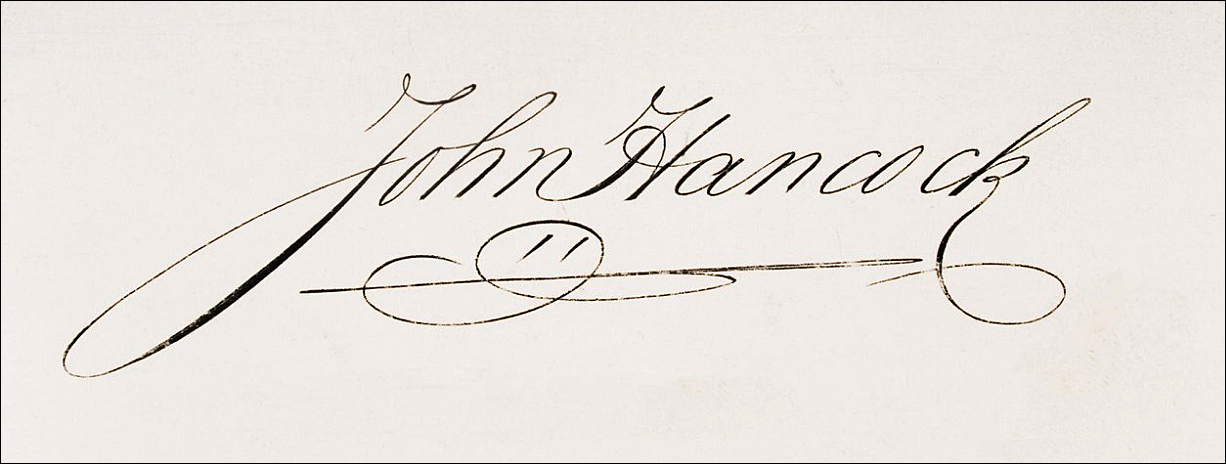
Hancock was president of Congress when the Declaration of Independence was adopted and signed. He is primarily remembered by Americans for his large, flamboyant signature on the Declaration, so much so that “John Hancock” became, in the United States, an informal synonym for a person’s signature. According to legend, Hancock signed his name largely and clearly so King George would be able to read it without his spectacles.
Hancock returned to Boston in July 1778, motivated by the opportunity to finally lead men in combat. Back in 1776, he had been appointed as the senior major general of the Massachusetts militia.
After much delay, the Massachusetts Constitution finally went into effect in October 1780. To no one’s surprise, Hancock was elected Governor of Massachusetts in a landslide victory, garnering over 90% of the vote. In the absence of formal party politics, the contest was one of personality, popularity, and patriotism. Hancock was immensely popular and unquestionably patriotic given his personal sacrifices and his leadership of the Second Continental Congress.
Hancock governed Massachusetts through the end of the Revolutionary War and into an economically troubled postwar period, repeatedly winning re-election by wide margins. Hancock took a hands-off approach to governing, avoiding controversial issues as much as possible. According to William Fowler, Hancock “never really led” and “never used his strength to deal with the critical issues confronting the commonwealth.” Hancock governed until his surprise resignation on January 29, 1785. Hancock cited his failing health as the reason for his resignation.
When he had resigned as governor in 1785, Hancock was again elected as a delegate to Congress, then known as the Confederation Congress after the ratification of the Articles of Confederation in 1781.
In an effort to remedy the perceived defects of the Articles of Confederation, delegates were first sent to the Annapolis Convention in 1786 and then to the Philadelphia Convention in 1787, where they drafted the United States Constitution, which was then sent to the states for ratification or rejection. Hancock, who was not present at the Philadelphia Convention, had misgivings about the Constitution’s lack of a bill of rights and its shift of power to a central government.
Hancock mostly remained silent during the contentious debates, but as the convention was drawing to close, he gave a speech in favor of ratification. Even with the support of Hancock and Adams, the Massachusetts Convention narrowly ratified the Constitution by a vote of 187 to 168. Hancock’s support was probably a deciding factor in the ratification.
Hancock was also put forth as a candidate in the 1789 U.S. presidential election. However, Hancock knew that Washington was going to be elected as the first president, but he may have been interested in being vice president, despite his poor health.
With his health failing, Hancock spent his final few years as essentially a figurehead governor. With his wife at his side, he died in bed on October 8, 1793, at age 56. By order of acting governor Samuel Adams, the day of Hancock’s burial was a state holiday; the lavish funeral was perhaps the grandest given to an American up to that time.
No full-length biography of Hancock appeared until the 20th Century. A challenge facing Hancock biographers as compared to other prominent Founding Fathers such as Thomas Jefferson and John Adams, Hancock left relatively few personal writings for historians to use in interpreting his life.
As a result, most depictions of him have relied on the voluminous writings of his political opponents, who were often scathingly critical of him. According to historian Charles Akers, “The chief victim of Massachusetts historiography has been John Hancock, the most gifted and popular politician in the Bay State’s long history. He suffered the misfortune of being known to later generations almost entirely through the judgments of his detractors.“
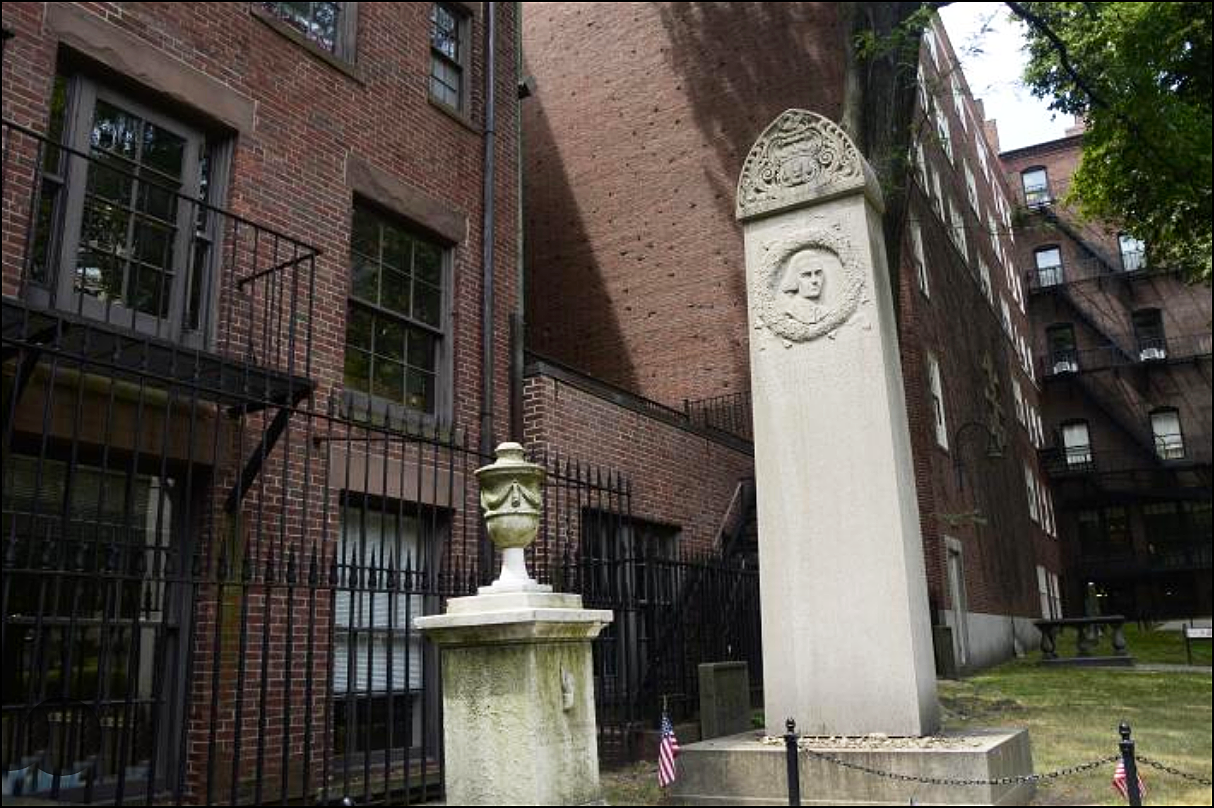
Hancock is interred at the Granary Burial Grounds in Boston, Massachusetts. ✪















▶️ DONATE VIA PAYPAL (DEBIT & CREDIT CARD)
ALL PayPal Transactions Are Encrypted For Card Holder Privacy & Security
▶️ DONATE VIA ZELLE (DIRECT BANK CASH TRANSFER)
ZELLE is the perfect online alternative to PayPal. It’s an incredibly simple, secure, easy, fast and FREE way to send or receive money to recipients directly from your online banking account without a middleman. Best of all, there’s NO fees.
ZELLE is a service provided by your bank and is already built in to your online banking account. You only need to activate it first before using. If you’ve already activated ZELLE in your online bank or credit union account, you can donate to The New Americanist by using our ZELLE address:
vip@thenewamericanist.com
To activate your ZELLE, follow these easy instructions (a simple two minute process):

▶️ DONATE VIA SNAIL MAIL