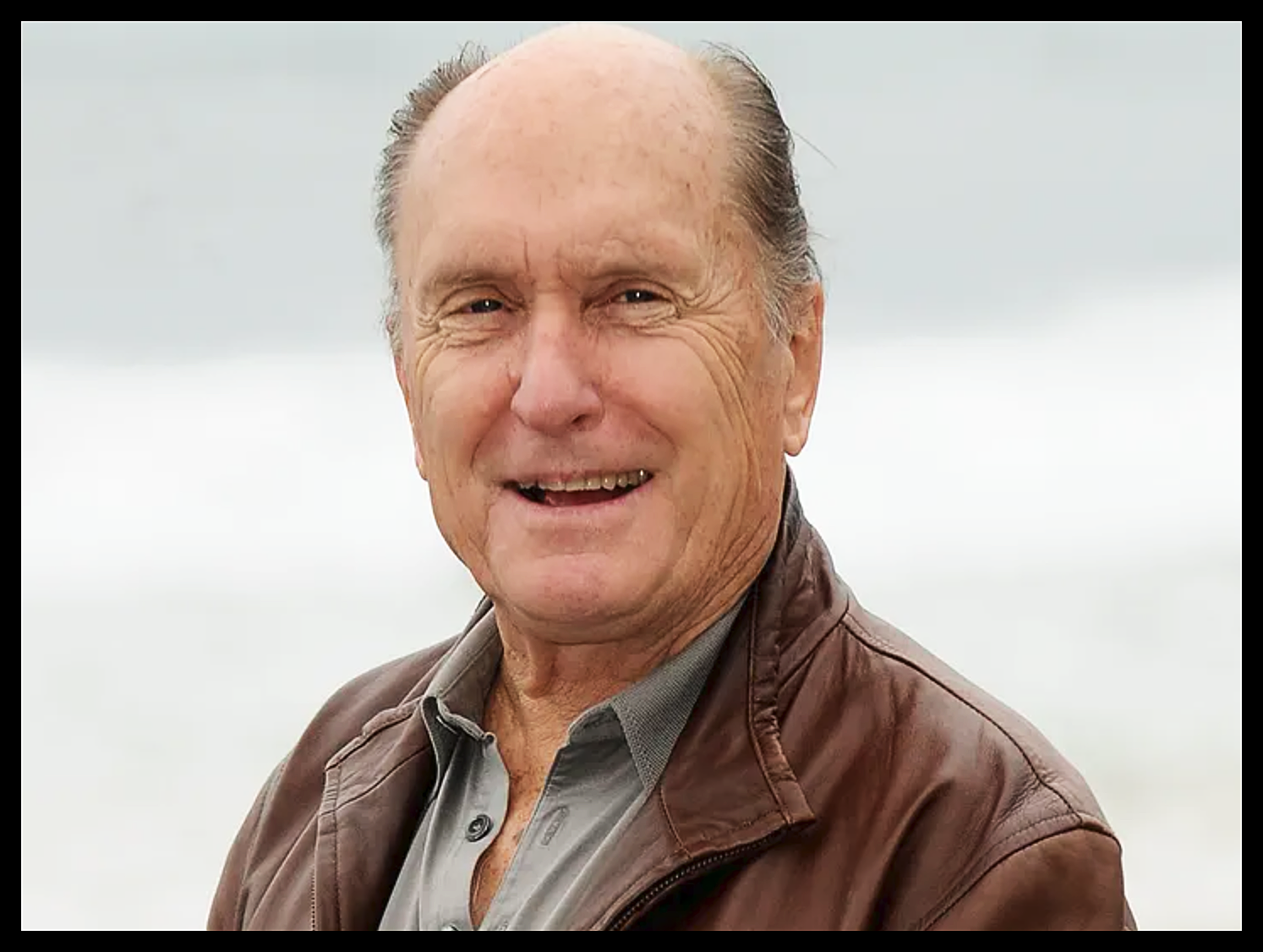

Robert Selden Duvall: January 5, 1931 – February 15, 2026
✪ Robert Selden Duvall was an American actor and filmmaker. With a career spanning seven decades, he received an Academy Award, a BAFTA Award, four Golden Globe Awards, two Primetime Emmy Awards, and a Screen Actors Guild Award. He is regarded as one of the greatest actors of all time.
Duvall began his television career appearing in minor roles in the 1950’s & 1960’s on The Defenders, Playhouse 90, and Armstrong Circle Theatre. He made his his Broadway debut in the play Wait Until Dark in 1966. He returned to the stage in David Mamet’s play American Buffalo in 1977, earning a Drama Desk Award for Outstanding Actor in a Play nomination. He made his feature film debut portraying Boo Radley in To Kill a Mockingbird (1962). His other early roles include Captain Newman, M.D. (1963), Bullitt (1968), TrueGrit (1969), MASH (1970), THX 1138 (1971), Joe Kidd (1972), and Tomorrow (1972).
Duvall won the Academy Award for Best Actor for his performance as an alcoholic former country music star in Tender Mercies (1983). His other Oscar-nominated roles included The Godfather (1972), Apocalypse Now (1979), The Great Santini (1979), The Apostle (1997), A Civil Action (1998), and The Judge (2014). His other notable films included The Outfit (1973), The Godfather Part II (1974), The Conversation (1974), Network (1976), True Confessions (1981), TheNatural (1984), Colors (1988), Days of Thunder (1990), Rambling Rose (1991), FallingDown (1993), The Paper (1994), Sling Blade (1996), Gone in 60 Seconds (2000), Open Range (2003), Crazy Heart (2009), Get Low (2010), Jack Reacher (2012), Widows (2018), and Hustle (2022).
Throughout his career, Duvall also starred in numerous television productions. He won the Primetime Emmy Award for Outstanding Limited Series and Outstanding Lead Actor in a Limited Series for the AMC limited series Broken Trail (2006). His other Emmy-nominated roles included the CBS miniseries Lonesome Dove (1989), the HBO film Stalin (1992), and the TNT film The Man Who Captured Eichmann (1996).
Robert Selden Duvall was born on January 5, 1931 in San Diego, California to Mildred Virginia Duvall (née Hart), an amateur actress, and Rear Admiral William Howard Duvall of the United States Navy. The second of three sons, Duvall grew up alongside his elder brother, William Jr., and a younger brother, John, who later became an entertainment lawyer.
Duvall was raised in a Christian Science household, though he later noted that he did not attend church. He spent much of his childhood in Annapolis, Maryland where his father was stationed at the United States Naval Academy. He attended Severn School in Severna Park, Maryland, and The Principia in St. Louis, Missouri, before graduating with a Bachelor of Arts Degree in Drama from from Principia College in Elsah, Illinois, in 1953.
Duvall’s father expected him to attend the Naval Academy, but Duvall said “I was terrible at everything but acting—I could barely get through school.” He instead enlisted & served in the United States Army after the Korean War, from August 19, 1953, to August 20, 1954; and was discharged as a private first class. “That’s led to some confusion in the press,” he explained in a 1984 interview, “Some stories have me shooting it out with the Commies from a foxhole over in Frozen Chosin. Pork Chop Hill stuff. Hell, I barely qualified with the M-1 rifle in basic training.”
In the winter of 1955, Duvall attended the Neighborhood Playhouse School of the Theatre in New York City to study studying under Sanford Meisner on the G.I. Bill. His classmates at the Playhouse included Dustin Hoffman, Gene Hackman, and James Caan.
In 1955, Duvall roomed with Hoffman in a New York City apartment while they studied together at the Playhouse. Around the same time also shared living accommodations with Hackman while working odd jobs such as clerking at Macy’s, sorting mail, and driving a truck.
Duvall began his professional acting career with the Gateway Playhouse, an Equity summer theater based in Bellport, Long Island, New York. His stage debut took place in its 1952 season, when he played the Pilot in Laughter in the Stars, an adaptation of The Little Prince, at what was then the Gateway Theatre.
During Gateway’s 1956 season, his third with the company, Duvall played Max Halliday in Frederick Knott’s Dial M for Murder (July 1956), Virgil Blessing in Inge’s Bus Stop (August 1956), and Clive Mortimer in John Van Druten’s I Am a Camera (August 1956). Playbills that year described him as “an audience favorite” in the last season and as having “appeared at the Neighborhood Playhouse in New York and studied acting with Sandy Meisner this past winter.”
Already receiving top-billing at the Gateway Playhouse during the 1959 season, Duvall appeared in lead roles as Stanley Kowalski in Tennessee Williams’ A Streetcar Named Desire (July–August 1959), Maxwell Archer in Once More with Feeling, Igor Romanoff in Peter Ustinov’s Romanoff and Juliet, and Joe Mancuso in Kyle Crichton’s The Happiest Millionaire.
Duvall made his off-Broadway debut at the Gate Theater as Frank Gardner in George Bernard Shaw’s Mrs. Warren’s Profession on June 25, 1958. However, the play closed only three days later (June 28) after five performances. His most notable off-Broadway performance, for which he won an Obie Award in 1965 and which he considers his “Othello,” was as Eddie Carbone, again, in Miller’s A View from the Bridge at the Sheridan Square Playhouse from January 28, 1965, to December 11, 1966.
In 1959, Duvall made his first television appearance on Armstrong Circle Theater in the episode “The Jailbreak.” He appeared regularly on television as a guest actor during the 1960s, often in action, suspense, detective, or crime dramas. His appearances during this time include performances on Alfred Hitchcock Presents, Naked City, The Untouchables, Route 66, The Twilight Zone, Combat!, The Outer Limits, The Fugitive, T.H.E. Cat, Voyage to the Bottom of the Sea, The Time Tunnel, The Wild Wild West, The F.B.I., and The Mod Squad.
▶️ 2 Minutes 3 Seconds
Duvall made his film debut as Boo Radley in the critically acclaimed To Kill a Mockingbird (1962). After To Kill a Mockingbird, Duvall appeared in a number of films during the 1960s, mostly in midsized parts, but also in a few larger supporting roles. Duvall had a small part as a cab driver who ferries McQueen around just before the chase scene in the film Bullitt (1968). He was the notorious malefactor “Lucky” Ned Pepper in True Grit (1969), in which he engaged in a climactic shootout with John Wayne’s Rooster Cogburn on horseback.
▶️ 2 Minutes 41 Seconds
Duvall became an established presence in American films beginning in the 1970s. He drew a considerable amount of attention in 1970 for his portrayal of the malevolent Major Frank Burns in the film M*A*S*H and for his portrayal of the title role in THX 1138 in 1971 where he plays a fugitive trying to escape a society controlled by robots. His first major critical success came portraying Tom Hagen Hagen in The Godfather (1972) and The Godfather Part II (1974), the 1972 film earning him an Academy Award nomination for Best Supporting Actor.
▶️ 6 Minutes 43 Seconds
By the mid-1970s Duvall was established as a top character actor in high demand; People magazine described him as “Hollywood’s No. 1 No. 2 lead.”” Duvall received another Oscar nomination for Best Supporting Actor and won both a BAFTA Award and Golden Globe Award for his role as Lt. Colonel Kilgore in Apocalypse Now (1979). His signature line “I love the smell of napalm in the morning” from Apocalypse Now is regarded as iconic in cinema history:
▶️ 2 Minutes 54 Seconds
“You smell that? Do you smell that? Napalm, son. Nothing else in the world smells like that. I love the smell of napalm in the morning. You know, one time we had a hill bombed, for twelve hours. When it was all over I walked up. We didn’t find one of ’em, not one stinkin’ dink body. But the smell! You know – that gasoline smell… the whole hill! Smelled like… victory. (Pause) Some day this war is going to end…”
Francis Ford Coppola praised Duvall as “one of the four or five best actors in the world.” Wanting top billing in films, Duvall returned to Broadway in 1977 to appear as Walter Cole in David Mamet’s American Buffalo, stating “I hope this will get me better film roles.”
Duvall continued to appear in films during the 1980s, including the roles of a detective in True Confessions (1981), a disillusioned sportswriter Max Mercy in The Natural (1984) and Los Angeles police officer Bob Hodges in Colors (1988). He won an Oscar for Best Actor as country western singer Mac Sledge in Tender Mercies (1983) where Duvall did his own singing, insisting it be added to his contract that he sing the songs himself. Duvall said, “What’s the point if you’re not going to do your own [singing]? They’re just going to dub somebody else? I mean, there’s no point to that.”
▶️ 2 Minutes 7 Seconds
In 1989, Duvall appeared in the miniseries Lonesome Dove in the role of Captain Augustus “Gus” McCrae, Texas Rangers (retired). He considered this particular role to be his personal favorite. He won a Golden Globe Award and earned another Emmy Award nomination.
▶️ 2 Minutes 18 Seconds
In 1992, Duvall founded the production company Butcher’s Run Films. Duvall maintained a busy film schedule throughout the 1990s, sometimes appearing in as many as four films in a single year. He received Academy Award nominations for his portrayals of evangelical preacher Euliss “Sonny” Dewey in The Apostle (1997); which he also wrote and directed.
Duvall directed Assassination Tango (2002), a thriller inspired by his long‑standing interest in tango: and he also portrayed General Robert E Lee in Gods and Generals (2003).
▶️ 4 Minutes 42 Seconds
Duvall continued working in television from the 1990s onward. He won a Golden Globe Award and received an Emmy nomination for his portrayal of Soviet Premier Joseph Stalin in the 1992 television film Stalin. He earned another Emmy nomination in 1997 for portraying Adolf Eichmann in The Man Who Captured Eichmann. In 2006, he won an Emmy for his performance as Prentice “Print” Ritter in the AMC miniseries revisionist Western miniseries Broken Trail.
In 2005, Duvall was awarded a National Medal of Arts by President George W. Bush at the White House. He also has a star on the St. Louis Walk of Fame.
Duvall was married four times but did not have any children. “I guess I’m shooting blanks,” he said in 2007. He added, “I’ve tried with a lot of different women, in and out of marriage.” He met his first wife, Barbara Benjamin, a former announcer and dancer on The Jackie Gleason Show, during the filming of To Kill a Mockingbird (1962). She and Duvall were married from 1964 until 1975.
His second marriage was to Gail Youngs, to whom he was married from 1982 to 1986. Duvall’s third marriage was to Sharon Brophy, a dancer, from 1991 to 1995.
In 2005, Duvall married his fourth wife, Luciana Pedraza, granddaughter of Argentine aviation pioneer Susana Ferrari Billinghurst. He met Pedraza in Argentina, recalling, “The flower shop was closed, so I went to the bakery. If the flower shop had been open, I never would’ve met her.” Both were born on January 5, though Duvall was 41 years older. They remained together since 1997.
He produced, directed, and acted with her in Assassination Tango (2002), much of which was filmed in Buenos Aires. Duvall was known as a skilled Argentine tango dancer and maintained tango studios in both Argentina and the United States. He also trained in Brazilian jiu-jitsu and practiced martial arts with his wife.
Duvall’s political views were variously described as libertarian and conservative. He was personally invited to Republican President George W. Bush’s inauguration in 2001. In September 2007, he announced his support for Rudy Giuliani’s campaign in the 2008 Republican Party presidential primaries. Duvall worked the floor at the GOP’s 2008 national convention. In 2014, Duvall said in an interview that he may become independent due to the Republican Party being a mess at that point.
In 2001, Pedraza and Duvall founded the Robert Duvall Children’s Fund to assist families in Northern Argentina through the renovation of homes, schools, and medical facilities. They were also active supporters of Pro Mujer, a nonprofit organization dedicated to helping some of Latin America’s poorest women, with their efforts focused on Pedraza’s home region in the Argentine Northwest.
In May 2009, Duvall spoke for historic preservation against Walmart’s proposal to build a store across the road from the entrance to the Wilderness Battlefield National Park in Orange County, Virginia. In 2011, he appeared at the Texas Children’s Cancer Center charity event in Houston, “An Evening with a Texas Legend.”
Duvall died peacefully at his ranch surrounded by his family in Middleburg, Virginia, on February 15, 2026 at age 95. His death was announced through a public statement by his wife Luciana Pedraza. In the statement she did not list a cause of death. ✪


















▶️ ◼️◼️◼️◼️◼️◼️◼️◼️◼️ ✪✪✪ DONATE ✪✪✪ ◼️◼️◼️◼️◼️◼️◼️◼️◼️◼️

▶️ DONATE VIA PAYPAL (DEBIT & CREDIT CARD)
ALL PayPal Transactions Are Encrypted For Card Holder Privacy & Security
▶️ DONATE VIA ZELLE (DIRECT BANK CASH TRANSFER)
ZELLE is the perfect online alternative to PayPal. It’s an incredibly simple, secure, easy, fast and FREE way to send or receive money to recipients directly from your online banking account without a middleman. Best of all, there are NO fees.
ZELLE is a service provided by your bank and is already built in to your online banking account. You only need to activate it first before using. If you’ve already activated ZELLE in your online bank or credit union account, you can donate to The New Americanist by using our ZELLE address:
vip@thenewamericanist.com
To activate your ZELLE, follow these easy instructions (a simple two minute process):

▶️ DONATE VIA SNAIL MAIL