
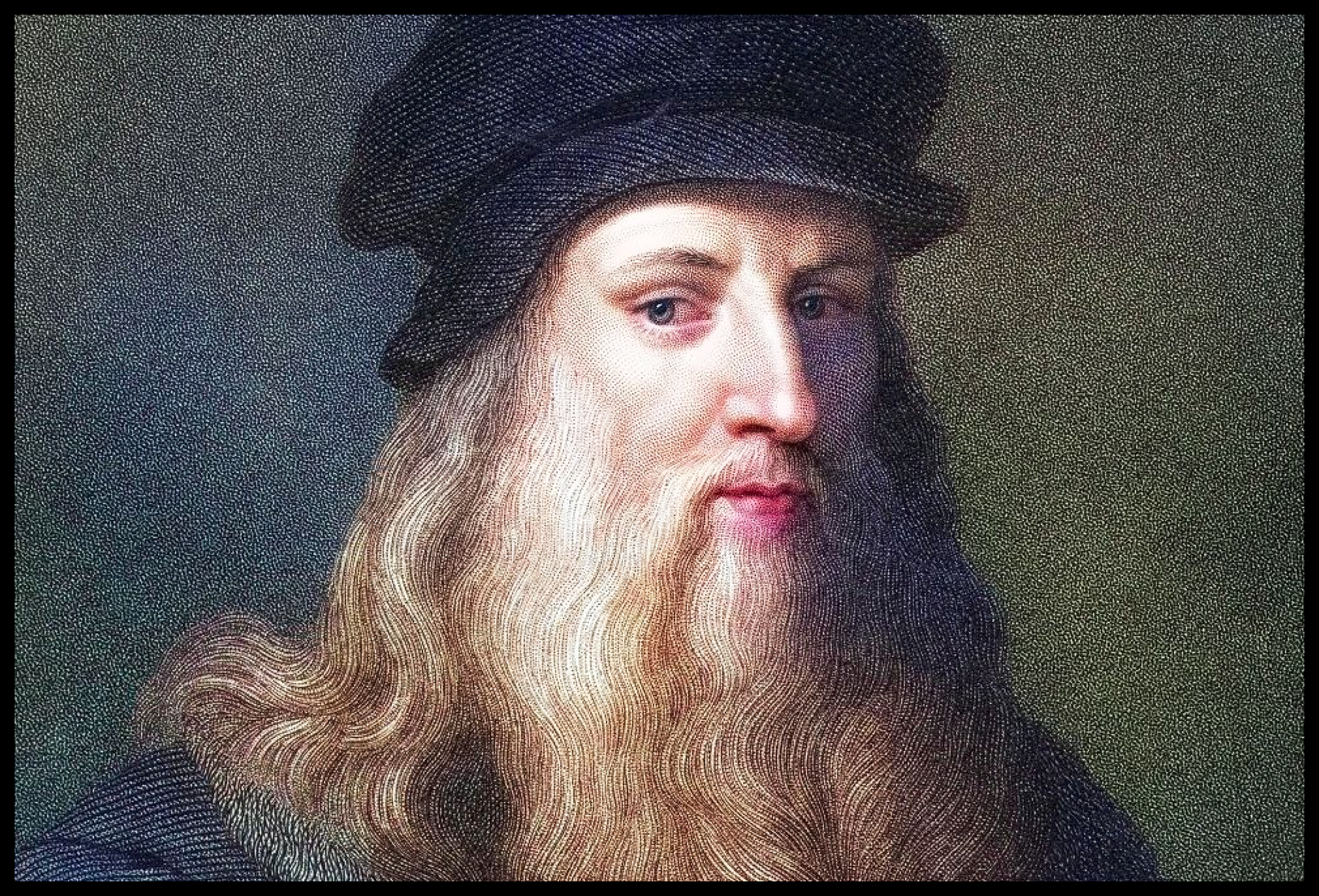

Leonardo di ser Piero da Vinci (April 15, 1452 – May 2, 1519)
✪ Leonardo di ser Piero da Vinci was an Italian polymath of the High Renaissance who was active as a painter, draughtsman, engineer, scientist, theorist, sculptor, and architect. While his fame initially rested on his achievements as a painter, he has also become known for his notebooks, in which he made drawings and notes on a variety of subjects, including anatomy, astronomy, botany, cartography, painting, and palaeontology. Leonardo is widely regarded as a genius who embodied & epitomized the Renaissance humanist ideal.
Leonardo is also identified as one of the greatest painters in the history of Western art and often credited as the founder of the High Renaissance. Despite having many lost works and fewer than 25 attributed major works; including numerous unfinished works, he created some of the most influential paintings in the Western canon. The Mona Lisa is his best known work and is regarded as the world’s most famous individual painting. The Last Supper is the most reproduced religious painting of all time and his Vitruvian Man drawing is also regarded as a cultural icon.
Revered for his technological ingenuity, Leonardo conceptualized flying machines, a type of armored fighting vehicle predating modern tank designs, concentrated solar power, a ratio machine which could be used in an adding machine, and the double hull. Relatively few of his designs were constructed or were even feasible during his lifetime, as the modern scientific approaches to the necessary metallurgy and engineering were only in their stages of infancy during the Renaissance.
However, some of Leonardo’s smaller inventions entered the world of manufacturing unheralded, such as an automated bobbin winder and a machine for testing the tensile strength of wire. He also made substantial discoveries which contributed to and influenced the fields of anatomy, civil engineering, hydrodynamics, geology, optics, and tribology. Unfortunately he did not publish the majority of his findings during his lifetime and they had little to no direct influence on subsequent science until much later.
Leonardo da Vinci, formally named Leonardo di ser Piero da Vinci (“Leonardo, son of ser Piero from Vinci”), was born on April 15 1452 out of wedlock as an illegitimate child to Piero da Vinci (1426–1504), a Florentine legal notary, and Caterina di Meo Lippi (1434–1494), from the lower class. The precise location of Leonardo’s birth remains uncertain; however the traditional account, from a local oral tradition recorded by the historian Emanuele Repetti, says he was born in Anchiano, Vinci, in the Republic of Florence. A small country hamlet which would have offered sufficient privacy for the illegitimate birth.
Very little is known about Leonardo’s childhood and much of his personal life is shrouded in mystery & myth. What little which is known is partially because of his biography in the frequently apocryphal Lives of the Most Excellent Painters, Sculptors, and Architects (1550) by 16th-century art historian Giorgio Vasari. Tax records indicate by 1457, Leonardo was living in the household of his paternal grandfather, Antonio da Vinci. Despite his family history, Leonardo only received a basic and informal education in (vernacular) writing, reading, and mathematics.
Leonardo would record his earliest memory, now in the Codex Atlanticus. While writing on the flight of birds, he recalled as an infant when a kite floated down into his cradle and opened his mouth with its tail. Historians still debate whether this anecdote was an actual memory, dream or fantasy.
In the mid-1460s, Leonardo’s family moved to Florence, which at the time was the centre of Christian Humanist thought and culture. At the age of 14, he became a garzone (studio boy) in the workshop of Andrea del Verrocchio, who was the leading Florentine painter and sculptor of his time.
In the studio of Verrocchio, Leonardo was exposed to both theoretical training and developed a wide range of technical skills, including drafting, chemistry, metallurgy, metal working, plaster casting, leather working, mechanics, and woodwork, as well as the artistic skills of drawing, painting, sculpting, and modeling.
Much of the painting in Verrocchio’s workshop was done by his assistants. According to Vasari, Leonardo collaborated with Verrocchio on his The Baptism of Christ (c. 1472–1475), painting the young angel holding Jesus’s robe with skill so far superior to his master’s that Verrocchio purportedly put down his brush and never painted again.
Vasari also tells a story of Leonardo as a very young man: a local peasant made himself a round buckler shield and requested that Ser Piero have it painted for him. Leonardo, inspired by the story of Medusa, responded with a painting of a monster spitting fire that was so terrifying that his father bought a different shield to give to the peasant and sold Leonardo’s to a Florentine art dealer for 100 ducats, who in turn sold it to the Duke of Milan.
By 1472, at the age of 20, Leonardo qualified as a master in the Guild of Saint Luke, the guild of artists and doctors of medicine. Leonardo’s earliest known dated work is a 1473 pen-and-ink drawing of the Arno Valley. According to Vasari, the young Leonardo was the first to suggest turning the Arno river into a navigable channel between Florence and Pisa
Leonardo worked in Milan from 1482 until 1499, where he was commissioned to paint the Virgin of the Rocks for the Confraternity of the Immaculate Conception and The Last Supper for the monastery of Santa Maria delle Grazie. Leonardo was employed on many other projects for Sforza, such as preparation of floats and pageants for special occasions; a drawing and wooden model in a competition to design the cupola for the Duomo Milan Cathedral.
in 1500 when the French attacked and occupied Milan, Leonardo fled Milan for Venice, accompanied by his assistant Salaì. In Venice, Leonardo found employment as a military architect and engineer: devising methods to defend the city from naval attack.
On his return to Florence in 1500, Leonardo and his household were guests of the Servite monks at the monastery of Santissima Annunziata where they were provided with a workshop, according to Vasari, Leonardo created the cartoon of The Virgin and Child with Saint Anne and Saint John the Baptist, a work that won such admiration that “men and women, young and old” would flock to see it “as if they were going to a solemn festival.”
By 1508, Leonardo returned to Milan to live in his own house in Porta Orientale in the parish of Santa Babila. In March 1513, after Lorenzo de’ Medici’s son Giovanni assumed the papacy (as Leo X); Leonardo went to Rome in September, where he was received by the pope’s brother Giuliano. From September 1513 to 1516, Leonardo spent much of his time living in the Belvedere Courtyard in the Apostolic Palace, where Michelangelo and Raphael were both active. Leonardo was given an allowance of 33 ducats a month and, according to Vasari, decorated a lizard with scales dipped in quicksilver. The pope gave him a painting commission of unknown subject matter, but cancelled it after Leonardo set about developing a new kind of varnish.
Leonardo eventually became ill, in what may have been the first of multiple strokes leading to his death. He practiced botany in the Vatican Gardens, and was commissioned to make plans for the Pope’s proposed draining of the Pontine Marshes. He also dissected cadavers, making notes for a treatise on vocal cords. These he offered to an official in hopes of regaining the Pope’s favor, but was unsuccessful.
Leonardo was accompanied during this time by his friend and apprentice Francesco Melzi, and was supported by a pension totaling 10,000 scudi. At some point, Melzi drew a portrait of Leonardo; the only others known from his lifetime were a sketch by an unknown assistant on the back of one of Leonardo’s studies.
The latter, in addition to the record of an October 1517 visit by Louis d’Aragon, confirms an account of Leonardo’s right hand being paralytic when he was 65, which may indicate why he left many works such as the Mona Lisa unfinished. Leonardo continued working at some capacity until he eventually became ill and was bedridden for several months.
Leonardo died at Clos Lucé on 2 May 1519 at the age of 67, possibly of a stroke. Vasari describes Leonardo as lamenting on his deathbed, full of repentance, that “he had offended against God and men by failing to practice his art as he should have done.” Vasari states that in his last days, Leonardo sent for a priest to make his confession and to receive the Holy Sacrament. Vasari also records that the King held Leonardo’s head in his arms as he died, although this story may be legend.
In accordance with his will, sixty beggars carrying tapers followed Leonardo’s casket. Melzi was the principal heir and executor of Leonardo’s estate, receiving, as well as money, Leonardo’s paintings, tools, library and personal effects. Leonardo’s other long-time pupil and companion, Salaì, and his servant Baptista de Vilanis, each received half of Leonardo’s vineyards. His brothers received land, and his serving woman received a fur-lined cloak. On 12 August 1519, Leonardo’s remains were interred in the Collegiate Church of Saint Florentin at the Château d’Amboise.
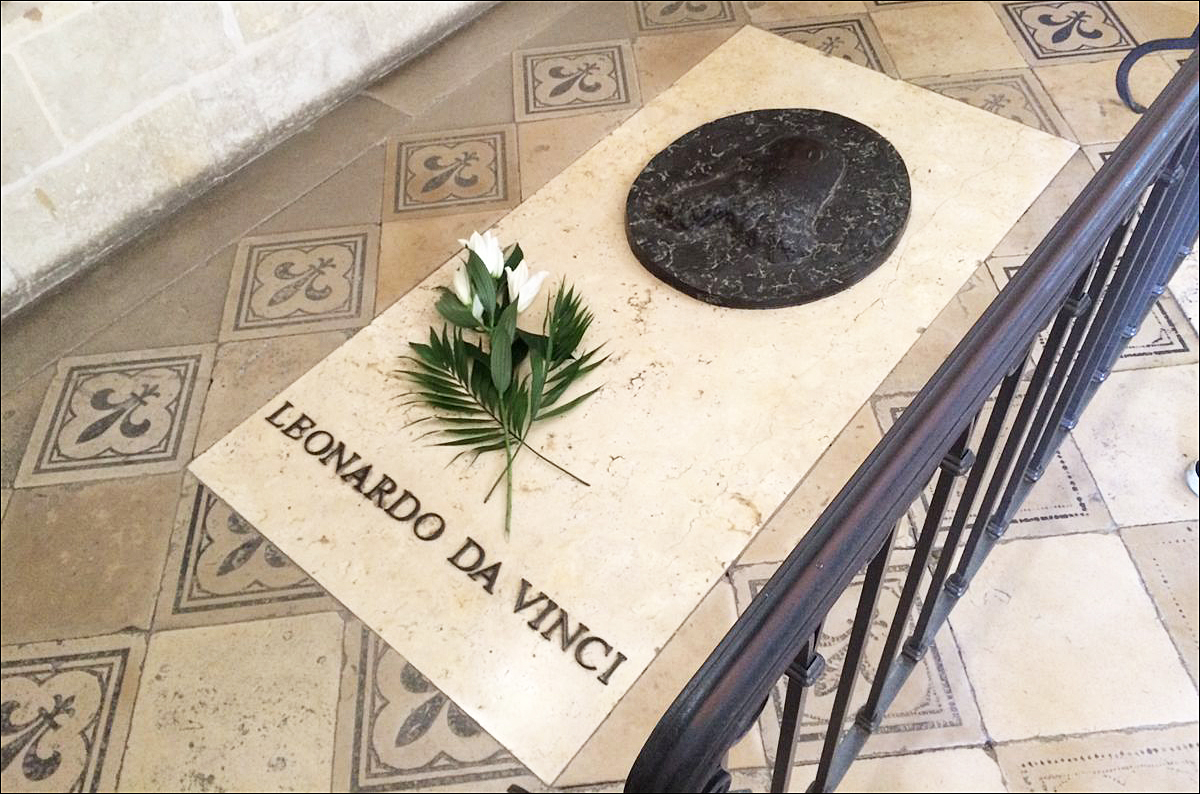
However, much of Château d’Amboise was damaged during the French Revolution, leading to the church’s demolition in 1802. Some of the graves were destroyed in the process, scattering the bones interred there and thereby leaving the whereabouts of Leonardo’s remains subject to dispute.
Despite the thousands of pages Leonardo left in notebooks and manuscripts, he scarcely made any references to his personal life. Within Leonardo’s lifetime, his extraordinary powers of invention, his “great physical beauty” and “infinite grace,” as described by Vasari, as well as all other aspects of his life, attracted the curiosity of others. One such aspect was his love for animals, which likely including vegetarianism and according to Vasari, a favorite habit of purchasing caged birds and releasing them.
Salaì, or Il Salaino (“The Little Unclean One“, i.e., the devil), entered Leonardo’s household in 1490 as an assistant. After only a year, Leonardo made a list of his misdemeanours, calling him “a thief, a liar, stubborn, and a glutton,” after he had made off with money and valuables on at least five occasions and spent a fortune on clothes. Nevertheless, Leonardo treated him with great indulgence, and he remained in Leonardo’s household for the next thirty years. Beyond friendships, Leonardo kept his private life secret.
Despite the recent awareness and admiration of Leonardo as a scientist and inventor, for the better part of four hundred years his fame rested on his achievements as a painter. A handful of works that are either authenticated or attributed to him have been regarded as among the great masterpieces. These paintings are famous for a variety of qualities that have been much imitated by students and discussed at great length by connoisseurs and critics. By the 1490s Leonardo was already described as a “Divine” painter..
Among the qualities that make Leonardo’s work unique are his innovative techniques for laying on the paint; his detailed knowledge of anatomy, light, botany and geology; his interest in physiognomy and the way humans register emotion in expression and gesture; his innovative use of the human form in figurative composition; and his use of subtle gradation of tone. All these qualities come together in his most famous painted works, the Mona Lisa, the Last Supper, and the Virgin of the Rocks.
Leonardo’s most famous painting of the 1490s is The Last Supper, was commissioned for the refectory of the Convent of Santa Maria della Grazie in Milan. It represents the last meal shared by Jesus with his disciples before his capture and death.
The writer Matteo Bandello observed Leonardo at work in the Convent and wrote that some days he would paint from dawn till dusk without stopping to eat and then not paint for three or four days at a time.
Among the works created by Leonardo in the 16th century is the small portrait known as the Mona Lisa or La Gioconda, the laughing one. In the present era, it is arguably the most famous painting in the world. Its fame rests, in particular, on the elusive smile on the woman’s face, its mysterious quality perhaps due to the subtly shadowed corners of the mouth and eyes such that the exact nature of the smile cannot be determined. The shadowy quality for which the work is renowned came to be called sfumato, or “Leonardo’s smoke.” Vasari wrote that the smile was “so pleasing that it seems more divine than human, and it was considered a wondrous thing that it was as lively as the smile of the living original.”
Vasari expressed that the painting’s quality would make even “the most confident master … despair and lose heart.” The perfect state of preservation and the fact that there is no sign of repair or overpainting is rare in such a panel painting of this date.
Leonardo was a prolific draughtsman, keeping journals full of small sketches and detailed drawings recording all manner of things that took his attention. As well as the journals there exist many studies for paintings, some of which can be identified as preparatory to particular works such as The Adoration of the Magi, The Virgin of the Rocks and The Last Supper.
Other drawings of interest include numerous studies generally referred to as “caricatures” because, although exaggerated, they appear to be based upon observation of live models. Vasari relates that Leonardo would look for interesting faces in public to use as models for some of his work.
Leonardo experimented with designs for centrally planned churches, some of which appear in his journals, as both plans and views, although none was ever realized.
Renaissance Humanism recognized no mutually exclusive polarities between the sciences and the arts, and Leonardo’s studies in science and engineering are sometimes considered as impressive and innovative as his artistic work. These studies were recorded in 13,000 pages of notes and drawings, which fuse art and natural philosophy (the forerunner of modern science). They were made and maintained daily throughout Leonardo’s life and travels, as he made continual observations of the world around him.
Leonardo’s notes and drawings display an enormous range of interests and preoccupations, some as mundane as lists of groceries and people who owed him money and some as intriguing as designs for wings and shoes for walking on water. There are compositions for paintings, studies of details and drapery, studies of faces and emotions, of animals, babies, dissections, plant studies, rock formations, whirlpools, war machines, flying machines and architecture.
Some works have found their way into major collections such as the Royal Library at Windsor Castle, the Louvre, the Biblioteca Nacional de España, the Victoria and Albert Museum, the Biblioteca Ambrosiana in Milan, which holds the 12-volume Codex Atlanticus, and the British Library in London, which has put a selection from the Codex Arundel online. The Codex Leicester is the only privately owned major scientific work of Leonardo; it is owned by Bill Gates and displayed once a year in different cities around the world.
Most of Leonardo’s writings are in mirror-image cursive. Since Leonardo was left handed, it was probably easier for him to write from right to left. Leonardo also developed and used a variety of shorthand and symbols; and states in his notes that he intended to prepare them for publication. In many cases a single topic is covered in detail in both words and pictures on a single sheet, together conveying information that would not be lost if the pages were published out of order. Why these detailed annotations were not published during Leonardo’s lifetime remains unknown. However, aspects of his work on the studies of anatomy, light and the landscape were assembled for publication by Melzi and eventually published later as A Treatise on Painting in France and Italy in 1651 and Germany in 1724.
Leonardo’s approach to science was observational: he tried to understand a phenomenon by describing and depicting it in utmost detail without emphasis on experiments or theoretical explanation. Since he lacked formal education in Latin and mathematics, contemporary scholars mostly ignored Leonardo the scientist; although he did teach himself Latin. His keen observations in many areas were noted, such as when he wrote “Il sole non si muove.” (“The Sun does not move”)
While living in Milan, Leonardo studied light from the summit of Monte Rosa. Scientific writings in his notebook on fossils are still regarded as influential and foundational in early palaeontology
While Leonardo’s experimentation followed scientific methods, a recent and exhaustive analysis of Leonardo as a scientist by Fritjof Capra argues that Leonardo was a fundamentally different kind of scientist from Galileo, Newton and other scientists who followed him in that, as a “Renaissance Man,” his methods of theorizing and hypothesizing integrated the arts and particularly painting.
Leonardo started his study of the anatomy of the human body during his apprenticeship with Verrocchio, who demanded that his students develop a deep knowledge of the subject. As an artist, he quickly became master of topographic anatomy, drawing many studies of muscles, tendons and other visible anatomical features.
Leonardo made over 240 detailed drawings and wrote about 13,000 words toward a treatise on anatomy. Leonardo’s anatomical drawings include many studies of the human skeleton, its parts, and the muscles and sinews. He studied the mechanical functions of the skeleton and the muscular forces that are applied to it in a manner that prefigured the modern science of biomechanics. He was the first to identify and define atherosclerosis and liver cirrhosis.
Leonardo also closely observed and recorded the effects of age and of human emotion on the physiology, studying in particular the effects of age. He drew many figures who had significant facial deformities or signs of illness. Leonardo also studied and drew the anatomy of many animals, dissecting cows, birds, monkeys, bears, and frogs, and comparing in his drawings their anatomical structure with that of humans. He also made extensive studies of horses.
During his lifetime, Leonardo was also highly regarded as an engineer. With the same rational and analytical approach that moved him to represent the human body and to investigate anatomy, Leonardo studied and designed many machines and devices. Leonardo’s journals include a vast number of inventions, both practical and impractical. They include musical instruments, a mechanical knight, hydraulic pumps, reversible crank mechanisms, finned mortar shells, and a steam cannon.
Leonardo was fascinated by the phenomenon of flight for much of his life, producing many studies, including Codex on the Flight of Birds (1505), as well as plans for several flying machines, such as a flapping ornithopter and a machine with a helical rotor.
Although he had no formal academic training, many historians and scholars regard Leonardo as the prime exemplar of the “Universal Genius” or “Renaissance Man,” an individual of “unquenchable curiosity” and “feverishly inventive imagination.” He is widely considered one of the most diversely talented individuals ever to have lived.
According to art historian Helen Gardner, the scope and depth of his interests were without precedent in recorded history, and “his mind and personality seem to us superhuman, while the man himself mysterious and remote.” Scholars interpret his view of the world as being based in logic, though the empirical methods he used were unorthodox for his time.
Interest in Leonardo and his work has never diminished in over 500 years. Crowds still queue to see his best-known artworks, T-shirts still bear his most famous drawing, and writers continue to hail him as a genius while speculating about his private life.
Vasari, in his Lives of the Artists (1568), opens his chapter on Leonardo:
In the normal course of events many men and women are born with remarkable talents; but occasionally, in a way that transcends nature, a single person is marvellously endowed by Heaven with beauty, grace and talent in such abundance that he leaves other men far behind, all his actions seem inspired and indeed everything he does clearly comes from God rather than from human skill. Everyone acknowledged that this was true of Leonardo da Vinci, an artist of outstanding physical beauty, who displayed infinite grace in everything that he did and who cultivated his genius so brilliantly that all problems he studied he solved with ease. ✪

















▶️ ◼️◼️◼️◼️◼️◼️◼️◼️◼️ ✪✪✪ DONATE ✪✪✪ ◼️◼️◼️◼️◼️◼️◼️◼️◼️◼️

▶️ DONATE VIA PAYPAL (DEBIT & CREDIT CARD)
ALL PayPal Transactions Are Encrypted For Card Holder Privacy & Security
▶️ DONATE VIA ZELLE (DIRECT BANK CASH TRANSFER)
ZELLE is the perfect online alternative to PayPal. It’s an incredibly simple, secure, easy, fast and FREE way to send or receive money to recipients directly from your online banking account without a middleman. Best of all, there are NO fees.
ZELLE is a service provided by your bank and is already built in to your online banking account. You only need to activate it first before using. If you’ve already activated ZELLE in your online bank or credit union account, you can donate to The New Americanist by using our ZELLE address:
vip@thenewamericanist.com
To activate your ZELLE, follow these easy instructions (a simple two minute process):

▶️ DONATE VIA SNAIL MAIL