⭐️ Huck Funn


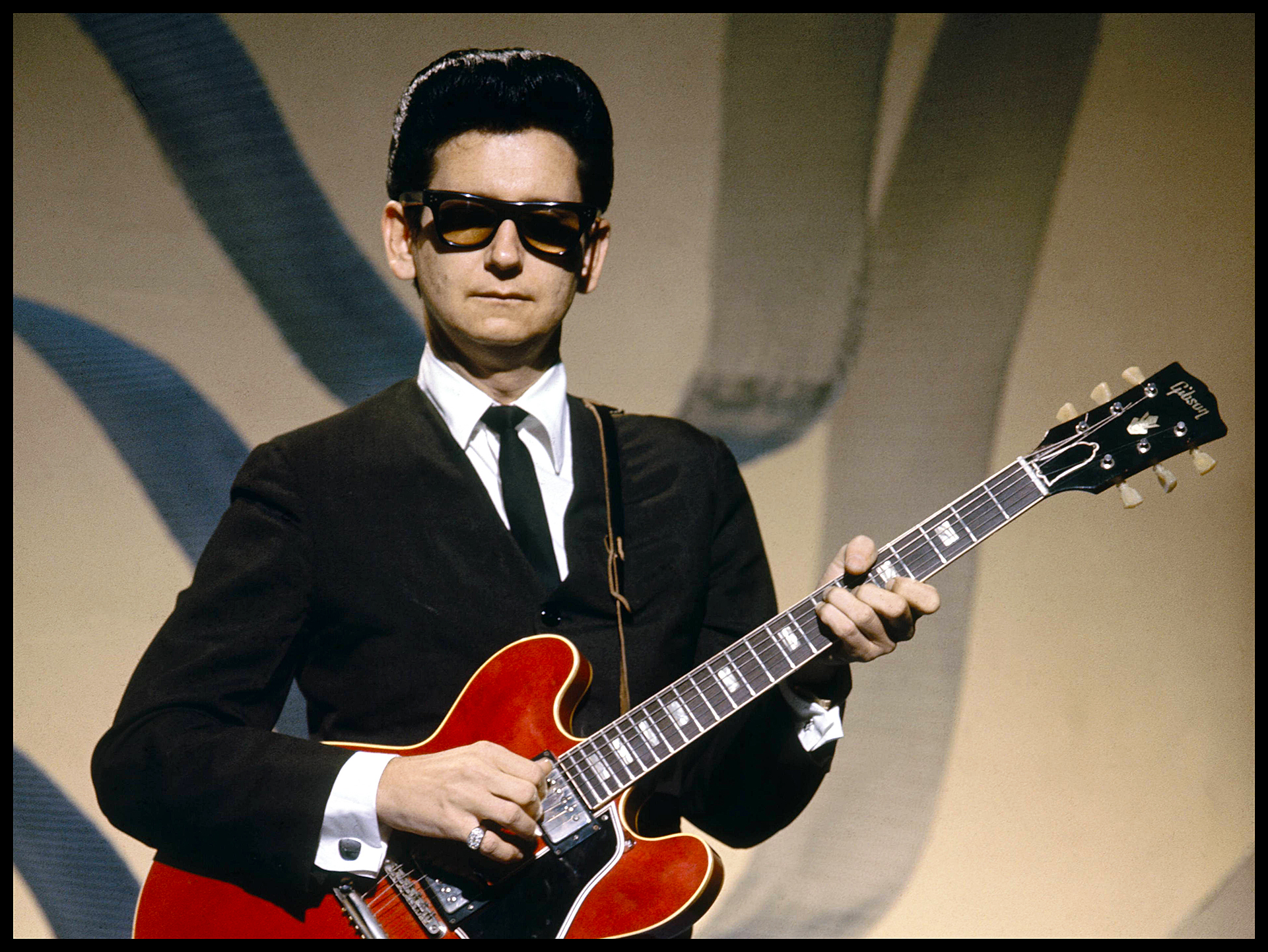

Roy Kelton Orbison (April 23, 1936 – December 6, 1988)
✪ Roy Kelton Orbison was an American singer, songwriter, and guitarist known for his distinctive and powerful voice, complex song structures, and dark, emotional ballads. Orbison’s most successful periods were in the early 1960s and the late 1980s. Many of Orbison’s songs conveyed emotional vulnerability at a time when most male musical performers were projecting strength. He usually performed with minimal motion on stage and wearing black clothes which matched his dyed black hair and dark sunglasses.
Orbison began singing in a country western band as a teenager. He was signed by Sam Phillips of Sun Records in 1956 after being urged by Johnny Cash to audition. After the mid-1960s, Orbison would suffer a number of personal tragedies, causing his career to falter. However, he experienced a resurgence in popularity in the 1980s, following the success of several cover versions of his songs..
Orbison’s career honors include inductions into the Rock and Roll Hall of Fame and Nashville Songwriters Hall of Fame in 1987, the Songwriters Hall of Fame in 1989, and the Musicians Hall of Fame and Museum in 2014. He received a Grammy Lifetime Achievement Award and five other Grammy Awards. Rolling Stone placed him at Number 37 on its list of the “Greatest Artists of All Time” and Number 13 on its list of the “100 Greatest Singers of All Time.” In 2002, Billboard magazine listed him at Number 74 on its list of the Top 600 recording artists.
Orbison was born on April 23, 1936, in Vernon, Texas; the second of three sons born to Orbie Lee Orbison (1913–1984) and Nadine Vesta Shults (1914–1992). His father was an oil-field driller, who often struggled to find work after the Great Depression. His mother was a housewife who enjoyed painting and writing poetry. His direct paternal ancestry can be traced to Thomas Orbison (born 1715) from Lurgan, Ireland who later settled in the Province of Pennsylvania in the middle of the 18th Century..
Orbison’s family moved to Fort Worth in 1942 for his father to find work in the aircraft factories. Due to eyesight problems, Orbison wore thick glasses from the age of four,
Orbison’s father gave him a guitar on his sixth birthday, and he was taught how to play it by his father and older brother. He recalled, “I was finished, you know, for anything else” by the time he was seven, and music became the focus of his life. His major musical influence as a youth was country western swing music. He was particularly moved by Lefty Frizzell’s singing style, with its slurred syllables; leading Orbison to adopt the stage name “Lefty Wilbury” during his time with the Traveling Wilburys. He also enjoyed Hank Williams, Bob Wills, Moon Mullican, and Jimmie Rodgers. One of the first musicians that he heard live in person was Ernest Tubb, playing on the back of a truck in Fort Worth.
Orbison also said that a formative experience was the regular singing sessions at Fort Worth, where he was surrounded by soldiers who were intensely emotional because they were about to be sent to the front line in World War II. In West Texas, Orbison was exposed to rhythm and blues, western swing, Tex-Mex (Tejano music), the orchestral arrangements of Mantovani, and Cajun music. The Cajun favorite “Jole Blon” was one of the first songs that he sang in public.
Orbison attended Denver Avenue Elementary School in Fort Worth until a polio scare in 1944 prompted his parents to send him (then eight) and his brother Grady Lee back to Vernon to live with their grandmother. As World War II wound down, Roy’s parents also returned to Vernon.
The Orbison family moved again in 1946, to Wink, Texas, in search of employment. Orbison described life in Wink as “football, oil fields, oil, grease, and sand” and expressed relief when he was able to finally leave the desolate town. He was self-conscious about his appearance and began dyeing his nearly white hair black when he was still young. As a teenager, he was quiet, self-effacing, polite, and obliging. During recess at school, he would often play guitar by himself while the other kids were playing physical games. As a teenager, Orbison’s lack of sporting ability left him with shyness and low self-esteem.
In 1949, Orbison (then 13 years old) formed the band “Wink Westerners.” They played country western swing standards and Glenn Miller jazz swing songs at local honky-tonk bars, and had a weekly morning radio show on KERB in Kermit, Texas. Their first performance was at a school assembly in 1953. When they were offered $400 to play at a school dance, Orbison realized he could make a living in music. Orbison was also part of a marching band and a singing octet. At the age of 15, he decided that instead of becoming a guitar player, he would use the guitar as an accompaniment to his singing. Around this time, Orbison began dyeing his hair (naturally a “dishwater grey color”) to jet black.
After graduating from high school in 1954, Orbison enrolled at North Texas State College in Denton. His plan was to study geology so he could secure work in the oil fields if music did not pay; however, he became bored with the course in its first year, and switched to history and English.
After high school, he resolved to become a professional musician. At a New Year’s Eve dance in 1954, the Wink Westerners mostly played country and western swing music throughout the night, but ended the night by playing Bill Haley & the Comets’ hit song “Shake, Rattle and Roll” repeatedly, which became the catalyst for the band switching to Rock and Roll music.
At the end of the spring semester of 1955, Orbison dropped out of North Texas State College, switching to Odessa Junior College. The Wink Westerners were disbanded in the fall of 1955, and Orbison formed a new band called the Teen Kings.
▶️ 2 Minute 9 Seconds
The Teen Kings’s first recording was the song “Ooby Dooby,” which was recorded at Norman Petty’s studio in Clovis, New Mexico, in March 1956. It was published by Odessa-based start-up label Je–Wel as the B-side of the JE-WEL 101 single. The A-side of the single was “Tryin’ to Get to You,” a song previously recorded by Elvis Presley.
After “Ooby Dooby” was published by Je-Wel Records, Orbison became convinced that a larger record company would be able to sell more copies of the record. Eventually, Sam Phillips’s Sun Records signed him up to record “Ooby Dooby,” but the events which led to this are disputed. Some claim Johnny Cash toured the Odessa area in 1955 and 1956, appearing on the same local TV show as the Wink Westerners. Cash said, “In late ’55 or early ’56, I was touring with Elvis when I met Roy in Texas… I told him to get in touch with Sun Records if he wanted to be a recording artist.” Orbison said when he did this, Phillips told him, “Johnny Cash doesn’t run my record company!”
The Teen Kings went into Sun Studio in Memphis, to re-record “Ooby Dooby” for publication by Sun Records. After an audition of the song, Sam Phillips signed the band up for “a year or two.” However, the band’s career soon slumped, since Orbison wanted to record emotional ballads rather than the rockabilly songs demanded by Sam Phillips, and Phillips’s goal for a successor to Elvis Presley moved on from Orbison to Carl Perkins.
Orbison also began writing songs in a rockabilly style, including “Go! Go! Go!” and “Rockhouse.” In June 1956, “Ooby Dooby” peaked at number 59 in the Billboard charts and sold 200,000 copies, but the follow-up singles did not reach the charts.
In the summer of 1956, Orbison purchased a brand-new purple Cadillac and a diamond ring with his first royalty check from “Ooby Dooby:” however, the band soon found out that their paychecks from the concerts were not covering their costs and that life as a touring band was a demoralizing experience. The band’s contract did not include any royalty payments (“BMI”) when their songs were played on the radio, and Orbison ran out of money by late 1956.
The band broke up in December 1956 and Sam Phillips said they were arguing about money, but the basic problem was that Orbison was too much of a loner and driven egoist. The lack of a band was a serious problem for Orbison’s contract at Sun Records, since the label had little use for a singer without a band.
After the Teen Kings split, Orbison stayed in Memphis with his girlfriend Claudette. However, Orbison was broke, and realized that he could not survive as a recording artist, so after several weeks, he returned to the road. At the time, Orbison was also addicted to sleeping pills and speed. Orbison was introduced to Elvis Presley’s social circle, and at some point worked picking dates for Presley in his purple Cadillac. Orbison and Claudette had married in 1957, and their first child was born on September 16, 1958. Playing shows at night and living with his wife and young child in a tiny apartment, Orbison often took his guitar to his car to write songs.
Orbison’s own style, the sound created at RCA Victor Studio B in Nashville with pioneer engineer Bill Porter, the production by Foster, and the accompanying musicians gave Orbison’s music a “polished, professional sound…” finally allowing Orbison’s stylistic inclinations free rein. Orbison requested to use string instruments instead of fiddles, which was unusual for the time.
The Rolling Stone Illustrated History of Rock and Roll states that the music Orbison made in Nashville “brought a new splendor to rock,” and compared the melodramatic effects of the orchestral accompaniment to the musical productions of Phil Spector.
Experimenting with a new sound, Orbison and Joe Melson wrote a song in early 1960 called “Only the Lonely (Know the Way I Feel).” Orbison was passing through Memphis when he tried to pitch the song to Elvis Presley (along with several other songs) to make some money quickly, but it was early in the morning and Presley did not want to see Orbison at that time. Orbison and Melson instead recorded the song at RCA Victor’s Nashville studio, with sound engineer Bill Porter trying a completely new strategy, building the mix from the top down rather than from the bottom up, beginning with close-microphoned backing vocals in the foreground, and ending with the rhythm section soft in the background. This combination would become Orbison’s trademark sound.
“Only the Lonely” shot to number two on the Billboard Hot 100 and hit number one in the UK and Australia. According to Orbison, the subsequent songs he wrote with Melson during this period were constructed with his voice in mind, specifically to showcase its range and power. When Presley heard “Only the Lonely” for the first time, he bought a box of copies to pass out to his friends.
Back in the studio, seeking a change from the pop sound of “Only the Lonely, Blue Angel” and “I’m Hurtin’,” Orbison worked on a new song, “Running Scared,” about a man worried that his girlfriend is about to leave him for another man. Just weeks later, “Running Scared” became Orbison’s first number-one hit on the Billboard Hot 100 chart and it reached number 9 in the UK. The B-side “Crying” followed soon after, and reached the top-five singles in August 1961. From 1959 to 1963, Orbison was the top-selling American artist and one of the world’s biggest names in music.
As “In Dreams” was released in April 1963, Orbison was asked to replace Duane Eddy on a tour of the UK in top billing with the Beatles. The tour sold out in one afternoon. Orbison had never heard of the Beatles, and annoyed, asked rhetorically, “What’s a Beatle, anyway?” to which John Lennon replied, after tapping his shoulder, “I am”. On the opening night, Orbison opted to go onstage first, although he was the more established act. The Beatles stood dumbfounded backstage as Orbison simply played through 14 encores. Finally, when the audience began chanting “We want Roy!” again, Lennon and Paul McCartney physically had to hld Orbison back. Ringo Starr later said, “In Glasgow, we were all backstage listening to the tremendous applause he was getting. He was just standing there, not moving or anything.”
In the autumn of 1964 , Orbison stayed on the charts for 14 weeks. “In Dreams” rose to number one in the UK, as well, spending a total of 18 weeks on the charts. The single sold over seven million copies.
Orbison was fascinated with machines. He was known to follow a car that he liked and make the driver an offer on the spot. While on tour again in the UK in 1966, Orbison broke his foot falling off a motorcycle in front of thousands of screaming fans at a race track; he performed his show that evening in a cast.
Roy and Claudette shared a love for motorcycles after Roy had been introduced to them by Elvis Presley. Orbison was a daredevil driver, blasting around on his Harley-Davidson motorcycle and owning a Ferrari, which he used to challenge other drivers to race him on the highway. On June 6, 1966, while Orbison and Claudette were both riding their motorcycles home from Bristol, Tennessee, she was struck by a pickup truck in Gallatin, Tennessee and thrown into the air. She was taken by ambulance to hospital, but her liver was seriously injured and she died, aged 25
Orbison recorded an album dedicated to the songs of Don Gibson and another of Hank Williams covers, but both sold poorly. During the counterculture era, with the charts dominated by artists including Jimi Hendrix, Jefferson Airplane, the Rolling Stones, and the Doors, Orbison lost mainstream appeal, yet seemed confident that this would return, later saying: “I didn’t hear a lot I could relate to, so I kind of stood there like a tree where the winds blow and the seasons change, and you’re still there and you bloom again.”
During a tour of Britain and playing Birmingham on Saturday, September 14, 1968, he received the news that his home in Hendersonville, Tennessee, had burned down, and his two eldest sons had died. This occurred two years after the death of his wife Claudette and Orbison’s grief meant he could not write songs. Fire officials stated that the cause of the fire may have been an aerosol can, which possiblycontained lacquer. The property was sold to Johnny Cash, whose house at the same location also burned down later.
Orbison continued recording albums into the 1970s, but his career stagnated during this decade. His fortunes sank so low in America that his concerts were mostly empty, such as the concert at Cincinnati Gardens he played on his 40th birthday in April 1976. Peter Lehman observed that Orbison’s absence was a part of the mystery of his persona: “Since it was never clear where he had come from, no one seemed to pay much mind to where he had gone; he was just gone.”
A compilation of Orbison’s greatest hits reached number one in the UK in January 1976, and Orbison began to open concerts that year for the Eagles, who started as Linda Ronstadt’s backup band. Ronstadt covered “Blue Bayou” in 1977, her version reaching number three on the Billboard charts and remaining in the charts for 24 weeks. Orbison credited this cover in particular for reviving his memory in the popular mind, if not his career.
In late 1977, Orbison was not feeling well and decided to spend the winter in Hawaii. He checked in to a hospital there, where testing discovered that he had severely obstructed coronary arteries and was barely alive. Orbison underwent open-heart surgery on January 18, 1978. He also suffered from duodenal ulcers since 1960 and was a heavy smoker since adolescence. Orbison said he felt rejuvenated after the procedure, but his weight would continue to fluctuate for the rest of his life. He also continued smoking cigarettes, against the advice of his doctor.
In 1980, Don McLean recorded a cover of Orbison’s 1961 hit single “Crying” and it went to the top of the charts. In 1981, he performed “Pretty Woman” on an episode of The Dukes of Hazzard. Before this time, Orbison was all but forgotten in the US.
In 1981, he and Emmylou Harris won a Grammy Award for their duet “That Lovin’ You Feelin’ Again.” It was Orbison’s first Grammy, and he felt hopeful of making a full return to popular music, In the meantime, Van Halen released a hard-rock cover of “Oh, Pretty Woman” on their 1982 album Diver Down, further exposing a younger generation to Orbison’s music.
The creation of the world’s most recognized supergroup, The Traveling Wilburys began in 1987, when Orbison began collaborating seriously with Electric Light Orchestra bandleader Jeff Lynne on a new album. Lynne had just completed production work on George Harrison’s Cloud Nine album, and all three ate lunch together one day when Orbison accepted an invitation to sing on Harrison’s new single. They subsequently contacted Bob Dylan, who, in turn, allowed them to use a recording studio in his home. Along the way, Harrison made a quick visit to Tom Petty’s residence to obtain his guitar; Petty and his band had backed Dylan on his last tour. By that evening, the group had written “Handle with Care,” which led to the concept of recording an entire album. They called themselves the Traveling Wilburys, representing themselves as half-brothers with the same father. Lynne later spoke of the recording sessions: “Everybody just sat there going, ‘Wow, it’s Roy Orbison!'”
The band’s debut album, Traveling Wilburys Vol. 1 (1988), was released on October 25, 1988. Orbison determinedly pursued his second chance at stardom, but he expressed amazement at his success: “It’s very nice to be wanted again, but I still can’t quite believe it.”
Orbison completed a solo comeback album, Mystery Girl, in November 1988. Mystery Girl was co-produced by Jeff Lynne. Orbison considered Lynne to be the best producer with whom he had ever collaborated
Around November 1988, Orbison confided in Johnny Cash that he was having chest pains. Orbison performed at the Front Row Theater in Highland Heights, Ohio, on December 4, 1988. Exhausted, he returned to his home in Hendersonville to rest for several days before flying again to London to film two more videos for the Traveling Wilburys. He was also booked in to tour the U.S. and Europe in the following year.
On December 6, 1988, he spent the day buying parts for model airplanes with his bus driver and friend Benny Birchfield and ate supper at Birchfield’s home in Hendersonville. After the meal, Orbison went to his mother’s house and chatted with his son Wesley. He went to the bathroom, but did not return for 30 minutes. He was found collapsed on the bathroom floor and was rushed to the hospital by ambulance, where he died of a heart attack at the age of 52. Orbison’s body was buried at Westwood Village Memorial Park Cemetery in Los Angeles an unmarked grave.
Orbison’s posthumous album Mystery Girl was released by Virgin Records on January 31, 1989 and became the highest-selling album of his career. The biggest hit from Mystery Girl was “You Got It,” written with Lynne and Tom Petty. “You Got It” rose to Number 9 in the US and Number in the UK. The song earned Orbison a posthumous Grammy Award nomination.
Traveling Wilburys Vol. 1 spent 53 weeks on the US charts, peaking at number three. It reached number one in Australia and number 16 in the UK. The album won a Grammy for Best Rock Performance by a Duo or Group.Rolling Stone included it in the top 100 albums of the decade.
On April 8, 1989, Orbison became the first deceased musician since Elvis Presley to have two albums in the US top five at the same time, with Traveling Wilburys Vol. 1 at number four and his own Mystery Girl at number five. ✪


















▶️ ◼️◼️◼️◼️◼️◼️◼️◼️◼️ ✪✪✪ DONATE ✪✪✪ ◼️◼️◼️◼️◼️◼️◼️◼️◼️◼️

▶️ DONATE VIA PAYPAL (DEBIT & CREDIT CARD)
ALL PayPal Transactions Are Encrypted For Card Holder Privacy & Security
▶️ DONATE VIA ZELLE (DIRECT BANK CASH TRANSFER)
ZELLE is the perfect online alternative to PayPal. It’s an incredibly simple, secure, easy, fast and FREE way to send or receive money to recipients directly from your online banking account without a middleman. Best of all, there are NO fees.
ZELLE is a service provided by your bank and is already built in to your online banking account. You only need to activate it first before using. If you’ve already activated ZELLE in your online bank or credit union account, you can donate to The New Americanist by using our ZELLE address:
vip@thenewamericanist.com
To activate your ZELLE, follow these easy instructions (a simple two minute process):

▶️ DONATE VIA SNAIL MAIL