
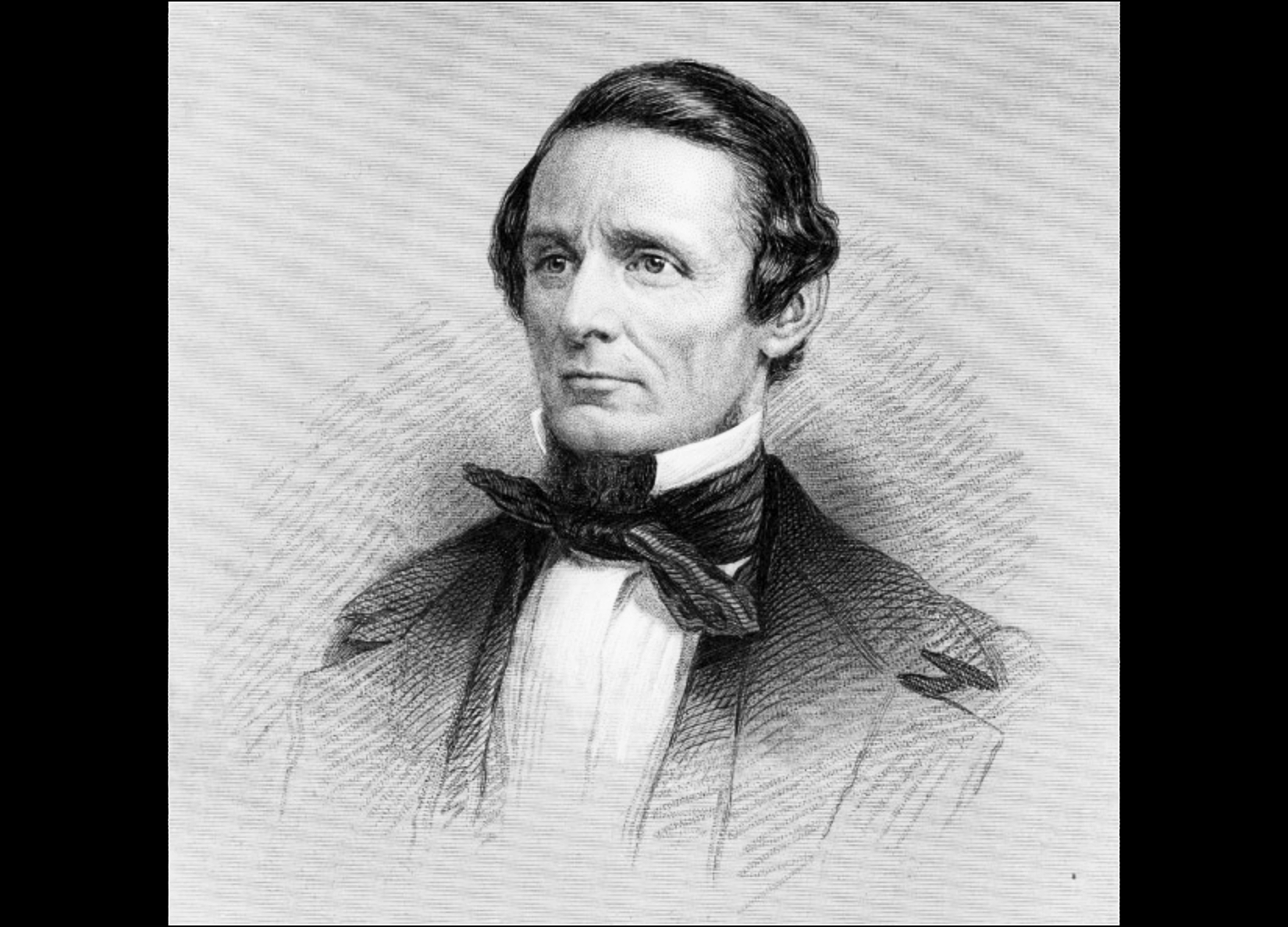

Jefferson F. Davis (June 3, 1808–December 6, 1889)
✪ Jefferson F. Davis was an American politician who served as the only president of the Confederate States from 1861 to 1865. He represented Mississippi in the United States Senate and the House of Representatives as a member of the Democrat Party before the American Civil War. He was the United States Secretary of War from 1853 to 1857.
Davis used the middle initial F., but there is no direct evidence what his middle name was. Some historians argue it may have been “Finis.”
During the Civil War, Davis guided the Confederacy’s policies and served as its commander in chief. When the Confederacy was defeated in 1865, Davis was captured & arrested for alleged complicity in the assassination of Abraham Lincoln. He was accused of treason and imprisoned at Fort Monroe. He would be released after two years without ever going to trial.
Jefferson Davis was the youngest of ten children of Jane and Samuel Emory Davis. Samuel Davis’s father, Evan, who was of Welsh background, originally came to the colony of Georgia from Philadelphia. Samuel served in the Continental Army during the American Revolutionary War, and received a land grant for his service near present-day Washington, Georgia.
Samuel wed Jane Cook, a woman of Scots-Irish descent whom he had met in South Carolina during his military service during 1783. Around 1793, Samuel and Jane moved to Kentucky. Jefferson was born on June 3, 1808, at the family homestead in Davisburg, a village Samuel had established that later would become Fairview, Kentucky. He was named after then-President Thomas Jefferson.
In 1810, the Davis family moved again to Bayou Teche, Louisiana. Less than a year later, they moved to a farm near Woodville, Mississippi, where Samuel cultivated cotton and built a house that Jane called Rosemont.
When Davis was around five, he received a rudimentary education at a small schoolhouse near Woodville. When he was about eight, his father sent him with Major Thomas Hinds and his relatives to attend Saint Thomas College, a Catholic preparatory school run by Dominicans near Springfield, Kentucky. In 1818, Davis returned to Mississippi, where he briefly studied at Jefferson College in Washington. He then attended the Wilkinson County Academy near Woodville for five years. In 1823, Davis attended Transylvania University in Lexington. While he was still in college in 1824, he learned his father Samuel had died. Before his death, Samuel had fallen into debt and sold Rosemont .
His older brother Joseph got Davis appointed to the United States Military Academy at West Point in 1824. However, Davis frequently challenged the academy’s discipline. In his first year, he was court-martialed for drinking at a nearby tavern. He was found guilty but was pardoned. The following year, he was placed under house arrest for his role in the Eggnog Riot during Christmas 1826 but was not dismissed. He graduated from the Academy 23rd in a class of 33.
In early 1829, he was stationed at Forts Crawford and Winnebago in Michigan Territory under the command of Colonel Zachary Taylor, who later became President of the United States.
Throughout his life, Davis regularly suffered from ill health. During the northern winters, he frequently contracted pneumonia, colds, and bronchitis. He traveled to Mississippi on furlough in March 1832, missing the outbreak of the Black Hawk War, and returned to duty just before the Battle of Bad Axe, which ended that war. When Black Hawk was captured, It was Davis who escorted him to detention in St. Louis. Black Hawk stated Davis treated him with kindness.
Davis was promoted to first lieutenant and deployed at Fort Gibson in the Arkansas Territory. In February 1835, Davis was court-martialed for insubordination but was acquitted. He requested a furlough, and tendered his resignation immediately after it ended effective on June 30.
Davis decided to become a cotton farmer. He returned to Mississippi where his brother Joseph had developed Davis Bend into the Hurricane Plantation, which would eventually expand to 1,700 acres of cultivated fields. Joseph loaned Jefferson funds to buy ten slaves and provided him with 800 acres; though Joseph retained the title to the property. Davis named his section Brierfield Plantation.
Davis spent much of his time developing Brierfield. Around this time, he became increasingly engaged in politics, benefiting from his brother’s mentorship and political influence.
Davis became formally publicly involved in politics in 1840 when he attended a Democrat Party meeting in Vicksburg and served as a delegate to the party’s state convention in Jackson; he served again in 1842. One week before the state election in November 1843, he was chosen to be the Democrat candidate for the Mississippi House of Representatives for Warren County when the original candidate withdrew his nomination. Davis still lost the election.
In early 1844, Davis was chosen to serve as a delegate to the state convention again. On his way to Jackson, he met Varina Banks Howell, the 18-year-old daughter of William Burr Howell and Margaret Kempe Howell,
Within a month of their meeting, 35-year-old Davis and Varina became engaged despite her parents’ initial concerns about their age difference and his politics. During the remainder of the year, Davis campaigned for the Democrat Party, advocating for the nomination of John C. Calhoun. He preferred Calhoun because he championed Southern interests which included the annexation of Texas, reduction of tariffs, and building up naval defenses in southern ports.
Davis and Varina married on February 26, 1845 and would have six children. During the same year, he was elected to the United States House of Representatives to serve for one year. From 1846 to 1847, Davis fought in the Mexican–American War as the colonel of a volunteer regiment. He was appointed to the United States Senate in 1847, resigning to unsuccessfully run as governor of Mississippi.
In March 1853, President Franklin Pierce appointed Davis as his Secretary of War. He championed a transcontinental railroad to the Pacific Ocean, arguing it was vital for national defense and was entrusted with overseeing the Pacific Railroad Surveys to determine which of four possible routes was best suited. He promoted the Gadsden Purchase of today’s southern Arizona from Mexico, partly because he preferred a southern route for the new railroad. The Pierce Administration agreed and the land was purchased in December 1853. After Pierce’s Administration ended in 1857, Davis returned to the Senate.
Davis resigned from the Senate in 1861 after Mississippi seceded from the United States. Mississippi seceded on January 9, 1861, though Davis remained in Washington until he received official notification on January 21. Calling it “the saddest day of my life.” he delivered his farewell address before the Senate and returned to Mississippi.
Before his resignation, Davis sent a telegraph to Mississippi Governor John J. Pettus informing him that he was available to serve the state. On January 27, 1861, Pettus appointed him a major general of Mississippi’s army. On February 9, Davis was unanimously elected to the provisional presidency of the Confederacy by a constitutional convention in Montgomery, Alabama which included delegates from the six states that had seceded: South Carolina, Mississippi, Florida, Georgia, Louisiana and Alabama. He was chosen because of his political prominence, military reputation, and moderate approach to secession, which Confederate leaders believed might persuade undecided Southerners to support their cause.
Davis had been hoping for a military command, but instead committed himself fully to his new role. Davis was inaugurated by the convention on February 18. On November 6, 1861, Davis was formally elected president for a six-year term. He took office on February 22, 1862.
In his inaugural speech, he admitted that the South had suffered disasters, but called on the people of the Confederacy to renew their commitment to independence.
In addition to being the constitutional commander-in-chief of the Confederacy, Davis was also the operational military leader as all the military departments reported directly to him.
Davis came to the role of commander in chief confident in his military abilities. He was a West Point Military Academy graduate who had already served in the army and commanded troops in combat. He actively oversaw the military policy of the Confederacy and worked long hours attending to paperwork related to the organization, finance and logistics needed to maintain the Confederate armies.
Davis was also a skilled orator who attempted to share the vision of national unity. He shared his message through newspapers, public speeches, and trips where he would meet with the public. His policies sustained the Confederate armies through numerous campaigns, buoying Southern hopes for victory and undermining the North’s will to continue the war.
Historians argue Davis may have been the best choice available to serve as commander in chief. Though he was unable to win the war, he rose to the challenge of the presidency; pursuing a strategy that not only enabled the Confederacy to hold out as long as it did, but almost achieve its independence.
On January 1 when Lincoln issued his Emancipation Proclamation, Davis saw it as attempt to destroy the South by inciting its enslaved people to open revolt; declaring the proclamation “the most execrable measure recorded in the history of guilty man.” He requested a law that Union officers captured in Confederate states be delivered to state authorities and put on trial for inciting slave rebellion.
In his address to the Second Confederate Congress on May 2, 1864, Davis outlined his strategy to achieve Confederate independence by exhausting the Union’s will to fight. If the South could demonstrate it would not be subjugated, the North would eventually elect a president who would make peace.
However, when the Union Army broke through the Confederate trench lines at the end of March, forcing Lee to withdraw and abandon Richmond, Virginia, Davis evacuated his family. On April 2, Davis and his cabinet escaped by rail to Danville, Virginia. He issued a proclamation on April 4, encouraging the people of the Confederacy to continue their resistance, but Lee surrendered at the Appomattox Courthouse on April 9.
When Lincoln was assassinated on April 14, the Union government directly implicated Davis, and a bounty of $100,000 (equivalent to $2,100,000 in 2024) was placed on his head. On May 5, Davis met with the remainder of his cabinet in Washington, Georgia, and officially dissolved the Confederate government.
On May 9, Union soldiers found Davis’ encampment near Irwinville, Georgia. He tried to evade them, but was captured wearing a loose-sleeved cloak and covering his head with a black shawl, which gave rise to depictions of him in political cartoons fleeing in women’s clothes.
Davis’s central concern during the war was to achieve Confederate independence. After Virginia seceded, the provisional government of the Confederacy moved the capital to Richmond. The Confederate federal government had almost no institutional structures in place and lacked an army, navy, treasury, diplomatic missions and administrative bureaucracy. Davis worked quickly with the Confederate Congress to create them.
Though Davis supported states’ rights, he believed the Confederate constitution empowered him with the right to centralize authority to prosecute the war. He worked with the Congress to bring military facilities in the South, which had been controlled by the states, under Confederate authority.
The main objective of Davis’s foreign policy was to achieve foreign recognition, allowing the Confederacy to secure international loans, receive foreign aid to open trade and provide the possibility of a military alliance. Davis was confident that most European nations’ economic dependence on cotton from the South would quickly convince them to sign treaties with the Confederacy. Cotton at that time made up 61% of the value of all U.S. exports and the South filled most of the European cloth industry’s need for cheap imported raw cotton.
On May 22, Davis was imprisoned in Fort Monroe, Virginia, under the watch of Major General Nelson A. Miles. Initially, he was confined to a casemate, forced to wear fetters on his ankles, required to have guards constantly in his room, forbidden contact with his family, and given only a Bible and his prayerbook to read.
Over time, his treatment gradually improved. Due to public outcry, his fetters were removed after five days. Within two months, the guard was removed from his room, so he could walk outside for exercise, and he was allowed to read newspapers and other books.
President Andrew Johnson’s cabinet was unsure what to do with Davis. He had been arrested for complicity in the assassination of Abraham Lincoln. The cabinet considered trying him by military court for war crimes—his alleged involvement in the assassination of Abraham Lincoln or the mistreatment of Union prisoners of war at Andersonville Prison—but could not find any reliable evidence directly linking Davis to either.
In late summer 1865, Attorney General James Speed determined that it was best to try Davis for treason in a civil criminal trial. In June 1866, the House of Representatives passed a resolution by a vote of 105 to 19 to put Davis on trial for treason.
However, after two years of imprisonment, Davis was released at Richmond on May 13, 1867, on bail of $100,000 (~$1.79 million in 2023), which was posted by prominent citizens including Horace Greeley, Cornelius Vanderbilt and Gerrit Smith. Davis’ treason case never went to trial. In February 1869, Attorney General William Evarts informed the court that the Federal Government declared it was no longer prosecuting the charges against him.
In the summer of 1869, Davis traveled to Britain and France, but found no business opportunities there. After the Federal Government dropped its case against him, Davis left his family in England and returned to the U.S. in October 1869 to become president of the Carolina Life Insurance Company in Tennessee. Davis was not able to retrieve his family from England until August 1870.
The Panic of 1873 adversely affected the Carolina Life Company, and Davis resigned in August 1873 when the directors merged the company over his objections. He returned to Europe again in 1874 to seek opportunities to earn money, but was still not able to find any. After returning to the United States in 1874, Davis continued to explore ways to make a living, including investments in railroads, mining, and manufacturing an ice-making machine.
In January 1877, the author Sarah Dorsey invited him to live on her estate at Beauvoir, Mississippi, and to begin writing his memoirs. He agreed, but insisted on paying board. Dorsey died in July 1879, and left Beauvoir to Davis in her will, and he lived there for most of his remaining years.
Davis’s first book, The Rise and Fall of the Confederate Government, was published in 1881. He also began dictating his memoirs, although they were never finished.
In 1886, Henry W. Grady, an advocate for the New South, convinced Davis to lay the cornerstone for a monument to the Confederate dead in Montgomery, Alabama, and to attend the unveilings of statues memorializing Davis’s friend Benjamin H. Hill in Savannah and the Revolutionary War hero Nathanael Greene in Atlanta. The tour was a triumph for Davis and got extensive newspaper coverage, which emphasized national unity and the South’s role as a permanent part of the United States. At each stop along the way, large crowds came out to cheer Davis, solidifying his image as an icon of the South and the Confederacy. In October 1887, Davis held his last tour, traveling to the Georgia State Fair in Macon, Georgia, for a grand reunion with Confederate veterans.
In November 1889, Davis embarked on a steamboat in New Orleans in a cold rain, intending to visit Brierfield Plantation. He fell ill during the trip, but refused to send for a doctor. An employee sent a telegram to Varina, who came to get him. Davis was diagnosed with acute bronchitis complicated by malaria. When he returned to New Orleans, Davis’s doctor Stanford E. Chaille pronounced him too ill to travel further. He was taken to the home of Charles Erasmus Fenner, the son-in-law of his friend J. M. Payne, where he died at 12:45 a.m. on Friday, December 6, 1889, in the presence of several friends and holding Varina’s hand.
Davis’s body lay in state at the New Orleans City Hall from December 7 to 11. Davis’s funeral was one of the largest held in the South; over 200,000 mourners were estimated to have attended. The coffin was transported on a two-mile journey to the cemetery in a modified, four-wheeled caisson to emphasize his role as a military hero. Davis was buried according to the Episcopal rites.
After Davis’s funeral, various Southern states requested to be the final resting site for Davis’s remains. Varina decided that Davis should be buried in Richmond, which she saw as the appropriate resting place for dead Confederate heroes. She chose Hollywood Cemetery.
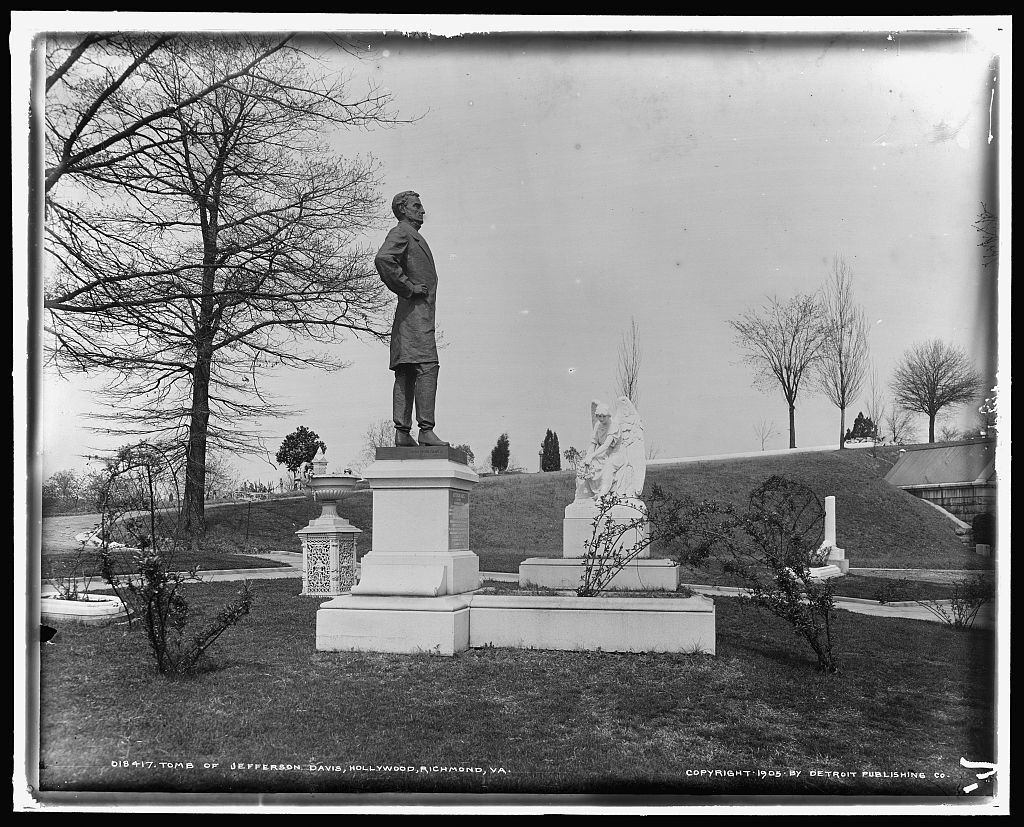
In May 1893, Davis’s remains traveled from New Orleans to Richmond. Along the way, the train stopped at various cities, receiving military honors and visits from governors, and the coffin was allowed to lie in state in three state capitols: Montgomery, Alabama; Atlanta, Georgia; and Raleigh, North Carolina. When Davis was reburied, his children were reinterred on the site as Varina requested; and, when Varina died in 1906, she was also buried beside him. ✪












▶️ DONATE VIA PAYPAL (DEBIT & CREDIT CARD)
ALL PayPal Transactions Are Encrypted For Card Holder Privacy & Security
▶️ DONATE VIA ZELLE (DIRECT BANK CASH TRANSFER)
ZELLE is the perfect online alternative to PayPal. It’s an incredibly simple, secure, easy, fast and FREE way to send or receive money to recipients directly from your online banking account without a middleman. Best of all, there’s NO fees.
ZELLE is a service provided by your bank and is already built in to your online banking account. You only need to activate it first before using. If you’ve already activated ZELLE in your online bank or credit union account, you can donate to The New Americanist by using our ZELLE address:
vip@thenewamericanist.com
To activate your ZELLE, follow these easy instructions (a simple two minute process):

▶️ DONATE VIA SNAIL MAIL